By Boyd D. Cathey
December 2, 2025
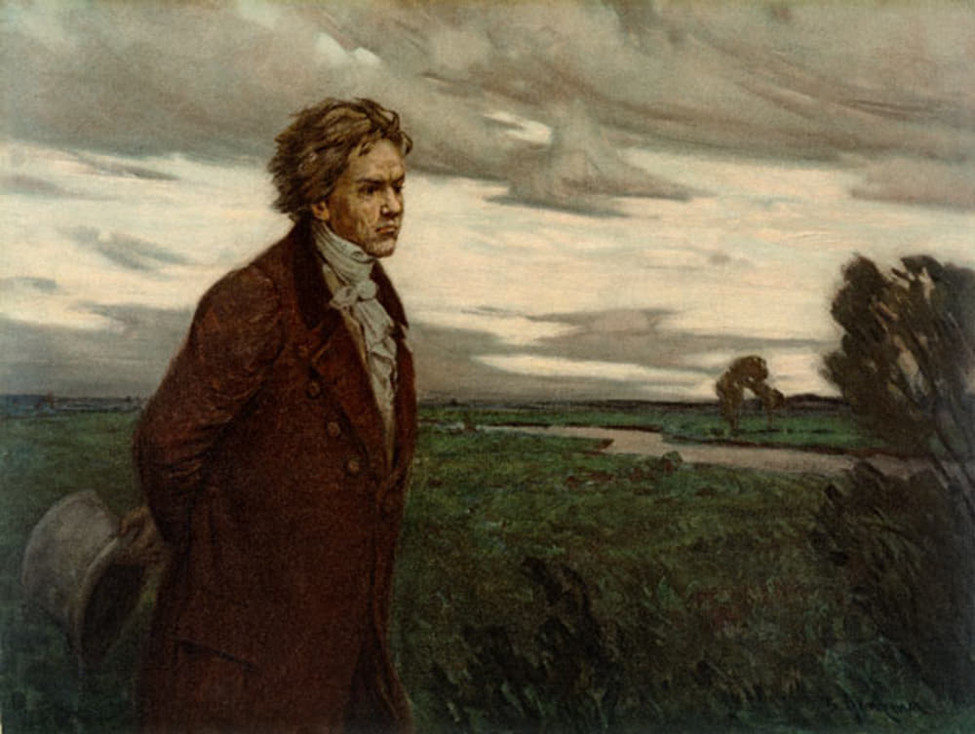
"Beethoven." Berthold Genzmer (ca. 1890).
December 16 is a special anniversary, a significant one in the history of our Western Christian civilization, but one that should not be forgotten. On that date, 255 years ago in 1770, the musician and composer Ludwig van Beethoven was born in the city of Cologne (Koln) in the Rhineland in what is now the Federal Republic of Germany, then part of the Holy Roman Empire. Traveling to Vienna as a young man, he spent much of his life there as one of the greatest composers of music of all time. His compositions and his persona continue to resound through the ages-as long as there is a Western and Christian culture to admire and celebrate.
Recently, I came upon a study of his life, a study that attempts to revise some of the commonly-held misconceptions about Beethoven, that somehow he was wrapped up in the secular ideals of the eighteenth century Enlightenment and even its anti-religious, or anti-Catholic ideas.
Written by Nicholas Junkai Chong (Columbia University, 2016), the work is a PhD dissertation which is titled "Beethoven's Catholicism: A Reconsideration" and it makes a number of significant points, among which that Beethoven was much closer in many of his views to the post-Napoleonic traditionalist Restoration than many other chroniclers have admitted. Indeed, we remember the story of his original dedication of his famous "Eroica" symphony (no. 3) to Napoleon, whom he had thought would "liberate" Europe, but then tore that dedication up, instead dedicating the work to Prince Lobkowicz, his patron, certainly no liberal. But that is just one instance, and there are others, including long passages from his letters, his Tagebuch ["Diary"], and the Heiligenstadt Testament, and books that he read by contemporary (and orthodox) theologians, that indicate that his early enthusiasm for the ideals of "liberté" and "egalité" were tempered by an abiding faith that eventually triumphed over many of his earlier illusions. And to this we must add his solid loyalty to the Habsburg Empire and its Kaiser.
Cultural giants like Beethoven have made precious contributions to our Western Christian heritage, a heritage that is critically threatened in our time by demonic and Gnostic demiurges who seek nothing less than the complete perversion of two millennia of Christian culture which brought together the salvific Gift of the Old Testament Hebrews, the philosophy of ancient Greece, and the classical traditions of Rome.
Beethoven was an integral part of that continuum. And like so many others who have contributed to our inherited corpus of art, music, architecture, and literature, he stands above the ages athwart the disintegration and the frenzied assaults on what the poet William Butler Yeats called (in his poem, "The Second Coming") the "rocking cradle" of Bethlehem-that "rocking cradle" of the Christ from which our culture proceeds.
Just as the post-Marxist and Progressivist academics and mobs and their allies in our cowardly political and media elites wish to put all reminders of our past-those monuments and symbols-whether Confederate or colonial, in remote museums, safely away from the inquiring eyes of most of our citizens, so, too, those epigones of Evil, those cultural vandals who would destroy our inheritance, wish to lock up our sacred traditions of music, literature, and the arts away from our population for whom that inheritance is a birthright. Or, separate them and make them practically inaccessible. And, far worse, "re-interpret" them using new templates based entirely on "race" and "gender"-thus, "women's studies" which views literature and music through the lens of "masculine oppression" and "toxic masculinity" throughout the ages.
In December 1940, at the end of a live national Saturday matinee broadcast of the Metropolitan Opera's production of Gaetano Donizetti's La Fille du Regiment, as author Paul Jackson (in his volume, Saturday Afternoons at the Old Met) recounts, the famous soprano Lily Pons advanced to the front of the stage, and holding a French flag aloft, sang "La Marseillaise." The audience erupted in emotional enthusiasm...not just there in New York, but across the entire nation where as many as forty million listeners tuned in and heard her salute to a defeated France. Forty million Americans in every state and territory (out of around 130 million citizens) were united not only in remembering fallen France, but by and in a culture and musical tradition they all shared, and, even if not devotees of opera, which they at least understood to be part of their precious cultural patrimony.
Today that unity no longer exists. It has been rent asunder by the very guardians of that cultural inheritance, those entrusted with its care and transmission, who have succumbed to the Dark Lord and the enticements that emit from the foulest voices and most fetid enemies of our civilization.
It was the Roman poet Juvenal two millennia ago in his Satires who wrote, "Quis custodiet ipsos custodes?," which translated means: "Who is guarding us against the guardians?" Today we must ask the same questions: Who is guarding us against the cabal of our Intelligence Agencies which now serve as instruments of the Deep State?-Who is guarding us against a political class bought and paid for by globalists who have no loyalty to country or to faith, but rather only to their secularized vision of a global Godless Utopia?-Who is guarding us against the academic elites who control our educational system and pollute the minds of our children?-Who is guarding us against the feculent pollution of our cultural and artistic heritage?
For decades-since before the Second World War-increasingly powerful Elites have controlled the destiny of the American nation. And this dominance has meant not just the revolutionary overthrowal of the traditional political order, but also the veritable abortion of our cultural heritage.
After an initial enthusiasm for and flirtation with what he thought Napoleon might bring to Europe, Beethoven became a strong supporter of the Habsburg monarchy...and an avowed foe of the Napoleonic destruction of the Old Order. He understood what that meant, just as the Blessed Pius IX after the Revolution of 1848 understood the deleterious effects of liberalism and its fanatical desire to destroy Christian civilization.
In 1813 to celebrate the great victory of the Marquess (later Duke) of Wellington over the French at the Battle of Vitoria in Spain (June 21, 1813), Beethoven composed a wonderful little ceremonial piece-"Wellington's Victory"-a kind of short audially evocative symphonic poem depicting that momentous battle that freed Spain from Napoleonic tyranny. In it he interpolated both French and British airs and songs, including a rousing version of "Rule, Britannia!" (The Brits were on the "good" side back then.) It stands as a musical symbol of both the cultural response that Christian Europe then offered to "the great thief of Europe" as well as a paean to military triumph over the forces of Revolution.
Today both Europe and the United States appear prostrate before the even more frenzied offspring of those 19th century revolutionaries. Let us, then, in 2026 seize upon the signs of Hope-those signs of contradiction against Modernism and Progressivism-and, like our ancestors, like Wellington and, yes, like a Beethoven with the scales removed from his eyes, raise up the banners of Christ the King.
While advancing once more beneath His Cross, we intone the Laudes Regiae: "Christus vincit! Christus regnat! Christus imperat!" chanted at the coronation of Charlemagne as Holy Roman Emperor on Christmas Day in the year 800 A.D. And we could do no better than letting "Wellington's Victory" become our symphonic clarion call of militant crusade against our powerful enemies who seek nothing less than the extinction of our culture, our faith and us.