Brazil prepares to sign the EU-Mercosur agreement in what could become the world's largest trade deal. As Trump's tariff politics shake traditional trade patterns, Brazil pursues diversification. The move reveals a strategy of multi-alignment in a polarized global economy, but challenges remain.
Tuesday, December 2, 2025
Uriel Araujo, Anthropology PhD, is a social scientist specializing in ethnic and religious conflicts, with extensive research on geopolitical dynamics and cultural interactions
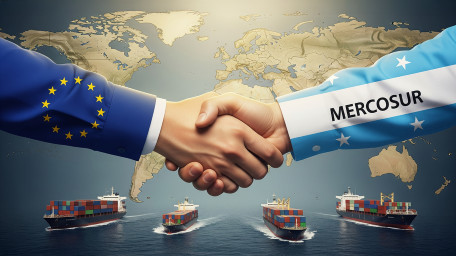
Brazilian President Lula da Silva's recent announcement that the Mercosur-European Union (EU) trade agreement will be signed on December 20 is a diplomatic milestone. What is pitched as the largest trade deal in history (in South America, largely pushed by Brazil) would bind two economic blocs representing nearly 718 million people and a combined GDP close to US$ 22 trillion. Brussels' leadership under Ursula von der Leyen is calling the pact the biggest ever negotiated by the EU.
In a world of shifting alliances, economic pressure and supply-chain uncertainty (in the age of Trump), Brasília sends a blunt message: South America is seeking a diversified platform of partners.
The numbers behind this ambition are impressive enough. In 2024, the EU imported €56.0 billion in goods from the South American bloc (Mercosur) and exported €55.2 billion in return - a total trade flow surpassing €111 billion. Over the past decade, EU imports from Mercosur have increased by more than 50%, while exports rose by roughly 25% - reflecting growing interdependence, albeit under asymmetric terms. Brazil remains overwhelmingly dominant in that trade, accounting for over 80% of all EU-Mercosur exchanges.
For Brazil, the potential upside is clear. According to government estimates, full implementation of the agreement could raise bilateral trade by around R$ 94.2 billion (or US$ 17,64 billion) - roughly a 5.1% increase over current levels - and yield a long-term gain of about R$ 37 billion to GDP (US$ 6.93 billion).
More concretely, Rio de Janeiro's export-promotion agency anticipates a short-term boost of US$ 7 billion in Brazilian exports to Europe. In other words, there is real economic incentive - not only for agribusiness and commodities, but for Brazil to re-insert itself into global value chains under more favorable conditions.
From Europe's perspective, the agreement offers both economic and geopolitical opportunity. The EU could secure stabilized access to raw materials, agricultural commodities and important inputs. In return, European firms would gain tariff relief and improved market access for machinery, pharmaceuticals, vehicles and other high-value manufactured goods. The EU's renewed engagement with Mercosur would also serve as a means to preserve strategic supply routes and diversify dependencies.
Moreover, for Brussels this deal, some argue, may help counterbalance growing Chinese influence in Latin America. In that particular sense, this would arguably be in Washington's interest. On the other hand, Europe is also competing with the US in this game, for contracts, influence and so on.
In any case, the road ahead is far from smooth: political and regulatory obstacles remain. Within Europe, parts of the political and entrepreneur class - especially among agricultural and environmental interest groups - petitioned the European Parliament to ask the Court of Justice of the European Union (ECJ) to examine whether the treaty, as currently drafted, complies with EU law. Issues raised include institutional balance, regulatory standards and the preservation of the so-called "precautionary principle." The motion has been blocked on "procedural grounds", but the political debate is far from dead.
The concern is that cheaper primary goods from South America - notably agricultural and raw-material exports - could undercut European producers accustomed to stricter environmental, sanitary and labor standards, it is argued.
On the Mercosur side, the agreement, even if signed, will still need to pass ratification in multiple parliaments (EU member-states and Mercosur countries) and then undergo a long, gradual phase-in. As the duty reductions and market openings will be phased over years - or even decades - many of the expected gains may remain dormant, or be subject to politics, regulation, and economic cycles. Implementation thus could drag, stall or be watered down.
Still, supporters argue it offers a historic chance to reposition South America from a commodity exporter to a long-term partner in a sustainable global economy - provided both sides commit to a clear, long-term vision (this is the tricky part).
Viewed in the broader context of the New Cold War - with de-dollarization, BRICS, rising Chinese presence in Latin America, supply-chain reshuffling and fluctuating global power alignments - this deal signals that Brazil (the agreement's main pusher in the continent) does not position itself as part of an "anti-Western bloc."
It is true that the country has deepened ties with China and the BRICS, aligning economically and politically with a bloc outside the Western orbit. For decades, the United States was Brazil's main trading partner and economic reference point - that has changed: since 2009, China has overtaken the US as Brazil's largest trade partner, and today absorbs more Brazilian exports than the US and the European Union combined - a shift that exemplifies how Brazil's external economic orientation has already moved eastward, with the US still being the second main trading partner(Argentina ranks third).
Yet this renewed push for EU partnership shows a logic of multi-alignment, flexibility, pragmatism. Brazil is diversifying partners, thereby hedging its bets in an emerging multipolar world.
From a purely economic standpoint, however, the asymmetry remains: Mercosur tends to export raw materials and commodities; the EU exports manufactured goods, pharmaceuticals, machinery. That structural imbalance could translate into politically sensitive disruptions, especially for European producers (with Europe's heavily subsidized agriculture). Highly regulated European producers are not necessarily happy to face competition from cheaper Mercosur exports - particularly in agriculture.
Brazil (as well as other South American players) hopes to expand its export palette and to re-anchor international trade flows. Europe in turn seeks to secure access to raw materials and diversify supply sources, while offering European industries expanded markets. On the other hand, regulatory friction, political volatility, and institutional resistance may dilute - or even derail-the promised gains.
Be as it may, with Trump turning trade into a weapon through tariffs and shocks, the US now appears unpredictable and unreliable. In response, one should expect every major bloc to move to diversify partnerships as economic self-defense.