By JD Breen
Pretium Insights
January 2, 2026
These pages often fill with nonsensical opinions about current events. They please some while rubbing many the wrong way, including their author.
He'd advise no one to take his words too seriously. They're merely ramblings of some numbskull with a Substack.
This writer's experience is limited. Like most of us, he doubts little yet knows nothing. Most of his "news" is filtered thru screens and can't be trusted. Just like what you're reading now.
Despite the tone with which I occasionally write, I'm generally optimistic. In some sense, I have no choice.
With a lovely wife and two wonderful sons, how could I not have hope for the future ? If I didn't, what would be the point?
But it's more than that. It's easy to think things have never been so bad. It's also preposterous... and hubristic. Who are we to bemoan our lot ? Few in history have had it so good.
As never before in the annals of man, our era luxuriates in leisure. Capital bears most of the burden labor once shouldered, freeing minds to scroll feeds, "like" posts, or create "content."
And, occasionally, to devise inventions that were recently unimaginable... and still are. Much of our seed-corn accumulated over centuries, allowing recent generations to reap the harvest while taking the bounty for granted.
The Fuel of Life
But material blessings we were bequeathed didn't happen by accident. They required sound money that lengthened horizons, encouraged saving, and nourished investment that facilitated innovation.
As industry thrived, it demanded and enabled more robust sources of reliable power. Solar energy came out of the earth... first from coal, especially from oil, and later from natural gas.
Despite their detractors, these hydrocarbons sustain our lives. They're the fuel that enables the food, mining, medicine, and mobility that undergird our modern existence. Because of them, most of us are shielded from the wrath of the weather, and rarely worry about our next meal.
Only recently has that been "normal".
"Fossil fuels" facilitated improvements in sanitation and hygiene that rendered many once-lethal illnesses obsolete. And they propelled medical advances that mitigate most of the maladies that still persist.
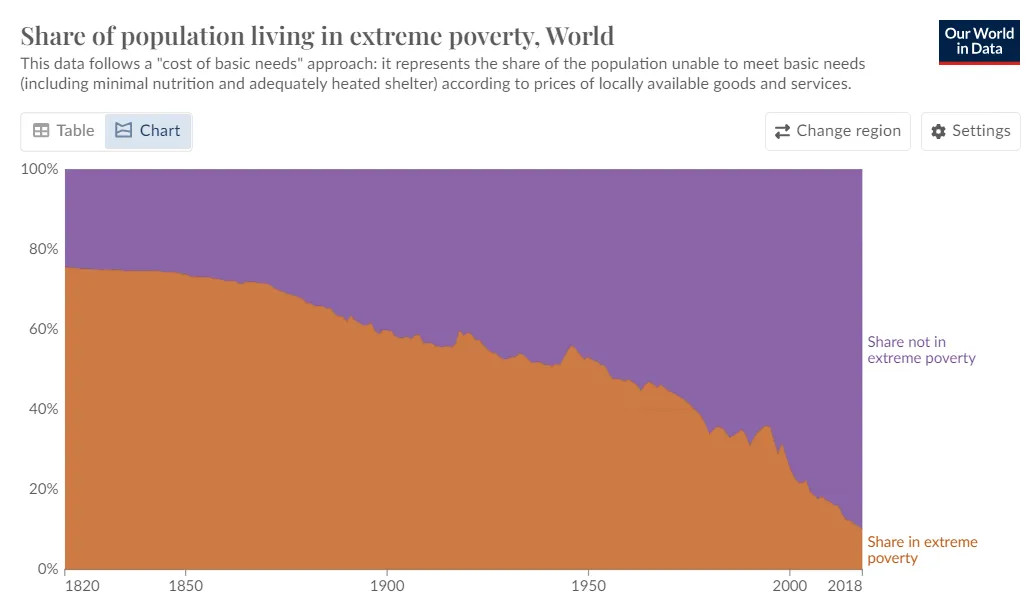
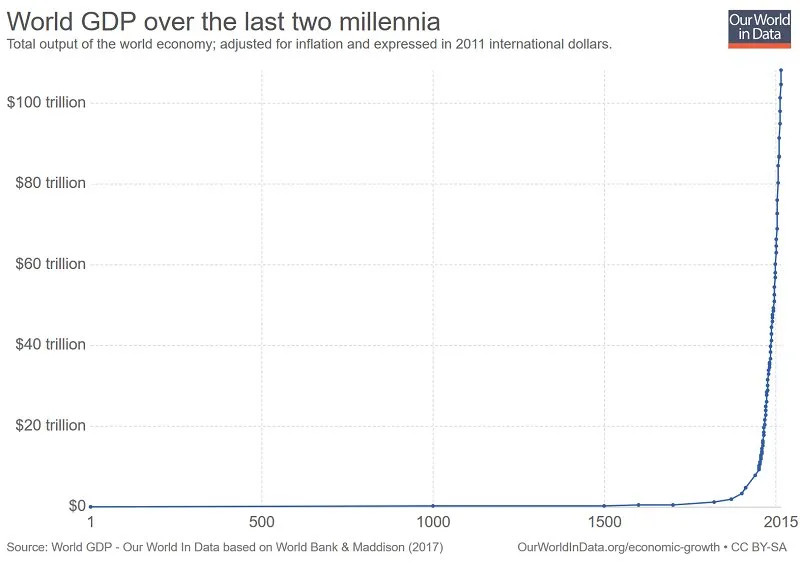
Not everyone is so fortunate to share in these blessings, and there'll always be those who won't be. But poverty afflicts fewer people than ever in history, and the decline has accelerated exponentially since the late-19th century, when oil transitioned from annoying goo to industrial fuel:
But problems persevere, and always will.
Spiritual voids, family breakdown, rampant nihilism, and lack of community are considerable challenges rotting the West. Religion is waning, the money is fake, and politics are a scourge.
But what else is new?
Only this: tho' much has been squandered on worthless "programs", reckless wars, and duplicitous scams, some of our seed corn is still here. Notwithstanding the obstacles we bemoan, modern technological, financial, and medical resources remain unmatched.
We can communicate instantaneously with almost anyone in the world. At a moment's notice and (relatively) minimal cost, we can go almost anywhere we want and be there within a day. Technology is advancing in ways that would've seemed like magic only a decade ago.
Gateway Drugs
Regardless surface chop, the prevailing current proceeds apace. Tides wax and wane, storms disrupt the prevailing offshore breeze, and occasional undertows pull us down. We seem to be struggling to overcome one now.
But the human spirit usually finds ways to keep its head above water. To avoid drowning, it finds strength to swim. It'll do so again. In many ways, it already is.
We mustn't be bogged down by remote menaces or imaginary threats. As Thomas Jefferson once wondered, "How much pain have cost us the evils which have never happened?"
It's worthwhile to occasionally recall whether what we feared six months ago ever came to pass. Or six months before that. Or before that.
More often than not, the answer is "no". Not that we shouldn't anticipate and prepare. Because something hasn't happened doesn't mean it never will.
But we mustn't sacrifice fulfillment to misplaced panic. As we've learned the last few decades, fears are like gateway drugsgive in to a small one, and before long you cave to larger ones.
Nerves are healthy if they motivate, but not when they cripple. Caution can be warranted if not taken to extremes. We mustn't be so frightened of wandering the world that we fear tending our gardens.
Concentric Circles
Minding our own business is the best we can do. It's also empowering, because it's something we can control.
An essential corollary is understanding what isn't our business, and avoiding it. That doesn't mean we should disregard neighbors in need. To the contrary. It would allow us to pay more attention to them.
Like the Catholic principle of subsidiarity, responsibilities ripple in concentric circles. They are most intense nearest to home, to our families, friends, and local community.
Much as adults are advised to put the oxygen mask on themselves before affixing it to their children, we should guard against sacrificing ourselves in ways that harm those for whom we profess to care.
Foreign squabbles and distant squalor may be unfortunate. But they aren't our concern. They can't be. And there's little we can do about them even if they were.
As we repeatedly remind ourselves, meddling inevitably make things worse.
That stands to reason. Resources are finite... including empathy, knowledge, wisdom, money, perspective, and time.
Demanding these be diverted from nearby needs merely weakens our region while offering minimal benefit (or considerable detriment) to distant recipients the aid is ostensibly meant to assist (assuming the intended beneficiaries even receive it).
The Rose on the Table
We enter a new year recalling an old story. One afternoon, a lady plucked a rose from a bush, and placed it prominently in her disheveled home.
But its beauty was diminished by piles of clutter covering the table. The woman removed the debris and dusted the surface, which allowed the flower to shine.
Yet the rest of her house was also a shambles. The beautiful blossom and clean table were stark anomalies amid the mess.
Out came the trash bags, wash rags, vacuum cleaner, and mop. Furniture was cleaned, rubbish removed, and floors polished, revealing a lovely home worthy of a rose.
The best way to improve the world is by sweeping our porch. We can't help others if we're unable to sustain ourselves. But we can form good habits and set worthy examples.
We can spend our life however we like, but we can only spend it once. The same can be said for the years and days of which it is made. This is one of them, and a great time to start.
Happy New Year.
JD