By John KIRIAKOU
Guards are leaving federal inmates in restraints for hours and even, in dozens of cases, as long as a week. That's just the latest finding on abuses pervading the system.
I'am a regular writer on prison conditions across the United States. Stated plainly, all Americans should be ashamed of the states of U.S. prisons, whether at the federal, state or local levels.
Overall prison conditions, medical care, poor food quality, violence, the use of solitary confinement as a punishment, drug and other contraband sales by guards, and sexual abuse are on par with some of the worst prison systems in the world. Indeed, they are akin to the situation in many underdeveloped countries.
The conventional wisdom in the United States is that the federal system is better than state and local prison systems and, if you must go to prison, you should want to be a federal facility. That's not saying much.
The federal Bureau of Prisons (BOP) is a broken, dysfunctional mess, even though President Donald Trump actually tried to shake up the place by naming a former federal prisoner as the BOP's deputy director. A year in to Trump's second term, however, there are no notable improvements.
Animal-Grade Food
Medical care remains substandard, to put it nicely. It is not unusual, for example, for prisoners to complain repeatedly to their prison's medical unit of serious symptoms, only to be given Tylenol or, frequently, accused of malingering and given nothing.
Months later, we read in the criminal justice media that the prison had cancer or AIDS or some other dread disease and that their family or estate had filed suit against the BOP for wrongful death.
Similarly, much prison food is classified as "animal grade," rather than "human grade." I'm not talking about the year-old dyed green bagels that prisoners get every day for months after they went unsold during the previous year's St. Patrick's Day. (I'm not joking here.)
I'm talking about food that is literally not meant for humans. When I first arrived in prison, on my first full day there, I saw boxes of fish stacked up behind the "chow line" in the cafeteria and clearly marked, "Alaskan Cod-Product of China-Not for Human Consumption-Feed Use Only." I declined the fish.
Part of the problem is that many prisons have been privatized, at all levels of government. Companies like GEO make a profit by spending as little money on prisoners as possible. And the easiest way to cut costs is in food and medication.
And who's going to do anything about it ? Can you imagine being a member of Congress running for reelection, and going out on the campaign trail to say, "I want to give prisoners BETTER food and medicine!" You won't win many new votes.
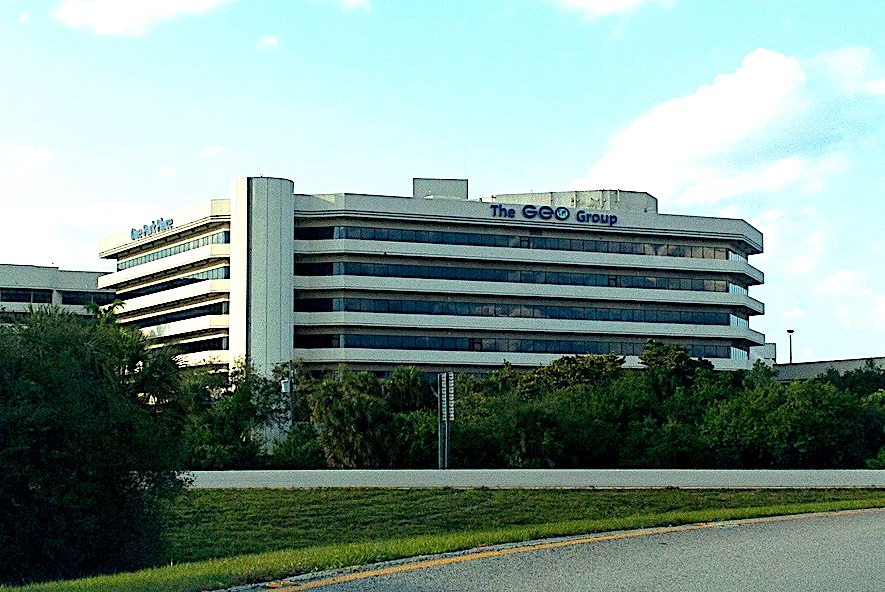
Headquarters of the GEO Group in Boca Raton, Florida, 2013. (Eflatmajor7th /Wikimedia Commons/ CC BY-SA 3.0)
The problems in the BOP go beyond food and medical care. I wrote recently in Consortium News about the arrests of a huge number of prison guards across the country on charges of bringing drugs, cell phones, and other contraband into prisons. It happens every day. But there are other problems besides these obvious ones that are not being addressed.
Unrestrained Restraints
Earlier this year, the Justice Department's Office of the Inspector General (IG) released a report taking the BOP to task for misusing restraints against prisoners. The IG found "thousands of incidents" where BOP guards kept prisoners in restraints involving both wrists and both ankles for at 16 hours.
In hundreds of incidents, prisoners were restrained for more than 24 hours, as well as dozens where prisoners were kept in restraints for as long as a week.
The law is clear that when a prisoner is in restraints, he must be checked every 15 minutes by a guard, every two hours by a lieutenant, every four hours by medical staff, and every eight hours by a psychologist. But a majority of guards were found to not understand the definition of the word "restraint," and so the extra supervision was rarely enforced.
Violence continues to be endemic in federal prisons. I'm not talking about prisoner-on-prisoner violence, which is to be expected. I'm talking about guard-on-prisoner violence, which, of course, is illegal, yet common.
In one recent example, a prisoner identified in court documents as JM bought a straw hat from the prison commissary. A guard, apparently not knowing that straw hats were for sale in the commissary confiscated it from JM.
Several hours later, JM asked for his hat back, only for the guard to pull him into an area not covered by security cameras. The guard beat JM severely, shoved a blunt object up his anus, and left him bleeding on the floor.
JM eventually made his way to the prison nurse, who refused to allow him to filed a sexual assault complaint against the guard. And when he complained in writing, he was transferred to a higher-security prison. JM said in his lawsuit that he knew the protocol for reporting such a crime because this was the second time a guard had sexually assaulted him.
The Justice Department isn't spending money on food or medication for prisoners, nor is it spending money to maintain the physical plant of its prisons.
U.S. Penitentiary Atlanta and the Metropolitan Detention Center in Manhattan, where Jeffrey Epstein died, were closed because they were literally uninhabitable. The Federal Correctional Institution (FCI) at Dublin, California, the site of the BOP's "rape club" was deemed to be "unreformable."
Fourteen prison officials, including the warden, the chaplain, the captain, and the doctor were charged with raping dozens of female prisoners, who ended up sharing in a $114 million federal settlement.
And now FCI Terminal Island, California, is being closed because chunks of concrete are falling from the facility's ceiling. One chunk was so big that it disabled the heating system for the entire prison. It would have been only a matter of time before someone was killed or injured.
Trump said earlier this month that he wanted to increase the Pentagon's budget from $1 trillion to $1.5 trillion. The current budget is already more than the next eight largest countries' defense budgets combined. How about a few bucks to ensure the most basic human rights of America's prisoners?
Original article: consortiumnews.com