Determining the true cause of death is the key to solving crime, fighting disease, and keeping unsafe products off the market. When medical examiners fail to do their job, disaster ensues.
By John Leake
Courageous Discourse
July 3, 2026
One of the primary mechanisms for concealing the harms of COVID-19 vaccines has been the willingness of coroners and medical examiners to turn a blind eye to the indications that these products have caused thousands of deaths since their rollout in 2021. In the United States and in many other nations, forensic pathologists have played a key role in concealing this massive crime.
I'll never forget the first time I heard of a medical examiner turning a blind eye to the true cause of death in order to serve a powerful interest-namely, in the film JAWS, when the medical examiner of Amity Island is pressured by the mayor to declare the first victim's death the result of a "boating accident."
I reckoned this was just a figment of Hollywood imagination, but years later, when I became a true crime author, I discovered many cases of medical examiners being subjected to political pressures and financial incentives to abandon their professional integrity.
I was reminded of this a few days ago when I was contacted by a documentary filmmaker in Austria who had learned about my investigation of a mysterious murder in Tyrol, Austria in 1991. Upon completing my investigation, I published a long and detailed report about it on my website. Readers interested in forensics-and how the forensic medical profession may go badly wrong-will find the story interesting.
As the former President of the Austrian Society of Forensic Medicine, Dr. Walter Rabl was, for many years, considered the foremost forensic doctor in Austria. During his career, he was commissioned to serve as the final scientific arbiter in complex and controversial cases, including those of Denisa Soltisova and Joerg Haider. When someone died in Austria under suspicious circumstances and the cause and manner of his death became a matter of debate, Dr. Rabl often had the last word.
As I recounted in my book, Cold a Long Time, Dr. Rabl played a key role in concealing the cause and manner of Duncan MacPherson's death. After I published the paperback edition in January 2012, I learned about other unnatural deaths in Austria that were handled by Dr. Rabl and the Austrian criminal justice system in a highly questionable manner. As the families of the deceased have suffered a fate similar to the MacPherson family, I believe it is appropriate to tell their stories on this website.
The Angelika Foeger Case
Thirty-two-year-old Angelika Foeger-wife of Walter Foeger and mother of two children-worked part time as an accountant at a cheese factory in the Tyrolean town of Graen. On June 9, 1990, she was assaulted and murdered-stabbed four times and strangled-at her place of work. Shortly after the police arrived, a young apprentice named Martin Kofler, who was heavily intoxicated, confessed to the crime. His motive, he explained, was sexual. He'd wanted to rape Angelika.
With this confession, the case seemed, at first glance, to be clear and simple. There was, however, a significant piece of physical evidence found at the crime scene that has haunted Angelika's widower ever since. Defensive stab wounds on Angelika's hands and right wrist indicated that she had fought her assailant. The injury pattern on her throat and congestive hemorrhaging around her eyes indicated that she had also been manually strangled with considerable force. In her bloody right hand were found approximately 20 light blond hairs, and it was obvious that she had ripped them out her assailant's head during the struggle.
Dr. Rabl examined the crime scene a few hours after Angelika was murdered, and in his initial report he wrote: "In the [victim's] right hand were found twenty light-colored hairs that obviously do not match the woman's hair color. The hairs are secured as evidence." This statement echoed the assertion of crime scene investigator Markus Hammerl, who wrote in his report: "In the victim's right hand were found blond hairs that are apparently not from the victim." The following morning, Dr. Rabl performed an autopsy and made the following notes pertaining to the hair evidence:
1. The [victim's] head hair is dark brown, the hair in upper region of the skull is circa 7-8 centimenters long; on the back of the head the hair is over 20 centimeters long. In so far as it is possible to judge from exterior inspection, the hair-bearing skin appears uninjured.2. Head hairs are taken from the victim for forensic comparative analysis.
From Dr. Rabl's statements pertaining to the hair in his crime scene and autopsy reports, it is clear that the next step in the investigation was to compare the "20 lighter hairs" found in Angelika's right hand to head hairs from the prime suspect-i.e., Martin Kofler, the young apprentice who confessed to the crime.
Kofler was a young and naive country boy, and at the time he gave his confession (with no witnesses or a lawyer present), he had a BAC of.19 The law officer who persuaded him to confess was the local Gendarmerie Kommandant-a man named Franz Wolf, who was well-known to be a good friend of the owner of the cheese factory in which the crime had taken place.
The light-colored head hairs found in Angelika's right hand presented the most valuable, objective means of confirming Martin's confession. It is therefore most peculiar that-in his concluding forensic evaluation of the crime, dated September 24, 1990-Dr. Rabl mentioned nothing about comparing the hairs found in Angelika's right hand with Martin Kofler's hair. Reference to a "comparative forensic analysis" of this primary trace evidence is also conspicuously missing from the Innsbruck Public Prosecutor's indictment of Martin Kofler, dated November 30, 1990.
A proper telling of all the bizarre twists and turns in the Angelika Foeger story would require an entire book. Walter Foeger's cousin-a retired Tyrolean gendarm named Wolfram Foeger-has written a first draft. An experienced criminal investigator, Wolfram was initially skeptical of Walter's perception that the Innsbruck authorities were not handling the case properly. However, at the moment he realized that the hairs found in Angelika's right hand did NOT match Martin Kofler's head hair, he became convinced that something was indeed badly amiss.
The Foeger family and Martin Kofler's defense attorney demanded that a proper comparitive analysis of Martin Kofler's hair, Angelika's hair, and the hairs found in Angelika's right hand be performed. At this point, the Innsbruck Court asked the Foeger family for a sample of Angelika's head hair. The Court did not mention that Dr. Rabl had already taken a sample of her hair for "forensic comparitive analysis."
About a year before Angelika was murdered, she'd changed her hair style from long to short, and Walter Foeger still had a large, braided lock that he had kept as a momento. This was turned over to the Institute of Forensic Medicine. Shortly thereafter Dr. Rabl presented his findings: The hairs found in Angelika right hand did NOT match Martin Kofler's hair. However, based on his analysis of the lock of Angelika's hair provided by the family, Dr. Rabl concluded that the victim had "light to white-colored" hair in the region of her temples. According to Walter Foeger, this is a bold-faced lie. The crime scene photos, as well as the autopsy photos that Dr. Rabl himself took (at the same time he took a sample of Angelika's hair) support Walter Foeger's contention.
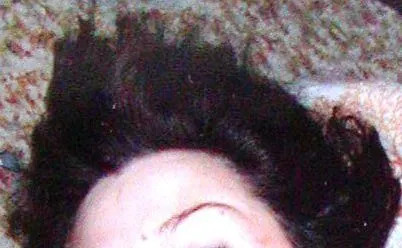
The above image was taken of Angelika at the crime scene, a few hours after her death. It is just one of many images that support Dr. Rabl's initial statement that the victim's hair color is "dark brown." Moreover, if Angelika had "light to grey" hair around her temples, why didn't Dr. Rabl note this during his autopsy, when he carefully examined her scalp for injuries, noted her hair color as "dark brown," and took a sample of her hair for "forensic comparative analysis"?
In spite of the highly questionable manner in which the key hair evidence was handled, Martin Kofler was convicted of the murder in 1991.
About a year after the trial, Walter Foeger complained to Dr. Rainer Henn-then director of the Innsbruck Institute of Forensic Medicine-about Dr. Rabl's hair evaluation, and Dr. Henn agreed to conduct his own evaluation. Shortly after he completed it, he informed the Foeger family that he would apply to the Innsbruck Court to reopen the investigation after he returned from a trip to the Austrian state of Carinthia, where he was scheduled to give a lecture about Oetzi the Iceman. As fate would have it, Dr. Henn never filed the application because he was killed in a car accident on his way back to Innsbruck from the lecture.
After Dr. Henn's death, Mr. Foeger and his sister made an appointment with Dr. Rabl to discuss Dr. Henn's evaluation of the hair. Upon their arrival at the Institute of Forensic Medicine, Dr. Rabl told them that he couldn't find Dr. Henn's report and that he knew nothing about it.
In 1993-two years after Martin Kofler's trial-DNA evidence was first accepted by Austrian criminal courts, and so both Walter Foeger and Martin Kofler's defense attorney petitioned the Innsbruck Court to reopen the investigation and to perform a DNA comparison of the hairs found in Angelika's right hand with a lock of her own hair. In flagrant violation of the Austrian Code of Criminal Procedure (StPO § 3. Objektivität und Wahrheitserforschung) the Innsbruck Court denied this request.
Walter Foeger and Matin's defense attorney then petitioned the Court to release the evidence to that another accredited institute could perform the analysis. The Innsbruck Court denied this request on the grounds of securing evidence.
On December 11, 2007, Walter Foeger visited Dr. Rabl at the Innsbruck Institute of Forensic and personally requested the hairs. Dr. Rabl replied that the hairs had been lost during a recent remodeling of the Institute. In a subsequent letter to the Innsbruck public prosecutor's office, the current Institute Director Richard Scheithauer stated that the hairs in question had indeed been lost. Only the empty nylon evidence bag could be found. So much for securing evidence.
Another disturbing aspect of the crime was a stab wound to the right side of Angelika's chest. As Dr. Rabl noted in his autopsy report:
The stab penetrated further into the superior vena cava approximately 3 centimeters above the pericardium. The superior vena cava is pierced through.
According to four forensic scientists with whom I have consulted, including two forensic doctors, Angelika could not have lived for more than five minutes with this injury. Given that she was still alive but rapidly dying when an emergency doctor arrived appoximately 8 to 10 minutes later, it is clear that someone inflicted this fatal wound after Martin Kofler ran to the neighbor's house to call an ambulance.
To further analyse the case, I showed the crime scene photos to the renowned Crime Scene Investigator, Kenton Wong. From his evaluation of the photos, he came to the same conclusion as Wolfram Foeger--i.e., that many aspects of the crime scene, as well as Angelika Foeger's injuries, do not match the official version of the crime (based on Martin Kofler's confession). He also observed that the crime scene in Martin's bedroom appears to have been staged. A striking indication of this is the shirt that Martin purportedly wore while he attacked Angelika and that was purportedly found by crime scene investigators on the floor of his room. He was not wearing it when he ran to the neighbor's house to call the ambulance.
Review of the photograph of Mr. Kofler's shirt (which was purportedly recovered on the floor of his bedroom and which he purportedly wore during his attack on Mrs. Foeger) revealed that the blood stain patterns observed on the shirt were not consistent with those typically associated with active blood spatter deposition while being worn by an assailant in cases involving multiple stab wounds. Rather, examination of the blood stain located at the area of the front upper right chest region of the shirt suggests that it was not worn and instead had been held/bunched together from the back of the garment (with the front area of the shirt facing outward) while it was subsequently utilized to wipe a bloody area in some fashion, which resulted in the contact transfer pattern exhibited on the shirt (see photo below). [Lab Report by Kenton S. Wong, Senior Forensic Scientist, Forensic Analytical Sciences, Inc, Hayward, California, 06.11.2012].
Other men were possibly present at the cheese factory on the day Angelika was murdered, including the owner's son--a young man the same age as Martin Kofler. Wolfram Foeger believes that a proper investigation would have included comparing the hairs found in Angelika's right hand with head hairs from the owner's son. However, given that the Innsbruck Institute of Forensic Medicine "lost" the hairs found in Angelika's right hand--just as it burned Raven Vollrath's t-shirt and neglected to analyze Duncan MacPherson's shredded limbs, clothing, and snowboard--the possibility of easily confirming or ruling out this hypothesis has been eliminated.
The Foeger case is yet another example of the psychological devastation that is wrought when the unnatural and violent death of a family member is not properly investigated. For 22 years, Walter Foeger has been tormented by the suspicion that another man committed or at least participated in the brutal assault and murder of his beloved wife, and that this man has been allowed to go entirely unpunished. A simple DNA test would have either indicated an accomplice or put Walter Foeger's suspicion to rest. Nevertheless, the Innsbruck Court refused to order this procedure and refused to hand over the evidence to the victim's next of kin. To add insult to injury, Dr. Rabl or one of his colleagues at the Institute of Forensic Medicine then "lost" this key evidence in a case of murder--a crime that has no statute of limitations.