December 17, 2025
Back when I was in college, more years ago than I'd like to consider, one of my majors was Classical History, and I did quite a lot of original research in that field. Then after I graduated and began my doctoral studies in Theoretical Physics, I took a little time to write up some of that work and published several articles in the leading scholarly journals.
My own area of study had been Greek and Hellenistic history, but I naturally picked up a reasonable knowledge of Rome as well, and although decades have passed some of that still remains in my memory.
Like most ancient states, Rome had originally been ruled by kings, but according to legend the last ones were overthrown by Lucius Junius Brutus, who founded the Republic and then had the Roman people swear a mighty oath to never again allow any man to rule them as king.
The republicanism of Brutus was of a very stern type, and while serving as the chief Roman magistrate, he willingly had his own sons and other close relatives executed for plotting to reestablish the monarchy. For many centuries, young Roman children were raised on such harsh patriotic stories, and a deep hatred of monarchy and kings became a central element of Rome's political culture.
The Roman Republic eventually defeated Carthage in the long Punic Wars of the third century B.C. and then conquered most of the Mediterranean world. This produced a vast inflow of wealth and slaves from Rome's newly acquired empire, leading to the impoverishment of many ordinary Roman farmers and severe social and economic stresses in Roman society. The eventual consequences were numerous political upheavals, including the murders of popular reformist leaders and even the outbreak of civil wars, with all of this deadly turmoil representing the severe decay of Rome's republican institutions. The era of the Late Republic saw various periods of dictatorship by victorious military commanders, but all of those leaders always insisted that their rule was strictly temporary and none of them ever dared adopt any monarchical pretensions.
The last and most important of these was Julius Caesar, Rome's greatest conquering general. After winning a bitter civil war, he became the all-powerful ruler and was eventually proclaimed "dictator for life."
According to later accounts, his allies soon began repeatedly offering him a crown and although he rejected it on each occasion, fears that he intended to make himself king inspired his assassination in the Senate, with his dozens of killers including many of his own former close friends and allies. Two of these deadly assailants came from the illustrious family of the original Brutus, and their decision to kill Caesar was surely facilitated by the stories they had absorbed of the famous example of their own heroic ancestor.
A new round of bloody civil wars immediately broke out, filling the next dozen years. The ultimate victor was Caesar's nephew Octavian, who assumed the name Augustus and became the first Roman Emperor, thereby permanently transforming the five century old Roman Republic into an entirely different political system. But Augustus recognized the fierce Roman hatred of monarchy, so he carefully retained all the traditional republican offices and other trappings, and merely called himself the princeps, meaning something like "first citizen." This is why the early Roman Empire is also known as the Principate.
So although Augustus held unlimited political power during his highly successful forty-year reign, he always treated the Senate and the elected officers of the Roman government with great respect and consideration, seeking to maintain the important fig-leaf that allowed proud Romans to avoid admitting to themselves that their republic had become a monarchy. This same approach was also followed during the twenty-three year reign of his stepson and successor Tiberias.
But then Caligula came to power and all such republican pretenses quickly vanished. His behavior soon became as outrageous and despotic as might have been found in the worst of the decadent Asiatic monarchies that Romans had always so despised.
Caligula declared himself to be a living god and as a sign of his total contempt for Rome's nominal republican institutions, he announced that he would appoint his horse to the consulship, the highest political office of the Roman government. Later writers claimed he'd had incestuous relationships with his sisters, also exhibiting numerous other extreme sexual misbehaviors so common in absolute monarchies. These historians even reported that his arrogant and erratic behavior often slipped into outright madness.
Whether or not these stories were true, Caligula's reign was certainly a rather brief one. He came to power at the age of 24 and was then overthrown and killed less than four years later. His wife and infant daughter were slaughtered as well, with the conspirators seeking to exterminate the entire imperial family.
But even leaving aside some of Caligula's most outrageous personal behavior, a crucial aspect of his short reign was that he unmistakably revealed to even the most gullible and dim-witted Roman citizen that their republican system of government no longer existed. Instead, Rome had been radically transformed into the sort of absolute monarchy that the Roman political culture had always detested, a reality that Augustus and Tiberius had made every effort to conceal.
Or at least that's what I remember about my Roman history from a distance of more than four decades.
Earlier this year I'd been interviewed by a right-wing British podcaster named Mark Collett, and he'd suggested that Donald Trump seemed an awful lot like Caligula, a historical analogy that I'd strongly endorsed.
Trump obviously hasn't declared himself a living god nor named his horse to the cabinet, and I'm personally quite skeptical whether any of the Epstein blackmail files show him engaging in any outrageous sexual misbehavior. But our current president has certainly been very wild and erratic in his public statements, his appointments, and his actions, and that was obviously what Collett meant and why I'd agreed with him.
But in many important respects, I think that Trump's second term has become the reign of President Caligula for different and much deeper reasons. Just as Caligula proved to Romans that their traditional republican system of government no longer existed, I think that the bold, unilateral actions taken by Trump have revealed to all Americans that our own traditional form of constitutional government has been transformed into something very different. Important stages of that transformation had already taken place under several previous presidents, but they had successfully concealed this reality, assisted by the active collusion of the mainstream media. However, Trump has now crudely torn off all those gauzy blindfolds and revealed the truth for everyone to see.
In the aftermath of World War II, a huge wave of decolonization had swept across the world, producing numerous newly independent countries in Africa, Asia, and the Middle East. The great prestige of America and its Western allies led most of these to establish constitutional systems of government, including elected parliaments and often independent judiciaries, with everything subject to the rule of law.
Many of these countries soon lapsed into outright dictatorships. But even among those that retained their nominal constitutional structures, most of that intricate system of political and legal governance quickly became a dead letter. Instead, the national leader often simply issued official decrees, proclaiming whatever policies or laws he wanted enacted, with few being willing to challenge him and those critics getting nowhere if they did. Whenever a leader was replaced, whether by semi-democratic means or more frequently by a military coup, his successor followed much the same approach.
So although government policies might sometimes drastically change, the framework under which they were enacted and implemented did not.
The many Latin American countries had been independent for generations, but most of them followed this same pattern of governance, as had the many dictatorships of Central and Eastern Europe throughout the 1920s and 1930s. During the last couple of years of Germany's democratic Weimar Republic, its elected leaders similarly relied heavily upon emergency presidential decrees, a system that Hitler merely adopted when he came to power, before eventually enshrining this policy into the laws of his new Third Reich as "Führer Directives."
I remember that decades ago I and my friends would always snicker at the many news stories describing these turbulent Third World countries, whose complex systems of constitutional governance were simply ignored by their leaders, who merely issued emergency presidential decrees whenever they wanted anything done.
Even those countries that had somehow managed to avoid military coups or illegal seizures of power usually trafficked in bare-faced, ridiculous lies as they claimed to be governed by the rule of law. Whenever a new leader came to power, generally after a disputed or outright stolen election, he would usually begin prosecuting all his political enemies, doing so by hook or by crook, while often taking massive bribes for himself and his family members.
Elected officials or other prominent figures from a rival party or from his own who challenged his authority were regularly denounced as traitors in very crude and insulting fashion, and even threatened with death by the leader and his loyal followers. Mysterious killings of these critics occurred frequently enough that such death-threats were usually taken quite seriously.
Given this situation, any such leader would naturally be extremely reluctant to ever allow his political opponents to regain power for fear of what he and his allies might suffer at their hands, so all sorts of outrageous manipulations were applied to prevent any change of political control.
Some of the more egomaniacal leaders would begin declaring themselves to be great geniuses or even renaming more and more of the country and its landmarks for themselves.
Those government officials or civil servants who honestly reported negative developments were quickly fired and replaced by sycophantic successors, who told the leader exactly what he wanted to hear.
Some of the more despotic or ruthless leaders would establish lavishly funded secret police forces, who might regularly snatch real or perceived political opponents off the streets and whisk them away to secret imprisonment centers.
Since the vast majority of parliamentarians had entered politics merely to obtain illicit wealth for themselves and their families, few saw any reason to challenge the leader of their own party, but instead enthusiastically endorsed and praised everything he did, even if his policies were suddenly reversed on a daily or weekly basis. Most of the subservient major media organs would do exactly the same thing.
These erratic and arrogant Third World leaders often adopted ridiculous economic policies and the many problems these produced naturally led to widespread popular grumbling and even threatened the regime's hold on power. So the leader would eagerly foment foreign confrontations to distract his gullible citizenry, sometimes proposing sweeping annexations or foreign wars, while trying to bully smaller countries into submission.
I always regarded such political manifestations as the mark of the despotic and corrupt Third World countries that all of us so widely ridiculed, but over the years many of those nations gradually moved towards more stable and responsible governments. Unfortunately, in recent decades our own country has very obviously been moving in exactly the opposite direction, with our current Trump Administration revealing this truth for anyone having eyes to see.
Even by the standards of those Third World countries, many of the policies enacted by President Trump since he returned to the White House earlier this year have been completely astonishing in their bizarre nature.
Soon after he was once again seated in the Oval Office, he began talking about annexing Greenland and Canada. Everyone naturally assumed that he was merely joking until it became obvious that he was making those proposals in all seriousness.
A couple of months ago, I happened to see a ridiculous joke somewhere that Trump had suddenly deployed bulldozers to demolish the White House, and wondered who had concocted such an amusing absurdity. But then the next morning, I discovered the story was entirely true, and that without any warning Trump had bulldozed the East Wing of the White House because he decided to replace that history-laden 1902 structure with a large ballroom. I cannot imagine any past American president ever taking such unilateral action without any public notice or discussion.
Earlier in the year, Trump had mused about having his face added to Mount Rushmore and his sycophantic supporters had enthusiastically endorsed the idea, declaring that after more than a century that national monument should be modified to incorporate our greatest president. Offhand, there doesn't appear to be room enough for another face, but while Washington, Jefferson, and Lincoln would probably remain, perhaps Theodore Roosevelt could be sandblasted off to clear the way for Trump. This obviously sounded like a joke, but then again I had originally thought the same thing about Trump's partial demolition of the White House.
Trump's supporters in Congress have introduced legislation to rename the Washington Dulles International Airport after our current president.
Such egomania certainly extended to personal vindictiveness. No sooner had Trump come into office than he demanded his subordinates prosecute former FBI Director James Comey on the rather doubtful charges of giving misleading testimony to Congress. When the experienced prosecutor whom Trump had appointed balked, arguing that the case was too weak to proceed, he was immediately fired and replaced by Trump's own personal lawyer, a former beauty queen who lacked any prosecutorial experience. She proceeded with the case only to have it thrown out by the courts.
New York State Attorney General Letitia James had earlier prosecuted Trump, so he demanded that she be prosecuted in return for allegedly filing misleading mortgage documents. That case was also eventually thrown out, with the grand jury refusing to reindict her.
Last month six members of Congress with military backgrounds produced a video encouraging members of the U.S armed forces to refuse to follow "illegal orders," which hardly seems a controversial position to take. But Trump reacted explosively on social media:
In several morning posts on his own social media platform Truth Social, Trump wrote, "This is really bad, and Dangerous to our Country. Their words cannot be allowed to stand. SEDITIOUS BEHAVIOR FROM TRAITORS! ! ! LOCK THEM UP? ? ? President DJT""SEDITIOUS BEHAVIOR, punishable by DEATH!," he added a couple of hours later.
Prior to writing and publishing his own, the president reposted several messages from users on Truth Social, including one by a user with the handle @P78 who wrote, "HANG THEM GEORGE WASHINGTON WOULD !!"
Threatening members of Congress with death for declaring their public opposition to "illegal orders" is what we might expect from a Third World despot, and the Trump Administration soon seemed to back away from that position.
For many years Trump had no more fervent loyalist than Rep. Marjorie Taylor Greene of Georgia, but earlier this year she'd become more and more critical of his policies, especially his sudden refusal to release the Epstein files as he had always promised. Because of that criticism, Trump publicly blasted her as a traitor—"Marjorie Traitor Greene"—and she soon announced her sudden retirement from Congress, partly due to the wave of death threats his words unleashed, directed against both her and her son.
One rather strange aspect of Trump's colossal arrogance as president is that he regained the White House in 2025 with absolutely no popular mandate.
Although Trump did win the 2024 election contrary to expectations, his victory against his extremely unpopular and totally unqualified Democratic opponent Vice President Kamala Harris was actually a rather tight one. He only won 49.8 of the popular vote, 1.5 points more than Harris, while his 312-to-226 electoral vote margin was better but hardly overwhelming.
Trump has never even received a bare majority of the popular vote, yet he has freely arrogated authority to himself far beyond that of any of his modern predecessors, including Franklin Roosevelt, Lyndon Johnson, and Richard Nixon, who each won gigantic landslide victories, with huge popular majorities while carrying nearly all the states.
Trump's colossal, bizarre arrogance was easily demonstrated in the first major Trump policy that drew my full attention a few weeks after his inauguration, involving taxes and international trade.
His outrageous "Liberation Day" tariffs were announced on April 2nd, but it would have been far more appropriate for them to have been released on April Fools' Day. The gigantic international tariffs that he imposed apparently based upon personal whim were quickly retracted a few days later, but then regularly restored, raised, and lowered over and over again during the months that followed. Not only was this the most bizarre sequence of massive international tax changes on trillions of dollars of goods that the world had ever seen, but all of it was a total violation of American constitutional law.
As I noted at the time:
Tariffs are just a type of tax levied on imports, and America annually imports well over $3 trillion worth of foreign goods, so tariff taxes obviously have a huge economic impact. But Trump suddenly raised those taxes by more than a factor of ten, taking them from around 2.5% to 29%, rates far, far beyond those of the notorious 1930 Smoot-Hawley Tariff and reaching the levels of more than 100 years ago. This certainly amounted to one of the largest tax increases in all of human history.According to our Constitution, tariffs and other tax changes must be enacted by Congressional legislation. But Trump ignored those requirements, instead claiming that he had the power to unilaterally set tariff tax rates under the emergency provisions of a 1977 law that no one had ever previously believed could be used for that purpose.
Across our 235 year national history, all our past changes in tariff, trade, or tax policy—including Smoot-Hawley, NAFTA, the WTO, and Trump 45's own USMCA—had always been the result of months or years of political negotiations, and then ultimately approved or rejected by Congress. But now these multi-trillion-dollar decisions were being made at the personal whim of someone who had seemingly proclaimed himself a reigning, empowered American autocrat.
Indeed, I emphasized that no crazed dictator or oriental despot had ever done anything so totally strange and extreme:
Across thousands of years, the world has seen many important countries ruled by absolute monarchs or all-powerful dictators, with some of these leaders even considered deranged. But I can't recall any past example in which a major nation's tax, tariff, or tribute policies have undergone such rapid and sudden changes, moving up and down by huge amounts apparently based upon personal whim. Certainly Caligula never did anything so peculiar, nor Louis XIV nor Genghis Khan nor anyone else who comes to mind. Lopping off the heads of a few random government officials was one thing, but drastic changes in national financial policies were generally taken much more seriously. I don't think that Tamerlane ever suddenly raised the tribute he demanded from his terrified subjects by a factor of ten, then a few days later lowered it back down by a factor of two.
Naturally enough, the stock market initially collapsed following Trump's gigantic, sudden tax hike on imports, then recovered most of its ground after he quickly reversed himself. But there were some highly suspicious aspects to this sudden U-turn:
Trump's totally unexpected reversal naturally produced a huge recovery in stock prices, which regained much of the ground that they had previously lost, and Trump boasted about all the money that his friends had made from that unprecedented market rebound. This led to some dark suspicions that our unfortunate country had just witnessed one of the most outrageously blatant examples of insider trading in all of human history.
- Donald Trump's Looney Tunes Trade Policy
- Ron Unz • The Unz Review • April 14, 2025 • 3,800 Words
Most recently, he imposed gigantic tariffs on products from Brazil and India for entirely political reasons:
Brazilian courts were prosecuting former right-wing President Jair Bolsonaro for allegedly plotting a coup in order to remain in office. These charges might or might not be true, but this was obviously an internal Brazilian matter to be decided rightly or wrongly by the Brazilians themselves.However, since Trump liked Bolsonaro and found his prosecution disagreeable, he immediately imposed a huge 50% tariff against Brazilian goods. This naturally outraged Brazil's current president and most ordinary Brazilians, who hardly took kindly to such heavy-handed American bullying regarding domestic Brazilian politics. Trump seemingly regarded himself as king of the world, freely using his tariff cudgel to beat those foreign countries that failed to follow his orders.
Even more remarkable was Trump's use of tariffs to support his failing Russia policy with regard to the Ukraine war. During his presidential campaign, Trump had boasted that once in office he would make peace between Russia and Ukraine within 24 hours, but more than eight months later the war continues, with Russia unwavering in its objectives and refusing to surrender to Trump's demands.
Trump therefore announced that he would put pressure on Russia by seeking to cut off that country's financially important oil sales around the world. He especially focused on India, threatening to impose enormous tariffs on its products unless it stopped buying Russian oil, utterly bizarre demands that appeared to be issued by the world's supreme autocrat. While heaping crude insults upon the economy of the world's most populous country, Trump imposed huge 50% tariffs, tremendously alienating that country's proudly ultra-nationalistic government.
- President Donald Trump as Founding Father of the Newer World Order
- Ron Unz • The Unz Review • September 8, 2025 • 4,200 Words
Although rapidly reversed, Trump's gigantic tax increase on trillions of dollars of imports had put a great deal of stress on our economy, so within a few months this was reflected in our national job creation statistics. But our president reacted in classic Stalinesque fashion as I explained at the time:
Then on August 1st the other shoe finally dropped, as the estimated new job numbers for July proved far below expectations while the revised data for May and June revealed that job creation had hit a wall soon after Trump's tariff announcement, reduced to almost nothing. The chart shown in the New York Times was quite telling, certainly justifying the headline:
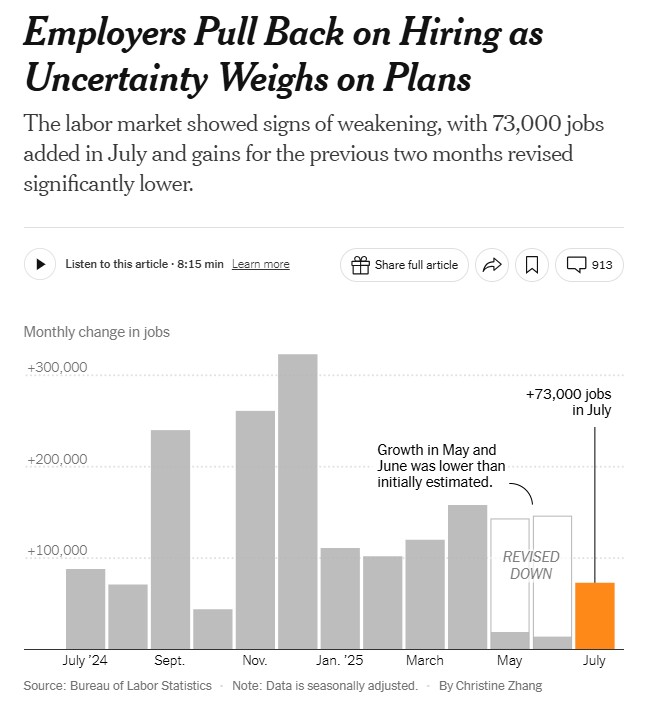
Our president's striking response to these gloomy economic results was absolutely Stalinesque. He immediately declared that the official jobs statistics were "rigged" and fired Erika McEntarfer, the professional statistician who served as commissioner of the Bureau of Labor Statistics for providing such unwelcome news. Although he didn't have her arrested by the NKVD and shipped off to the Gulag as a Trotskyite saboteur, his reaction otherwise seemed quite similar to that of the notorious Soviet dictator.Prior to this shocking incident, I'd never heard of McEntarfer and I'm sure that the same was true for almost all Americans. As a professional labor economist and statistician, she had quietly toiled in government service for decades, never arousing the slightest bit of controversy. When she had been appointed to head the BLS last year, she had been confirmed by an 86-to-8 vote in the Senate, with nearly all the Republicans supporting her.
But with Trump having declared her a Trotskyite spy, most of the cowed Republican officeholders quickly fell into line, seconding the accusations of our erratic president. Meanwhile, both liberal and conservative economic experts defended and praised McEntarfer as a nonpartisan professional who diligently reported the actual economic data gathered by her bureau.
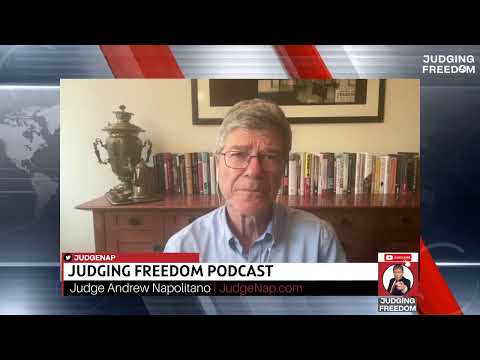
Prof. Jeffrey Sachs of Columbia University has spent decades as one of our leading international economists and given his stature and influence in those financial circles, he has regularly met with top world leaders and other global elites. So he is much more willing to speak plainly than most. In numerous interviews this year, he has highlighted the utterly lawless and illegal nature of so many Trump Administration policies, including that immediate firing of an important government civil servant for reporting unfavorable economic statistics:
- History as Farce with Donald Trump's Tariff Policies
- Ron Unz • The Unz Review • August 11, 2025 • 3,200 Words
McEntarfer's sudden removal was merely part of a much broader pattern of Trump actions.
For 90 years, it has been settled American law that the president cannot fire or otherwise remove the members of independent government agencies without serious cause. All of this was based upon a unanimous, landmark 1935 Supreme Court decision that prevented Democratic President Franklin Roosevelt from taking such actions, and no president in all the decades since then had ever challenged those restrictions.
But Trump has now done exactly that on numerous occasions, removing such officials at his personal whim or to ensure that Republicans possessed majorities on the various boards or commissions. And most astonishingly, the current Supreme Court appears likely to endorse Trump's dramatic violation of settled Constitutional law, a decision that would overturn nearly a century of legal precedents and drastically expand existing presidential powers.
During my entire lifetime, virtually all Democrats, Republicans, and media pundits have always boasted that the political independence of our Federal Reserve system has been a central reason for American economic stability and the respect that our currency has generally enjoyed in world financial markets. But Trump has been dissatisfied with the unwillingness of the Fed to rapidly lower interest rates and pressured them to do so by threatening to fire the chairman and declaring that he had fired one of the other members.
In doing this, Trump is seeking to overturn the 1951 Accord between the Federal Reserve and the Treasury Department that restored full independence to that former institution in the aftermath of World War II. No previous president had ever challenged that policy in the three generations since it was put into place. Once again, the Supreme Court will soon be ruling on this completely unprecedented expansion of presidential power, though in this case the court seems much less likely to support Trump.
In oral arguments last month, the Supreme Court including its conservative justices had also expressed quite a lot of skepticism over Trump's claims that despite the clear language of the U.S. Constitution he had the right to unilaterally set tariff tax rates by emergency presidential orders.
For example, Justice Neil Gorsuch, whom Trump himself had put on the high court, very tellingly noted that according to the reasoning of the Trump Administration, a different president could unilaterally impose a 50% tariff on all gas-powered cars and auto parts because of our ongoing "climate emergency," and that there would effectively be no checks on such power by Congress or any other body.
The power to tax is the power to destroy, and Trump has thereby claimed that as president he has the power to issue emergency executive orders unilaterally allowing him to destroy any product, service, or industry at will, with all future presidents permanently possessing that same massive power. This would represent one of the most extraordinary expansions of presidential authority in our entire national history.
Although the remarkable aggrandizement of tax and administration power by the Trump Administration has been constitutionally outrageous, I have argued that these are hardly its most worrisome domestic activities:
Just a few weeks after Trump's second inaugural I highlighted one of the most shocking actions taken by the new administration:A 30-year-old Tufts doctoral student and Fulbright Scholar from Turkey was walking across her Boston-area neighborhood on the way to a holiday dinner at a friend's house when she was suddenly seized and abducted in the early evening by six masked federal agents of the Department of Homeland Security. The terrified young woman was handcuffed and taken to a waiting car, secretly detained for the next 24 hours without access to friends, family, or lawyers, then shipped off to a holding cell in Louisiana and scheduled for immediate deportation, although a federal judge has now temporarily stayed the proceedings.
Just one of the Tweets showing a short clip of that incident has been viewed more than 4.5 million times, with a much longer YouTube video accumulating another couple of hundred thousand views.
That very disturbing scene seemed like something out of a Hollywood film chronicling the actions of a dystopian American police state, and that initial impression was only solidified once media reports explained why Rumeysa Ozturk was snatched off the streets of her home town. Her only reported transgression had been her co-authorship of an op-ed piece in the Tufts student newspaper a year earlier sharply criticizing Israel and its ongoing attacks on the civilian population of Gaza.Apparently, one of the many powerful pro-Israel censorship organizations funded by Zionist billionaires became outraged over her sentiments and decided to make a public example of her, so its minions in the subservient Trump Administration immediately ordered her arrest.
Numerous other permanent legal residents of America suffered similar fates for expressing criticism of Israeli government policies.
This followed the storm of controversy unleashed earlier this month by the very high profile arrest of Mahmoud Khalil, a recent Columbia graduate student heavily involved in last year's campus protests against the Israeli attacks on Gaza. Seized in an early morning raid on his campus student housing, which he shared with his wife, an American citizen eight months pregnant, he was taken off to detention, first in New Jersey and then transferred to a holding cell in Louisiana, once again with no initial access to his family, friends, or lawyers.As a Green Card holder—a permanent legal resident of the U.S.—he was considered fully entitled to all the normal rights and privileges of an American citizen, but Secretary of State Marco Rubio declared that his Green Card would be canceled and he would be deported based upon an obscure legal doctrine never previously employed for that purpose, eliciting a strong legal challenge in federal court. Moreover, his transfer from a New Jersey jurisdiction to a different one in the Deep South also seemed to violate normal legal procedures...
A day earlier Rubio explained that he had already authorized the arrest and immediate deportation of more than 300 students around the country for their criticism of Israel, so these particular cases obviously represented merely the tip of a very large iceberg.
Trump has also made remarks about stripping citizenship from large numbers of Americans, and given some of our president's other public statements, this might include those individuals deemed insufficiently loyal to the State of Israel.
- The Zionist Destruction of American Higher Education
- Ron Unz • The Unz Review • March 31, 2025 • 7,300 Words
Such very public abductions by government ICE agents acting without warrants were soon widely employed against alleged illegal immigrants, drawing loud cheers from the anti-immigration activists who heavily dominate the Republican Party and Trump's own political base. But right-wing Internet provocateur Andrew Anglin raised some shrewd and very disturbing issues.
He noted that with ten or twenty million illegal immigrants living in America, employing squads of federal agents to individually seize them one at a time was absurdly inefficient and made absolutely no logical sense. Therefore, this dramatic Trump policy must be driven by some entirely different motive.
He persuasively suggested that what we were actually seeing was an attempt to normalize the practice of having squads of masked government agents snatch terrified people off city streets without legal warrants and then hustling them into unmarked vehicles for delivery to "black sites" where they could be held without any ability to communicate with the outside world.
Nothing like this had ever previously happened in American society. But Anglin argued that the goal was to inure the American population to seeing such horrifying scenes in their daily lives and social media feeds, while giving ICE agents good experience in such brutal tactics. Once that was achieved, exactly those same methods could then be deployed against American citizens as well, justified by accusations that they were suspected of being terrorists or traitors or enemy agents.
He noted the astonishing growth in the ICE budget:
The Big Beautiful Bill is turning ICE into the biggest federal cop group in American history. Their budget is going to go from $10 billion to $100 billion, which surpasses the combined budgets of the FBI, DEA, ATF, Bureau of Prisons, and the Marshals Service.
- Dear MAGA: If You Think Masked ICE Thugs Wouldn't Do the Same to You, You're Even Dumber Than You Look
- Andrew Anglin • The Daily Stormer • July 11, 2025 • 3,100 Words
As I discussed at the time:
I think one regular sign of a society or a political system that is heading towards total collapse is a series of rapid, dramatic shifts from policies endorsed by one extreme end of the ideological spectrum to the other.Over the last several years we have seen the imposition of what amounted to an asylum-based system of Open Borders established by non-legislative means, resulting in the uncontrolled influx of millions of unauthorized foreign immigrants. And now in reaction to that very unpopular policy, the Trump Administration has begun to transform ICE into an enormous, militarized federal police force that regularly snatches people off our streets without any probable cause or due process, then ships them off to brutal prison camps located domestically or overseas, conjuring up memories of the notorious Soviet NKVD.
- ICE Raids, Asylum Policies, and Other Immigration Controversies
- Ron Unz • The Unz Review • July 21, 2025 • 10,100 Words
The issue of illegal immigration has certainly been emphasized by the Trump Administration as a means of maintaining the support of much of his base.
Just days after his inauguration, Trump had delighted his right-wing followers by issuing an emergency executive order abolishing birthright citizenship for the American-born children of illegal immigrants. Naturally, this was immediately blocked by lower court injunctions, but earlier this month the Supreme Court agreed to review the case. Six of the nine Justices are conservative, Republican appointees, half of them by Trump himself, so there is some speculation that Trump's order might be affirmed.
Although in recent years many or most conservative organizations and activists have taken this position, it would seem to be an absolute violation of every purported conservative judicial principle, given that it would overturn the long-settled 127 year interpretation of the high court's 1898 ruling in United States v. Wong Kim.
What makes this popular conservative legal argument so totally ridiculous is that it apparently first appeared during the immigration battles of the 1990s, roughly one hundred years after the Supreme Court decision it now seeks to reverse. Throughout the twentieth century, probably many millions of American-born children of illegal immigrants received their citizenship under such birthright provisions, and as far as I can tell, no one had ever challenged that legal assumption.
I am not arguing that this interpretation of the law was affirmed by judicial rulings. Instead, I am making the far stronger claim that for nearly one hundred years it was never once even publicly questioned by anyone in America, whether lawyer, elected official, journalist, pundit, or political activist. So if the high court ruled in favor of Trump, it would be declaring that for nearly a full century every American lawyer and every American non-lawyer had misinterpreted the meaning of the 14th Amendment, about as dramatic a violation of the supposed conservative principle of judicial restraint as could be imagined.
Indeed, such a Supreme Court ruling would be as utterly ridiculous as for the Justices to suddenly claim that the U.S. Constitution guaranteed a right to Gay Marriage although neither its drafters nor a single American for more than two hundred years had been aware of that fact. But given the 5-to-4 Obergefell v. Hodges decision of 2015, I think it is far from impossible that Trump's executive order abolishing birthright citizenship might be affirmed.
At least so far a totally subservient Congress has backed all of Trump's domestic policies as have most of the justices of the Supreme Court.
During the months of Trump's second term, Prof. Jeffrey Sachs has been one of the very few mainstream public figures willing to repeatedly emphasize the utterly outrageous nature of Trump's lawless actions, declaring that after nearly two and a half centuries, our Constitutional system is hanging by a thread. And I personally fear that there exists the very real possibility that the heavily Republican Supreme Court may be about to cut that thread.
We are now less than one year into Trump's current presidential term, and regardless of how those future court decisions go, he has already successfully expanded the power of the presidency to an absolutely unprecedented extent, deploying emergency executive orders as an all-purpose tool of lawmaking. Trump has seized the unilateral power to set or change all tax rates at will, and to remove all members of independent boards and commissions, while effectively eliminating the civil service provisions that put an end to the spoils system in the late nineteenth century. If upheld, all of these powerful administrative weapons would be available for any future president to wield.
Moreover, he has accomplished this massive aggrandizement of presidential power while lacking any sort of political mandate. In none of his three presidential elections did he ever even get a majority of the vote. This demonstrates that brash boldness often succeeds where more cautious methods may fail.
On the foreign policy front, Trump's behavior has been at least as extreme and erratic, even becoming outright criminal during the last few months, especially with regard to Venezuela and the rest of Latin America.
During the course of 2025, our government began regularly denouncing Venezuelan President Nicolas Maduro and regime as "narco-terrorists," a totally nonsensical new term that Trump and his officials were popularizing. He backed these denunciations by emphasizing the many tens of thousands of annual American deaths due to Fentanyl drug overdoses, certainly a terrible aspect of our decaying society. But he appeared totally unaware the none of our Fentanyl comes from Venezuela while providing no evidence that President Maduro or his government were significantly involved in any other drug-trafficking, with informed experts mostly dismissing those accusations.
Although Trump never substantiated any of his charges against Maduro, he repeatedly threatened the Venezuelan leader and demanded that he leave office, underscoring those threats by stationing a powerful American naval task force off the coast of that country, including the U.S.S. Gerald R. Ford, our largest aircraft carrier.
But Maduro stayed put, and with Trump apparently reluctant to actually attack, our president decided to show he meant business by ordering our military to begin a series of deadly missile strikes against numerous small boats in the international waters around Venezuela. Once again, Trump declared without any evidence that the occupants were narco-terrorists planning to traffic deadly drugs to our country, and many dozens of such victims have now died in these American attacks.
But knowledgeable observers had sharply disputed Trump's claims, noting that none of the vessels possibly had the fuel to travel the thousand mile distance to reach American shores. Attacking defenseless boats and killing their occupants in international waters is obviously a war crime, and perhaps concerned with the risks of future prosecution, the four-star admiral commanding American forces in the region soon announced his resignation.
While it's certainly possible that some of those boats may have been carrying drugs, no evidence has ever been provided, and experts noted that some obviously held far too many passengers to be smuggling drugs. Moreover, after our military forces captured a couple of the survivors of one such missile strike, they soon released these individuals instead of seeking to prosecute them. That embarrassing incident apparently led our government to adopt a new policy of using follow-up strikes to ensure that there were never any survivors.
Yet oddly enough, even as Trump was ordering those deadly missile strikes against random civilians and perhaps even a few drug smugglers while threatening to do the same against President Maduro, he decided to balance those harsh measures by mercifully giving a full presidential pardon to former Honduran President Juan Orlando Hernández. Just last year, Hernández had been convicted by an American jury of smuggling hundreds of tons of cocaine into our country and sentenced to 45 years in federal prison. Although now freed by Trump, the former president cannot return to his own country since he would still face arrest for his heavy involvement in one of the world's leading drug trafficking rings.
I doubt that even Caligula in his madness would been willing to juxtapose these two contradictory policies, and although I long enjoyed the wacky British humor of Monty Python's Flying Circus, I cannot imagine that its writers would have ever been daring enough to produce such a ridiculous skit.
Just a few days ago, Trump added to his pressure on Venezuela by ordering the American military to seize a large tanker carrying oil from that country to Cuba, then loudly declared that America would keep the oil. Apparently, the only justification for this seizure, which obviously amounted to international piracy, was that Trump so strongly disliked the governments of both Venezuela and Cuba.
Although international pirates still do exist here and there in the world, with gangs of fierce Somali tribesmen being perhaps the most notorious, I think the last time any government engaged in such piracy may have been the case of the notorious Barbary Coast Pirates, North African corsairs based in Tripolitania. During the early 1800s, these pirates regularly seized sailing vessels of countries that refused to pay them tribute, and those shipping attacks finally led President Thomas Jefferson to initiate the successful First Barbary War, with our military victory on "the shores of Tripoli" becoming part of our Marines' Hymn.
But while our President Jefferson sought to suppress international piracy, more than two centuries later his successor President Trump apparently seeks to actively promote and lead it, publicly declaring that he planned to keep the nearly two million barrels of Venezuelan crude that he had seized in his pirate attack, perhaps hoping that the revenue would partly compensate for the high daily cost of keeping our naval task force operating in that location.
Some observers have suggested that the Trump Administration has returned to the notorious "Big Stick" foreign policy that President Theodore Roosevelt employed in the early years of the twentieth century, including with regard to the militarily weak countries of Latin America and his expansive interpretation of the Monroe Doctrine. But I strongly dispute this. As far as I can tell, no major country in hundreds of years, perhaps even many hundreds of years has consistently behaved in so utterly lawless a fashion as the U.S. under President Trump.
Similarly, some of the top officials that he has appointed to implement his national security policies appear to be completely unprecedented in their outrageous personal history and lack of qualifications, notably including his Secretary of Defense Pete Hegseth whose department Trump suddenly renamed the Department of War in a surprisingly candid executive order.
Although a military veteran of the Iraq War, Hegseth had never commanded anything larger than a rifle platoon, but he had apparently caught Trump's eye as a gung-ho commentator on FoxNews. However, when Trump nominated him, it quickly came out that he had a long and severe drinking problem while the non-profit veterans organizations he led had financially collapsed.
Worse still, while drunk at a Republican conference he had been very plausibly accused of raping one of the women there, who had both told her colleagues about the brutal attack and also reported it to the police at the time, with Hegseth desperately begging her not to press charges and later paying $50,000 for her silence. This nearly led to the defeat of his nomination in the Republican-controlled Senate, but massive pressure from Trump had allowed him to squeak through on a tie-vote broken by Vice President JD Vance, only the second time this had happened in American history.
Once in office, Hegseth violated all security protocols by sharing details about missile strikes with his friends and relatives, an incident that was widely but mistakenly expected to result in his immediate termination.

Secretary of War Pete Hegseth
I'm not sure of the last time any major power has put its military under the control of a totally unqualified, incompetent, and heavily tattooed drunken rapist, and I suspect that even the overwhelming majority of Third World countries would balk at such a doubtful personnel decision.
Trump's choice for FBI Director was Kash Patel, who had no background in law enforcement whatsoever, and his girlfriend Alexis Wilkins last month attracted considerable attention for filing multi-million-dollar lawsuits against conservative influencers who casually accused her of being an Israeli agent. Meanwhile, the FBI Deputy Director installed by Trump was Dan Bongino, a former low-level Secret Service agent best known as a popular and highly conspiratorial right-wing podcaster.
One strange aspect of Trump's presidency has been the extreme difference between his first and second terms.
When Trump very unexpectedly entered the White House in January 2017, everyone expected him to do dramatic things, his opponents doing so with great fear and his supporters with hope and expectations.
Yet he did almost nothing unusual during his first four years in office except send out waves of angry Tweets. Almost all his major appointments were either mainstream Republicans or hardcore Neocons, so in many respects his administration seemed to look and act much like one that had been established under a Jeb Bush presidency.
Yet his second term has been utterly different, certainly one of the most unusual and remarkable presidencies in all of American history. What accounts for such a stark difference?
I think the answer may partly be found in the story of another distant historical figure, the Emperor Justinian II of the Byzantine or Eastern Roman Empire. He came to the throne in 685 and according to historians spent his first decade ruling in reasonable and generally successful fashion. But his tax policies were unpopular, so in 695 he was overthrown by a general named Leontius, who became emperor in his place.
Rather than killing his predecessor, Leontius instead cut off his nose and exiled him, assuming that a mutilated former emperor would not pose any future political threat.
Leontius then ruled for a few years until he, too, was overthrown by a different general named Tiberius and had his own nose cut off for similar reasons.
But then matters took a surprising turn. While living in exile, Justinian managed to gain the support of a large barbarian army, promising its chieftain rich financial rewards and also the hand of his own daughter in marriage. With their help, he successfully seized the Byzantine capital and regained the imperial throne, doing so while wearing a replacement nose made of gold.
According to later historians, the mutilation and years of bitter exile suffered by Justinian had seriously unbalanced him, and during his second reign he ruled much more harshly and erratically. After publicly torturing and executing both of his predecessors, he then began doing the same to large numbers of other prominent Byzantines, whom he rightly or wrongly suspected of opposing him. Next, he turned upon the barbarian tribe that had restored him to the throne, but they soundly defeated him in battle.
His unpopular behavior and military defeats eventually inspired a revolt against his rule, and he was overthrown by a different general. The latter took no chances this time and had Justinian beheaded, golden nose and all, also killing his son and heir and thereby putting a permanent end to the century-long Heraclian dynasty.
When Trump first came into office in early 2017, his activist supporters often chanted "Lock Her Up!" enthusiastically endorsing Trump's promise to prosecute and imprison Hillary Rodham Clinton. But he did no such thing, nor took similar legal actions against any other former Obama officials, greatly disappointing his vengeful followers.
However, instead of displaying any gratitude, Trump's many bitter enemies in the political establishment took their legal immunity as a sign of his weakness, so they immediately began hounding him with the ridiculous accusations that he was a Russian agent, starting major legal investigations and eventually orchestrating his two impeachments.
Furthermore, during his 2020 presidential campaign, they essentially stole the election from him, denounced him as an insurrectionist after the huge DC protest demonstrations of his supporters, and hunted down and prosecuted hundreds of the Trumpists who had stormed the capitol. After banning Trump from social media, they later launched numerous outrageous lawsuits and prosecutions against him, trying to drive him into personal bankruptcy and send him to prison. At times it seemed very possible that he might be waging his 2024 presidential campaign from inside a prison cell.
Therefore, it was not entirely surprising that when Trump once again beat the odds and won the 2024 presidential race against an extremely unpopular Vice President Kamala Harris, he had become a far more erratic and unbalanced leader, launching a wave of extremely vindictive attacks against all his political and media enemies and cutting all sorts of legal corners to do so.
In metaphorical terms, after driving Trump from office in the 2020 election, his enemies cut off his nose, and they are now reaping the political consequences of what they did. But unfortunately our entire country and system of government has been suffering the same fate.