December 25, 2025
Donald Trump as the Emperor Caligula
Last week I'd published an article noting the considerable similarities between the reign of the notorious Roman Emperor Caligula and the second term of our own President Donald Trump.
According to the ancient sources, Caligula had best been known for proclaiming himself a living god and for declaring that he would appoint his horse to the consulship, the highest office of the Roman state. Many of these later historians declared that he was mad.
Given that America's huge legion of bitter Trump-haters has spent years denouncing our president in every possible way, they would surely endorse this historical analogy. Trump may not have yet appointed a horse to his cabinet, but as one recent commenter suggested, he had certainly done so with a donkey, putting our entire armed forces under the authority of Secretary of War Pete Hegseth, an incompetent, unqualified, heavily tattooed drunken rapist.

Secretary of War Pete Hegseth
But the primary analogy I was actually making was a somewhat more subtle one. For centuries the Romans had always had a deep and abiding hatred of kings. So when Augustus became the first emperor in 27 B.C., he was careful to nominally retain all of Rome's many republican institutions and treat them with great respect, thereby allowing his subjects to pretend to themselves that they were not living under a monarchy. His successor Tiberius continued that same policy.
But Caligula's outrageous behavior and the total contempt he expressed for Rome's traditional political institutions removed all such pretense. He revealed to even the most naive Roman citizens that their republican form of government had been transformed into the sort of absolute monarchy that their political culture had always detested.
In much the same way, Trump's constant use of emergency executive orders has demonstrated that our American constitutional system no longer exists. On a weekly or even daily basis Trump has drastically changed the tariff tax rates on our three trillion dollars of annual imports, doing so based upon personal whim. Disregarding the civil service regulations enacted in the late nineteenth century, he has claimed the authority to fire government workers at will. He has also seized the right to remove the members of independent boards and commissions, defying a unanimous Supreme Court ruling that has prohibited such action for the last 90 years.
No past president has ever so rapidly arrogated near total governmental power to himself. By doing so without suffering any major political repercussions, Trump has demonstrated that our traditional constitutional system of checks and balances has largely disappeared.
In his numerous interviews throughout this year, Prof. Jeffrey Sachs of Columbia University has described how our Congress has completely abdicated all its traditional Constitutional responsibilities. He has also expressed great concerns that the Supreme Court may be on the verge of overturning a century or more of its own previous rulings and blessing much of Trump's total usurpation of Congressional authority. Just a few days ago, he reiterated these points, describing Congress as "dead."
Prof. Jeffrey Sachs : Trump's Empire of Hubris.
Prof. Jeffrey Sachs : Trump's Empire of Hubris.
Some elements of this ongoing transformation had already occurred under past presidents from Bill Clinton onwards. But these previous leaders sought to conceal what was happening and with the assistance of the mainstream media, they had generally succeeded in doing so. However, Trump has made no effort to hide the reality of the nearly all-powerful presidency he has established, revealing it to every American who has eyes to see.
Trump has also displayed elements of the megalomania long ascribed to Caligula. Our president swept clean the board of the Kennedy Center, replacing its members with his own loyalists, and the latter then voted to rename their institution "the Trump Kennedy Center." Wags YouTube Takes The Oscars that our capital might soon become known as the site of "the Trump-Washington Monument" and "the Trump-Lincoln Memorial."
In that same article, I also noted that one sign of a political system veering towards total collapse is that it may often undergo rapid, dramatic swings from one set of extreme and legally dubious policies to those at the opposite end of the ideological spectrum. I suggested that the best example of this has been our immigration policies of the last decade or two.
Although many of the most extreme such measures have recently been implemented by the Trump administration, previous Democratic administrations had sometimes taken similar steps. For example, after President Obama tried but failed to pass Congressional legislation shielding illegal immigrants who had arrived as children from deportation, he issued an executive order establishing the DACA policy that did exactly that. This bold but obviously illegal change in our immigration laws attracted the enthusiastic support of most of our mainstream media.
As a political issue, immigration had been crucial to Trump's surprising political victories and it has become his signature domestic policy, but I'd only very briefly discussed it in that article. So I think it is now worth focusing upon Trump's immigration policies in much greater detail as well as the reasons that issue provided such an important political opening for his populist outsider candidacy.
Decades of Bipartisan Elite Support for Open Borders
The starting point is to recognize that for decades all our national elites have embraced an "Open Borders" policy of allowing almost unlimited immigration. I explained this in a long 2011 article on that subject.
The political reality is that both major parties are enormously dependent upon the business interests that greatly benefit from the current system and are also dominated by disparate ideologies-libertarian open-borders and multicultural open-borders-whose positions tend to coincide on this issue.As an extreme example of the bizarre ideological views of our current political elites, consider a less-publicized element of the immigration reform plan that President George W. Bush trumpeted during his 2004 reelection campaign. This provision would have allowed any foreigner anywhere in the world to legally immigrate to America if he accepted a minimum-wage job that no American were willing to fill, an utterly insane proposal which would have effectively transformed America's minimum wage into its maximum wage. Naturally his opponent, Sen. John Kerry, saw absolutely nothing wrong with this idea, though he did criticize various other aspects of Bush's immigration plan as being somewhat mean-spirited.
The bizarre immigration views of these elites were further brought home to me a couple of years later when I was invited to NYC to participate in a 2013 Intelligence Squared debate on exactly such a hypothetical "Open Borders" proposal regarding private employment. The event was carried on NPR and rebroadcast on various television outlets around the country, with the sponsoring organization also providing a convenient transcript.
Let Anyone Take A Job Anywhere
Let Anyone Take A Job Anywhere
As I explained at the time:
Under the regular operating rules, the organizers held before and after votes of the large New York City audience, regarding the winning side as being the team that shifted the margin in their direction. Given my two decades of past writing on immigration issues, I found it quite ironic and amusing that I had been selected for the "anti-immigration" side of the debate, together with Kathleen Newland, co-founder of the eminently pro-immigrant Migration Policy Center. This indicates how yesterday's fringe ideas have now become the accepted mainstream perspective of American elites. The resolution under consideration was certainly as extreme and radical a formulation of the views of economic libertarians as might be imagined: "Let Anyone Take A Job Anywhere."Under the literal interpretation of such a proposal, one can easily imagine twenty or thirty million of the world's desperate poor coming to America within the first few years of enactment, drawn from a global pool numbering in the billions. The resulting social and economic changes would be on a scale unprecedented in human history let alone America's past, and the potential for an utterly destructive outcome leading to the collapse of our society seems completely obvious.Nonetheless, at the pre-debate vote the supporters of this proposal outnumbered opponents by a landslide margin of some twenty-five points, 46% to 21%, while one-third of the audience remained undecided. Indeed, during the televised pre-debate discussion between the moderator and the Intelligence Squared chairman, some doubts were expressed that any intelligent person could oppose such a sensible free market policy in labor mobility.Once the debate began, I focused on the obvious point that the law of supply and demand ensured that a huge increase in the number of willing workers would greatly reduce their economic bargaining power against their employers. Wages for ordinary Americans have been stagnant for forty years and it is probably more than pure coincidence that the last forty years have witnessed one of America's greatest waves of foreign immigration. Adopt a proposal that immediately increases such immigration levels by a factor of five or ten, and America's minimum wage would be transformed into its maximum wage, with the natural outcome being economic devastation for most working Americans.Certainly America's affluent and highly educated urban elite-the sort of New Yorkers attending the debate-would benefit in the short run from enacting a policy that drastically cut the share of the national income going to shopkeepers, nannies, construction workers, and probably 90% of all other Americans. But the eventual social consequences of the total impoverishment of the American middle and working classes might lead to the sort of extreme political reaction we sometimes read about in the history books.Such points might seem totally obvious to me, but many of the audience members had seemingly never encountered them before, and the results were striking. After ninety minutes of hearing both sides of the issue, there was a swing of thirty-two points toward our opposed position, and we won handily. As a point of comparison, at the reception prior to the show we had been told that the largest previous swing at any Intelligence Squared debate had been the shift of eighteen points that occurred during a 2006 debate on the nature of Hamas in the Mid East conflict.I have little doubt that those many hundreds of earnest New Yorkers who decided to spend their time and money to attend an evening policy debate rather than see a Broadway show or watch Gravity in 3-D, consider themselves well-informed people, who regularly read The New York Times and many of the leading liberal opinion magazines. But such purportedly "liberal" outlets studiously avoid mentioning that a massive influx of foreign workers would be an economic catastrophe for the bulk of the American population. Hence the apparent surprise of so much of the audience at the notion that a huge increase in the supply of workers might produce a sharp decline in the market value of their labor and the income they receive.
- Open Borders, American Elites, and the Minimum Wage
- Ron Unz • The Unz Review • November 11, 2013 • 1,700 Words
Our bipartisan political elites stubbornly continued their support for this lunatic open borders policy, thereby eventually providing a huge political opportunity for a rank outsider such as Donald Trump who was willing to challenge it. Trump very effectively used that issue to seize the Republican nomination in 2016 and then against all odds won the White House in November of that same year. A few weeks before that shocking victory, I explained the demographic and ideological roots of his tremendous success:
In the year 1915 America was over 85% white, and a half-century later in 1965, that same 85% ratio still nearly applied. But partly due to the passage of the Immigration Reform Act of that year, America's demographics changed very rapidly over the following five decades. By 2015 there had been a 700% increase in the total number of Hispanics and Asians and the black population was nearly 100% larger, while the number of (non-Hispanic) whites had grown less than 25%, with much of even that small increase due to the huge influx of Middle Easterners, North Africans, and other non-European Caucasians officially classified by our U.S. Census as "white." As a consequence of these sharply divergent demographic trends, American whites have fallen to little more than 60% of the total, and are now projected to become a minority within just another generation or two, already reduced to representing barely half of all children under the age of 10.Demographic changes so enormous and rapid on a continental scale are probably unprecedented in all human history, and our political establishment was remarkably blind for having failed to anticipate the possible popular reaction. Over the last twelve months, Donald Trump, a socially liberal New Yorker, has utilized the immigration issue to seize the GOP presidential nomination against the vehement opposition of nearly the entire Republican establishment, conservative and moderate alike, and at times his campaign has enjoyed a lead in the national polls, placing him within possible reach of the White House. Instead of wondering how a candidate came to take advantage of that particular issue, perhaps we should instead ask ourselves why it hadn't happened sooner.The answer is that for various pragmatic and ideological reasons the ruling elites of both our major parties have largely either ignored or publicly welcomed the demographic changes transforming the nation they jointly control. Continuous heavy immigration has long been seen as an unabashed positive both by open borders libertarians of the economically focused Right and also by open borders multiculturalists of the socially focused Left, and these ideological positions permeate the community of policy experts, staffers, donors, and media pundits who constitute our political ecosphere.Earlier this year, Democratic presidential candidate Bernie Sanders, an elderly individual with unabashed socialistic views, was interviewed by Vox's Ezra Klein, and explained that "of course" heavy foreign immigration-let alone "open borders"-represented the economic dream of extreme free market libertarians such as the Koch brothers, since that policy would obviously drive down the wages of workers and greatly advantage Capital at the expense of Labor. These notions scandalized his neoliberal interlocutor, and the following day another Vox colleague joined in the attack, harshly denouncing the candidate's views as "ugly" and "wrongheaded," while instead pointing to the editorial page of the Wall Street Journal as the proper font of progressive economic doctrine. Faced with such sharp attacks by young and influential Democratic pundits less than half his age, Sanders soon retreated from his simple statement of fact, and henceforth avoided raising the immigration issue during the remainder of his campaign.Only a brash, self-funded billionaire contemptuous of establishment wisdom would challenge this bipartisan immigration consensus among our political elites, and only a prominent celebrity could launch his campaign with sufficient visibility to achieve a media breakthrough. This seemed an unlikely combination of traits to find in one individual, but the unlikely occurred, and our national politics has been upended.There had already been strong previous indications of this smoldering political volcano among voters, though these signs were repeatedly ignored or discounted by the DC Republican apparatchiks who spent their time attending each others' receptions and fundraisers. During the 2014 election cycle, immigration was a key issue behind the stunning defeat of Republican House Majority Leader Eric Cantor, who lost to an unknown primary challenger whom he outspent 40-to-1, constituting one of the greatest upsets in Congressional history. Prior to that, anti-immigration Tea Party insurgents had ended the long careers of incumbent Republican senators Bob Bennett of Utah in 2010 and Richard Lugar of Indiana in 2012.
- A "Grand Bargain" on Immigration Reform?
- Ron Unz • The Unz Review • October 3, 2016 • 4,700 Words
- Open Borders Under the Biden Administration
- Trump's 2016 victory stunned the American political elites, and they were initially terrified of what he would do on immigration matters and everything else after his January 2017 inauguration.
- But although Trump had loudly promised his legions of devoted followers that he would "Build a Wall!" and otherwise control our borders, in practice he didn't do much of anything. This hugely emboldened his many enemies in the political establishment.
- When Trump left office four years later after the disputed election of 2020, foreign immigration had indeed sharply fallen, but that decline was merely due to the Covid epidemic, which had locked down our entire country and its economy.
- Believing that they had successfully seen off the political menace of Trump and Trumpism, our elites decided to redouble their push to implement an open borders policy under the incoming Biden Administration. Once the temporary Covid-induced decline in immigration abated, waves of immigrants in absolutely unprecedented numbers soon began arriving.
- According to the official CBO/Census estimates, total net immigration during the years 2021-2024 exploded to more than 10 million and even sharply accelerated, with the influx in 2023 or 2024 being triple what it had been in 2021. Moreover, anti-immigration activists allege that the true figures were actually much higher:

- Nothing like this had ever previously happened in American history, and the natural result was a huge political backlash that became a major factor behind Trump's victorious 2024 presidential campaign. I discussed all of this soon after his November victory:
Although the immigration debate of the last couple of years has been framed as being fought over the issue of illegal immigrants, I actually think that this is rather misleading.
- As I've explained, for decades the elite political establishments of both parties had advocated something much closer to an open borders policy, including the removal of many existing restrictions on immigration. But despite the overwhelming financial support they contributed to the project, they had repeatedly failed to pass any such legislation in Congress.
- However, the powerful ideological backlash against Trump's harsh immigration rhetoric and his efforts to strengthen border enforcement gave them an opening to circumvent existing policies. Using a series of judicial rulings and administrative decisions, they gradually managed to eliminate legal restrictions against immigration by reclassifying most migrants as protected asylum seekers, who must be allowed to remain in our country after crossing the border.
- I explained these legal maneuvers in greater detail earlier this year:
Beginning in 1951, a special exception to American immigration restrictions had been carved out for the case of refugees seeking asylum, and media pressure during the first Trump Administration had led to a series of judicial rulings and administration decisions that had potentially swelled that category beyond all recognition, with these trends continuing under Biden.
- Traditionally, when migrants lacking legal documents entered America, they had sought to evade our border control officers, and if caught, were immediately deported. However, they now discovered that they could instead declare themselves to be refugees seeking asylum on a variety of different grounds, and simply turn themselves in. Given our overburdened judicial system, they would be granted a court hearing date well in the future, and generally released into American society for years, immediately disappearing into the local immigrant communities. As paroled asylum-seekers, they were under various legal restrictions regarding employment, but given the huge numbers, these were seldom if ever enforced.
- So in effect, a quasi-Open Borders policy had been established in American immigration law through non-legislative means. What had once been intended as a small and narrow exception had swallowed our entire immigration system. This transformed the influx of what would have previously been considered illegal immigrants into quasi-legal "migrants," much like the waves of millions of "migrants" admitted into Germany and other European countries about a decade earlier.
- The resulting size of the inflow was staggering:
With millions of foreigners casually entering the U.S. and only a small fraction of them ever being deported, the enforcement of laws against unauthorized entry largely disappeared as a matter of practical federal policy. And by effectively eliminating the notion of illegal immigration and allowing migrants to remain here, our country naturally began attracting more and more eager entrants from all across the world.
- During the Immigration Wars of the 1990s, activists had warned that our country would soon be swamped by endless waves of immigrants from Mexico and the rest of Latin America, but I'd always regarded this as total nonsense. Mexican birth-rates were rapidly declining toward replacement levels during those years, with most other countries of the region following that same trajectory, and according to official estimates, the population of Latin America will peak and begin to decline within another generation. America's wrong-headed efforts to sanction and destroy the Venezuelan economy has produced a heavy outflow from that country, but we are obviously the ones responsible for that particular problem.
- However, one very surprising recent development has been the large influx of migrants from Africa, something we had never previously experienced in such numbers. For many years, blogger Steve Sailer has publicized what he calls "the Most Important Graph in the World," showing that the population of Sub-Saharan Africa is expected to grow by 700% from 1990 to 2100, rapidly approaching half of the entire world's population and thereby providing an almost unlimited source of future migrants.
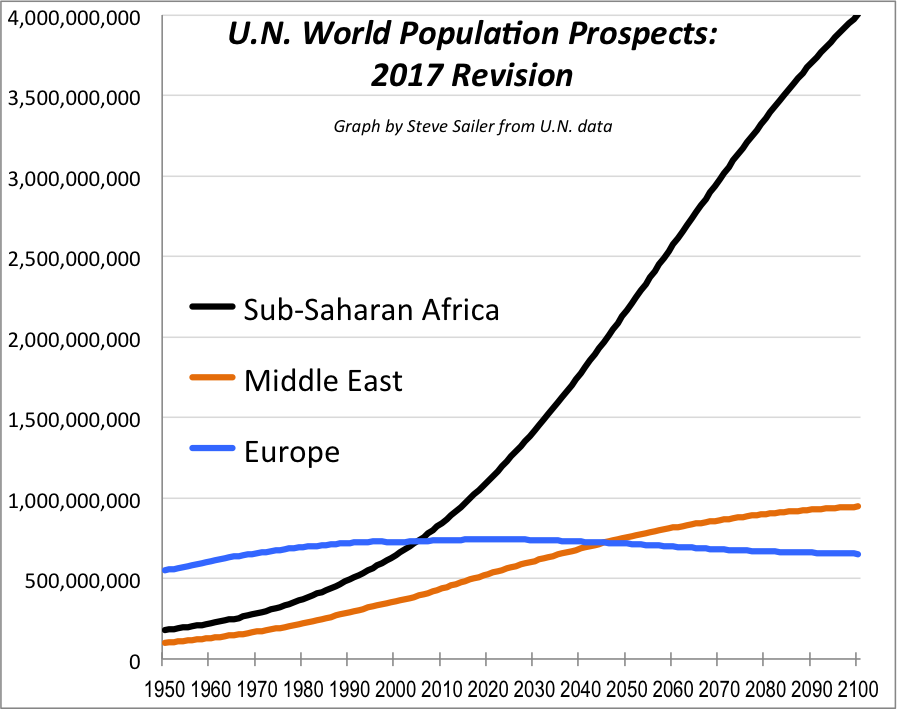
So the combination of effectively eliminating our restrictions on immigration together with Africa's exponential population growth might easily lead to unprecedented demographic changes in our society, with the sudden recent wave of African migrants being merely an early warning of what might eventually come.
- Although it's unclear how much of the voting public explicitly recognized this dystopian scenario, it may have quietly circulated in attenuated or euphemistic form, provoking the sort of uneasiness that shifted support towards Trump, who was promising a policy of large-scale deportations if elected.
- Towards the end of the campaign, Republicans had focused on the recent inflow of African-ancestry Haitians, claiming these immigrants were eating family pets, and perhaps this was partly an indirect means of raising such concerns.
- Immigration, Hispanics, and the Political Triumph of Donald Trump
- The Insane Bipartisan Consensus on Immigration
- Ron Unz • The Unz Review • November 11, 2024 • 8,800 Words
The Backlash Against Open Borders by Hispanics and Asians
This massive wave of immigration under Biden impacted American politics in unexpected ways, and earlier this year I discussed these.
But this huge and almost unchecked new wave of unauthorized immigrants to America under the Biden Administration had a very ironic political consequence.For decades, leading Republican figures such as President George W. Bush, Sen. John McCain, and political strategist Karl Rove had mistakenly argued that the best means of attracting Hispanic voters to the GOP was a pro-immigration policy, and this led them to promote the repeated failed efforts to enact legislation loosening immigration restrictions.
But the reality was that Hispanics living in America actually had very mixed feelings about high levels of continued immigration, and this came to the fore as the numbers of new migrants crossing our Southern border spiked under the Biden Administration.
By the early months of 2022, the New York Times ran a major article bearing the striking headline "How Immigration Politics Drives Some Hispanic Voters to the G.O.P. in Texas," with this dramatic trend soon confirmed by a Republican victory in a special Congressional election a few months later. The Times and other mainstream media outlets were stunned as the shift of Hispanics towards the Republican camp continued into November.
As I discussed in a November 2022 article, that remarkable story of the strong movement of Hispanics and Asians toward the Republican Party of Donald Trump was confirmed in the subsequent midterm elections:
The demographic results provided strong evidence that America's rapidly growing populations of Hispanics and Asians were continuing their political convergence with the existing white majority.
Taken together those two groups already represent a quarter of our total population, roughly double what they had been thirty years earlier, and according to reasonable projections they may account for one-third of all Americans within another generation. In recent decades, they have voted overwhelmingly for the Democrats, and the likely impact of their increasing numbers had become a linchpin of the confidence of party leaders in their long-term prospects. But although those groups do still lean strongly in that direction, over the last half-dozen years, these margins have sharply declined, a trend that initially shocked much of the media given that it seemed so contrary to their narrative of a "white supremacist" takeover of the Republican Party by Trump and his right-wing, MAGA supporters.
Political analyst William Galston is a staunch Democrat based at the Brookings Institution, and writing in the Wall Street Journal on election night, he summarized some of those alarming trends:
Democrats have even more cause for worry about their standing among Hispanics, who gave Donald Trump 38% of their votes in 2020, up from 28% in 2016, while Joe Biden's share was only 59%, down from Hillary Clinton's 66% in 2016. Recent surveys suggest this slide is continuing. AEI reported that Hispanic support for Democratic congressional candidates averaged only 53% in October. A Wall Street Journal survey conducted in late October 2022 offered even worse news, with Hispanic support for Democratic congressional candidates averaging 46%, only 5 points ahead of their Republican counterparts.
The actual results were released the following day by two different consortia of major news and research organizations, and these were considerably better for the Democrats, but still confirmed the very substantial gains the Republicans had made since the previous midterms:
In House contests, 11 percent of voters indicated they were Hispanic. In both polls, they voted 60 percent for Democrats, 39 percent for GOP ones. In 2018, nearly seven in ten Hispanics voted for Democrats. Democrats also appear to have lost significant ground among Asian voters. In 2018, around 80 percent of them supported Democrats. In this election, it was around 60 percent.
Obviously, well over half of Hispanics and Asians still voted for the Democratic candidates in 2022, but changes in ethnic party loyalties are usually glacial, and so rapid a shift is really quite remarkable.
A few days prior to the election, the Atlantic had published a lengthy article discussing these same Hispanic trends.
- Why Democrats Are Losing Hispanic Voters
- The left has alienated America's fastest-growing group of voters just when they were supposed to give the party a foolproof majority
- Tim Alberta • The Atlantic • November 3, 2022 • 8,100 Words
Prominent political demographer Ruy Teixeira has long been associated with the Democratic Party and twenty years ago, he had co-authored The Emerging Democratic Majority with John Judis, a widely discussed book arguing that long-term population trends were likely to ensure the party's political success. But in his latest Atlantic article, he now argued that the Democrats were continuing to lose working-class voters, greatly damaging their prospects. Given that Hispanics are heavily concentrated in that economic category, both these developments were obviously related.
- Democrats' Long Goodbye to the Working Class
- The party's biggest challenge heading into the midterm elections is the erosion of its traditional base of support
- Ruy Teixeira • The Atlantic • November 6, 2022 • 3,800 Words
Although a single election result can easily be dismissed as an outlier, several in a row have now revealed a new American political landscape that must be recognized. According to the exit polls, white voters favored Republican candidates by a 60-40 margin, while Hispanics and Asians leaned in the opposite 40-60 direction, certainly a clear difference but hardly an unbridgeable ideological chasm.
And even these figures may considerably exaggerate the influence of ethnicity in such voting patterns. Although Texas is solidly Republican and Florida is evenly divided, the bulk of Hispanics and Asians live in heavily Democratic states such as California, New York, Illinois, and New Jersey. Moreover, both these groups are considerably younger than whites, and youthful voters skewed very heavily Democratic. So their overall voting patterns may not have differed so greatly from whites of the same age and region.
The increasing political amalgamation of these non-white populations with the existing white majority is a development of enormous consequence for our country's future. If these trends continue, the voting behavior of members of these rapidly growing groups will become much less determined by their ethnic ancestry than by the same set of factors that influence the choices of their white counterparts, not only the aforementioned impact of age and geography, but also characteristics such as education, affluence, occupation, and religiosity. And if this occurs, then from a political perspective Hispanics and Asians would become little different than Americans of Irish or Italian heritage.
- Hispanics and Asians Join the White Political Mainstream
- Ron Unz • The Unz Review • November 14, 2022 • 6,400 Words
Strong Hispanic and Asian Support for Trump in 2024
In November 2024 I explained that these shifts carried Trump to victory that year:
These trends have continued and they even accelerated in last week's remarkable results, in which exit polls revealed that Trump won nearly half the Hispanic vote, the largest share of any Republican candidate in modern American history. Indeed, Trump actually did slightly better with Hispanic men than he did with white women.
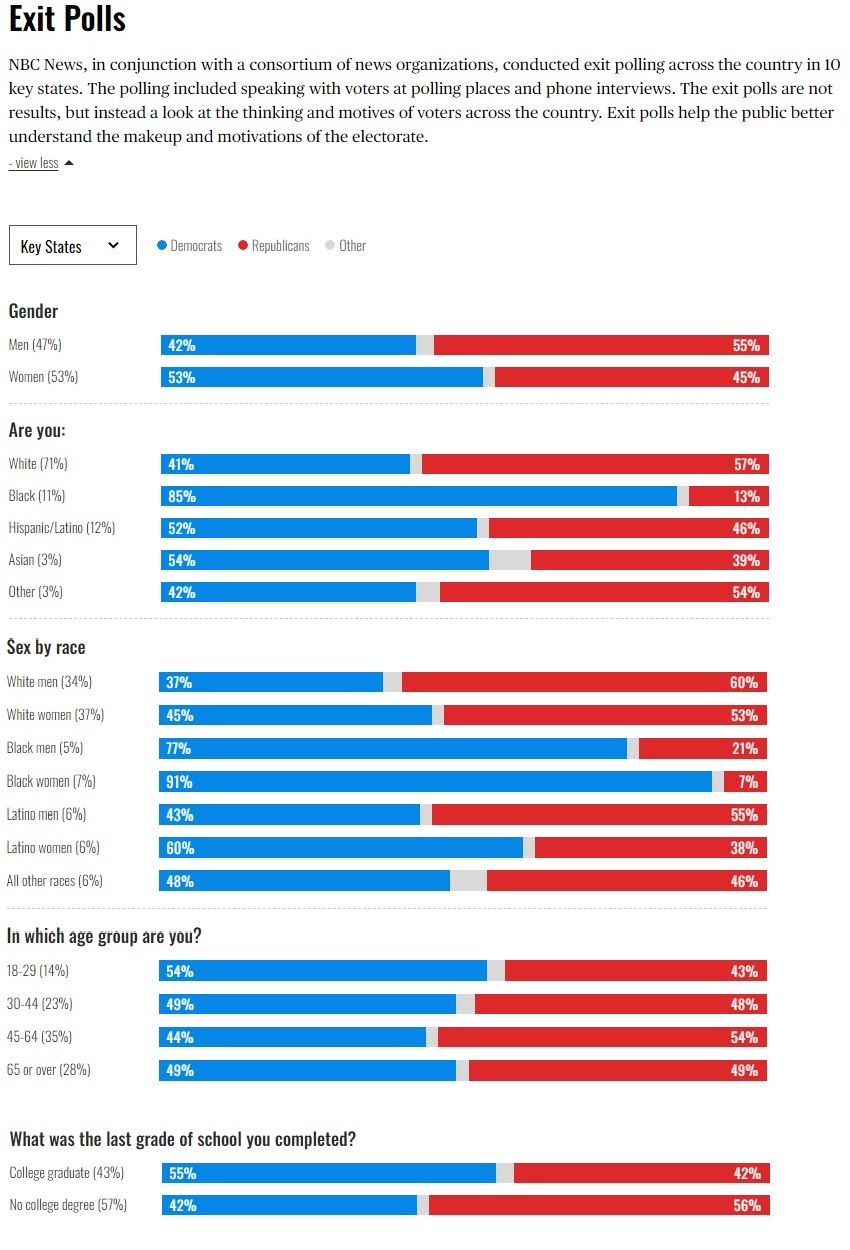
Once again, I believe that even these dramatic results considerably understated the actual degree of political convergence between Hispanics and whites since the former are so heavily concentrated in overwhelmingly Democratic states, and probably voted much like their white neighbors. Someone also noted that on a national basis there was virtually no difference in voting between between Hispanics and whites who were under thirty.
Similarly, the much smaller Asian population is even more heavily concentrated in Democratic states and liberal cities, while disproportionately being well-educated and affluent. So their substantial skew against Trump was probably little different from that of whites of the same income, education, or geographical location...Donald Trump was certainly the most divisive political candidate in modern American history, regularly vilified by our mainstream media as a white racist intensely hostile to non-whites. Yet these results suggest that if Hispanics and Asians—who together represent more than a quarter of our total population—had instead been white, their presidential voting patterns would have been almost unchanged, a result with tremendously important political implications for our country's future. This momentous development was recognized not merely by mainstream conservative media organs such as the New York Post, but also by a prominent White Nationalist writing under the name of Gregory Hood.
- Immigration, Hispanics, and the Political Triumph of Donald Trump
- The Political Amalgamation of Hispanics, Asians, and Whites
- Ron Unz • The Unz Review • November 11, 2024 • 8,800 Words
One of Trump's highest-profile campaign issues during the 2024 race was his promise to control our borders and deport the millions of illegals who had recently arrived, and this naturally galvanized his national base of conservative whites. But both Democratic and Republican political analysts were shocked when this exact same message resonated so strongly with Hispanics as well, giving him roughly half their votes, a larger share than that of any previous Republican presidential candidate.
Republican strategists had always assumed that support for greater rates of immigration was the best way to win Hispanic votes, but Trump proved that the exact opposite was the case. This merely demonstrated the ignorance of those political operatives, whose knowledge of Hispanic sentiments was probably restricted to their interaction with the self-important leaders of Hispanic advocacy organizations, who naturally always sought to increase the size of the population that they claimed to represent.
As far back as my 2011 article on immigration, I'd noted that the historical evidence was actually quite often on the other side:
Consider, for example, the case of self-educated union activist Cesar Chavez, a liberal icon of the 1960s who today ranks as the top Latino figure in America's progressive pantheon. During nearly his entire career, Chavez stood as a vigorous opponent of immigration, especially of the undocumented variety, repeatedly denouncing the failure of the government to enforce its immigration laws due to the pervasive influence of the business lobby and even occasionally organizing vigilante patrols at the Mexican border. Indeed, the Minutemen border activists of a few years back were merely following in Chavez's footsteps and would have had every historical right to have named their organization the "Cesar Chavez Brigade." I think a good case can be made that during his own era Chavez ranked as America's foremost anti-immigration activist.
A different but equally interesting political signpost had appeared in 2020, when a major effort by California Democrats to restore Affirmative Action in their state suffered a crushing defeat at the polls, with the votes of Asians and Hispanics being a major reason for that debacle. Both Democratic and Republican political operatives generally assumed that those ethnic minority groups strongly supported Affirmative Action but discovered that they had been seriously mistaken about this.
Hispanics and Asians Return to Being Swing Voters
The widespread confusion on issues of political demographics was actually far deeper than this. All these Democratic and Republican pundits were naturally shocked when Trump won half the Hispanic vote and that he did nearly as well among Asians, having long held the belief that both those groups almost always voted Democratic in overwhelming numbers. But once again, such underlying assumptions were entirely false, and based upon their ignorance of longer-term American political history.
During the mid-1990s California Republicans had unleashed a fierce attack against Hispanic immigrants largely for opportunist political reasons, and Congressional Republicans soon did the same on the national level, also extending their attacks to Asian immigrants.
The unsurprising result was that both those groups strongly shifted their support away from the Republicans, who prior to that had usually received one-third to one-half of their votes. If Republicans had insulted and attacked Catholics in similar fashion during the 1990s, Catholic voters would surely have reacted by becoming staunch Democrats in exactly the same way.
I'd explained that important but forgotten history in the same 2011 article:
A perfect example of this danger may be found in the recent political history of California, whose huge size and heavily immigrant population render it a useful testbed for the nation as a whole. During the four decades from 1950 to 1990, California supported the Republican presidential ticket almost without fail, going Democratic only during Lyndon Johnson's unprecedented 1964 landslide. The state was considered as solidly Republican as Wyoming or Idaho, and the huge number of electoral votes it carried combined with the enormous expense of contesting them established it as the anchor of the GOP presidential strategy, leading to the widespread notion of a Republican "lock" on the White House.Although Hispanic and Asian numbers had been growing steadily for years, their support for Republicans had been growing as well, and by the early 1990s, a GOP candidate could regularly expect to receive around one-third or more of the Hispanic vote and half that of the Asian. For example, Pete Wilson's narrow 1990 gubernatorial victory over Dianne Feinstein, which significantly relied upon his criticism of "racial quotas," was achieved with 53 percent of the white vote, 47 percent of the Hispanic vote, and 58 percent of the Asian vote according to the prestigious California Field Poll used by the New York Times, though others placed his ethnic totals lower.
But all of this permanently changed following Wilson's harsh 1994 reelection campaign, whose television ads relentlessly scapegoated Hispanic immigrants for the state's terrible economic woes. Although his words were carefully chosen in lawyerly fashion to distinguish between legal and illegal immigrants, his message was perceived very differently, and his loudest grassroots activist supporters certainly made no such distinction. Moreover, the resounding California Republican landslide that resulted soon emboldened the newly established Republican majorities in the U.S. House and Senate to focus on passing anti-immigration legislation, which thus placed legal Asian immigrants in the same political crosshairs.
As a direct consequence, Republican support sharply dropped among Hispanics and Asians and has never really recovered. Moreover, the immigration battle frightened and energized many traditionally apolitical Hispanics into finally naturalizing and registering, and during the 15 years that followed, their share of the state vote more than doubled to 22 percent, severely compounding the blow to Republican prospects.
The consequence was that gigantic California—almost as populous as Texas and New York combined—suddenly switched from being the strong anchor of every Republican national campaign to being the equally strong anchor of every Democratic one. In the years that followed, the large GOP congressional delegation was decimated and the powerful state Republican Party, which had once propelled Nixon and Reagan to national leadership, was reduced to near irrelevance.
Consider the interesting case of Howard Ahmanson, long one of California's wealthiest politically active Evangelical Christians and during the early 1990s routinely described by the media as a central pillar of the Christian Right within the Republican Party. In a prescient 1993 letter to Commentary, he warned of the rising tide of anti-immigrant sentiment in conservative circles and expressed a concern that Republicans would "doom themselves" if they drove away these socially conservative voters, perhaps losing them for generations, just as previous Republicans had done with Italian and Irish immigrants a century earlier. The California Republicans completely ignored his warning, with the political consequences already noted.
In Ahmanson's opinion, today's California GOP has shrunk to the point where it now represents only the most dogmatically taxophobic elements of the state. Meanwhile, the Democrats have expanded so much that they usually incorporate both sides of almost every political divide: business and labor, whites and non-whites, the rich and the poor, liberals and conservatives. This inclusiveness certainly extends to the staunchest socially conservative voters, since it was the overwhelming support of California non-whites that defeated gay marriage at the ballot box in 2008. And these days Howard Ahmanson is a registered Democrat.
- Immigration, Republicans, and the End of White America
- An Anti-Immigration Backlash
- Ron Unz • The American Conservative • September 19, 2011 • 12,200 Words
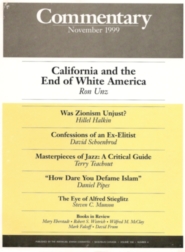
A dozen years earlier I'd covered the very important but largely forgotten history of those events of the 1990s in much greater detail in a 1999 Commentary cover story.
- California and the End of White America
- Ron Unz • Commentary • October 1999 • 8,600 Words
Trump's Militarized ICE and Its Reign of Terror
As I emphasized earlier this year, Trump's 2024 victory led to an elite reappraisal of the outrageous asylum laws that had been the basis for the tidal wave of uncontrolled immigration under Biden:
The Economist surely ranks as the world's most influential newsweekly, and the cover story of its latest issue must have greatly surprised many longtime readers of that staunchly neoliberal publication. The headline was "Scrap the Asylum System" and the inside pages fleshed out this emphatic statement in a leader backed by a long article.
For decades, the Economist has been known for its strong support of immigration and immigrants, asylum-seeking refugees certainly included, and an apparent ideological reversal of such magnitude naturally caught my eye.
Although many different elements may have gone into this surprising shift, I suspect that the strident anti-immigration policies and rhetoric of President Donald Trump were probably the decisive factor.

Given these developments, Donald Trump returned to the White House in January 2025 holding some extremely strong ethnic political cards, but then proceeded to play them in disastrously poor fashion:
His support from our rapidly growing population of Hispanics and Asians was unprecedented for a Republican candidate, and he had attracted much of that support by promising a sharp crackdown on the completely uncontrolled immigration that our country had experienced under the Biden Administration.He had merely to secure our borders as he had promised and drastically restrict our absurdly burgeoning asylum laws as the Economist now advocates, and he would both satisfy his right-wing base and also nail down much of his strong support from Hispanics and Asians. With Trump being perceived as having an election mandate and with vehemently anti-immigration Republicans in control of both the House and the Senate, this should not have been especially difficult. Yet instead he has adopted policies that will likely prove utterly disastrous for both himself and his Republican Party, not to mention American society.
Although the overwhelming majority of America's 65 million Hispanics are U.S. citizens or otherwise legal residents, many or most of that population does probably have close family ties to undocumented immigrants, individuals who have peacefully lived here, often for decades. It's not at all uncommon for such fully assimilated American-born citizens to have a mother or a grand-mother or an uncle who still lacks legal status and may have spent many years on the waiting list for a green card. For exactly that reason, immigrant advocates have endlessly lobbied Congress to allow such long-time residents to legalize their status.
There was strong support among many Hispanics for Trump to deport most of the millions of new immigrants who had arrived during the last couple of years and prevent any further influx. But this was very different than targeting those who had already lived here for ten or twenty or thirty years and long since integrated themselves into the community.
Yet exactly those latter sorts of round-ups have now become the very high-profile enforcement measures of Trump's immigration policies. Teams of masked ICE agents wearing military-style gear have begun grabbing people off the streets without any probable cause, simply because they looked Hispanic and were found in a heavily immigrant area, and numerous videos of such horrifying scenes are widespread across social media.
This has almost amounted to inflicting a reign of terror upon the heavily immigrant parts of Los Angeles and other cities, naturally leading to public protests. Trump then responded to the latter with a massive show of force, deploying thousands of armed national guardsmen and U.S. Marines, and completely bypassing local elected officials to do so. Nothing like this has happened since the 1950s when the federal government deployed armed troops to enforce desegregation orders upon various Southern states and cities against the will of local governors.
Over the last couple of months, Trump's immigration-control measures have been unprecedented in their harshness, sending masked federal officers to snatch suspected illegal immigrants off the streets of our major cities, then deploying thousands of national guardsmen and marines to Los Angeles to intimidate and suppress the resulting public protests. Judges, mayors and other elected officials from around the country have sometimes been arrested and dragged away for allegedly interfering with such immigration operations.
California is America's largest state with a population of some 40 million, perhaps half of them from an immigrant background, and our senior U.S. Senator is Alex Padilla, a respected moderate Democrat from the Los Angeles area. Last month Sen. Padilla attempted to ask Secretary of Homeland Security Kristi Noem a probing question about immigration policies at her LA press conference, only to be manhandled, handcuffed, and thrown to the ground by members of her security detail, an incident that absolutely astonished me. I'd never previously heard of any similar physical attack upon so high-ranking an elected official in modern American history. This seemed more like the sort of behavior we'd expect to see in a despotic Third World dictatorship.
Most recently, the Trump Administration publicly touted the creation of a new prison-camp in Florida swampland to hold those arrested for immigration violations, proclaiming it the "Alligator Alcatraz." Trump had already made arrangements to send other such civil offenders off to brutal foreign prisons in El Salvador or Africa's Sudan, sometimes even doing so in direct violation of orders issued by federal judges. Trump officials have apparently convinced themselves that the harshest possible measures taken against immigrants and their advocates are the recipe for political success.
- ICE Raids, Asylum Policies, and Other Immigration Controversies
- Ron Unz • The Unz Review • July 21, 2025 • 10,100 Words
ICE Raids Against Legal Residents Who Criticize Israel
All these actions by the Trump Administration seem so wildly counter-productive on both political and policy grounds that suspicious minds have begun considering alternative explanations.
For example, deploying teams of militarized federal agents to snatch harmless but terrified taco vendors off the streets of our major cities hardly seems a cost-effective means of enforcing our immigration laws. I was absolutely astonished to discover that the legislation recently passed by Congress allocated an unprecedented $170 billion to immigration control measures, roughly half of it going to ICE, which suddenly became our highest-funded federal law enforcement agency.
It's also quite intriguing that the earliest examples of such street abductions by militarized ICE agents began several months ago, with the victims being fully legal permanent residents who had criticized Israel. As I wrote at the time:
Late last week an astonishing event occurred in American society, and video clips of that incident quickly went viral across the Internet.
A 30-year-old Tufts doctoral student and Fulbright Scholar from Turkey was walking across her Boston-area neighborhood on the way to a holiday dinner at a friend's house when she was suddenly seized and abducted in the early evening by six masked federal agents of the Department of Homeland Security. The terrified young woman was handcuffed and taken to a waiting car, secretly detained for the next 24 hours without access to friends, family, or lawyers, then shipped off to a holding cell in Louisiana and scheduled for immediate deportation, although a federal judge has now temporarily stayed the proceedings.
Just one of the Tweets showing a short clip of that incident has been viewed more than 4.5 million times, with a much longer YouTube video accumulating another couple of hundred thousand views.
That very disturbing scene seemed like something out of a Hollywood film chronicling the actions of a dystopian American police state, and that initial impression was only solidified once media reports explained why Rumeysa Ozturk was snatched off the streets of her home town. Her only reported transgression had been her co-authorship of an op-ed piece in the Tufts student newspaper a year earlier sharply criticizing Israel and its ongoing attacks on the civilian population of Gaza.
Apparently, one of the many powerful pro-Israel censorship organizations funded by Zionist billionaires became outraged over her sentiments and decided to make a public example of her, so its minions in the subservient Trump Administration immediately ordered her arrest.
CBS News covered a local protest demonstration demanding the young woman's release, and quoted the remarks of one of the participants:
"The university campus should absolutely be a place for the free and open exchange of ideas and the fact that someone can just be disappeared into the abyss for voicing an idea is absolutely horrifying," said rally attendee Sam Wachman.
Now suppose that such a scene—for such a reason—had taken place on the streets of Russia, China, Iran, or any other country viewed with great disfavor by our government. Surely that incident would have quickly become the centerpiece of a massive global propaganda offensive aimed at blackening the reputation of the regime responsible. Audiences worldwide would have been forcefully told that the arrest demonstrated the terrible dangers of living in a society lacking the freedoms guaranteed by our own Constitution and our Bill of Rights. I don't recall seeing any recent propaganda campaigns along these lines, so this suggests that such incidents are extremely rare in those countries.

But unfortunately that is hardly the case in today's America. A day or two before that Tufts graduate student was snatched off the streets of her city, a 21-year-old Columbia University junior went into hiding to avoid a similar fate after federal agents raided her campus dorm to arrest her. As the Times reported, high school valedictorian Yunseo Chung had moved to the U.S. with her family from South Korea when she was 7, but her permanent residency was suddenly revoked for her public criticism of Israeli policy. She was ordered immediately deported back to a country that she barely even remembered.
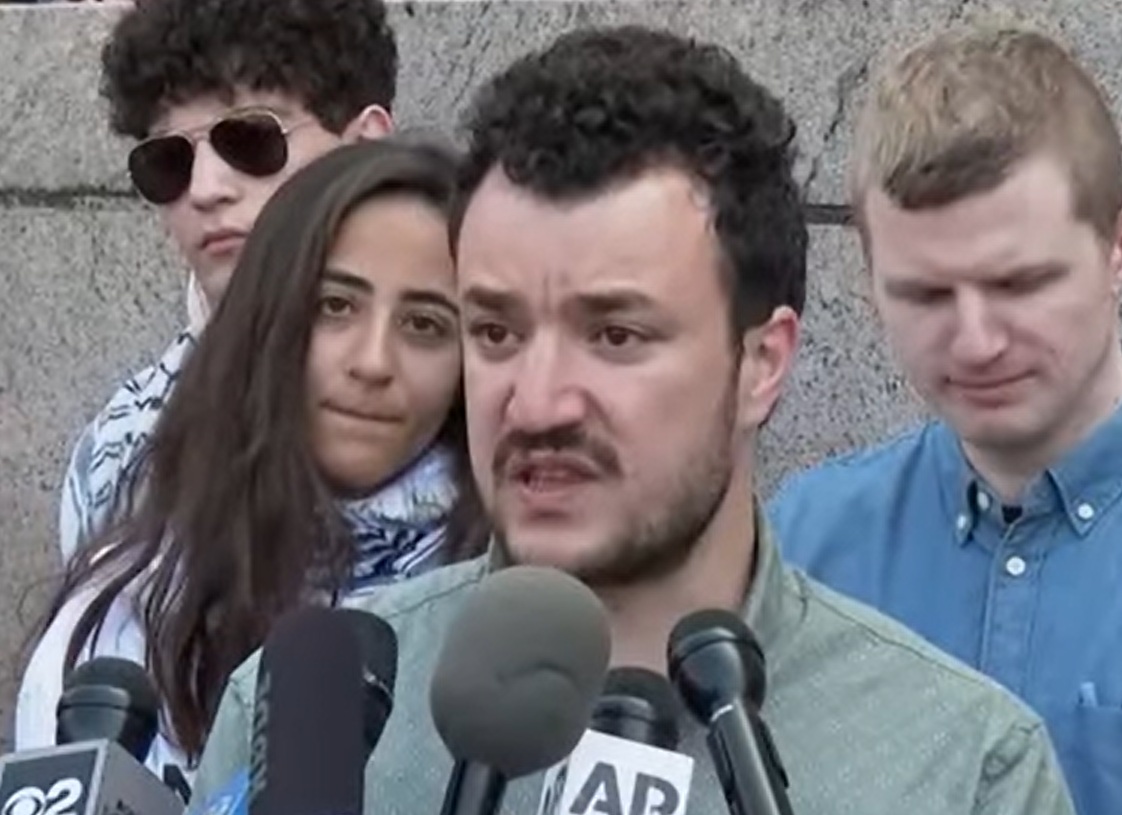
This followed the storm of controversy unleashed earlier this month by the very high profile arrest of Mahmoud Khalil, a recent Columbia graduate student heavily involved in last year's campus protests against the Israeli attacks on Gaza. Seized in an early morning raid on his campus student housing, which he shared with his wife, an American citizen eight months pregnant, he was taken off to detention, first in New Jersey and then transferred to a holding cell in Louisiana, once again with no initial access to his family, friends, or lawyers.
As a Green Card holder—a permanent legal resident of the U.S.—he was considered fully entitled to all the normal rights and privileges of an American citizen, but Secretary of State Marco Rubio declared that his Green Card would be canceled and he would be deported based upon an obscure legal doctrine never previously employed for that purpose, eliciting a strong legal challenge in federal court. Moreover, his transfer from a New Jersey jurisdiction to a different one in the Deep South also seemed to violate normal legal procedures.

A week after that arrest, Ranjani Srinivasan, another Columbia doctoral candidate from India on a Fulbright Scholarship, hurriedly packed her bags and fled the country to Canada when she narrowly missed being arrested by federal authorities who raided her student housing. As the New York Times reported:
"The atmosphere seemed so volatile and dangerous," Ms. Srinivasan, 37, said on Friday in an interview with The New York Times, her first public remarks since leaving. "So I just made a quick decision."
A day earlier Rubio explained that he had already authorized the arrest and immediate deportation of more than 300 students around the country for their criticism of Israel, so these particular cases obviously represented merely the tip of a very large iceberg.
- The Zionist Destruction of American Higher Education
- Ron Unz • The Unz Review • March 31, 2025 • 7,300 Words
Trump has also made remarks about stripping citizenship from large numbers of Americans, and given some of our president's other public statements, this might include those individuals deemed insufficiently loyal to the State of Israel.
ICE Intended as an American NKVD?
Right-wing Internet provocateur Andrew Anglin is hardly a great supporter of immigrants, legal or otherwise, but the combination of all these factors raised huge concerns in his mind, concerns that he rather plausibly outlined in an important article he published in July:
A lot of people on the internet are celebrating and cheering on some pretty brutal videos of ICE grabbing Mexicans out of parking lots, out of Walmarts, wherever. It's understandable. I understand, and my instinct is to celebrate it as well. And I would be celebrating it if I knew less about the situation than I do.Please, allow me to explain why I'm not celebrating it.
Let's start with just how uncomfortable I am with the cops. The Big Beautiful Bill is turning ICE into the biggest federal cop group in American history. Their budget is going to go from $10 billion to $100 billion, which surpasses the combined budgets of the FBI, DEA, ATF, Bureau of Prisons, and the Marshals Service...
But there is no "once the mission is complete, ICE's staffing and funding will be drastically downsized" clause in the BBB or anywhere else. This is a standing army, trained to run around the country throwing people into vans, without warrants...
If we want to get an idea of what they will do with these cops, perhaps we should recall Waco and Ruby Ridge, then imagine that sort of thing happening everywhere, all the time.
Another fact that is rather important in my view is that most of these people we see being arrested are not being deported at all. The BBB does nothing to address the laws that make it virtually impossible to deport 98% of illegal immigrants. Getting rid of the laws that prevent deportations should and would be the first move of anyone who was even remotely serious about deporting tens of millions of people. Among other things, you would expand expedited removals, end "credible fear" interviews for "asylum seekers," and defund immigration courts. This could all be done by Congress...
Of course, the idea of tens of millions of people via mass roundups is completely nonsensical on its face...You are not going to pick them up one at a time in the Walmart parking lot...
Far from moving to arrest the employers and landlords of illegals, which I suspect many in the Trump administration would view as antisemitic, Trump has not even managed to cut off illegal immigrant access to all of the free social services...
...now these people are just being interned indefinitely as the courts prevent deportation...most of these people being detained by ICE are no longer being deported and are instead being sent to detainment facilities...
This "Alligator Alcatraz," where MAGA patriots plan to eat delicious bread while watching Mexicans being eaten alive by large lizards, is a "black site." That is, it is a prison camp where people are held indefinitely without access to due process. Just to be clear, no, it does not have to be secret to be a "black site." Guantanamo Bay, where Trump is also sending immigrants instead of deporting them..is the world's most famous prison and is also, definitionally, a "black site."... if you imagine that the federal government is not using this current circus atmosphere to build these sites across the country, you are as innocent as a babe or as stupid as an ox who's suffered severe head trauma...
Along with a brand new army of fully militarized federal cops trained to drive around the country and disappear people into vans in broad daylight, these black sites are another thing that the Trump Administration will be gifting to the AOC administration...
The most important gift Trump will give to AOC will be an AI police state control grid run by Palantir, so that the government will be able to keep close tabs on racists, sexists, homophobes, transphobes, and most importantly of all, antisemites.
Will the Democrats use this series of gifts to identify, arrest, and detain all the people viewed as a threat to democracy ? Of course, I have no way of predicting such a thing, all I can do is say that it would be very easy to do..
Personally, I think these street scenes of ICE agents grabbing people are being created to desensitize people to seeing this sort of thing, and I think it is only a matter of time before these methods are used against those viewed as "dissidents" in America.
- Dear MAGA: If You Think Masked ICE Thugs Wouldn't Do the Same to You, You're Even Dumber Than You Look
- Andrew Anglin • The Daily Stormer • July 11, 2025 • 3,100 Words
Trump's Effort to Severely Restrict Birthright Citizenship
Finally, we should consider Trump's current efforts to severely restrict America's birthright citizenship laws. In my article last week, I'd briefly discussed and ridiculed this project:
Just days after his inauguration, Trump had delighted his right-wing followers by issuing an emergency executive order abolishing birthright citizenship for the American-born children of illegal immigrants. Naturally, this was immediately blocked by lower court injunctions, but earlier this month the Supreme Court agreed to review the case. Six of the nine Justices are conservative, Republican appointees, half of them by Trump himself, so there is some speculation that Trump's order might be affirmed.Although in recent years many or most conservative organizations and activists have taken this position, it would seem to be an absolute violation of every purported conservative judicial principle, given that it would overturn the long-settled 127 year interpretation of the high court's 1898 ruling in United States v. Wong Kim.
What makes this popular conservative legal argument so totally ridiculous is that it apparently first appeared during the immigration battles of the 1990s, roughly one hundred years after the Supreme Court decision it now seeks to reverse. Throughout the twentieth century, probably many millions of American-born children of illegal immigrants received their citizenship under such birthright provisions, and as far as I can tell, no one had ever challenged that legal assumption.
I am not arguing that this interpretation of the law was affirmed by judicial rulings. Instead, I am making the far stronger claim that for nearly one hundred years it was never once even publicly questioned by anyone in America, whether lawyer, elected official, journalist, pundit, or political activist. So if the high court ruled in favor of Trump, it would be declaring that for nearly a full century every American lawyer and every American non-lawyer had misinterpreted the meaning of the 14th Amendment, about as dramatic a violation of the supposed conservative principle of judicial restraint as could be imagined.
Indeed, such a Supreme Court ruling would be as utterly ridiculous as for the Justices to suddenly claim that the U.S. Constitution guaranteed a right to Gay Marriage although neither its drafters nor a single American for more than two hundred years had been aware of that fact. But given the 5-to-4 Obergefell v. Hodges decision of 2015, I think it is far from impossible that Trump's executive order abolishing birthright citizenship might be affirmed.
The elimination of birthright citizenship for the children of illegal immigrants is wildly popular among Trump's right-wing supporters and indeed the entire conservative movement, so just as I expected I received quite a number of angry responses to my statements.
I replied to those critics by merely reiterating my argument in summary form:
(1) Throughout the twentieth century, many millions of the American-born children of illegal immigrants were automatically granted American citizenship.(2) As far as I can tell, for nearly 100 years not a single person in America—lawyer, politician, journalist, or just random fringe-activist—ever publicly questioned or disputed that interpretation of the 14th Amendment.
If you disagree, please find me any such public statement. Just an op-ed or a public speech or even an angry mimeographed pamphlet written by an eccentric fringe-activist.
(3) It's exactly analogous to the notion that our Constitution guarantees a right to Gay Marriage. For more than 200 years, I doubt that a single American anywhere had ever made that claim.
Over the years, I have issued that same challenge on numerous occasions, and no one has ever been able to find any American, even including the most disreputable right-wing fringe-activist, who ever questioned the assumed birthright citizenship of the children of illegal immigrants until the 1990s.
I have closely followed immigration issues for more than forty years, and I distinctly recall when that dispute over birthright citizenship first arose during the Immigration Wars of that decade. The Wikipedia page confirms this, explaining that in 1993 Sen. Harry Reid (D-Nev) first introduced legislation restricting such citizenship to the children of U.S. citizens and legal residents.
Consulting ChatGPT similarly confirmed my recollection that conservative Political Science Prof. Edward J. Erler of Cal State San Bernardino and the Claremont Institute first raised the question of whether our longstanding interpretation of the 1898 Supreme Court decision was mistaken and birthright citizenship should not have been applied to the children of illegal immigrants. He apparently did so in Loyalty Misplaced, a 1997 collection of essays edited by Gerald Frost, and then subsequently repeated and extended that same argument in numerous other writings over the years.
Even so, all those many conservative critics agreed that the passage of Congressional legislation was required to eliminate such assumed birthright citizenship. Until the Trump Administration, I do not think that any credible individual had ever claimed that such a radical change in American citizenship laws could be enacted solely by a presidential executive order.
Consider that this fundamental interpretation of Constitutional law has impacted many, many millions of Americans and remained in place for almost one hundred years without ever once being questioned or challenged. Given such facts, suddenly abolishing it by emergency executive order seems a very doubtful legal procedure to endorse, just as doubtful as allowing a president to drastically change tariff tax rates on a daily basis by will or by whim.
Moreover, consider the consequences of such a Supreme Court ruling that affirms Trump's order eliminating such assumed birthright citizenship provisions after 127 years. I expect that the political results of such an extreme example of judicial overreach would be disastrous, especially for those who had supported it.
If we exclude our relatively small populations of Puerto Ricans and Cubans, I think that a very large majority of other American Hispanics acquired their citizenship under those birthright provisions or had parents, grandparents, or great-grandparents who had done so. Therefore, they would hardly view with total equanimity a Supreme Court ruling that their American citizenship had been wrongly granted.
Furthermore, many of the critics of our current policy of birthright citizenship have strongly asserted over the years that the 1898 Supreme Court case was wrongly decided rather than merely misinterpreted. One of their main arguments has been that the 14th Amendment was originally enacted to grant citizenship to black slaves and therefore should not have been applied to the children of Asian immigrants.
For generations, nearly all Asian-Americans received their citizenship due to that late nineteenth century Supreme Court ruling. I think our Asian population would react with serious concern to public declarations that their citizenship or that of their parents, grandparents, and great-grandparents had been improperly granted.
Finally, legal arguments have been advanced over the decades that the 14th Amendment itself along with the other two Reconstruction Amendments were improperly ratified and are therefore legally invalid. Among other issues, the Southern states of the former Confederacy were then still under military occupation and were coerced into ratifying those measures. So perhaps reasonable questions can be raised about the citizenship of blacks or even whether slavery is still legally valid in our country.
Many of the loudest Internet critics of our current birthright citizenship policy are self-proclaimed White Nationalists, who argue that only whites were ever intended to be full citizens of this country. In support of that position, they note that our Naturalization Act of 1790 explicitly restricted granting such citizenship to "free white person(s)...of good character." From their perspective, the current American citizenship of Hispanics, Asians, and blacks is legally rather dubious.
However, Hispanics, Asians, and blacks together now constitute more than 40% of the American population. So raising all these serious doubts about their American citizenship could surely be utilized by ruthless Democratic Party operatives and propagandists to inspire them to huge and extremely skewed turnouts in future elections. Given their numbers, the impact upon Republican candidates would be catastrophic.
As discussed above, Anglin has plausibly argued that one of Trump's most important lasting legacies has been that he bequeathed to a future Democratic administration a lavishly funded and fully militarized national ICE police force. These ICE agents have become very experienced at snatching people off their city streets without any warrants or due process and then secretly confining them indefinitely to "black site" prison camps with no access to friends, family, or lawyers.
All of this seems eerily reminiscent of Stalin's NKVD, and although the current targets of ICE are suspected illegal immigrants or fully legal residents who have criticized Israel, it would surely be quite easy for the government to broaden their mandate to include American citizens suspected of being terrorists, foreign agents, racists, homophobes, or antisemites.
Trump's efforts to eliminate birthright citizenship by executive order seem ideally designed to ensure that his Republican heir is swamped by a tidal wave of angry non-white voters in the 2028 election. So we may fairly soon have an empirical test of whether an embittered future Democratic president would use that ICE national police force against conservative political enemies.