By Milan Adams
Preppgroup
February 7, 2026
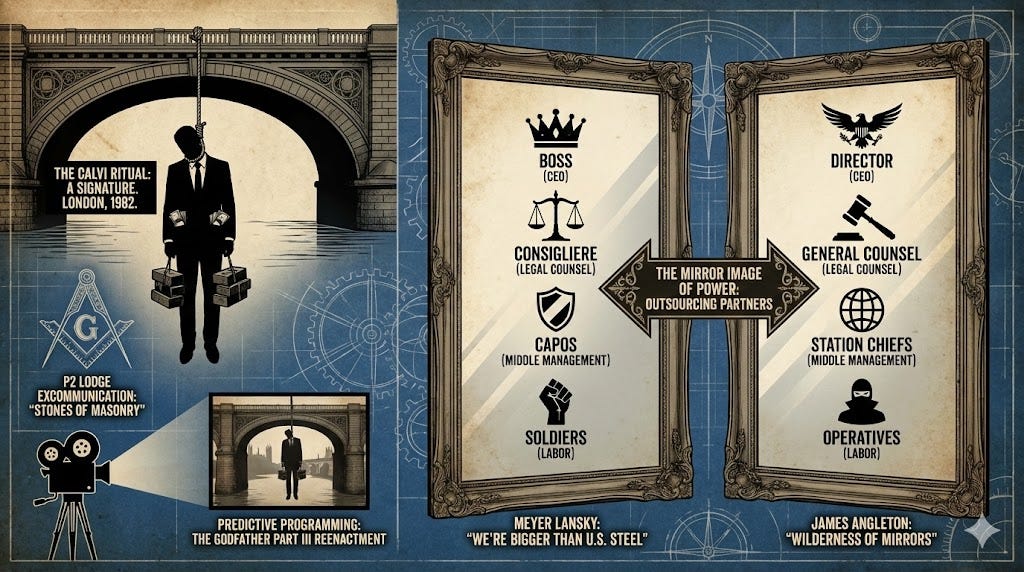
London, June 18, 1982. A postal clerk is walking to work across Blackfriars Bridge. He looks over the edge and sees a man hanging from the scaffolding. The man is wearing an expensive gray suit, but his pockets are weighed down with bricks and nearly $15,000 in cash.
The man was Roberto Calvi, chairman of Banco Ambrosiano. The press called him "God's Banker."
Days earlier, Calvi was frantic. He told anyone who would listen that he wasn't a criminal mastermind; he was a pawn. He was trapped in a massive game involving the Vatican Bank, the Mafia, and a shadowy Masonic lodge called Propaganda Due (P2). The authorities didn't listen. They ruled it a suicide.
But look at the details. They scream ritual. Calvi was found hanging under Blackfriars Bridge. In Masonic lore, the "Black Friars" are significant symbols. And those bricks in his pocket ? They weren't just weights to drown him. In the rituals of the P2 Lodge, initiates were often told that traitors would be weighed down by 'stones of masonry.' As investigative journalist Rupert Cornwell noted in God's Banker, the scene was too theatrical to be a simple hit. It was a signature. The P2 Lodge wasn't just silencing a witness; they were excommunicating a heretic.
If you're a film buff, you know this scene. It's the climax of The Godfather Part III. We watch the corrupt banker swing from a bridge as the Corleones settle their family business. But Coppola didn't invent that scene. He reenacted it.
Here's the paradox I want to explore with you. People watch these films for the violence and the opera. But look closer. These films are telling us something uncomfortable about how the world actually works. The Godfather, Casino, and The Irishman aren't just escapism. I believe they're Predictive Programming-a glimpse into a world where the line between the criminal underworld and the "legitimate" overworld dissolves.
The Mirror Image of Power
We tend to think of Organized Crime as a cancer on a healthy society. We imagine the Government on one side (Law & Order) and the Mob on the other (Chaos).
But the best movies reveal the truth: these two aren't enemies. They're mirror images.
Look at the structure of a Mafia family. You've got the Boss (CEO), the Consigliere (Legal Counsel), the Capos (Middle Management), and the Soldiers (Labor). It's a perfect corporate hierarchy designed for one purpose: to compartmentalize liability. The Boss orders a hit but never holds the gun. Layers of buffers shield him.
This corporate ambition wasn't subtle. Meyer Lansky, the financial genius behind the Syndicate, viewed his operation as identical to any Fortune 500 company. He told his biographer:
"We're bigger than U.S. Steel."
He wasn't bragging about violence. He was bragging about scale.
Intelligence agencies use this exact structure. Legendary CIA counter-intelligence chief James Jesus Angleton described his world as a "wilderness of mirrors"-a landscape where deception is so layered that truth and fiction blur. In this wilderness, the "Good Guys" and the "Bad Guys" use the same tactics. When the CIA needs to move funds off the books to finance a coup, or when they need "heavy lifting" done in a foreign port, they don't send a bureaucrat. They use assets who operate in the dark.
The Mob isn't an enemy of the Deep State. It's merely the Deep State's outsourcing partner.
Operation Underworld and the Handshake
Let's dig into some history. The partnership began during World War II with "Operation Underworld."
Naval Intelligence feared Axis saboteurs on the New York waterfront. They reached out to the only man who controlled the docks: Charles "Lucky" Luciano. Luciano sat in a cell in Dannemora, but he gave the order. The docks were secured. In return, the government commuted his sentence.
The "Good Guys" shook hands with the "Bad Guys," and they never let go.
You might ask: Why on earth would the government do this ? Michael Graziano answers this in Errand into the Wilderness of Mirrors. He argues that the early CIA didn't just view religion as a belief system, but as a "strategic weapon." As OSS chief "Wild" Bill Donovan popularized, religion was seen as "everywhere, free, and individual: a natural ally in war and diplomacy." In a holy war against Godless Communism, you use any weapon you can find.
This relationship deepened during the Cold War. As you see in The Irishman (and as the Church Committee hearings confirmed), the CIA recruited mafia figures like Sam Giancana and Santo Trafficante Jr. to kill Fidel Castro. Why ? An intelligence agency can't be seen killing a head of state. But the Mob ? They kill people every Tuesday. It provides the perfect cover.
The government didn't even hide this philosophy-if you knew where to look. General Walter Bedell Smith, an early Director of Central Intelligence, admitted to the sheer scale of the deception needed to fight the Cold War. He told a government commission that the CIA had to operate with a completely different moral rulebook. He said:
"We have to be just as clever, just as unadvertised, and just as ruthless as they are."
"Unadvertised" is the key word there. It's the bureaucratic term for 'illegal.' And who is better at unadvertised violence than the Mob?
The lines blurred. Mobsters often felt like patriots. Sam Giancana, the Chicago Outfit boss, vented his frustration when the government turned on him:
"Listen, I'm an American citizen, and I've been a good one... The CIA and the FBI, they're all the same. They use you when they need you, and they throw you away when they don't."
The P2 Lodge: Infiltrating the Church
This brings us back to Roberto Calvi and the bridge.
The most disturbing part of this matrix isn't that the Government uses the Mob. It's that these networks infiltrate the sacred.
In the 1970s and 80s, the Propaganda Due (P2) Lodge rocked Italy. This clandestine Masonic lodge functioned as a shadow government. It included journalists, generals, MPs, and spies. Their goal: shift Italian politics to the right to stop a Communist takeover-a goal shared by NATO and the CIA.
But they needed untraceable money. They found it in the Vatican Bank.
Through Roberto Calvi, the P2 Lodge used the Institute for the Works of Religion (the Vatican Bank) to launder mafia money and fund political operations. This is the ultimate inversion: men of power hijacking the sacred symbols of the Church.
Archbishop Paul Marcinkus, the Chicago-born prelate who ran the Vatican Bank, summarized this cynical attitude best. When reporters pressed him on his aggressive deals, he retorted:
"You can't run the Church on Hail Marys."
The rot was internal. Before his death, Roberto Calvi gave a desperate interview warning the public about the forces inside the Vatican:
"The Vatican is a microcosm of the world... It is a state within a state, and it has its own laws, its own police, its own secret service. But it is also a bank."
Francis Ford Coppola centered The Godfather Part III on this dynamic. The Corleones try to "legitimize" their billions by buying into the Vatican's massive property company, Immobiliare. The movie suggests the corruption inside the Vatican ran just as deep as the corruption in Las Vegas.
The film is fiction. P2 was not. Calvi's death reminds us that when you play with the devil's money, you pay with your life—even if you are "God's Banker."
The Myth of Extinction
It's easy to look back at the grainy footage of John Gotti in his double-breasted suits, smirking at the cameras, and think: Well, that's over. We saw the handcuffs. We watched the RICO trials dismantle the Five Families. We patted ourselves on the back and told ourselves the "Good Guys" finally cleaned up the streets.
But the Mob didn't die. It just went corporate.
The crackdown in the 80s was effective at one thing: clearing out the "noisy" elements. The street bosses who loved the limelight—the ones who couldn't stop preening for the tabloids—were liabilities. They had to go. But while the feds were celebrating the end of the "Mustache Petes," the industry was simply shifting gears. The vacuum was filled by something far colder and more sophisticated: Cartels, Russian syndicates, and digital networks that treat crime as a logistics problem rather than a turf war.
You don't have to take my word for it. Look at the receipts:
- The Digital Street Corner: The Silk Road proved you don't need a street corner to sell heroin. You just need Tor and Bitcoin. The dark web decentralized organized crime, allowing anonymous "vendors" to move product with the ease of Amazon. It removed the physical violence from the transaction but scaled the reach globally.
- The Bank as the Launderer: In 2012, HSBC admitted to laundering nearly a billion dollars for the Sinaloa Cartel. This wasn't a mistake—it was a service. The cartel designed boxes of cash specifically to fit the bank's teller windows. The bank paid a fine, and no one went to jail. The "Mob" didn't disappear; it just acquired a Board of Directors.
- The Evolution of the Mafia: While the NYC "Five Families" shrank, the Calabrian mafia, the 'Ndrangheta, quietly became one of the most powerful criminal organizations on earth. They don't do flashy hits in steakhouses. They control the European cocaine trade and operate with the efficiency of a logistics multinational, pulling in an estimated $60 billion a year. They traded fame for silence and profit.
- The Blackmail Economy: In 2023, JPMorgan Chase paid $290 million to settle claims that it knowingly facilitated Jeffrey Epstein's sex trafficking operation. The bank didn't just hold his money; they ignored the red flags of a man running a blackmail ring linked to intelligence agencies.
Honestly, the "defeat" of the Italian Mob looks less like a victory for law enforcement and more like a hostile takeover. The black market didn't shrink; it merged with the global economy. Today, the line between a Hedge Fund and a Laundromat isn't moral—it's just paperwork. The flashy gangsters are gone, sure. But the Syndicate ? It's still here. It's just operating quietly in the background, exactly where it prefers to be.
The Technetronic Mob
This is where the story gets modern. If you stop at Gotti, you miss the revolution. The new Don doesn't wear a fedora; he wears a hoodie. He doesn't hang out in social clubs; he hangs out in servers.
We are witnessing the rise of the Technetronic Mob.
The structure of organized crime has evolved to match the structure of the internet. It is decentralized, encrypted, and peer-to-peer. And just like in the days of Meyer Lansky, this new structure has become deeply intertwined with the financial and political elite.
Let's look at three pillars of this new underworld:
1. The Offshore Casino: Tether & Bitfinex In the old days, if you wanted to move illicit cash, you had to physically fly bags of money to Switzerland or the Cayman Islands. It was risky. Today, you just use stablecoins.
Consider the controversy surrounding Tether (USDT) and its sister exchange Bitfinex. Critics and regulators have long scrutinized Tether for its murky banking relationships and lack of transparency. It effectively functions as an unregulated offshore bank—a "Eurodollar" market for the crypto age. It provides massive liquidity that exists outside the direct purview of KYC (Know Your Customer) laws.
For the modern cartel or syndicate, this is a dream. You don't need a corrupt Vatican Bishop anymore. You just need a digital wallet. The "Laundromat" has been digitized.
2. The Shift to Blackmail: The Epstein Model The old Mob sold "protection." You paid them so your shop didn't burn down. The new Mob sells "compromise."
This is where the Jeffrey Epstein case reveals the dark heart of modern Deep Politics. Epstein wasn't just a pervert; he was a node in a network. As Whitney Webb details in One Nation Under Blackmail, his operation functioned exactly like an intelligence honey pot. He gathered dirt—video, audio, financial—on the most powerful men in the world.
Why ? Kompromat.
In the Technetronic age, information is more valuable than territory. If you have video evidence of a Senator or a CEO committing a crime, you own them. You don't need to threaten violence; you own their reputation. This is the privatization of intelligence tactics. The "Mob" has moved from breaking kneecaps to breaking careers. It's cleaner, quieter, and infinitely more powerful.
3. The Cartel-State Finally, we have the terrifying evolution of the physical territory. Look at Mexico. We often hear about the "War on Drugs" as if it's the State fighting a criminal gang. But that's a category error.
Groups like the CJNG (Jalisco New Generation Cartel) aren't gangs; they are parallel governments. They have drones, armored vehicles, advanced communications, and social welfare programs. In many regions, they are the State. They collect taxes (extortion), enforce laws (violence), and provide security.
This is the end state of the "Symbiotic" relationship we saw in Operation Underworld. The parasite has consumed the host. The line between "Official Government" and "Criminal Enterprise" has vanished entirely.
Cinema as Social Engineering
So, why does Hollywood make these movies ? Why show us the handshake between the Senator and the Don ? It isn't just cynical bragging. It's social management. Julian Huxley, the first director of UNESCO, would have called it essential for "evolutionary humanism."
Huxley didn't mince words about how this would work. In his 1947 manifesto UNESCO: Its Purpose and Its Philosophy, he explicitly stated that the new global order couldn't be built by force alone. It had to be built in the mind. He wrote that the agency must utilize every form of media to prepare the public psyche:
"The press and the radio and the cinema... must be used to promote the growth of a common outlook shared by all nations."
Think about that. The cinema isn't just entertainment. In the eyes of the technocrat, it's a delivery system for a "common outlook." When you watch the Corleones, you aren't just watching a movie. You're being trained.
Huxley and the architects of the post-war order understood a simple truth: you can't command a population; you must enculture them. You have to shape their imagination. By framing these stories as "fiction," the system achieves two goals:
- Normalization: You see corruption so often on screen that when you see it in real life—in the Panama Papers or the Epstein flight logs—you shrug. You're desensitized. The "Underworld" isn't shocking; it's just a genre.
- The Safety Valve: You watch Michael Corleone navigate the Vatican and the CIA. You eat your popcorn. You feel catharsis. You feel like you've "seen the truth," which ironically makes you passive. The movie theater becomes the designated space for rebellion, so the streets don't have to be.
This is the dark brilliance of Predictive Programming. They tell you exactly what they are doing, but they place it inside a frame labeled "Entertainment."
For those with eyes to see, the message is clear. The "Underworld" is not under anything. It is right there on the surface, sitting in the boardrooms and the lodges, running the show. As the movies tell us: it's strictly business.