February 10, 2026
Back a few weeks ago I'd seen a ridiculous joke circulating about President Donald Trump. As an energetic former real-estate developer, he'd supposedly dispatched bulldozers to suddenly knock down our White House as part of a new construction project.
But then the next morning I was shocked to discover that the story was absolutely true. Trump had indeed demolished the history-laden 1902 East Wing, home to generations of First Ladies, doing so without any advance notice or public discussion.
A month later, I'd seen an equally ridiculous satire that Trump had declared himself "the Acting President of Venezuela," publicly assuming that role after his Delta Force commandoes had successfully kidnapped Nicolas Maduro, the president of that oil-rich Latin American country.
But once again, that ridiculous joke turned out to be entirely true.
Given those two incidents and some others, I'd resolved that I would never again dismiss as a joke anything I heard about the activities of our 47th chief executive, no matter how outlandish it might seem.
That new policy served me in good stead when I heard that America's president was suing his own government for $10 billion. I thought that the story might possibly be true, and sure enough it was.
Under normal circumstances I'd think something like that would have generated banner-headlines across all our media outlets. But given so many other dramatic recent events, it seemed to have gotten only limited public attention, being buried on the inside pages and receiving similarly light coverage in the social media ecosphere that has largely replaced our mainstream media outlets as sources of information.
But the comprehensive article in the Wall Street Journal laid out some of the considerable peculiarities of this case. These were made clear in both the title- "Trump Lawsuit Against IRS Puts Him on Both Sides of the Same Case"-and the subtitle: "The president is the plaintiff, but he also oversees the people who could decide on a payout."
WASHINGTON-President Trump's lawsuit against the government that he runs presents a mind-bending minefield of conflicts that could end with the president's appointees approving a federal payout to him.Trump is simultaneously supervising the private attorneys demanding at least $10 billion in damages over the past disclosure of his tax records, while also overseeing the senior Justice Department attorneys with authority to settle the case and authorize a payment.The unusual dynamics are intensified by Trump's expansive view of executive authority and his history of leveraging the presidency's unique powers to secure settlements from private parties, said Peter Keisler, who served as acting attorney general in the George W. Bush administration."This creates the risk of the most collusive lawsuit of all time, because it is ultimately the president suing a defendant whom he says has to do whatever he directs," Keisler said.Trump, two of his sons and his businesses sued the government in federal court in Miami on Thursday, arguing that they were harmed when former IRS contractor Charles Littlejohn illegally disclosed their tax information to the New York Times and ProPublica in 2019 and 2020...The extraordinary lawsuit puts Trump on both sides of the same courtroom. He is the plaintiff in his personal capacity, seeking damages for an illegal action that made him a crime victim. But he's also the ultimate boss of the defense attorneys in an administration that declared that federal lawyers cannot take legal positions contrary to the opinion of the president or attorney general.
Perhaps I'm mistaken but I've never heard of any previous case of a democratically-elected national leader suing his own government in such a way, nor for that matter any reigning monarch nor dictator.
A few weeks before that lawsuit was announced, Trump had sat down for a wide-ranging two-hour interview with four New York Times reporters, and he was extremely bold in his public assertions of his own totally unlimited power and authority.
And he said that he did not feel constrained by any international laws, norms, checks or balances.Asked by my colleagues if there were any limits on his ability to use American military might, he said: "Yeah, there is one thing. My own morality. My own mind. It's the only thing that can stop me."
- The Trump Doctrine
- Ron Unz • The Unz Review • January 12, 2026 • 7,200 Words
Those sorts of statements struck me as what Louis XIV might have said, or perhaps some of the more arrogant Czars of the Russian Empire.
Although probably apocryphal, the most famous phrase attributed to that former figure, who exemplified absolute, divine monarchy, was L'État, c'est moi-"I am the State"-and Trump's remarks immediately brought that phrase to my mind. But although the French Sun-King did many remarkable things during a 72-year-reign that stretched into both the 17th and 18th centuries, I don't recall that he ever sued himself in such a way. So we really do live in extraordinary times.
Given that our official national debt is fast approaching $40 trillion, growing by a couple of trillion every year, the $10 billion that Trump is demanding is obviously just a pittance, an insignificant, trifling amount. Perhaps this was one of the reasons that the story received relatively little attention.
Furthermore, it's not at all clear that Trump will receive that full payout. After all, our president often brags of his brilliance in handling business deals. So it would surely make sense for President Donald Trump to appoint Negotiator Donald Trump to handle the settlement talks with Plaintiff Donald Trump, perhaps effectively bargaining down the latter into accepting a much smaller payout such as $7 billion. And if that happened, Trump could then reasonably boast that he had saved our long-suffering American taxpayers billions of dollars.
Indeed, since Trump and his avid supporters have sometimes suggested that he might run for a third term, this notable financial success might be one of the major campaign issues.
Admittedly, the Twenty-Second Amendment might pose an obstacle to such a 2028 campaign. But as I noted last week, Trump and his administration have already successfully defanged the First, Second, and Fourth Amendments, with the Sixth Amendment also facing serious risk. And while these early component parts of our famed Bill of Rights are reasonably well-known, I doubt that even three Americans in one hundred could explain what the Twenty-Second Amendment did. So Trump could easily issue an executive order repealing that 1951 statute, and almost no one would know or care that it no longer existed.
The Alt-Right movement had been enthusiastic supporters of Trump from the 2015 launch of his original presidential campaign, and those right-wing activists had regularly used the term "Clown World" to ridicule and denounce the absurdities of American society and the rest of the West. The Alt-Right disappeared years ago and I've only very rarely seen any recent use of that particular pejorative phrase, but it's difficult to imagine any better example of our own unfortunate country's current predicament.
The same day that the WSJ first broke the story of Trump's $10 billion lawsuit against his own government, the front-page of that same newspaper had featured a different story, much longer at nearly 4,000 words but involving a far smaller financial payment to the Trump family. A team of four journalists had revealed that top oil sheikhs had secretly bought a large stake in the Trump family's cryptocurrency company, and the article opened with the following revelatory paragraphs:
Four days before Donald Trump's inauguration last year, lieutenants to an Abu Dhabi royal secretly signed a deal with the Trump family to purchase a 49% stake in their fledgling cryptocurrency venture for half a billion dollars, according to company documents and people familiar with the matter. The buyers would pay half up front, steering $187 million to Trump family entities.The deal with World Liberty Financial, which hasn't previously been reported, was signed by Eric Trump, the president's son. At least $31 million was also slated to flow to entities affiliated with the family of Steve Witkoff, a World Liberty co-founder who weeks earlier had been named U.S. envoy to the Middle East, the documents said.The investment was backed by Sheikh Tahnoon bin Zayed Al Nahyan, an Abu Dhabi royal who has been pushing the U.S. for access to tightly guarded artificial intelligence chips, according to people familiar with the matter. Tahnoon- sometimes referred to as the "spy sheikh"-is brother to the United Arab Emirates' president, the government's national security adviser, as well as the leader of the oil-rich country's largest wealth fund. He oversees a more than $1.3 trillion empire funded by his personal fortune and state money that spans from fish farms to AI to surveillance, making him one of the most powerful single investors in the world.The deal marked something unprecedented in American politics: a foreign government official taking a major ownership stake in an incoming U.S. president's company.Under the Biden administration, Tahnoon's efforts to get AI hardware had been largely stymied over fears that the sensitive technology could be diverted to China. Of particular concern was one of Tahnoon's own companies, the AI firm G42, which had stoked alarm among intelligence officials and lawmakers over its close ties to the sanctioned tech giant Huawei and other Chinese firms. The company said it severed ties with China in late 2023, but concerns persisted.Trump's election reopened the door for him. In the months that followed, Tahnoon met multiple times with Trump, Witkoff and other U.S. officials, including in a March visit to the White House where the sheikh told officials he was eager to work with the U.S. on AI and other issues, according to people familiar with the matter.Two months after the March meeting, the administration committed to give the tiny Gulf monarchy access to around 500,000 of the most advanced AI chips a year-enough to build one of the world's biggest AI data center clusters. The framework agreement called for roughly one-fifth of the chips to go to G42, The Wall Street Journal previously reported.The agreement was widely viewed as a coup for the emirate's ruling family, overcoming longstanding U.S. national security concerns and allowing the country to compete with the most powerful economies in the world at the cutting edge of AI advances.
Thus, soon after top UAE sheikhs invested hundreds of millions of dollars in that Trump family company, the Trump Administration completely reversed our country's existing national security policy and authorized the sale of 500,000 top AI microchips to a UAE enterprise. This obviously raised all sorts of serious questions.
Those questions become even more serious when the Journal writers went on to explain:
At the time of the investment, World Liberty had no products.
Surely investing hundreds of millions of dollars in a company with no products seems unlikely to have been done for purely economic reasons. Furthermore, as part of that investment, the leading UAE lobbyists for that huge microchip sale had actually joined the board of the Trump family company.
The microchip purchaser had close ties to China and these had been the national security grounds under which the American government had previously blocked that sale. Ironically enough, exactly those Chinese-affiliated individuals, one of whom was Chinese by birth, had then actually joined the leadership of the Trump company.
The Journal article went on to describe some of the worrisome implications of this secret transaction: The Secret Team Best Price: $11.58 (as of 06:10 UTC - Details)
Legal experts said the deal with Aryam could violate the emoluments clause and said the proximity of the country's chip agreement to the World Liberty deal posed a significant conflict of interest.The provision is intended to prevent any government official from being "in the pocket of a foreign government," said Kathleen Clark, a law professor and former ethics lawyer for the city of Washington, D.C. "This sure looks like a violation of the foreign emoluments clause, and more to the point, it looks like a bribe."The transaction, she said, "should be a five-alarm fire about the federal government being for sale."Trump's conflicts of interest have so dwarfed those of his predecessors that "it's like complaining about kayaks when B52s are flying overhead," said Ty Cobb, who served as a top White House lawyer in Trump's first administration. "My advice as an ethics lawyer would have been clear: You don't do business deals with the families of the leaders of foreign countries. It taints American foreign policy."
In 2020, the Biden Administration had used national security issues to impose serious restrictions on the sale of cutting-edge AI microchips to China. My own view at the time had been that this policy was entirely wrong-headed, and nothing since then has changed my perspective.
But the Trump Administration has been at least as hawkish towards China as was the Biden Administration, and they have naturally maintained or even extended all those technological restrictions. So their sudden willingness to reverse that policy and make a special exception so soon after hundreds of millions of dollars were given to a Trump family company seems a very doubtful way of running a serious country.
Trump has always loved money, and he has regularly expressed such sentiments on numerous occasions.
However, as all of us know, a fulfilled life involves more than money alone, and this is certainly the case with our current president.
For example, a few weeks ago he had expressed his outrage to the Prime Minister of Norway because the Nobel Committee of that country had not awarded him last year's Peace Prize. Instead, that notable honor had gone to pro-American Venezuelan political activist María Corina Machado, and Trump was very gratified when the latter had soon re-gifted him her Nobel medallion, which he then gleefully hung on his wall.
I'm actually glad that this happened since otherwise it's quite possible that Trump might have dispatched his Delta Force commandos to raid Norway and seize the supply of those Peace Prize medals so that he could grant himself that great honor, perhaps even several times over.
Trump must surely have been similarly proud when his hand-picked appointees to the board of DC's Kennedy Center renamed that leading cultural institution "the Trump-Kennedy Center," while some of his other supporters in Congress later introduced legislation to similarly rename the Washington Dulles International Airport in honor of our heroic chief executive.
As these matters unfolded, I had joked that perhaps DC might soon became known as the site of the "Trump-Lincoln Memorial" and the "Trump-Washington Monument." But although those latter possibilities are not yet under consideration, Trump is certainly moving ahead on other, somewhat less grandiose efforts to permanently enshrine his historical legacy.
Sen. Chuck Schumer of New York leads the Democrats in the Senate, and on Friday the New York Times revealed that the Trump Administration was withholding government transportation funds for his state's projects, hoping to pressure Schumer into supporting efforts to rename both the Dulles Airport and NYC's Penn Station after Trump.
Some of Trump's more ardent supporters have also demanded that his visage be carved onto Mount Rushmore, but such important steps must always be taken one at a time.
All of these proposals seem implicitly based upon the belief that Trump's achievements have already established him as one of the greatest presidents in our entire national history. While I'm not sure that I would accept that verdict, I'd certainly agree that Trump is the most unusual president that America has ever had.
These were the sorts of issues that had inspired the title of one of my December articles
- Donald Trump as Our President Caligula
- Ron Unz • The Unz Review • December 15, 2025 • 8,300 Words
I've never met Trump nor had any dealings with him, but based upon what I've seen, he hardly seems any sort of rigid ideologue, right-wing or otherwise. Instead, I think his primary goals are much more personal in nature.
He wants to collect as much money as possible for himself and his family, he greatly enjoys receiving the fulsome praise of numerous eager flatterers, and he seeks to slap his name on as many buildings, public facilities, and national monuments as he possibly can. I don't get the sense that any political issues are nearly as important to him.
Consider, for example, Pat Buchanan, a very high-profile conservative Republican whose career peaked during the 1990s. In his three runs for the presidency, Buchanan's main issues were restricting foreign immigration, supporting high tariffs, opposing racial diversity policies, and ending American's long series of foreign military interventions. This agenda was often subsumed under the label of "America First" and these obviously closely match most of Trump's own signature issues.
Yet whereas Buchanan seemed quite consistent in his views, Trump wobbles around in haphazard fashion. Our president has promised to offer visas to 600,000 Chinese students, changed his tariff rates from week to week or day to day, and bombed or otherwise attacked around seven different countries in just the last few months, an unprecedented level of foreign interventionism
Indeed, there are widespread claims that on political and policy issues, Trump tends to follow the views of the last person whom he heard. If so, this might explain the dramatic differences between Trump's first and second administrations.
When he had unexpectedly reached the White House in 2016, America's political establishment regarded Trump as a dangerous loose cannon and feared what he would do. But he actually did so few noteworthy things that I rarely mentioned him or his activities in any of the many articles I published during his four years in office.
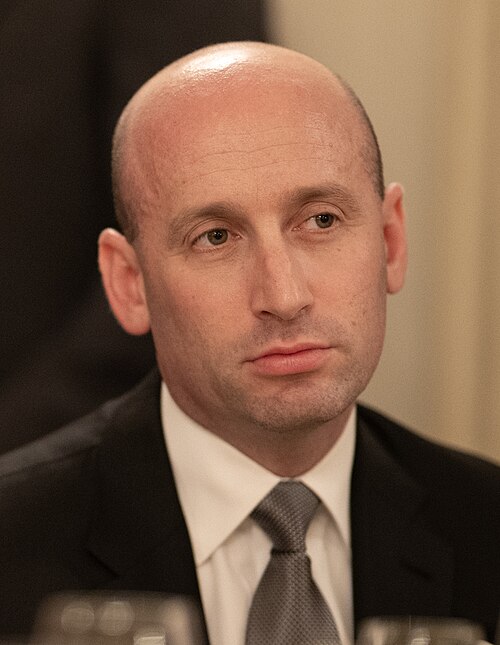
So perhaps the biggest difference between then and now is explained by changes in his top advisors. And of these changes, the most important may involve the standing of Stephen Miller, who currently serves as deputy chief of staff.
Although Miller had been a senior advisor and chief of speechwriting during Trump's first term, I'd only been slightly aware of him as an immigration hawk. A few months before the 2020 election, I'd noted how deeply he was hated by Trump's ideological enemies.
But despite his rather non-descript title in the second Trump administration, his role seems absolutely enormous.
He has often been identified with immigration policy, so in the wake of the controversial ICE shootings in Minneapolis, the WSJ ran a major front-page story last week and it was eye-opening, indicating that Miller's influence was far greater than I had ever imagined.
Secretary of Homeland Security Kristi Noem is nominally in charge of ICE and all immigration matters. But she is an empty-headed former beauty queen, who became a laughingstock in 2024 when the media discovered that she hadn't even bothered reading her own autobiography, which contained wildly fabricated stories about her heroic international exploits. According to the Journal:
Kristi Noem, the homeland security secretary, echoed Miller's early description of Pretti and has told others that Miller directs major decisions at her department...
So Miller has actually been in charge of ICE and immigration, which is hardly surprising given his past focus.
But soon after Trump took office, ICE began a series of very high-profile raids and abductions targeting hundreds or even thousands of fully legal residents accused of criticizing Israel. Thus, over the last year ICE actions have steadily demolished our First, Second, and Fourth Amendments, and based upon the details in the Journal article, Miller has very likely been the mastermind of this.
- Say Goodbye to the Second Amendment—and Most of the Others as Well!
- Ron Unz • The Unz Review • February 2, 2026 • 5,700 Words
Last July Miller also told CNN that the administration was "actively looking at" suspending habeas corpus, thereby allowing the permanent imprisonment of Americans without charges or trial in total violation of our Sixth Amendment.
And according to the Journal, Miller's authority has now extended far beyond these domestic matters.
Miller helped come up with the idea to blow up drug boats, officials said, and to deport migrants to a prison in El Salvador using the wartime Alien Enemies Act, an action now under court challenge...More recently, Miller has broadened his portfolio beyond immigration to national security. In early January, he boasted on CNN that the U.S. could pursue Trump's ambitions to control the Arctic with an invasion. "Nobody's going to fight the United States militarily over the future of Greenland," Miller said in the TV interview. Other White House officials said they were amazed at the comments, which weren't authorized by Trump.
Coming just after our successful kidnapping of Venezuela's president, Miller's media appearance established him as the leading government spokesman defending that action and he expressed our foreign policy in "Might Makes Right" terms more brazen than I'd ever heard from any senior Western political figure in modern history. That clip was viewed more than two million times on Twitter:
Tapper: "We went into the country, and we seized the leader of Venezuela..."
Miller: "D*mn straight we did!! We're not going to let tin-pot communist dictators send…
Finally, one of the most remarkable aspects of Trump's second term has been his widespread use of executive orders to grant himself essentially monarchical powers on all sorts of matters, especially those involving finance and taxes.
For more than two centuries, presidents have followed the Constitutional requirement that all changes in tax policy must be based upon legislation originating in the House of Representatives. But Trump has enacted all his changes in tariff taxes by emergency executive orders, doing so based upon his personal will or personal whim and making these dramatic changes on a weekly or sometimes even daily basis. This drastically impacts what we pay for the three trillion dollars worth of goods we annually import.
Most recently, Trump even claimed the authority to issue executive orders controlling the financial decisions of every corporation in America, including its policies regarding dividends, stock buybacks, salaries, and bonuses:
An executive order posted Wednesday evening said companies "are not permitted in any way, shape, or form to pay dividends or buy back stock, until such time as they are able to produce a superior product, on time and on budget."Earlier Wednesday, Trump said in a Truth Social post that he would limit executive pay to $5 million, but the dollar figure wasn't included in the executive order.
But according to the Journal, Miller has actually been responsible for all of Trump's executive orders:
Miller was influential in Trump's first term, but his power has expanded in the second one. He personally drafted or edited every executive order the president signed...
This strongly suggests that Miller is just as economically illiterate as the president whom he serves.
- Donald Trump's Looney Tunes Trade Policy
- Ron Unz • The Unz Review • April 14, 2025 • 3,800 Words
The underlying assumption of the high-tariff policies enacted by Trump and Miller has been that foreign corporations are so eager to sell their products here that they will gladly absorb the increased tariff taxes in order to do so. Thus, our country would gain considerable tax revenue at relatively little cost to the average consumer.
However, enough time has now passed that researchers have been able to test that assumption and as the Wall Street Journal reported last month, it has turned out to be entirely false:
FRANKFURT—Americans, not foreigners, are bearing almost the entire cost of U.S. tariffs, according to new research that contradicts a key claim by President Trump and suggests he might have a weaker hand in a reemerging trade war with Europe.Trump has repeatedly claimed that his historic tariffs, deployed aggressively over the past year as both a revenue-raising and foreign-policy tool, will be paid for by foreigners. Such assertions helped to reinforce the president's bargaining power and encourage foreign governments to do deals with the U.S...
The new research, published Monday by the Kiel Institute for the World Economy, a well-regarded German think tank, suggests that the impact of tariffs is likely to show up over time in the form of higher U.S. consumer prices...
By analyzing $4 trillion of shipments between January 2024 and November 2025, the Kiel Institute researchers found that foreign exporters absorbed only about 4% of the burden of last year's U.S. tariff increases by lowering their prices, while American consumers and importers absorbed 96%...
Rather than acting as a tax on foreign producers, the tariffs functioned as a consumption tax on Americans, the report said.
"There is no such thing as foreigners transferring wealth to the U.S. in the form of tariffs," said Julian Hinz, an economics professor at Germany's Bielefeld University who co-authored the study.
The $200 billion in additional U.S. tariff revenue last year "was paid almost exclusively by Americans," Hinz said. That is likely to fuel higher U.S. inflation over time, he said.
Thus, despite the lack of any Congressional legislation, the Trump Administration enacted a gigantic tax increase upon American consumers and American businesses. As these new tariff taxes work their way through the supply-chain, the impact of this huge tax increase will steadily rise during the coming months leading up to the mid-term elections.
But the larger goal of these tariff hikes had been to reindustrialize America, restoring our once dominant manufacturing industry. Two weeks later the Journal ran another article reporting that this project had been an equally dismal failure:
The manufacturing boom President Trump promised would usher in a golden age for America is going in reverse. After years of economic interventions by the Trump and Biden administrations, fewer Americans work in manufacturing than any point since the pandemic ended.Manufacturers shed workers in each of the eight months after Trump unveiled "Liberation Day" tariffs, according to federal figures, extending a contraction that has seen more than 200,000 roles disappear since 2023.
An index of factory activity tracked by the Institute for Supply Management shrunk in 26 straight months through December, but showed a January uptick in new orders and production that surprised analysts. The Census Bureau estimates that manufacturing construction spending, which surged with Biden-era funding for chips and renewable energy, fell in each of Trump's first nine months in office...
"There's very little in our product portfolio that has benefited from tariffs," said H.O. Woltz III, chief executive of North Carolina-based Insteel Industries.
With tariffs on foreign steel doubled to 50% this year, Insteel has increasingly struggled to get from U.S. suppliers the metal it shapes into wire that reinforces concrete infrastructure, such as the Gordie Howe bridge, a major trade crossing that will soon connect Detroit to Canada. Instead, Insteel has at times turned to tariffed imports from Algeria, India and elsewhere when there weren't enough American supplies to go around.
"Our growth today could be compromised by the dearth of [domestic] raw material available to us," Woltz said.
Although the Journal writers didn't raise the issue, one obvious reason for the lack of manufacturing growth has been the wildly erratic and transitory nature of Trump's tax changes on imports. Major business investment decisions require stability above all else, and with Trump raising and lowering his tax rates with such alarming frequency, no sensible corporate executive would commit to spending hundreds of millions of dollars building major new factories if their economic viability could be destroyed in a thoughtless moment by our mercurial president.
Indeed, by some estimates only the unprecedented hundreds of billions in capital expenditures of the current AI Boom—or AI Bubble—kept the American economy from falling into recession during the first half of last year.
Although these serious economic problems will continue to weigh on the popularity of the Trump Administration during the course of this year, the last few weeks have been heavily dominated by the controversial ICE killings in Minneapolis.
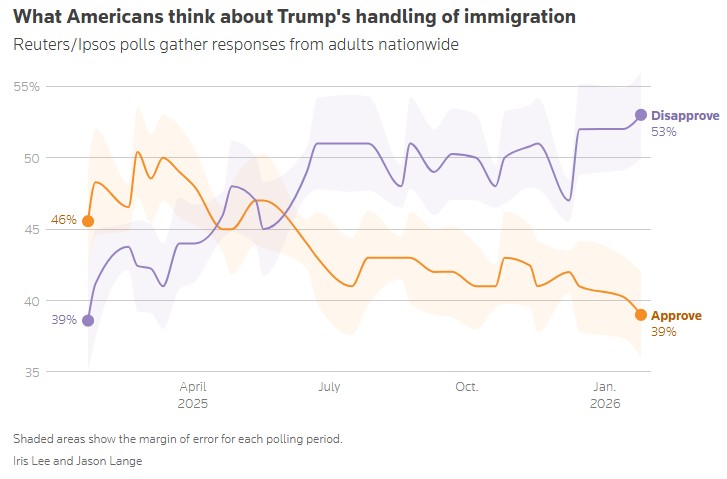
During his 2024 presidential campaign, immigration had been one of Trump's strongest issues and it played a central role in his victory that November. But as longtime Republican strategist Karl Rove had warned in January, over the last six or eight months, images of brutal ICE raids across several of our major cities have caused a complete collapse of Trump's public support in that area.
A January 26th Reuters article carried the headline "Trump's Immigration Approval Drops to Record Low," and the polling results supported that claim.
Rove spent most of his career running races in Texas, and new election results from that state strongly supported his concerns.
At the end of January, the Republicans lost a special election in a district that they had regarded as completely safe. The GOP candidate outspent her rival by almost 6-to-1, but she was still swamped by an astonishing swing of 31 points, easily sweeping her Democratic opponent into office.
A Journal editorial entitled "A Texas Election Jolt to the GOP" was probably correct in arguing that Trump's brutal immigration policies were primarily responsible for that stunning upset:
How does a Republican lose by 14 points in a safe conservative Texas state Senate seat that President Trump carried by 17 points in 2024 ? Answer: When there's a voter backlash against the Trump Administration, notably its mass deportation debacles.That's what happened Saturday in a special election to fill a GOP seat in Tarrant County in the Fort Worth area. Democrat Taylor Rehmet, a labor union leader and veteran, romped over Republican Leigh Wambsganss, who had a Truth Social endorsement from Mr. Trump and vastly outspent Mr. Rehmet.
The election timing was awful for Republicans in the wake of the two killings by immigration agents in Minneapolis. Ms. Wambsganss has been a leader in the parental-rights movement in school boards and wasn't a bad candidate. But state politics is often national these days, and the 31-point vote swing in a little more than 14 months can only be explained as part of a rising tide of opposition to Mr. Trump's first year and a sour public mood.
Democrats and independents came out in droves, as they did in last November's races, while GOP turnout was down. This has been the trend throughout 2025 and the New Year, with an average swing in double digits toward Democrats in special elections for the U.S. House.
Few of the media stories reporting the striking drop in Trump's support on immigration have emphasized certain important aspects of this situation. Under the direction of Stephen Miller, masked and militarized federal ICE troopers have become the public face of that policy, and as I explained last week, this seems to have no precedent in American or even world history:
Among liberals and leftists, these masked ICE troopers wearing military-style gear are often denounced as Trump's Gestapo or his Nazi SA Stormtroopers. Meanwhile, I have generally labeled them as an American version of Stalin's Soviet NKVD, while others have identified them with the earlier Bolshevik Cheka.But although I do think that those latter characterizations are closer to the mark, I'd admit that none of these analogies actually seem correct.
As far as I know, none of the members of any of these highly disreputable security services were regularly masked, nor sported the military-combat-style gear favored by ICE troopers. The Gestapo and the Cheka were generally dressed in ordinary civilian clothes except for the long leather trench-coats that they often favored. And although the SA and the NKVD wore more military uniforms, masks or combat-style gear were not part of their typical outfits.
So the ICE troopers that we are seeing on the streets of Minneapolis and other major American cities do not resemble an American Gestapo nor an SA nor a Cheka nor a NKVD. Instead, given their masked total anonymity, they are actually far more fearsomely garbed.
Indeed, I think that the inspiration for their outfits may have come less from our history books than from the fertile imaginations of Hollywood screenwriters.
Over the decades there have been many films and television shows depicting the horrors of some future fascist American regime, and the dreaded security forces that it deployed to crush all resistance. I think that in some cases these latter were portrayed as masked, militarized commandoes, wearing outfits that were deliberately intended to terrorize their helpless civilian victims, and that seems to have been the model for ICE.
So the masked federal ICE troopers now patrolling the streets of our cities, snatching terrified college students into their unmarked vans, and smashing open front doors without judicial warrants represent a cartoonishly exaggerated version of what liberals had always imagined an American fascist state would look like. What we are seeing almost seems based upon the script of some over-the-top leftist propaganda-film but instead actually taking place in real life.
Back in June, a former longtime FBI agent had confirmed the unprecedented nature of these ICE policies in a long interview:
Some wear balaclavas. Some wear neck gators, sunglasses and hats. Some wear masks and casual clothes.Across the country, armed federal immigration officers have increasingly hidden their identities while carrying out immigration raids, arresting protesters and roughing up prominent Democratic critics.
It's a trend that has sparked alarm among civil rights and law enforcement experts alike.
Mike German, a former FBI agent, said officers' widespread use of masks was unprecedented in US law enforcement and a sign of a rapidly eroding democracy. "Masking symbolizes the drift of law enforcement away from democratic controls," he said.
The Department of Homeland Security (DHS) has insisted masks are necessary to protect officers' privacy, arguing, without providing evidence, that there has been an uptick in violence against agents.
But, German argued, the longterm consequences could be severe. The practice could erode trust in the US law enforcement agencies: "When it's hard to tell who a masked individual is working for, it's hard to accept that that is a legitimate use of authority," he noted.
And, he said, when real agents use masks more frequently, it becomes easier for imposters to operate.
Unlike all other police forces in American history, ICE agents are always masked and they fail to wear uniforms, badges, or any other forms of organizational or personal identification.
In the case of the most recent Minneapolis ICE killing, this eventually led to some rather ironic revelations in a ProPublica article that one of our commenters noticed and highlighted:
Two CBP Agents Identified in Alex Pretti ShootingThe two federal immigration agents who fired on Minneapolis protester Alex Pretti are identified in government records as Border Patrol agent Jesus Ochoa and Customs and Border Protection officer Raymundo Gutierrez.
So basically, two hispanics working for "U.S. border control" shot and killed a white man* who was legally carrying a gun?
You have to laugh at the absurdity that is modern America...
I responded with my own observations:
Well, I have to be fair. For years all sorts of right-wingers have been telling me that Hispanics would start brutally killing whites on the streets of our cities and I was always skeptical. But it turns out they were 100% correct.The only thing that would be funnier is if it turned out that one or both of the ICE shooters had originally been illegal immigrants, who later got their papers and became citizens. Maybe the older one was amnestied as a young child when Reagan signed that 1986 law...