I had intended to publish a difference piece on the evolution of tactics in the Ukrainian war as promised last time, but given the escalating nature of the Iranian theater, it felt more relevant to write on this topic again for now-so the Ukrainian one will be pushed back a little bit.
The salient jumping-off-point comes this week with a new article from Foreign Affairs, the journal of the Council on Foreign Relations:
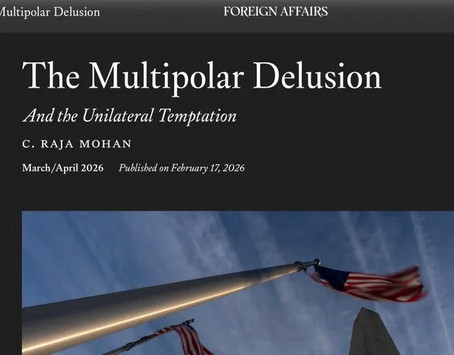
The article's chief thesis is an interesting one that strikes chords of particular pertinence vis-a-vis Iran. It essentially posits that the grand ushering-in of the "multipolar world", heralded for years as the kind of final culmination and death of Fukuyama's "End of History" cycle, is not what it seems. It has conversely led to the unshackling of previous US constraints imposed by the idea that the US as sole global superpower should rule in an equitable fashion, like some placid and benevolent king lording over his subjects.
The demise of this idea in favor of a more cutthroat multipolarity has ironically enabled a figure like Trump to strip away these inherited pretenses and transition the US to a mode of 'free-for-all' operations focused entirely on self-interest, with no principled considerations for the types of wider consequences that may have previously curbed such actions, given the expectations inherent to being the world's leader and global 'role model'.
The author writes:
This seeming convergence obscures a difference in how the various players define "multipolarity." For the Trump administration, acknowledging multipolarity doesn't mean accepting limits on American power. Instead, it serves as a justification for abandoning the traditional U.S. conception of global leadership and the responsibilities that come with it.
Further:
The idea of multipolarity allows Washington to pursue a narrower, more transactional foreign policy-one focused on extracting advantage rather than underwriting order, unconcerned with the maintenance of institutions or norms that do not serve immediate American interests.
The difference in definition for the Global South, the author aptly notes, is significant:
For China, Russia, and many developing countries, by contrast, multipolarity is not merely descriptive but aspirational. It is a political project aimed at constraining American dominance, eroding Western-led institutions, and constructing alternative models of governance, development, and security in which the United States is not the only country in charge.
In many ways, we can argue the idea is a play at semantics: the US as global "unipolar" hegemon acted with roughly the same self-interest as it now does within the "multipolar" conception. Another way of looking at it is Trump views the arrival of the "multipolar" concept as a kind of relief-to his mind, it relieves the US of burdensome responsibilities and allows it to act unconstrained towards previously off-limits interests.
The contradiction is that the originating purpose of multipolarity was to create counterbalances to the US's previously unconstrained mode of operations. Thus we're faced with a kind of paradox where the idea of the multipolar world simply defines more of the same, but gives the US a kind of ideological edge in pursuing its interests unreservedly and with little shame or compunction. It's as if Trump is saying: "You wanted multipolar with a weak US ? That's fine, now this weak US will be forced to do whatever's necessary to keep its slice of the pie." Unfortunately for the rest of the world, that "slice" is generally the entire pie when it comes to the Empire's gluttonous appetites.
Why this transition was necessary is likely due to the onus the US was forced to carry in being the unipolar global hegemon. The US's hegemonic power stemmed to a large degree from the 'myth' or illusion of the global 'Rules Based Order' and the misty 'Rule of Law' underpinning it. For the US to act in too unrestrained a fashion would mean undermining this fragile conception: appearances had to be kept up, the pretense of "legal" actions, even if it meant concocting dubious justifications for military interventions as we saw in Iraq and elsewhere.
The author writes:
The reality is that the world is still unipolar. The illusions of multipolarity have not created a more balanced international arrangement. Instead, they have done the opposite: they have empowered the United States to shed previous constraints and project its power even more aggressively. No other power or bloc has been able to mount a credible challenge or work collectively to counter U.S. power. But unlike in the prior period of unipolarity that emerged at the end of the Cold War, the United States is now exercising unilateral power shorn of responsibilities.
Read that again: "But unlike in the prior period of unipolarity that emerged at the end of the Cold War, the United States is now exercising unilateral power shorn of responsibilities."
That said, I disagree with the author's next conceit: that multipolarity is currently an illusion because the world continues to retain only one pole, which the author believes to be the US, as sole hyperpower capable of fulfilling his list of attributes. The one criterion that China lacks in comparison is the ability to project militarily around the globe. But China makes up for this with a far more robust ability to project its economic soft-power and influence compared to the US, making the two asymmetrically equal and thus definitionally commensurate with at least bipolarity rather than unipolarity.
One of the reasons the author erroneously ascribes solo primacy to the US is because of his misguided belief that China's economy is only two-thirds the size of the US one. It's clear the author is a disciple of the specious nominal GDP count, and is either ignorant of-or intentionally blind to-the more correct and applicable PPP standard, where China dwarfs its counterpart. He even admits that China was able to neutralize US in the tariff trade war, but claims that the US still holds other economic wildcards over its foe.
But the rest of the author's accolades toward US's primacy appear more to indirectly credit Europe's support of US's unilateral military actions, like those against Iran or Venezuela. The claim is that US enjoys sole hyperpower status because there was no outcry to those acts of aggression-but as stated, this is more a credit to the conformity of the Western Order at large and its toeing of the Western imperial line, rather than US's singular might. The US is merely coasting on decades' old Western elite solidarity, and somehow the chorus of their combined actions is being imputed to US's individual might.
AMERICA UNLEASHEDThe first year of Trump's second term has punctured the narrative of American decline and the rise of multipolarity. Trump's assertive use of economic, diplomatic, and military power to push U.S. interests highlights the extraordinary freedom of action the United States enjoys. The weak international response to Washington's aggressive trade policies, its interventions in Latin America and the Middle East, and its threats to take new territory have exposed how difficult it is for any coalition to mount effective resistance to the United States. Power is spread more widely across the international system than it was at the end of the Cold War, but that diffusion makes it harder to channel collective action against Washington.
Note the following nuanced point: US's pursuit of its interests is used as evidence of its unstoppable hyperpower status-but whether pursuits are successful or not is completely ignored, despite this fact being crucial to the proper analysis of the extent of the US's putative power.
In Iran, we saw the US's unhinged ability to strike, but what we missed was the ability of said strikes to actually effect any reasonably decisive outcome, apart from transitory PR gains for Trump. In Venezuela, we saw the same thing: a flashy military operation resulting in a highly questionable and ambiguous denouement, where no real quantifiable gain could be perceived, apart from some undocumented 'rumors' that China may be getting less Venezuelan oil, or some such thing. Trump's throwing out of random big profit figures is as abstruse and unfalsifiable as his tariff boasts, with regular claims of hundreds of billions in profits whose whereabouts no one seems aware of. In fact, just today the Supreme Court appeared to rule the tariffs illegal, potentially forcing Trump to repay importers tens if not hundreds of billions of dollars.