Alastair Crooke
With the demise of diplomacy, the conflict has moved from the realm of strategic calculus and realism into one of psychological conditioning.
Thursday's diplomatic negotiations (26 Feb) - for all the panglossian noise from mediators and negotiators - confirmed the essential impasse. The U.S. demands presented to Iran were:
- The complete dismantling of the Fordow, Natanz, and Isfahan nuclear sites.
- The transfer all enriched uranium to the United States.
- The ending of all sunset clauses, and permanent restrictions.
- The Acceptance of Zero Enrichment - with only the Tehran Research Reactor allowed to remain.
- Minimal sanctions relief upfront; further relief only after full compliance.
These demands plainly were formulated to obstruct, rather than facilitate, any diplomatic solution. It reflects a strategy rooted in the viscerally-held presumption of Iranian weakness that, in the face of a U.S. military show of force, was confidently anticipated would surely yield to Iranian capitulation. That hypothesis always was hubristic. It has proved manifestly false as predictably, Tehran rejected the U.S.' demands:
- [Iran] insisted on recognition of its right (under the NPT) to enrich uranium for civilian needs.
- Rejected 'zero enrichment'.
- Refused to transfer Iranian enriched uranium from its territory.
- Insisted that any agreement must both include recognition of its right to enrich - and a significant lifting of sanctions. Iran rejects the notion of indefinite restrictions placed upon it.
The mood music at the end of the talks was determinedly upbeat. Iran's lead negotiator FM Araghchi said: "Today's round was the best among the rounds so far. We clearly presented our demands". The Iranian side wanted to make clear for both domestic and overseas audiences that they (at least) had negotiated in earnest.
Reports from the U.S. however, suggest that the decision to attack was already made during the 29 December 2025 Mar-a-Lago summit, between Netanyahu and Trump.
The Iranian leadership well understood that any concessions that Iran might reasonably have offered in the talks would not have given Trump his desired quick political 'win'. The more so, as Iran insisted that missile defences were non-negotiable.
Whilst placing Iran's nuclear program at the centre of the talks, U.S. Secretary of State Rubio - ahead of this (last) round of negotiations - nonetheless underlined that from Washington's perspective, the threat of Iran's ballistic missiles to be "a fundamental component that cannot be ignored".
Rubio's unlikely claim however is consonant with Israeli Hebrew press reporting that after Netanyahu's December 2025 meeting with Trump, it was Netanyahu who demanded that the U.S. strike Iran's ballistic missile capabilities - and that striking its missile armoury must take priority over attacks on Iran's nuclear facilities.
The same (Israeli) reporting said that Trump accepted Netanyahu's peremptory demand.
Overall, Trump has remained adamant that whatever the Iranian stand-off outcome - whether achieved through Iranian capitulation or attained by military force - he personally had to exit the confrontation appearing 'strong' and having an historic 'achievement' under his belt.
A war in search of a rationale
Thus, with the demise of diplomacy, the conflict has moved from the realm of strategic calculus and realism into one of psychological conditioning. That is, how to characterise a war without any clear rationale to an increasingly doubting American public. And how best to trigger war in such a way to provide the right psychological advantage to Trump in the lead up to Midterm elections.
Hence, we have the absurd claims by Trump that Iran is working to produce ICBMs with which to attack the U.S. mainland. In this psy-narrative, Trump is not just saving Israel, he is saving America!
These psychological conditioning considerations are forcing a divided Trump Team to move further and further away from reality - scrabbling to find the plausible casus belli to justify a military strike on Iran. Iran, despite Rubio's claims, does not threaten the U.S. with ICBMs. Iran does not pose a threat to the U.S. at all - nor does it possess nuclear weapons.
Make no mistake, Will Schryver observes,
"This is an American war of choice. This war - and all its consequences - are owned by the United States. This is Trump's war. This war was started January 3, 2020, by Donald Trump's direct order".
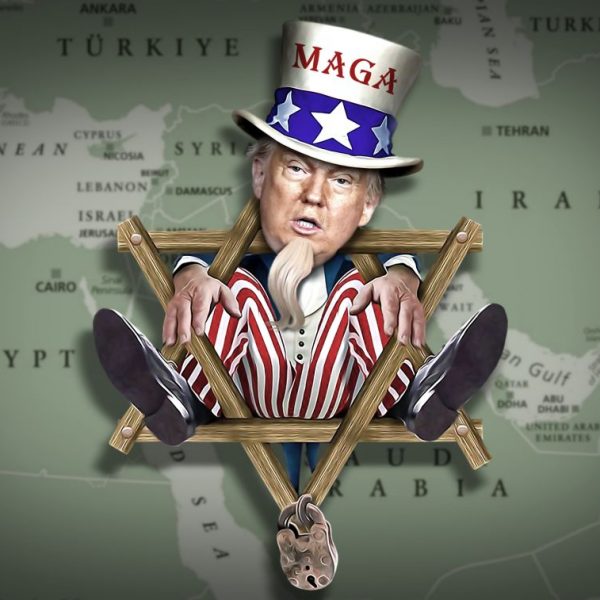
But for Team Trump to say out loud that a strike on Iran is about cementing Israel's Middle East hegemony, is considered by the Team to be a non-palatable framing for touting 'another big Middle East war' to an U.S. electorate adverse to casualties and increasingly sceptical of Trump's prioritising of Israeli interests.
The dilemma of a lack of rationale for war evidently became so acute that U.S. officials agreed that Israel should strike first, in order to make an Iranian war as 'politically palatable' to the domestic audience as possible.
Anna Barsky, writing in Hebrew Ma'ariv last week, argued that the suggestion that Israel 'goes first' "... seeps from the ironic to the chilling. Because it outlines a scenario in which Israel functions, consciously and by design, as the opening shot of a move that is intended first and foremost to produce a consciousness effect in the United States".
The build-up of U.S. forces was first imagined by Trump to be, of itself, sufficiently intimidating psychologically for Iran, that capitulation was pre-ordained. Witkoff said it plainly on Fox News: Trump was confused and frustrated as to why Iran had not already capitulated in face of such an American array of forces near to Iran.
But more than this, for Trump - who lives by grandiose statements and promises of 'unbelievable American military prowess' - he was disconcerted to see leaks revealing that, despite the force build-up, the U.S. does not have the military capacity "to sustain [beyond] a four to five day intense aerial assault on Iran - or a week of lower intensity strikes". He later contradicted his Generals.
Trump's Generals had provided him with a much more complex picture: They were not willing to guarantee regime change; there would be no certainty about the length of the campaign, and there would be no ability to accurately predict Tehran's response - or the regional implications.
Likely, Trump, despite the warnings, imagined (or hoped for... a short bloody war of a few days, after which he could claim 'Victory' over the extended debris, and then hope to manoeuvre towards a ceasefire - with media headlines shouting another 'Trump Peace'.
Wars, of course, are never determined by one side alone. Iran warned that if it was attacked, it would trigger all-out war - not just in Iran, but across the region. On just the first day of the war, this is what Iran has now done, with attacks on U.S. bases across the Persian Gulf - U.S. military bases are on fire and smoking for all to see. Major oil companies have just suspended shipments through the Strait of Hormuz.
Trump - but more precisely Netanyahu - has just triggered a multi front war, with attacks on Israel from many directions (from Iran, Yemen, Iraq...). A long war is more likely than a quick war.
Trump is stuck in Zugzwang. He is compelled to make the move on Iran, but in so moving, aggravates his own situation - 'Zugzwang'. Reportedly, "many inside the Pentagon believe the U.S. will face generational disaster if it over-commits to a large-scale conflict with Iran [and does not perform 'brilliantly']".
Yet the ideological momentum for a strike originating from the camp of Netanyahu and his diverse auxiliaries and donors in the U.S. proved compelling. These latter see a U.S. strike as a 'once in a generation opportunity' to re-cast the geo-strategic map - to remake Iran as a pro-western ally of Israel in a new coalition at war with Islamic radicalism.
Such sentiments - though fantastical - should not be brushed aside lightly. They are deeply embedded in culture and in various eschatological beliefs.
War logistics carry their own momentum: Once the 'spring' of military deployment is released, it takes a major effort to wind it back. At the outset to WW1, it proved impossible for the European leadership to reverse the mechanics of deployment - simply owing to the limitations inherent to the railway system. It takes a major effort to bring wide war-momentum to a halt.
In triggering such an existential global trial of strength, Trump will not be able, like King Canute, to 'command' the tide to recede. He has started events that will determine our global geo-political future. The future of China, Russia and Iran will hang in the balance, one way or another.
The economic order hangs in the balance too. Trump's solution to the debt crisis hangs largely on his trade war. The viability of Trump tariffs to mitigate its debt obligations hangs on dollar hegemony. And dollar hegemony largely is a function of preserving the myth of U.S. exceptional military invulnerability.
But with Iran effectively having called Trump's bluff, he is faced with the humiliating choices of either TACO-ing out (i.e. by twisting some premature call for ceasefire, as in the 12-day war, to proclaim 'Victory'), or were it to be a longer war, to accept the U.S. military being perceived as a paper tiger and seeing the consequences reverberate across debt markets.
Trump is a truly committed supporter of Israel, but he is within a whisker from sinking his Presidency on this rock.
Perhaps he had no choice.