
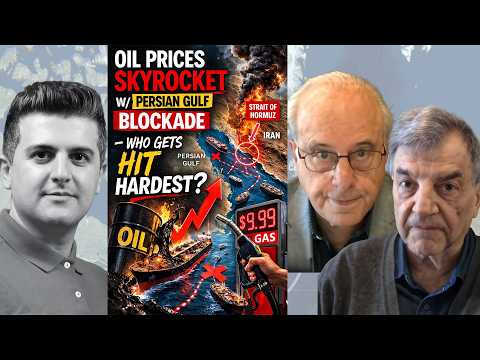
NIMA ALKHORSHID: Hi everybody. Today is Thursday, March 5, 2026, and our dear friends, Richard Wolff and Michael Hudson, are here with us. Welcome back, Richard and Michael.
MICHAEL HUDSON: Good to be back.
NIMA ALKHORSHID: I think we have to talk about what's going on in the Middle East because of the war that is happening right now. Let me start, Michael, with you. And what is your understanding ? Many people are asking themselves. You know, you see Democrats, Republicans, many people outside of the United States, inside of the United States, they're saying—what is happening ? What was the main reason for this war ? Why did it happen ? What is your understanding of that?
MICHAEL HUDSON: The same reason that we had for the war against Iraq in 2003. The same shock-and-awe policy taking over the country and the same enabling lie that began it. You remember the lie that was used by Secretary of State Colin Powell that was given to him by Cheney and Rumsfeld that Iraq had weapons of mass destruction, not only moving towards an atom bomb, but bioweapons and chemical weapons, and was buying uranium from Niger. All of that was a lie promoted by the CIA and also by Tony Blair and MI6, in fact. Well, you have the same identical lie with Iran today. Iran is moving towards getting an atom bomb. Well, what happened last Friday, I think, explains why the United States and Israel had to go to war very quickly by Saturday. And that is because, after the negotiations between the Iranians and the Americans in Oman were taking place, the Omani foreign minister, who had acted as a mediator, went public and said, "Iran has made unprecedented agreements to surrender to the American position in order to avoid war. It's actually going to dispose of its 60% enriched uranium and move it to other countries. It's actually going to promise not to undertake further enrichment and to any uranium that it keeps, it's going to dilute it."
Well, right after you had this agreement on Friday, Ayatollah Khomeini brought together his other religious leaders and the head of the Iranian army to draft their proposed agreement and the language that they were going to give, going way beyond what the original agreements under the Obama administration had been to guarantee Israel, America, and all other countries that Iran was going to be the only country in the world that was willing to give up the enrichment of uranium over a given point. Well, imagine what would have happened if this report had come out. That would have destroyed the whole lie that justified the American attack on Iran. It would have said that, contrary to what Donald Trump was saying, Iran was not set on getting an atomic bomb, that everything Trump said would have been exposed as a lie. The United States and Israel desperately had to go to war to bomb not only Khomeini, but the whole group of Iranians that were in charge of making the official reply to the negotiations and [drafting] the official agreement. They had to be killed before they could come out and say, "Wait a minute, all this is not what we agreed on. And we agreed on exactly what the Omani foreign minister said."
So they had to do it in a hurry. And so Trump and Netanyahu, the United States and Israel agreed to make a surprise attack on these officials and to bomb them because the real aim was never to stop Iran from having an atom bomb because Iran was never running the policy of getting an atom bomb. The immediate aim was exactly what Donald Trump has said it was. Regime change. "We want a regime change." And yesterday he came out and said, "Not only is there a regime change, but I, Donald Trump, will be appointing the new heads of Iran. We can't have any one religious leader there." Obviously, the United States wants to bring back the Shah's son with all of his torture groups and the whole group that Khomeini so brilliantly overthrew when the whole Iranian population fought back against all of this.
So the United States wants the regime change and why does it want a regime change ? It wants oil. So we're brought back to a policy that the United States has had at least since 2003, when General Wesley Clark said, "We're going to attack seven near Eastern countries in five years and we're going to take control of the oil." Just as when Donald Trump said, "You know, when we're in Iraq, we've got to take our oil." That's what it's all about. And that's what, from the very beginning, the role of Israel has been in the Near East, to act as what I've heard military officers in America say Israel is: our landed aircraft carrier there, to make sure that there's no regime that's going to emerge that breaks the basic agreement that Saudi Arabia and the other OPEC countries made in 1974 [when] they were told they can charge whatever they want for their oil but they have to price their oil in dollars and they have to keep all of the savings from their oil exports in the United States in the form of bank deposits, [of] U.S. Treasury securities, and of U.S. stocks and bonds. And this overwhelming, overriding position has been the basis for American foreign policy ever since 1974. And the reason that America has gone to war with Iran, and before that, gone to war with Iraq to seize its oil, gone to war with Libya to grab its money and to seize its oil, gone to war with Syria using al-Qaeda troops to have a civil war there is to seize its oil. And the purpose of seizing oil isn't simply to assert U.S. ownership of oil. The U.S. doesn't have to actually own the oil. It just has to have a client oligarchy in place that agrees that all of the money from the oil exports will be taken in dollars and sent to the United States as the national savings of the countries that are doing the exportation of the oil.
Well, why is the United States gone to war in Venezuela ? Well, now Venezuela has said, "We're going to begin pricing Venezuelan oil in Chinese currency, the RMB. We're not going to price it in dollars because we're not selling oil to America. We're under attack by America. We're going to sell it to friendly countries and countries that are investing in us." The United States has gone to war with Russia in Ukraine because Russia's not pricing its oil in dollars. It can't do it in dollars because the dollars in foreign exchange savings of 300 billion were all confiscated by the Europeans. So it can't do that. So the United States needed to take Iran out of the picture so that Iran wouldn't be the one country that was powerful enough to continue to export oil, not only in foreign currency, not dollars, but in Chinese currency, because 80% of Iran's oil is sent to China.
Now, that accounts only for 5% of Chinese oil, but the United States is also trying to block Russian oil from being transported to China. Just a few days ago, the British shot down a Russian tanker off Gibraltar that was trying to trade Russian oil, and the Europeans are trying to threaten to blow up Russian tankers in the Baltic to prevent Russia from having any access at all to its exports. So Iran defended itself, obviously, and it defended itself basically against letting itself be torn apart in the way that America's proxy armies are trying to destroy it. America has two proxy armies in the Middle East. Obviously, Israel has long been the main army, and the Israeli-American ally is al-Qaeda. And the terrorists, it's al-Qaeda that was all put in place as a result of America's war in Afghanistan to control that part of the region. And together, al-Qaeda and Israel have acted as attack dogs against any country that is moving to assert its own sovereignty in taking control of its oil trade.
So Iran [is] finally under attack. I want to talk about the way in which it's fought back. And I know this takes another minute, but the first thing it did was it began to attack the American military bases throughout the neighboring Arab countries that were used to bomb it. It bombed the bases in Kuwait and other countries. And Kuwait said, "Why are you bombing us ? We're not attacking you, Iran." And Iran said, "Well, of course you are. You're leasing your bases to the Americans, and the American airplanes and missiles are coming from your country. So, of course, you're at war with us. If you're not, if you don't want to be attacked by us, then don't act as the basis for America to attack us." And Iran followed up by blowing up the gas refineries that were being used in Bahrain and other countries that were making the LNG. This is as important as blocking the Strait of Hormuz and blocking the oil trade. The gas refineries that are making the LNG have been blown up, it takes at least two weeks to rebuild the refineries, the photographs of the bomb hits have been all over the internet, and it'll take another two weeks to mount them up again. Within one day the price of gas in Europe jumped 20 percent and the price of gas, LNG, in Japan and Korea jumped a similar amount, and yesterday the Korean stock market plunged by almost 80 percent.
So the whole world is threatened now not by Iran but by the American terrorist attack on Iran. The neighboring countries that thought that they were gaining protection from America by letting it have the military bases there are now all being endangered by Iran's response to, quite rightly, attack these military bases and the allies of America—Japan, Korea and Europe—that are dependent on near eastern oil are all suffering. So the U.S. attack on Iran has become an attack basically on its allies, and it's turned the war in Iran into I think...what you have to look at is a World War, because oil is consumed all over the world. And America's strategy against Iran is part of the overall global strategy of the United States to control the world's oil trade so that it can use sanctions to turn off the spigot to other countries and cause chaos there.
So this has led the whole rest of the world to say, "Well, wait a minute." It turns out that the whole enabling fiction that has justified all of America's demands for subsidies, for special givebacks to Trump for his tariffs, all the demands that you have to support America because we are spending the money to defend you against the attack of Russia, fictitious, against the attack in case China attacks Asia, which is fictitious. It doesn't need to attack anyone given its economic power. And against the attack of Iran with atomic bombs, completely fictitious. It turns out that the countries under attack are America's allies and they're under attack by the United States in the backwash from the American attempt to control the Near East and lead to what, as of yesterday, was announced to be a war that's going to go at least three months through September.
I think that Trump will be desperate to try to wind all this up by the time that the elections and the off-year elections occur in November, because the whole country is being... America will be confronted with rising oil prices. The price won't be so much in America. The war in Iran will be a bonanza for American oil companies because the price of world oil is going to go up abroad. But that's going to create a price umbrella for the domestic American oil producers and the fracking producers and gas producers, which is going to make them highly profitable. So the Americans will be primarily the large winners here. And the American government has been stockpiling huge oil reserves. It's going to deplete the oil reserves that the government has to flood the economy with enough oil that prices are not going to go up for drivers. And Europe has spent the last year also increasing its oil reserves, as has China.
So the governments are going to deplete their oil reserves just as they've depleted their arms reserves and reserves of bombs and missiles. It is part of the war in Ukraine and now the war in Iran. But they're painting themselves way into a corner where, without the reserves to hold down variations in prices, you're going to have a huge increase in the price of gas, electricity, fertilizer made out of gas, and chemicals made out of gas and oil. The attack on Iran has become a destabilizing factor on the entire world economy that is worldwide, is military, and in that sense, America has become the very threat that it's been promising to protect other countries against. That's the irony of all this. It's all a fiction, the Americans' enabling fiction that we're here to protect you, when actually we're here to destabilize you if you don't acquiesce in U.S.-controlled foreign policy, as we've outlined, if you don't give up your loyalty to the principles of the United Nations and international law. This is really what's at stake, and this is what makes the war in Iran civilizational in character, as we've said on previous broadcasts.
NIMA ALKHORSHID: Richard, jump in.
RICHARD WOLFF: Okay, I like Michael's invocation of irony, and I like his history. So I'd like to build on those two and talk about other histories that bear upon all of this. I'm going to start with Israel because we've talked about that in the past. Israel is trying to undertake what is called in history "settler colonialism." It wants to move into areas occupied by other human beings in order to acquire economic benefits and geopolitical and population benefits by either moving or destroying the existing population. And that's why it's called a genocide, and that's why it has all these others... And we have been arguing or developing the idea that the settler colonialisms undertaken two centuries ago in South Africa, in Australia, in New Zealand, in Canada, and in the United States, were possible, then, because of the relationships between [the colonized countries and] a colonizing capitalism that had to find new sources of raw materials, new sources of food, new markets, etc.
And so colonialism solved certain problems for them, but that the world has evolved over the last two centuries. And so the settler colonialism that you could undertake and achieve [back] then is a completely different proposition now. And that, in fact, we are living in an age that has been called by others an anti-colonialism period of human history. Almost all of the old colonies have been overthrown, almost always by one or another kind of revolutionary upsurge demanding political independence, economic independence, and so forth. And that therefore the Israeli project is more difficult, has more opposition, and takes even more horrific forms than the old one did because the conditions are different. And now Israel, because it can't face what I just said, does not agree with that, finds itself having made an historical deal. And I'm quite persuaded that this is understood, perhaps not in the words I'm about to use, but basically understood. The United States will fund, arm, and protect Israel if, in return, Israel functions as the military arm of the United States, threatening and where necessary, fighting any effort of the rest of the Middle East to get out from under its colonial history, which has not changed much, even though they have won political independence.
Now, the next irony of history. It was 1953, so three quarters of a century ago, that an Iranian prime minister, Mosaddegh, tried to find a way to make the oil discovered under the soil of Iran be a valuable national asset for the national development of Iran. And the Americans and the British overthrew his government. That has since been admitted and verified by records that have been opened up under the 50-year rule—[the time limit under which] you allow records to be exposed—and England and America had more than enough records to show that this was a deliberate overthrow. In its place, the British and the Americans put the Shah family, the Pahlavi family of Iran, to be a loyal asset of the United States, which the Shah was for quite some time. When the revolution, the Islamic Revolution and the Mujahideen Revolution explodes in the late 70s, the Shah has to leave the country and goes to the United States, where Henry Kissinger welcomes him as the hero for America.
So what we are now viewing, Americans need to know, is not the first time that the United States has gone militarily into that country to get rid of one government and replace it with another. This is not new. But here's the parallel with Israel. What you could do in the 1950s, you can't do now. That's the problem. In the 1950s, the only ally Mosaddegh could have turned to was the Soviet Union, which at that time had barely recovered from World War II. There was no China, in the modern sense, able to help them. The Chinese Revolution didn't end until 1949, which is four short years before the Mosaddegh [overthrow] happens. So everything has changed since that time. And it is now much easier for the country to function, even though it has a government... granted, it's a government of the Ayatollahs and the Mullahs and all that means, it is a religiously shaped and dominated society...
But that's not what the United States wanted. That's why Mr. Trump is able to say, "I have to pick the [next] one, because we don't want another Ayatollah." And what he doesn't say is, "We don't want another Shah either, because that's a very bad part of Iranian history, and if we pick someone like that, it's going to look like what it is, and that's going to make the opposition, if we take over there..." let's remember, we have just murdered its leader. Try to imagine with me what would go on inside the United States if folks had come and murdered our leader. So we're going to have opposition in Iran. Lots of opposition. The people of Iran have been in opposition against the existing government. Lots of people know how to organize, they have things to learn, they have problems, but you are undertaking quite a risk. If you know much about Iranian history, you'll also know that they had the most developed, most sophisticated, and most powerful communist party in all of the Middle East, the Tudeh Party. And the children of Tudeh are still around, and they learn things from their parents, just like such children do everywhere else.
My point is to suggest to everyone that what we have here are historically out-of-date attempts, and they are desperate. The Israelis [are] desperate because the great gamble, the great risk of Israel is that they cut a deal with the most powerful power. And now that most powerful power isn't the most powerful power anymore, and the deal you struck is a more dangerous deal with every passing day and leads to more desperate activity. And the same is true, in my judgment... It's not about the oil alone. I agree with what Michael said, but it's also a bigger project. It's a project to try in every way you can to slow down the decline of the empire. You can't control Venezuela. It's got a revolutionary half of its people. It has mountains. It has terrain. And it has all of Latin America on its side. That's one of the reasons there isn't an overthrow there beyond snatching Mr. Maduro. It's very important... You can't do... you can't just get rid of one leader and bring in another. That's the old Monroe Doctrine. Can't do that anymore.
They don't know what to do in its place, so they talk a lot about the Monroe Doctrine. They didn't have to talk about it for the last century. They just did it. They can't anymore. And you can't in the Middle East either. Look at all of those countries. I'll conclude with that. I'm going to be crude for a moment, but in the interest of time... The countries of the Middle East now being threatened by Iran are all concoctions of Western imperialism. This was one large desert carved up into little groups by Europeans, turned over by them to selected families who looked like they would be loyal if you paid them enough. These are tiny countries. They're desperate. They live on oil and gas, and they will die on oil and gas. They have tried, in some cases, for 70 years to diversify. They don't have much to show for that. They're still dependent on oil and gas. They're dispensable to everyone except themselves. Very dangerous place to be.
So the United States picks two very vulnerable things: Venezuela and the Middle East. Nice, it gets you little corners on the oil. And look how hard Mr. Trump works to keep fossil fuels, to denounce every effort to switch to other forms of energy. So the area of the empire he can try to expand and hold on to, to demonstrate that the empire isn't dying, which he has to do because it is... And he can feed that into the continuing oil-dependent global economy. The anti-climate is part of the same debt. They know that it's not good for our health. They know that we don't want to be reliant on burning fossil fuels because they will eventually kill us and the pollution from it will eventually make us... they know all that. They don't need us for that. They're fighting to hold on. If it costs them, they will still fight to hold on. They may be coughing all night, but they will hold on...
It's important to understand that mentality is applicable here. If we control the Venezuelan oil a little for a while, we've slowed down where things were going. And if we can dictate a new Middle East configuration, if the Iranians allow us to do it, and don't mount a resistance that will make running Iran impossible, way too expensive... And we can get Israel to be the paid goon for the United States to keep people in line with military horror... All I can say is that's a tremendous long-shot theory and approach. This is the policy of a dying empire. And if the people who are suffering the most, whether it be in Gaza or now in Tehran, if and when they get their act together, the revenge on the West will be staggering. And you know, the Europeans get it. Spain broke from NATO. NATO endorsed the American-Israeli attack. Unbelievably stupid for NATO, but that's, you know, they're slavish in NATO. They couldn't resist the tariffs. They couldn't resist Mr. Trump. And now they can't resist here either. They are, like Israel, the paid underling.
But it's breaking apart. Even Macron, wobbling. Only Mertz so far is staying with the Iran-Israel move. The Spanish have been very clear, Mr. Sanchez... and that's the breakup of NATO that everyone has been [foreseeing]. Now, even our military doesn't agree, and the disagreement is so strong that it bursts into the public. I think you need to see it. Otherwise, the mainstream media here, who focus on everything other than what we're talking about, leave you with the impression that this is some clever maneuver of Mr. Trump. This is another desperate effort to hold on a little longer, to slow down economic processes.
And if you remember who lost the war in Korea, in Vietnam, in Afghanistan, and in Iraq, then don't be so quick to assume who will win this war. Oh, we'll hear about wonderful bombing, precision bombing. Then we'll hear about an invasion. Then we'll hear about surges of our troops. We'll hear all about it. And then one day they'll all be [cramming] onto a helicopter, getting out of Tehran as fast as they can.
MICHAEL HUDSON: If they really get in. I think Richard's quite right in saying, "Look at this exercise in Iran," that I agree with him. It's going to go the same way that America's war in Vietnam went, Afghanistan, Iraq, everywhere it's done, it's ended up losing. I can't believe that they're really going to try to mount an American invasion with American troops. You've seen how that's worked in every other country. They've gotten slaughtered. America prefers to use proxy troops. As we've said, it's used Israeli troops to let them die and let al-Qaeda die, and now, in the last few days, America has backed the Kurdish groups. President Trump has called the Kurdish leaders in Iran to say, you know, "Why don't you fight against Iran?" I think I've mentioned before that I've sat in on meetings and military meetings with Herman Khan way back in 1975, 74, when he outlined the U.S. plans to break up Iran into five regions. And Iran is, I won't say, unique, but very different from the Western civilizations and from Christian civilizations in many ways. The most important way is [that] it's multi-ethnic and there has not been any ethnic separatist movement there. The ethnic ethnicities all get along just fine. That used to be a characteristic of all of the empires in the Middle East ever since the Babylonian Empire and the Persian Empire, which were multi-ethnic with the Jews, right down through the Iranian state when it was no longer an empire, but was just a multi-ethnic country. There's a very active Jewish population in Iran, many of whom I've met who have told me about how free and open Iran is to the Jews.
But now the Americans are trying to make the Kurds sacrificial... the Iranian version of the Ukrainians. Die to the last Ukrainian. "Will you Kurds please follow the leader who is being supported by Trump, and die to the last Iranian Kurd?" I'm told that the Kurdish People's Party in Turkey is not at all in favor of this and is opposing them. And so you're having a fight among the Kurds, but the Kurds in Iran are apparently willing to mount some kind of a fight there. Well, the point that I want to get that Richard was making was: how do you stop an empire in decline from desperately flailing out and taking down the whole rest of the world with it ? Well, you prevent an alternative from developing, and that's what the United States had to do. It needed to prevent an alternative from developing in China, in Russia, in Venezuela, in Cuba, and now in Iran.
And Iran is unique in another way, and that's the role of the clergy there. I have a book coming out on the history of world banking from the Crusades to World War I that'll be out by the spring. And I have a chapter on Iran and its role in foreign investment. Iran was one of the most marginalized countries in Europe throughout most of the 19th century. And gradually... it was not forced to let foreign countries invest in its resources, but it wanted to industrialize and do for itself what the Western European countries were doing for themselves—put in power and [an] industrial base. It made a number of agreements with British investors, and the agreements were pretty awful. And the worst agreement was when Iran sold its tobacco monopoly to a British consortium that would take complete control of all the production of tobacco and the marketing of tobacco within Iran, and merge that with heroin cultivation. And the origins of essentially much of the Chinese opium trade were based for quite a while out of Iran as a byproduct of tobacco.
Well, the entire Iranian people revolted and the revolts were led by the clergy who put fatwas on dealing with the companies that were British-owned and had taken over. And it was the clergy in Iran that had led not only to overthrowing and ending the British takeover of Iranian tobacco and railroads and other areas, but also led to a constitutional reform in 2005 that led to the Iranian people, again, working very closely with the clergy, to overthrow the ruling Klan that had been running it through dominating Iranian politics through the entire 19th century.
Well, finally, in 1925, they were attempting to create a civilian authority and civilian independent democratic rule. That's when Britain stepped in militarily and selected a Persian general, and that was the Shah's father, the first Shah, to put in. And this was in 1925. And just as Richard mentioned, the Tudeh Communist Party [was] very strong in Iran after World War II. It was very strong after the Russian Revolution there. And the role from the very beginning of the British-backed military in Iran was to get rid of the communists and the left-wingers there and act as the proxy government for the British and for other foreign investors, including what became the British Petroleum... the Anglo-Persian Oil Company and concession in Iran is what led to British petroleum and the power of Britain in the first place.
So that when the overthrow of Mosaddegh was trying to maintain and perpetuate Britain's declining empire, well, America had pretty much absorbed the British Empire in the sterling area by that time, 1953, but at least it thought it could maintain its power in Iran under the Shah. And that happened, and the Shah imposed a brutal dictatorship there that finally, once again, was overthrown by the clergy because the only place that Iranians could gather free of the Shah's secret police was in the mosques. And that's part of it. So the result is that the Iranians, rather than being a terrorist state, they put an end to the Shah's terrorism that had been imposed on Iran for many decades. And you have today America being in the same position that Britain was in. All it has [is] to prevent an alternative from developing, to replace the American empire, to replace dollarization, to replace the control of world oil, so that countries can buy oil from suppliers other than those backed by the United States and Europe. The only way that America can do it is by terrorist acts, not only such as we're seeing in Iran, but the terrorist acts in Ukraine against the Russian population, the terrorist acts, the military buildup in the China Sea to try to arm Taiwan, to drag the Philippines into a fight in Japan, into a fight against China.
All that America can do is try to find allies who are going to fight its wars, to fight to the last Ukrainian, to the last Kurd, to the last Japanese, to the last Philippine, and maybe ultimately, if there is an American armed invasion, to the last American infantryman there. And what are other countries going to do ? The costs of this American terrorism and the destabilization of oil that is being created by the United States trying to keep control of oil to... as the financial and trade buttress of the old American empire increases, this is going to threaten other countries' ability to import oil and import gas. It threatens to turn the whole world into what's happened to Germany when Germany was directed to cut off oil and gas imports from Russia.
So rather than America basing its empire on other countries contributing to it, saving the world from terrorism, the fact is that controlling the world's oil trade requires ongoing terrorism and a permanent war in the Middle East. You'll have to continue this war against it. And the only way to oppose it is, as the president and the head of Spain said two days ago, we are not going to permit any American military base in Spain to act as a base to attack Iran. We think the war is wrong. We think that Europe should turn away from the United States and turn toward where we want to turn, toward the part of the world that is growing and offers us a much better trade deal, a much better financial deal, and a much better market for our investors, namely China, Russia, and Iran. These are the three countries that are the core of what is often called BRICS, but it's really Russia and Iran, not India, and China that are the core of what's going to emerge as the other pole of the world, acting as a magnet to attract Europe, Africa, South America, the global south, and Eurasia into their orbit because America has nothing to offer now that it's deindustrialized and become a world debtor instead of a world creditor.
And so that the world no longer needs the dollars for its own savings, no longer needs the dollars for their economic growth. And in fact, adopting the dollar and paying the price of belonging to the dollar area means a sacrifice of their growth to participate in the American war against the whole rest of the world, vainly trying to keep its empire with the aid of Britain, France, and Germany.
RICHARD WOLFF: I'd like to use a little bit of the time we have left to talk about the limits to all of this that come from inside the U.S. economy. Let's go through this with a little arithmetic. Our current budget for war, what we used to call the defense budget, I guess now we call it the war budget, is about $900 billion. There are not that many numbers to keep in one's mind: $900 billion. Before the war in Iran, before, Mr. Trump indicated he wanted to increase that in next year's budget to $1.5 trillion. In other words, he wants to add $600 billion. That's a two-thirds increase in your military budget. Now, what should have been asked is: what in the world is going on that a country that is already the most militarily armed in the world should be wanting to increase its military spending at all, let alone by an unprecedented two thirds in one year ? Okay ? That question was not asked. With a wave of the hand, we were told Russia and China present a bigger problem, and therefore, okay.
We now have a war in Iran, on top of the fact that we're still hemorrhaging money by producing weapons and so forth for Ukraine. And there are the other warlike issues on the horizon. If anything, that means the money going to defense will be even larger than the 600 billion that were budgeted for it before Iran. Keep now in mind that the United States, as Michael just said, is the world's largest debtor country. That a few years ago, our debt crossed 100% of our GDP, which is a kind of number people pay attention to. I believe it's now crossed 120% of our GDP, which is usually a warning sign that you have got a problem here. And there are a number of countries around the world that have spent the last few years reducing their holdings of Treasury instruments so that the ability of the United States to borrow is shrinking, as seen by the unwillingness of the normal buyers, lenders to us, to continue to do so.
And now we have discovered that the tariffs, which raised about $160, $170 billion, are unconstitutional, and that money is going to have to be refunded or something like that. You know what that put those together. That means a federal deficit that may really surprise us by requiring an additional trillion or more dollars when we have absolutely no way to raise that money. We are not going to be able to borrow. Or let me put it differently. Were we to be able to borrow a trillion dollars, given that we're overindebted, given that all three of the major rating agencies have taken away the AAA rating for American debt, we're going to have to pay, here we go, higher interest rates to get such money.
And we all know that higher interest rates, especially if prices go up, are an environment that is going to make the affordability problem, which is the only plank the Democratic Party has figured out to offer the people, is going to make it very powerful over the next six months and make a desperate government even more desperate than it has been as the financial impossibility of its... and nor do I see anything. Michael should correct me if I'm wrong, but I don't see anything on the horizon that's going to step in here. Are they going to forego their military buildup when they're in a new war and they admitted they needed 600 billion more ? They're going to say, well, we won't be able to do it. What kind of message does that send ? And if they're not willing to forego it, and if they don't want to have higher interest rates, then the only way will be to cut back on social programs here in the United States. And we will have another crazy Elon Musk Doge experiment in the year ahead. And that's not politically sustainable anymore either.
MICHAEL HUDSON: Well, here's why we're going to have what exactly Richard is talking about. The increase in the military budget to one and a half trillion was done before the attack on Iran. Every day that America's naval force is in Iran and the army [and] air force are sending bombs and missiles costs, I think they've calculated, many billions of dollars per day of the war. And these billions of dollars are not only in current costs, but the depletion of America's supply of bombs and missiles and maybe F-14 fighters as they're shot down and aircraft. And all of this has been calculated. I think I made a calculation when I had the daily expenditures before me a few days ago. This is going to add by September another trillion dollars just to replace the armaments that have been expended in Iran and the cost of outfitting and fueling and keeping the Navy and the Air Force and the troops at the ready in Iran.
So the costs are going to be much greater, even than the absurdly high costs that Richard just mentioned. And he's absolutely right in saying that America is following the same path as Merz is in Germany. Talking to labor and saying, Labor, are you patriotic ? It's worth lowering your salaries and lowering your government support for your programs and taking away your social security to help defend you from the imminent Russian attack and to prevent you from the Iranians dropping bombs that if they... once they attack the Near East, the next thing you'll know, they'll be landing in New York, just as the Vietnam would have... If we didn't defeat them in Iran, we would have had to [defeat] them here, as the Army and the Navy and the Air Force said again and again and again.
So this is the political fight. And, unfortunately, there's only one group, one group to the right of Trump, and that's the Democratic Party that is all in favor... The Democratic Party, finally, [has] in sight the dream of President Obama, to privatize the social security system, to abolish... to slash Social Security way back and tell American labor, you're on [your] own, to put your savings in the hands of Wall Street investment funds to be privatized. We're going to roll back social programs just as Germany's doing it, being patriotic as it is. And we're asking you to be patriotic. And that's their enabling mythology that they're going to use to put the class war back in business in the United States.
So it's not only the American empire that's being run down, it's the whole social contract, the illusion that the role of the American government is to raise living standards for a strong government to protect savings of labor, to raise living standards and prosperity... [it's] just the opposite. The role of the American government is to subsidize the financial real estate sector and the rent extraction, to polarize the economy to serve its campaign contributors: the 1%, basically, maybe the 10%, but basically to continue the polarization. And all of this... what Trump has done that is, I guess, unique to the Democrats is he's made the president and the cabinet and Congress the direct beneficiaries of all of this war spending by insisting that the U.S. participates. Trump's family has made billions already in the last year from Qatar and Saudi Arabia and other countries, giving money to his stepson and to Witkoff for the Trump family fortune. And that's why people have sort of joked that Trump's MAGA Make America Great Again policy is really Miriam Adelson Governs America. I mean, it turns out that Trump has put American foreign policy and domestic policy up for sale, and he's profiteering, along with the buyers of his policy, the neocons in Congress, the Warhawks, the military-industrial complex, and most to which most of the Democratic as well as Republican politicians belong.
RICHARD WOLFF: Let me add if I could.
NIMA ALKHORSHID: Go ahead, Richard.
RICHARD WOLFF: I know what I'm about to say is ominous, but someone has to say it. What happens to Israel as the empire goes down, as the various strategies to slow the process, whether in Venezuela or the Middle East, play out with no better result than you got in Vietnam or in Afghanistan. At that time, what do we expect ? Here's what I expect: a falling out among the thieves, a decision in America that...to paraphrase Tucker Carlson, you spent your time doing what the Israelis wanted you to do. And so the Americans can blame the Israelis for what happened. And the Israelis, for their part, will blame the United States. But out of that falling apart will come one thing for certain: the worst possible outcome for the Israelis one can imagine. The very, very dangerous gamble that's going on here, and that should not be lost sight of, especially by the people who stand, if I'm right, to lose as much in the future as is now being imposed on the people of Iran.
MICHAEL HUDSON: Well, there's only one solution then for Israel to conquer Saudi Arabia.
NIMA ALKHORSHID: Thank you. Thank you, Richard and Michael, for being with us today. Great pleasure, as always.
RICHARD WOLFF: Thank you.
NIMA ALKHORSHID: See you soon.
RICHARD WOLFF: Bye-bye.
Transcription and Diarization: scripthub.dev
Editing: RALPH LOMBREGLIA
Review: ced
Photo by Susan Wilkinson on Unsplash