Raphael Machado
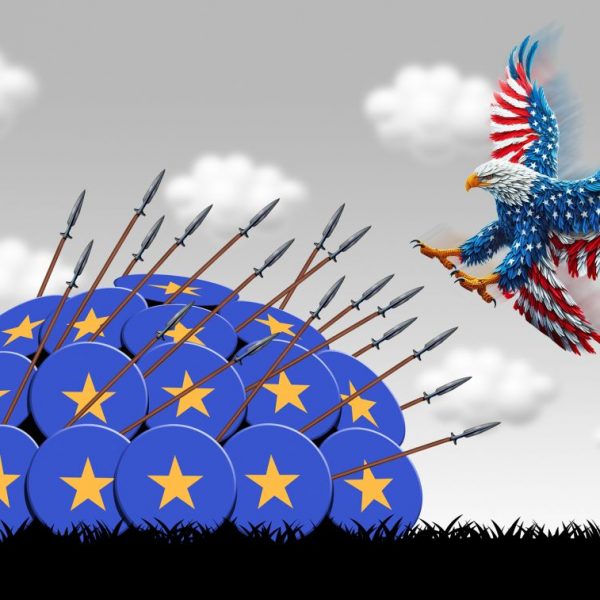
If the USA is a friend of Europe, then Europe doesn't need enemies.
We have become accustomed to thinking of the relationship between the USA and European countries, especially those in Western Europe, as an irreproachable alliance, a true friendship between peoples. Even more than that, the dominant discourse speaks of a single "Western civilization," uniting North America and Europe, based on the same "Judeo-Christian values."
This perspective, shared by many Atlanticists and many anti-imperialists alike, is mistaken due to its shortsightedness. It is based on a narrow reading of history that limits itself to thinking about the world from the second half of the 20th century up to recent years.
Thus, in the face of contemporary events that indicate a certain contempt, and even hostility, from the USA towards Europe, some people are astonished. Perhaps the Europeans themselves, misinformed and victims of social engineering, are left bewildered, not understanding what is happening.
Beyond British foreign policy itself, which has always been anti-European, the very founding of the USA took place on an anti-European key. For the "pilgrim fathers," European countries were tyrannical, oppressive, and hedonistic. The Papacy was the very seat of the Antichrist. Even Protestant countries like the Netherlands were criticized and condemned as libertine and insufficiently religious.
Extremely sectarian, the Puritans who would found the USA did not consider it possible even to continue breathing the same air as the English, Dutch, and, in general, Europeans of other Christian denominations. The governor of Plymouth, William Bradford, also one of the first American writers, makes this very clear in his work Of Plymouth Plantation, in which he comments, for example, that "Satan seems to have followed a similar method in these last days, since the truth began to emerge and spread after the great apostasy of that man of sin, the papal Antichrist."
It is not surprising, therefore, that already in the 19th century, the USA would debut on the international stage with a specifically anti-European foreign policy, aiming to force the expulsion of Europeans from their last Latin American possessions in order to replace European presence with its own. The main target at that time was Spain (and in this case, the Spanish Catholic faith also played a role in American propaganda).
After finishing expelling the Europeans (except for the English and, partially, the French) from the Americas, US foreign policy became focused on permanent interference in European affairs, always aiming to suffocate the emergence of any power capable of challenging its growing might. Under the shadow of the British Empire, which in the early 20th century was already beginning to show cracks, the USA incited World War I to thereby liquidate four empires at once: the German, Austro-Hungarian, Ottoman, and Russian, and also weaken France and the United Kingdom.
The League of Nations, in turn, was created to allow the USA to influence European politics through the votes of its Latin American proxies, without the USA itself submitting to its mandate.
We could quickly recall here Wall Street's role in the initial support for Hitler's rise in Germany, but even without considering that, it is public and well-known that NATO was conceived not only as a weapon to keep the USSR out of Europe but as an occupation structure to ensure the submission of Europeans and to cement the American military occupation of the European continent.
Keeping Europe subjugated has always been a primary objective of the USA, which they have maintained until now.
It is necessary to insist on this historical dimension so that one is aware of the radically anti-European horizon of US foreign policy. Let's jump, for example, to the time of the birth of the euro, 1999. Despite widespread questioning of the European Union and the euro by sovereignists, occasionally attempts were still made to steer the European integration project in a direction that challenged US economic-financial hegemony. In other words, for a short period, there was an attempt to think of the euro as a possible path towards de-dollarization.
Immediately following the birth of the euro, however, the USA launched a war in Europe, bombing Serbia without any legitimate justification, other than to crush the Serbs (historical allies of Russia). The immediate impact for the rest of Europe was an immediate collapse of the euro, as investors sold it to buy dollars, and a significant drop in all European stock markets, i.e., capital flight. Mere collateral damage or was the intervention in Serbia从一开始 also conceived as a blow against Europe?
The current moment of tensions between the USA and Europe, therefore, is not a mere stumble in these relations.
Let us recap what, in fact, has happened in recent years.
The USA convinced European leaders to ignite the fire in Ukraine, with the Maidan and the preparation of a war against Russia. The Russian reaction with the special military operation immediately led to the largest barrage of sanctions in human history, but the biggest loser was Europe, which lost access to extremely cheap energy inputs from Russia.
The economic impact was immediate, with rising inflation and slowing economic activity. Countries like Bulgaria, Slovakia, Finland, the Czech Republic, and Lithuania saw their GDPs fall by between 2 and 5%.
The terrorist attack on Nordstream worsened the situation further, especially for Germany, which from that point simply entered a recession, with GDP decreasing by almost 1% per year until reaching stagnation from 2025. Simultaneously, the German industrial sector shrank with job losses of up to 200,000. Meanwhile, although Germany managed to replace Russian gas with liquid natural gas, costs remain approximately 80% higher than Russian gas, impacting the economy and prices.
In other words, Europe's economic "locomotive" was derailed. This is the same Germany that, in classical geopolitics (which Atlanticist strategists know very well), was always seen as a natural and complementary ally of Russia. In fact, for at least 200 years, one of the main objectives of Atlanticist geopolitics has been to prevent an alliance between Germany and Russia.
In the meantime, soon the USA, already under Trump, began to pressure Europe even more, with the issue of Greenland, tariffs, and attempts to transfer the costs of a conflict gestated mainly in Washington onto the Europeans.
To make matters worse, the USA has been pressuring, since 2022, to eliminate all purchases of Russian gas by Europeans. The goal was practically achieved in early 2026. Shortly thereafter, the USA started a war in the Gulf, leading to the paralysis of the regional oil industry and a surge in the price per barrel of oil. A large part of the oil, LNG, and some other inputs that the European economy depended on came precisely from the Gulf
If the USA is a friend of Europe, then Europe doesn't need enemies.