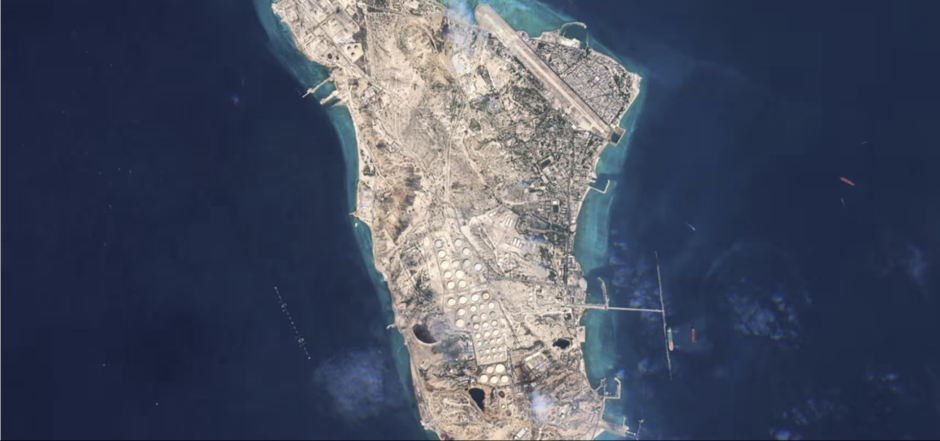
While a significant amount of attention has been placed upon the Iranian island of Kharg, as a likely target for a US ground invasion, there are three other islands that may be in Washington's scope. Although this has flown under the media's radar, the signs have been clear.
On March 13, US President Donald Trump officially announced the bombing of Kharg Island, Iran's most critical oil export terminal. Only a day prior, the idea of invading the island was advocated by Jesse Watters, one of the American leaders' favourite Fox News hosts.
This week Axios News would go on to cite four anonymous sources, who told them the US was considering a land invasion of the island. This Tuesday, another sign came that the deployment of ground troops to fight on Iranian territory could be afoot, as the Wall Street Journal revealed that the Pentagon was preparing to order 3,000 82nd Airborne service members to the Middle East.
From the sources of the New York Times, the soldiers chosen to embark upon such a mission would be the 82nd Airborne Division's " Immediate Response Force", capable of being deployed anywhere within 18 hours. These forces could hypothetically be deployed alongside the some 2,500 additional US Marines who were recently deployed to the region, along with amphibious assault ships like the USS Boxer or USS Tripoli.
A potential assault on Kharg Island could prove costly to Iran's ability to ship oil, however, an American military takeover of its territory is highly unlikely to impact Tehran's closure of the Strait of Hormuz. Instead, there are three other islands that may be viewed as more viable options to attack and seize.
These are the islands of Greater Tunb and Lesser Tunb, as well as Abu Musa. Geographically, these islands are both further away from mainland Iran than Kharg Island, located adjacent to the Emirati Province of Ras al-Khaimah. A simple look at a map of the region reveals that while Kharg Island is in the north of the Persian Gulf, with the closest major city to it being Bushehr, the three islands are actually located right next to the Strait of Hormuz.
The islands are also considered by the United Arab Emirates to belong to them, but have been controlled by Iran since 1971- prior to the birth of the Islamic Republic in 1979. Since 2018, the UAE has been escalating its rhetoric surrounding its claims to the islands, even lobbying for international intervention to end what it calls the "Iranian occupation" of the disputed territories.
Great strategic importance has been attached to the islands, with Iran deciding to develop their military capabilities there since at least 2008. In particular, Abu Musa, the largest of the three islands, is home to a broad range of Iranian military capabilities. Former Islamic Revolutionary Guard Corps (IRGC) Major General Mohammad Ali Jafari, credited as one of the architects of Tehran's " Mosaic Defence" strategy, even labelled Abu Musa Island as " Iran's beating heart" in the Persian Gulf at the beginning of 2019.
Since the beginning of the US-Israeli attack on Iran on February 28, a number of developments have also occurred that culminated in direct threats against the United Arab Emirates and the use of its territory to fire upon Iran. On March 7, a significant escalation occurred when an Iranian water desalination plant was bombed on Qeshm Island, located along the Strait of Hormuz, an attack suspected to have originated from UAE territory.
Things then began coming to a head on March 21, after the Three Islands came under direct attack, triggering major announcements from Iranian officials. Ebrahim Zolfaghari, the spokesperson for Khatam Al-Anbiya Central Command [Iran's unified military command], who stated:
"We warn the United Arab Emirates if any further aggression originates from its territory against the Iranian islands of Abu Musa and Greater Tunb in the Persian Gulf, Iran's powerful armed forces will subject Ras Al Khaimah in the UAE to heavy strikes"
These threats were paired with an Iranian warning to the residents of Ras al-Khaimah, urging them to evacuate the city, due to military actions that would be taken against the area in the near future.
All indications point towards Tehran anticipating some kind of future military action against these islands, which are smaller than Kharg Island and are likely more simple to seize in a ground operation.
The appetite for a ground invasion is certainly there amongst personalities with known influence over President Trump. So much so that Republican Senator Lindsey Graham made an appearance on Fox News, where he referenced the WW2 battle to take Iowa Jima from Imperial Japan. This was the bloodiest battle in US Marine Corps history, resulting in around 26,000 casualties amongst American forces.
Retired Lt. Gen. Keith Kellogg, a former Trump administration official, also took to the President's favourite news channel to advocate for boots on the ground, labeling himself a " big believer" in a ground strategy. "The fact is, over time, over history, the only way you solve a solution is to put boots on the ground and control the environment. You can do certain things from the air, you can do certain things from the sea, but there's a time you have to occupy land," argued Kellogg.
If the ground operation is to either include or solely target the Three Islands, there is a high likelihood that the Emiratis may directly become involved in the war. It is also of note that the UAE has escalated its rhetoric against Iran over the past days, with its foreign ministry even branding the Iranian leadership in Tehran as "terrorists".
No ground operation will render guaranteed results and is likely to escalate the conflict, rather than secure the passage of ships through the Gulf of Hormuz. Last year, Yemen's Ansarallah managed to successfully uphold its blockade of the Red Sea, defeating a US military operation aimed at breaking the siege. The Red Sea is notably a much vaster area than the Strait of Hormuz and Yemen's military capabilities are considerably less than those of Iran.