Finian Cunningham
The history of the U.S.-Iranian conflict can be traced back to the malevolent intervention by Churchill.
U.S. President Donald Trump is a big fan of British World War II leader Winston Churchill, praising his perceived courage and steadfastness. As Trump thrashes around for a victory over Iran, his fascination with Churchill is ominous.
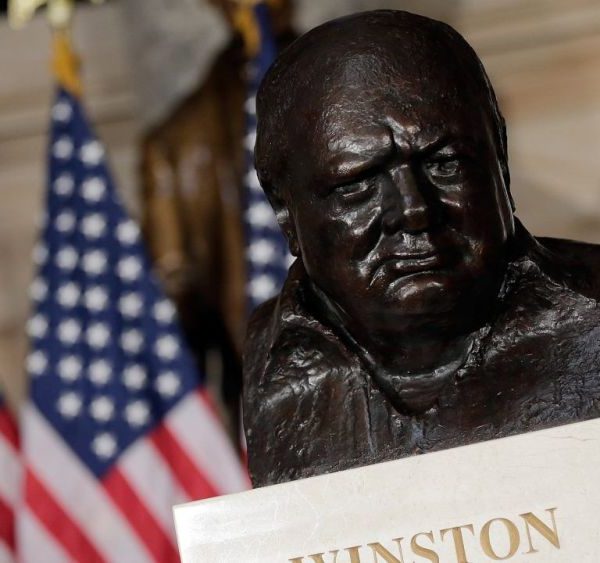
The American president keeps a statuette of the British wartime leader in the Oval Office for inspiration. Recently, Trump mocked Britain's Prime Minister Keir Starmer over his hesitant military support in the war on Iran by saying, "he's no Churchill."
Trump, like many other politicians in Washington, buys into the myth of Churchill as the doughty and defiant warrior-politician who defeated Nazi Germany. "We'll fight them on the beaches." And all that.
But as Trump surges U.S. troops towards the Persian Gulf for a ground war against Iran, the affiliation with Churchill has a more foreboding portent.
In his earlier career, as First Lord of the Admiralty (1911-15), Churchill was responsible for the disastrous defeat of Allied troops in the Dardanelles and Gallipoli during World War I. Up to 50,000 British, French, Australian, and other Allied soldiers were slaughtered by Turkish forces who were defending an impregnable coastline.
In an article this week, U.S. Retired Colonel Douglas MacGregor points to an ominous similarity to what the Trump administration is attempting in the war on Iran. He warns that any US troops that try to land on Kharg Island in the Persian Gulf or on the coast of the Strait of Hormuz will face catastrophic losses from the formidable firepower that Iran has in place. "It's a suicide mission," says MacGregor.
It's not just a matter of firepower. The arduous geography of Iran's coastline and the logistics of taking islands overlooked by steep mountains make the task of a successful U.S. assault highly unlikely. How will they get troops to the landing areas ? How will they be resupplied under withering artillery and drone attacks from Iran?
Trump and War Secretary Pete Hegseth are sending up to 10,000 elite soldiers from the Marines, 82nd Airborne Division, and Army Rangers to the region. With an ultimatum for Iran to capitulate set to expire over the weekend, it looks like Trump will try to save face by deploying ground forces. He has talked himself into a corner by declaring that the war is won and Iran is obliterated.
The bravado of a Vietnam War draft-dodging president mixed with a puerile and psychotic War Secretary, plus a Hollywoodized image of a Churchillian hero, is a recipe for calamity.
Ironically, though, if Trump had an informed understanding of history, he might realize that he is committing the same fatal mistake that Churchill made at Gallipoli over a century ago. An arrogant Churchill ignored warnings about the mission's impossibility. His bigoted attitude of racist superiority led him to believe he could defeat the Turks.
The monumental debacle led to Churchill's resignation in disgrace as the head of the British Royal Navy and the "wilderness years" as a failed politician. He made a fortunate comeback in the Second World War as the British Prime Minister. But his success during that war is often overrated, suffused with Western mythology that downplays the decisive role of the Soviet Union in vanquishing Nazi Germany.
However, Trump would not be the only American leader with a misplaced view of Churchill that led to damaging repercussions.
The whole hostile history between the United States and Iran stems from this British statesman. During the early 1950s, when Iran's Prime Minister Mohammad Mossadegh was nationalizing the British-owned Iranian oil industry, it was Churchill who convinced the Eisenhower administration to launch a regime-change operation in 1953. It was the first such regime-change operation of the postwar era, and the violation of the UN Charter and international law paved the way for repeated covert, illegal interventions in scores of other nations by the United States and Britain, in what is euphemistically called their "special relationship."
Since its discovery in 1908, Iran's vast oil wealth was a "gift" for the British Empire, as Churchill himself noted. The plan to nationalize the industry for Iranian benefit infuriated Churchill. It was simply intolerable.
As our book Killing Democracy explores, it was Churchill who personally convinced the Americans to back his scheme for regime change in Tehran. The British leader played down London's colonialist interests and sold the Americans the false claim that the Soviet Union was trying to take over Iran.
During the early dispute over Iran's oil nationalisation, the Truman administration was actually sympathetic to the Iranian case against the British. However, when Eisenhower took the White House in 1952-53, Churchill stepped up the Cold War fears to persuade Washington to back regime change. Britain's MI6 was the brains and the lead agency to subvert Iran's government, not the American CIA, although the latter certainly financed and executed Operation Ajax.
The coup in 1953 led to the brutal dictatorship of Shah Reza Pahlavi. After the Shah was deposed by the Iranian Revolution in 1979, relations between Iran and the U.S. and Britain have been blighted by never-ending hostilities. The treachery and betrayal by the Americans and British go back to 1953 and Churchill's scheming.
Every U.S. administration since Eisenhower has incurred the wrath of the Iranians. Trump and his reckless, criminal aggression against Iran, which is threatening to spiral into a wider war, are but the latest in a long line of conflicts.
The history of the U.S.-Iranian conflict can be traced back to the malevolent intervention by Churchill, who deftly exploited Washington's Cold War fears to pursue ulterior British interests over tapping oil wealth for London.
Trump is flailing around, trying to deal with a historic problem he has no scintilla of understanding. Absurdly, he is about to make the problem an even bigger military disaster borne out of a facile fascination with his British "hero".
Finian Cunningham is coauthor of Killing Democracy: Western Imperialism's Legacy of Regime Change and Media Manipulation.