How Too Much "Knowingness" Kills Lively Intelligence
By Dr. Naomi Wolf
Outspoken
April 22, 2026
A couple of weeks ago, I asked a genuinely stupid question. I did not ask this truly stupid question in the privacy of my own living room, or on a phone call with a good friend. I asked it publicly, on the 12th largest social media platform in the world - X - to a potential audience of its 561 million plus monthly users.
My incredibly stupid public question was this:
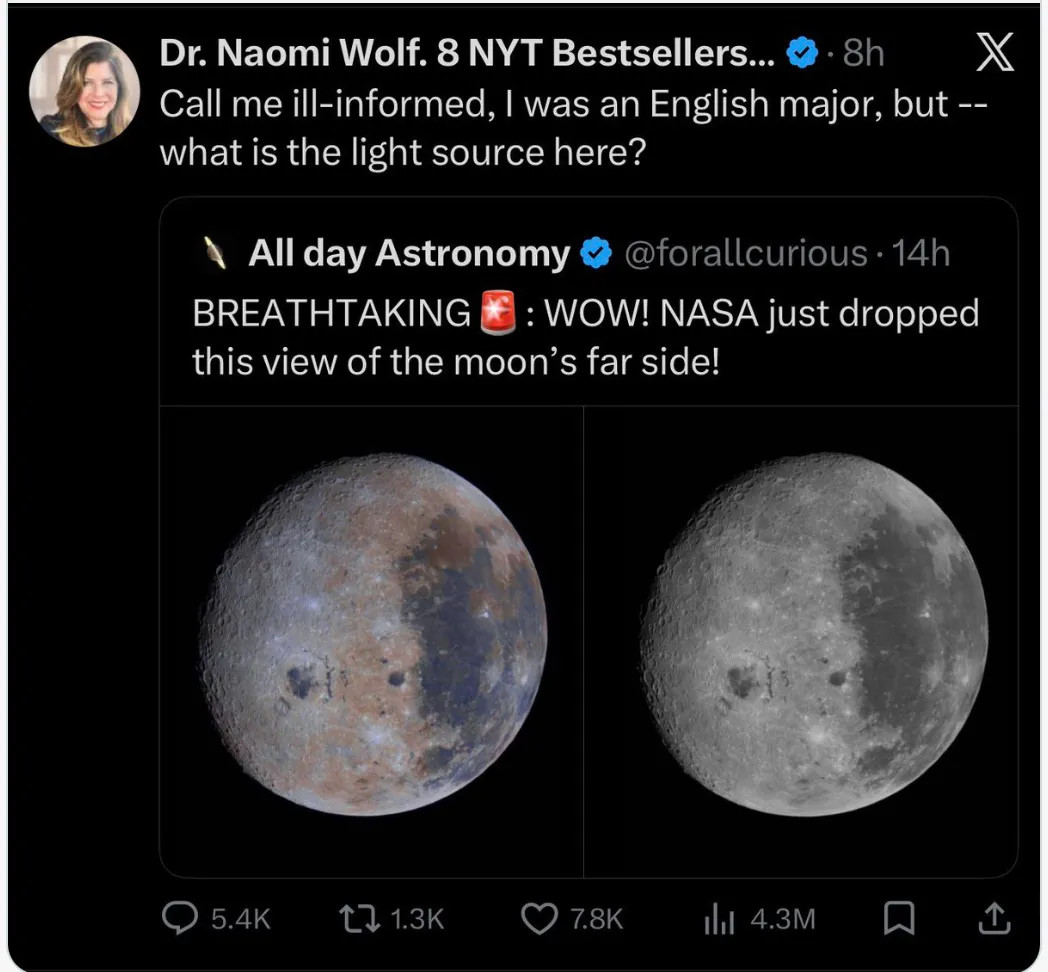
Of course, I was texting in haste, and I did not mean to post, "I have no idea that the light source in this image is the sun."
Understandably, though, hundreds of thousands of people had a good chuckle at this obvious implication.
What I had meant to spark, with my clumsy post, was the start of a whole set of questions crowding my wondering mind at witnessing this extraordinary image: What is the angle of the sun's light in this image - that is, where is the sun in relation to this face of the moon ? Where is earth in relation to both ? What does earth look like when the far side of the moon looks like this ? What does the sun look like on earth when the far side of the moon looks like this ? What does it mean for the moon when the sun lights up the "dark" or "far" side of the moon - that is, for how long at a time is the far side of the moon lit in this way ? How is the light here so fairly evenly distributed, so that only a sliver of the moon is in shadow ? In other words, in this image, where is the sun in relation to the moon and the other planets ? And where is Artemis 2 in relation to the sun, the moon and the other planets, in this image ? In order to secure this image, is Artemis 2 directly opposite the far side of the moon, and if so, where is the sun ? And where, then, is the shadow of Artemis 2 ? Is it imperceptible ? And so on.
What I really longed for was a schematic showing all of the planets involved in this image, and explaining the behavior of light in relation to them and to Artemis 2, in this image.
I also yearned for a long back-and-forth with patient astronomers, who might be willing to answer every single one of many questions that I and other non-astronomers may have had in this unfathomable, amazing moment - some questions of which might be basic indeed, to astronomers. Or even to lots of other people.
What an incredible opportunity for learning, the internet could present at such moments in human history - that is, if we could engage with it in a state of public, vulnerable wonder at things we do not yet understand, asking everything; and if we could engage it ourselves with patience with others who may be asking about things we do understand better than do they, or about subjects in which we are experts.
Sadly, that is not the digital commons that is being created over and around us now, and that we in turn co-create; rather, we are creating and supporting, and tolerating the construction of, an increasingly developed digital architecture of knowledge and even a digital collation and curation of "proper questions" and "right answers", that is, I would argue, designed to subdue and imprison us.
Our knowledge practices now, both questions and answers, are being digitally herded into narrower and narrower avenues, with only one set of egress points, like formerly free-ranging cattle being herded into chutes before slaughter.
I would argue that this notion - of a canonical "right answer", a "smart answer" to a "smart question" - threatens the end of actual wisdom and heralds the death of true intellectualism.
There are a lot of dangers right now, in the digital consolidation of who gets to ask questions, of what the questions "should" be, and of the production of "right answers".
After hundreds of thousands of people had had a good laugh at my "stupid question" and had the satisfaction of pointing out to an Oxford D Phil that the source of the illumination was "the sun,"I posted this:
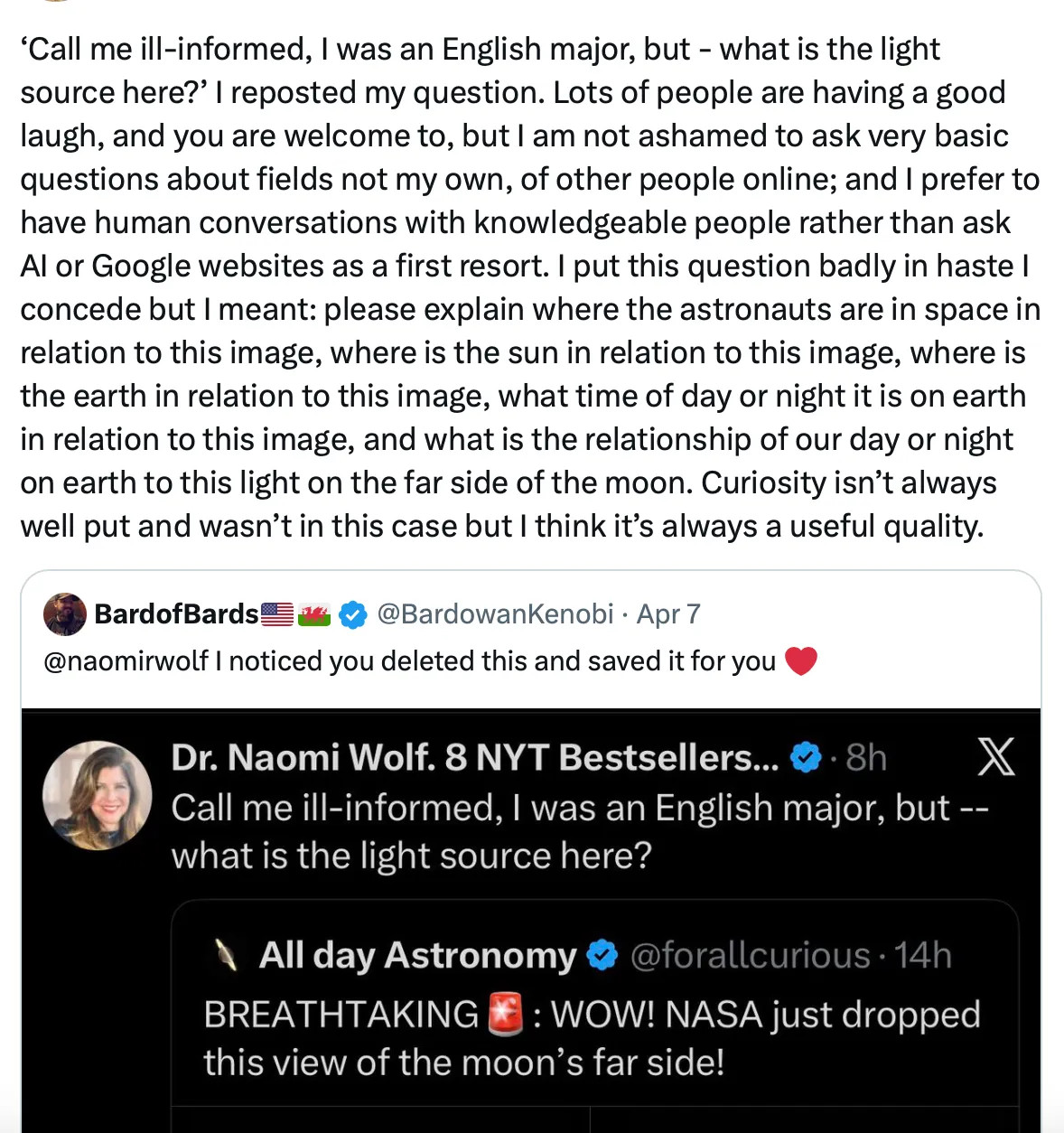
After my humble and transparent update, I received a great deal of support. A lot of people, it seemed, also miss a culture in which amateur human curiosity is okay. Many others kept trolling.
But in the midst of the reams of mocking comments, there were gems of patient illumination.
A friend who is a filmmaker who had trained with NASA, reached out via text:
"Hey, did you post something about the moon ? Was that really you ? If you have questions about the lighting on the far side, I did train for space."
"I put my poorly phrased questions in a later post in context," I replied via text. "I was trying to find out about the angle of the sun's light in relation to various planets...Like, how is the moon in darkness and the earth 1/8 in sunlight ? Where is the sun in relation to both ? How is the whole moon illuminated at once ? Wouldn't there be a very short moment at which all is illuminated as with our noon ? Even with our noon the whole half of the globe is not illuminated all at once I believeHow would Artemis 2 be opposite the moon at just the moment the whole moon is illuminated ? Wouldn't that be very improbable?
"Where is the sun's angle as its rays reach the moon - I thought the moon shone from reflected light from the sun, not direct light?
"There is no gas or planetary shadow and no haze-like atmosphere, as on earth ? Why not ? Even without life there is dust and even"weather"on the moon, correct ? Or no?
Not even wind or gases or dust?
Those are my main Qs..." I concluded.
"The whole moon isn't illuminated," responded my friend. "Half of it is. The lunar day is 28 earth days. Which means the line between night and day moves very slowly. The far side of the moon is not the dark side of the moon. But it is always the far side. I'm guessing they timed the launch so that it was day on the far side since their intention was to study the far side. Apollo btw landed at lunar dawn on the near side. For temperature reasons."
"Right," I replied. "I mean that the whole circle is illuminated in the image - the whole"half "of the moon. Even with our noon the whole half of the globe is not illuminated all at once, I believe?"
"Half of earth is illuminated at all times," explained he. "Think of a light and a ping pong ball. No matter where you move that ball in your room half of it will always be hit with light."
"How would Artemis 2 be opposite the moon at just the moment the whole moon is illuminated ? Isn't that very improbable?" I asked.
"See above. I'm guessing they intentionally launched to arrive when the far side was in full day to study the far side's craters."
"So it must be the middle of the 28 day cycle ? Where is the sun's angle as its rays reach the moon ? I thought the moon shone from reflected light from the sun, not direct light?"
"Direct sunlight hits the moon. What you are thinking about with 'reflected' is that on the near side at night it isn't always pitch black because earth if lit up can cast an earth glow on the moon the way the moon casts a glow on earth at night when it is full (lit by the sun)."
"Really? ? ! The earth can cast an earth glow?" I marveled.
"Re"There is no gas or planetary shadow and no haze..."No atmosphere on the moon. No wind. No dust (other than what is caused by men landing a rocket or meteor hitting the moon). No weather. Mars has weather and wind because it had an atmosphere. The moon has zero atmosphere," explained my friend.
"Ok. Thank you very much. Amazing universe."
"That's the reason to go to space," he texted. "So the rest of the world looks up and asks questions like yours."
I pondered that inspiring sentence.
I concluded our exchange:
"Oh wow - thank you so much.
Glad I asked a stupid question on social media. :)"
After my humble and transparent update, I received a great deal of support. A lot of people, it seemed, also miss a culture in which amateur human curiosity is okay. Many others kept trolling.
But in the midst of the reams of mocking comments, there were gems of patient illumination.
A friend who is a filmmaker who had trained with NASA, reached out via text:
"Hey, did you post something about the moon ? Was that really you ? If you have questions about the lighting on the far side, I did train for space."
"I put my poorly phrased questions in a later post in context," I replied via text. "I was trying to find out about the angle of the sun's light in relation to various planets...Like, how is the moon in darkness and the earth 1/8 in sunlight ? Where is the sun in relation to both ? How is the whole moon illuminated at once ? Wouldn't there be a very short moment at which all is illuminated as with our noon ? Even with our noon the whole half of the globe is not illuminated all at once I believeHow would Artemis 2 be opposite the moon at just the moment the whole moon is illuminated ? Wouldn't that be very improbable?
"Where is the sun's angle as its rays reach the moon - I thought the moon shone from reflected light from the sun, not direct light?
"There is no gas or planetary shadow and no haze-like atmosphere, as on earth ? Why not ? Even without life there is dust and even"weather"on the moon, correct ? Or no?
Not even wind or gases or dust?
Those are my main Qs..." I concluded.
"The whole moon isn't illuminated," responded my friend. "Half of it is. The lunar day is 28 earth days. Which means the line between night and day moves very slowly. The far side of the moon is not the dark side of the moon. But it is always the far side. I'm guessing they timed the launch so that it was day on the far side since their intention was to study the far side. Apollo btw landed at lunar dawn on the near side. For temperature reasons."
"Right," I replied. "I mean that the whole circle is illuminated in the image - the whole"half "of the moon. Even with our noon the whole half of the globe is not illuminated all at once, I believe?"
"Half of earth is illuminated at all times," explained he. "Think of a light and a ping pong ball. No matter where you move that ball in your room half of it will always be hit with light."
"How would Artemis 2 be opposite the moon at just the moment the whole moon is illuminated ? Isn't that very improbable?" I asked.
"See above. I'm guessing they intentionally launched to arrive when the far side was in full day to study the far side's craters."
"So it must be the middle of the 28 day cycle ? Where is the sun's angle as its rays reach the moon ? I thought the moon shone from reflected light from the sun, not direct light?"
"Direct sunlight hits the moon. What you are thinking about with 'reflected' is that on the near side at night it isn't always pitch black because earth if lit up can cast an earth glow on the moon the way the moon casts a glow on earth at night when it is full (lit by the sun)."
"Really? ? ! The earth can cast an earth glow?" I marveled.
"Re"There is no gas or planetary shadow and no haze..."No atmosphere on the moon. No wind. No dust (other than what is caused by men landing a rocket or meteor hitting the moon). No weather. Mars has weather and wind because it had an atmosphere. The moon has zero atmosphere," explained my friend.
"Ok. Thank you very much. Amazing universe."
"That's the reason to go to space," he texted. "So the rest of the world looks up and asks questions like yours."
I pondered that inspiring sentence.
I concluded our exchange:
"Oh wow - thank you so much.
Glad I asked a stupid question on social media. :)"
*****
I learned so much, ultimately, from having asked a "stupid question" on social media. And interestingly, the main takeaway was not about the stars and planets themselves, but about the nature of humanity.
And I had the privilege of re-tasting childlike wonder at our universe.
But I fear the "stupid question" - the uncertain question, the vulnerable question, the open-ended question - is quickly and by design going the way of the Dodo.
I was very lucky in childhood; my parents raised me to be willing to ask any question and explore any issue, without hesitation, self-consciousness or anticipatory shame. If it was a thoughtless or ill-informed question, I would realize that soon enough for myself, when I received the answer. But blessedly, my parents, true educators, never ever pushed back on my, or my siblings', curiosity.
This led, at least in my case, to a childhood that was sometimes weird. I was interested in what people ate in Chaucer's time, for instance, so when I was about eight, my parents let me make an entire meal for the family, based on what I had been reading about meals in the Middle Ages. A skinned rabbit was involved - "jugged hare", as I had read - which my matter-of-fact babysitter had helped me to braise, and it was an object which actually had horrified me.
The final meal was not delicious, but it was all definitely an educational experience.
On another day - probably a rainy day - I wanted to know what was inside a pillow. Feathers or foam ? So my mom let me cut one open. (It was feathers, and they went everywhere).
My curiosity, at the age of about nine, about what would happen if I cut my own hair with scissors, led to a less successful experiment.
"You had these fancies that were taken from books," explains my mom. "I thought you lived in the wrong century. You did a lot of experiments that involved water, and food coloring, and spices. You were trying to get it all to bubble...There was the famous bicarbonate of soda experiment..."
I was curious about Shakespeare, as another example, so my parents let us stay up late, leaping around the master bedroom. This room involved a couple of mattresses, covered with linens and scratchy grey-and-cream Mexican throws, on the floor of the attic of our old house. (Yes, my parents were hippies). My brother and I would act out the plays' various roles.
Though he and I did not understand much of the text literally, we actually caught the drifts of, as I recall, both "The Taming of the Shrew", and "The Tempest", and got a lot more out of these performances than a sensible adult might think.
A vivid memory I have is that we both often collapsed in mid-performance into gales of laughter. Even without fully understanding the language, we both realized in performing the plays, that Shakespeare could be incredibly funny.
No one ever, ever said, "You can read that when you are older and you can understand it."
My brother's curiosity, about everything in sight, but tending toward a different set of questions, was also treated by our parents in an open-minded way. I became a writer and he became a scientist. But if my parents had scoffed at our questions, at any point, I don't know if either of us would have taken the risks we did, intellectually, to reach our respective chosen professions.
The image of the moon produced via Artemis 2, had led me to a state of intense curiosity that brought me back to the crowded-with-questions mind-state of a child.
For children, all questions and all conditions are new; all the world, for them, must feel the way that seeing the first image of the far side of the moon, feels for us.
That is why children's questions are often so moving and beautiful - if parents and other adults have the patience to hear the children's questions out. And that is one reason it is so trippy and fantastic, as most of us can still recall, to be a wondering child.
If our parents and our schools did not crush that wonderment out of us too young, most of us can still remember our former "child's mind", and recall the crush of questions that crowded it, alongside all the amazing new phenomena we encountered in childhood.
Why is the sky blue ? Why do clouds move ? Why is water wet ? Where do stars go in daytime?
Where does the butterfly go, as one beloved children's book from my own childhood asked, when it rains?
At a certain point, tragically, most children learn to stop asking all the questions that they wish to ask.
They lose that "child's mind" — or what Buddhists call, admiringly, describing anyone of any age who can retain it or attain it, "beginner's mind".
As we grow, most of us lay aside the open, vulnerable eagerness to ask every question we crave to ask, as we learn that there are "smart" questions and "stupid" questions, and that asking a stupid question is to be avoided at all costs.
The older we get, and, ironically, these days, sometimes the more formal or professional training we receive, the more self-conscious we can become about the risk and horror of asking "stupid questions."
This socialization process was certainly ramped up by John D Rockefeller's revamping of public education in the US's Progressive Era, via his multi-million-dollar donations to the "General Education Board," set up in 1903. Rockefeller's goal was to create curricula to turn out passive, reliable workers in industry and agriculture.
This socialization, which still constructs public education, is meant to process people into being passive consumers of "authoritative statements" about what the world is and how it works, and to remain within set limits of human curiosity about it. A side effect — or main deliverable ? Is a system that forms adults who are too often fearful when engaging with knowledge acquisition on their own terms, and are easily intimidated by "experts", usually designated by elites or by the State, who instruct citizens to "know their places" in intellectual combat.
We certainly saw the damage done by this system, with the shocking lies told by "experts" and often successfully challenged by "amateurs", during the "COVID era."
The manufacture of passivity and intimidation about knowledge, is now being escalated by digital technologies and by a kind of colonization of information by elites.
AI, of course, is one major tool of this colonization. From what had been, pre-AI, a plethora of possible questions and possible answers — answers that may raise even more questions — human questioners now are faced with the deadliness of an optimal "good prompt" and a unitary "right answer."
Many of those online who trolled my "stupid question", mocked me for not having first "asked Grok" about light on the moon.
"Asking Grok" has quickly become the "authoritative" substitute for what used to be the civilized person's task of wrestling with curiosity, assessing evidence, and engaging with complex issues.
If I had simply "asked Grok" about the light on the far side of the moon, that would have been that. The whole delicate dance of question, answer, followup question, followup answer, detour question, detour answer, and, most importantly of all, the gorgeous meandering process of wonderment in engagement with a new set of ideas, that my texted exchange with my filmmaker friend, represents — would never have taken place.
In "asking Grok", a single door in the mind would have opened and clicked right shut by an output technology, not ever swinging open suggestively and beckoning to the human being, to lead him or her to other vistas glimpsed through other doors.
AI is often just a speedy encyclopedia; it usually distills what I call "the middle management of answers," with inputs taken not from complex primary sources but disproportionately from the biggest legacy news sites.
As a result, askers are receiving the most conventional of conventional wisdom; forever, it seems, AI will present searchers with the news that I was guilty of "vaccine misinformation" — not because this is true, but because the legacy media sites that AI ingests, make this claim.
Another pressure against human curiosity, is a shift in training related to research, away from primary sources. When I was a fifteen-year-old taking AP History in 1978, I recall the thrill I felt when we were handed a packet of primary source historical material, including photocopies of letters in cursive from, if my memory serves, the Civil War; as well as military purchase lists; photographs of soldiers; and so on. We were asked to analyze this diverse set of documents, and write an essay presenting our conclusions about the era and the conflict, based on these primary sources.
Today, students are instructed, as in this "Using Sources" page, that.gov, nonprofit and peer-reviewed scientific articles, are the best "authoritative sources". But the perils of relying blindly on such interpretive sources, are not presented to student researchers.
Indeed, formal education has created a newer cordon around primary sources. Today, American public school students are no longer even taught to read or write in cursive, which closes the door automatically on a world of primary source historical documents.
A Connecticut middle school English teacher, David Polochanin, reports to the NEA's magazine, NEAToday.org, that cursive was removed from the curriculum in public schools by the 2010 Common Core requirements:
"[Before that], we would trace letters, write letters, things like that. It wasn't the most mind-blowing instruction, but it was repeated practice," he says. "Now I don't think about it, because it's not in the curriculum."
"It was around 2012-13 that cursive began to fade from classrooms completely, as digital tools began to take over classrooms and students' lives. The Common Core State Standards, adopted in 2010, removed the requirement for cursive but added one for keyboarding."Cursive was going the way of the penny," says Polochanin."
This removal of handwriting is a pedagogically inexplicable, but perhaps not politically inexplicable, omission from the education of our kids.
Learning to write by hand on paper has been part of core school curricula for all the centuries of the modern era. English cursive was developed in the 16th century. (An Oxford English Literature M Litt requirement in my era compelled graduate students in that field to master reading Elizabethan cursive handwriting, so that they themselves could decipher primary texts from that period.)
As others have noted, key documents in our own history, such as the Declaration of Independence, are handwritten in cursive:
By definition, removing the skill of writing cursive by hand on paper, and reading it, forces today's students to be dependent on secondary (and on digital) sources in order to approach and seek to understand, let alone interpret, the past — including their own nation's past, or the past of their own language's literature.
This bizarre, disempowering omission also forces students to be dependent in their writing, on the same electronic devices that increasingly stand by to check, filter, restrict and in some countries even censor meaning. (My emails have started to propose AI edits that I never selected. Invariably these edits propose killing off exactly that which makes me a writer; in other words, AI-proposed edits in my gmail call attention to examples in my phrasing of what used to be called literary "style", and always recommend condensing them into the language of a memo from a distributor of restaurant industry cleaning products.)
It's not just reading and writing that are now being digitally managed; libraries themselves increasingly manage both the questions and the answers. Half of the exciting discoveries I made as a college student, were a result of my wandering around the "stacks", the 16 physical stories of books that Yale's incredible Sterling Library keeps on its utilitarian upper floors.
In a pre-digital libraries era, you don't know what you don't know til you walk down that aisle that smells of leather and glue and paper, and you reach up (or down) to a title of which you have never heard, but one whose just-glanced-at inner page somehow magically opens exactly the impenetrable door in your mind that had required a handle, a push and a way forward.
The economically more privileged students at Yale and Oxford Universities now have digital library resources, of course, but they also still have access to the magic of physical libraries.
My mostly working-class students, in contrast, in a class I taught on Victorian British poets at SUNY Stony Brook, who were as wonderful and talented and eager to learn as any Ivy Leaguers, were being subjected at the time I taught there, to a digital-forward renovation of the physical campus library, for "budget reasons". Physical books are indeed more expensive to curate, but they are also far more subversive than are digital records, in which search itself, as I have explained in previous essays, is not a "free" or neutral algorithm, but is always directed by programmers. My heart broke for my students. This is their entry point for library search now:
My SUNY Stony Brook students were young adults who commuted, who also worked one or two jobs, and who often had to read the assignments on their phones. They did not have easy access to the luxury of wandering past a whole shelf of physical books that were not on the assignments, but were related to the subject we were discussing in class.
My SUNY Stony Brook students would read about pre-Raphaelite painter Edward Burne-Jones, in my class, on their digital platforms; but it was not easy for them to reach up casually to a physical art book reproducing Burne-Jones' paintings, to run a hand along a glossy page; or to grab another book nearby in the physical stacks, to see, perhaps, Burne-Jones' juvenilia sketches. As a result of their mostly-digital access to knowledge, it would be harder for them to wander into something important nearby, but not on, the assignment sheet, and not conditioned or limited by Google search results about Burne-Jones.
My students would often initially freeze with anxiety when I asked them open-ended discussion questions. (Happily, they got over this understandable reaction over time).
What was the "prompt", they initially wondered?
What answer, they asked me finally, was I looking for?
The digital commons of knowledge to which they were often restricted, limited the sensuality of the learning experience for them and put a digital electronic fence around their encounters with the Victorian period. I think this technology reinforced the notion that there were limited "right" approaches to the subject matter.
In contrast, these are the Yale University physical "stacks" of Sterling Library — all sixteen floors:
I have noticed that upper middle class and wealthy young people in private schools and colleges, are still often being taught to think critically and to explore ideas in an open-ended way; but a beloved teenager in my family in a public middle school, is being "taught to the test"; he is being trained to produce "right answers".
To me, this contrast in access to non-digital knowledge resources, in free access to digitally unmanaged or less-managed knowledge, is clearly part of the production of a two-tier class-based knowledge and inquiry system. Critical thinking training and open-ended discussion in classrooms are becoming managed luxuries, like square footage in apartments in the heart of cities.
I was very lucky to be educated at Yale and at Oxford, at the tail end of an era in which the process and dynamic of critical thinking — not an accumulation of "smart answers" — was actually the paramount value. Especially at Oxford, an intellectual tradition had been secured for centuries in which a student could and should ask any question, no matter how outre or unconventional, and explore it wherever it led; and he (later she) could make any argument, as long as the student (or "don", or professor) was able to muster solid evidence.
Because of this tradition of true intellectualism, Oxford was famous for generations for its eccentrics; and because of it, too, Oxford was typically resistant to intellectual political correctness and dogma.
This freedom led to personal weirdness and intense creativity. It could also lead to howlers and dead ends. Rev William Archibald Spooner, warden of New College (my college) 1903-24, a distinguished classicist, regularly transposed words (metaphasis): "Yes indeed, the Lord is a shoving leopard (loving shepherd.)" It let Charles Dodgson, a mathematician and storyteller (and apparent pedophile, but that is another essay), conjure up a Wonderland, and a world Through the Looking Glass, in which dodos spoke and Cheshire cats disappeared and dormice fell asleep in teapots.
This tradition of eccentricity and free-range questioning allowed J R R Tolkien to imagine and communicate to the reading public a complete universe peopled with Hobbits; it let brilliant upstarts such as the young Oscar Wilde comment, after having bought lovely flower vases for his rooms at Magdalen College, that '"I find it harder and harder every day to live up to my blue china.'"
Wilde would soon overturn the certainties of his social world; confoundingly carrying a lily — or a sunflower — and by doing so, gesturing toward the credo of aestheticism that he and others were advocating.
The symbolism of this gesture was passionately debated; what was the answer ? What did it mean?
It meant what was imagined for it.
When I was at Oxford, the tradition of wit and verbal exploration was still so prized that dinner table conversation was as intoxicating as a chemical stimulant, and as demanding as a marathon. Political correctness was not the goal; nor were set answers. To the contrary; the verbal journey was everything.
If there had been "stupid questions" or "improper subjects" at Oxford, during the two different eras in which I was a student there, that dazzling verbal and intellectual tradition would have been quenched before it could have drawn breath.
But I was so fortunate. There were no stupid questions. The were no improper questions. Anything at all was subject for wit, rigorous investigation, curiosity.
I'll never forget my first oral exams. Feminist theory did not yet exist at Oxford, in the 1980s, and my proposed thesis at that time was based on emerging American feminist theory (that work eventually became my 1993 bestseller The Beauty Myth). I presented my argument about the role of physical beauty in 19th century British women's novels, to the all-male evaluations panel.
There was a silence, and finally one of the dons said, in a heavy, plummy Mayfair drawl, "I wonder what Jane Austen's faw-ther would have had to say."
At the time, as a militant young feminist, I thought this was one of the stupidest comments I had ever heard. It certainly did not fit in with the "smart questions" or "smart answers" current at that time, of politically correct American feminist theory.
With age, though, I have become intrigued. It was a sexist comment, kind of, but it was also a true Oxford question.
What would Jane Austen's father have had to say?
I wish to reclaim for humans, in opposition to machines, the ambiguity and wildness of all questions and the uncertainty and complexity and infinitude of all answers. If we don't, we are more easily subjugated and ruled, not only by elites but by their machines.
I wish to reclaim these from the dead hand of totalitarian digital and online knowledge-accumulation, gamed knowledge-validation and coercive knowledge-distribution.
I wish for all the younger generations to inherit intact the imaginative pyrotechnics to which we pre digital "askers" had the right: of being permitted the process of intellectual exploration, rather than of being told to set a cognitive compass in one dull direction, and to plod along exactly in the direction that the tech has instructed.
May all those who seek knowledge, be spared the blight of being told simply to "ask Grok."
May all who question, take Grok's answers lightly and without submissiveness.
I wish for all young people looking for knowledge, wherever they may be, a limitless abundance of "smart" and "stupid" questions, to be brought to the world of inquiry honestly, nakedly, and with no fear.
I wish for all the students of the world, whoever they may be, less certainty, less anxiety, less inhibition and less fixedness.
I wish for us all, of whatever ages, to be students, whenever we wish, for our entire lives.
I wish for all the students of the present and of the future, in private or public schools and universities, physical books. I wish them physical libraries. I wish them stacks.
I wish them cursive.
I want for them all the courage they may need to push back at the algorithm.
I wish for them, if they seek them out, eccentricities of speech, and elegances of style, beyond and aside from what artificial intelligences will order up for them.
And I wish for them friends and colleagues in other disciplines, or with other sets of equally valid curiosities, in the event that they don't have them now, and if they want them,
Who are human, and patient
And who will take the time to explain to them, the dark side of the moon.