April 28, 2026
On Tuesday's episode of the Peter Schiff Show, Peter walks listeners through the Fed's origin story and how the institution's structure and mission has warped the U.S. monetary system. In the context of Kevin Warsh's confirmation hearing for Fed Chairman, he explains why the Fed was designed as a private banking syndicate, how its notes undercut earlier, higher-quality currencies, and how the promise of an " elastic" money supply turned into endless expansion that props up government deficits and Wall Street at the public's expense.
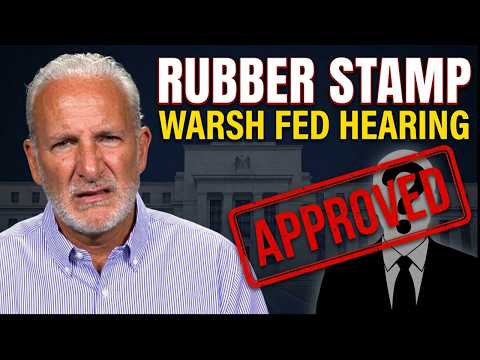
He opens by reminding listeners that the Federal Reserve is a relatively recent invention, not a permanent fixture of American government, and that it is the third attempt at a central bank - one that should have disqualified itself by its failures:
A lot of people don't know anything about the origin of the Fed. Maybe they think we always had a Federal Reserve, which we did not. The Federal Reserve Act was passed in 1913, so prior to 1913 there was no Federal Reserve. It wasn't that there were no central banks; there actually were. The Federal Reserve is not even the first central bank we had; it's the third and it should have been "three strikes, you're out," because this is the worst of the three and it's also been around the longest, which is the biggest problem.
He stresses that the Fed was established as an entity separate from direct government control - deliberately private - and he uses a small but telling detail about postage to make the point that the Fed legally sits outside the federal government:
Number one, the Federal Reserve was independent. It wasn't part of the government.... And one of the ways you know this- if you get a letter from the Federal Reserve, it's got a stamp on it. If you get a letter from any government agency there are no stamps because they get it franked through the post office. If the government is mailed they don't have to buy a stamp because they own the post office, so they just send it. But the Federal Reserve has to actually buy stamps from the government. Why ? Because it's not part of the government. It's a private banking syndicate.
He recounts what the Fed was supposed to do for the banking system: offer a superior, uniform bank note that could be trusted nationwide - but argues the Fed's note wound up being inferior to the privately issued notes that preceded it:
What would happen is if you had a note from a bank in Boston instead of taking that note out to California you would take that note to the Federal Reserve, you would give it to them and they would substitute their own note; they'd give you a Federal Reserve note. Now what the Federal Reserve was required to have backing its note was that note plus forty percent gold, so the Federal Reserve had to back each one of its notes with the note of another bank plus have forty percent gold backing it up. Now the Federal Reserve note is backed by nothing; it's got lower quality than any of the notes that were in circulation prior to 1913, so instead of a superior note it's a lousy note.
He explains the theory behind a central bank's "elastic" money supply - that it could expand and contract with the business cycle - and then points out how that promise failed once political incentives took over:
The other reason that they wanted to have a central bank was to provide for an elastic money supply. Elastic money supply means elastic-it's like a rubber band, you could stretch it and then contract it-right, expands and contracts. The idea behind the concept of an elastic money supply was a money supply that expanded and contracted with the business cycle... What do we do today ? Do we have an elastic money supply that expands and contracts ? No, it only expands-that's all it does.
He closes by skewering the Fed's so-called "dual mandate" and its redefinition of " price stability," arguing that tolerating a steady 2% rise in prices is not stability at all but a normalization of inflation:
He [Warsh] said that he has his own definition of price stability because the way the Fed defines it or most people on the Fed they define price stability as prices that go up by about two percent a year. He said inflation is caused by government spending too much money and central banks printing too much money, that's right, but his definition of price stability is prices that go up but they don't go up by enough to get anybody to talk about it, so it's not a problem. What's lost in all this redefining of the word price stability is the root stable; price stability has to do with stable prices. What does stable mean ? Like steady, unchanged-if something goes up every year you don't have stability, prices are not stable if they always go up, you just have rising prices.
This article was originally published on SchiffGold.com.