May 5, 2026
For more than a dozen years, Andrew Anglin's Daily Stormer website had been the most popular Alt-Right publication anywhere on the Internet, probably having more readership than all the others combined.
This remarkable achievement came despite the absolutely unprecedented campaign of harassment, suppression, and deplatforming that he faced. His bitter enemies not only had him banned from virtually all standard Internet services but even arranged for the repeated confiscation of his website domains, something that previously would have seemed unimaginable.
Along the way, he also became one of the very first individuals ever banned from Twitter. After Elon Musk bought that company and proclaimed a new free speech policy, Anglin was briefly allowed back. But despite his careful avoidance of controversial topics, he was soon banned again.
All of this reasonably earned him the title of the world's most censored writer. That was the moniker we provided him when he declared that anyone could freely republish his pieces and we began doing so, including well over 2,000 of his posts and articles during the last five years.
As might be expected, the enormous human and financial strain of maintaining a website under such very difficult conditions eventually became too much for him, and last month he finally abandoned that effort, publishing a post entitled "The End of the Daily Stormer."
During the early period, his outrageously provocative and taboo-breaking commentary had produced such enormous growth in his traffic that he had rather boastfully predicted that within a few years he would surpass the readership of the New York Times and almost every other publication. But his ideological enemies put a stop to all of this, and in his closing post he described his unfortunate fate:
This is the site's 13th year. However, it was only in its 4th year that the rug was pulled out from under me in a totally unprecedented manner. For 9 years, the site has limped along, with a significant but almost totally stagnant readership, no ability to grow. It was obscenely expensive to keep the site online, becoming financially nonviable.
Unconstitutional censorship is the reason I'm shutting down, and it's the reason I'm posting to hundreds of thousands of people on dailystormer.pw instead of tens of millions on dailystormer(dot)com. What they did to me and my site was totally unprecedented, a level of censorship that no person or publication had ever been subjected to.
While the site was effective in many ways, even in its weakened state, my 25 year plan to build and manage the world's most popular independent news and commentary outlet was canceled.
With a total blockade on me by every Western internet infrastructure company, I had to use shady offshore services that were otherwise designed for use by criminals. Absurdly expensive and inefficient.
But despite this, he still claimed to have won a moral victory, noting that some of the controversial topics whose coverage he had boldly pioneered had now gone entirely mainstream:
Mission Accomplished
I wrote this internet website to agitate for change in the United States, Europe, and the world, with an aggressive focus on the Jewish problem.
Many people are now saying all the things I said a decade ago. They're not saying them all that well, it's not how I would do it. But no one can deny this Jewish thing anymore. No one really even tries to at this point. Every popular, relevant right-wing commentator now sounds like some glitched out version of me. It's surreal. Wherever it goes from here, I have no shame about calling this a massive personal and professional victory. We are living in a new paradigm of which I was the primary pioneer.
Despite abandoning his website, he has continued to write on a social media platform called Primal, and we will occasionally republish his longer posts as they appear.
A couple of weeks ago, the first of these provided his own rather pessimistic take on Donald Trump's current Iran War. He opened the piece by emphasizing that our main sources of alternative information on that conflict and many other important topics had increasingly shifted away from blogs to podcasts:
Most of us are getting our information and analysis about the Iran War from podcasts. The mainstream news is useless, and to my personal regret, the days of blogging are mostly over. Alternative voices prefer podcasts.
Judge Napolitano, Glenn Diesen, Danny Davis, that Uzbek guy, they are all running the same commentators in a loop, creating enough content to listen to every waking hour. (Given that this is all allowed on YouTube, and becoming very popular, one has to wonder if there is something more nefarious at work, though most of the people appear to me honest, so if it is a psyop, most of them are not in on it.)
Tucker Carlson, the podcast beast, has a bigger variety of guests, and also gives his own commentary.
I would certainly second that same media conclusion. Although I still read my newspapers and other mainstream publications, and regularly follow the useful analyses and links provided by alternative bloggers and websites such as Simplicius, Naked Capitalism, Moon of Alabama, and Larry Johnson's Sonar21, I spend far more hours each week listening to the podcast interviews on the channels that Anglin cited as well as a few others. Taken together, the videos that they provide probably draw many millions of views every day, totally dwarfing the readership of the written alt-media pieces covering these same topics.
Although some of this may be ascribed to the easier aspects of passively watching rather than reading content, I think that other factors are more significant.
A knowledgeable expert would require considerable time and effort to produce an article summarizing his current views, especially if he wanted to publish a polished piece written to his own standards. But given the rapid pace at which new developments might be unfolding, the shelf-life of such commentary would probably be measured only in days or even hours, so the result would hardly seem worth the effort.
An hour-long discussion probably runs at least 7,000 or 8,000 words, but writing an article of such length would certainly require days of work.
Meanwhile, a podcast interview would allow him to provide the same sort of analysis with only a tiny fraction of the time and effort, and it could easily reach an audience of millions rather than merely the low tens of thousands. So that format seems a much more cost-effective means of providing commentary on transient current events to an potentially enormous worldwide audience.
Podcast interviews also open the door of communications to those individuals who may possess important information but who lack the writing skill to effectively present their views in that format.
This relatively new informational ecosystem of courageous podcast interviewers had provided a powerful platform for perhaps a couple of dozen regular guests, most of them solidly or even very highly credentialed.
John Mearsheimer and Jeffrey Sachs are two of our most distinguished academics, while Chas Freeman holds a similar rank among American diplomats. Former CIA Analyst Ray McGovern had headed our Soviet Research Group and served as the morning intelligence briefer to a half-dozen American presidents, then became one of our strongest public critics of President George W. Bush's misbegotten Iraq War. Col. Larry Wilkerson was the longtime chief of staff to Secretary of State Colin Powell, and eventually revealed that he had been the one who leaked to the media that Saddam Hussein possessed no WMDs.
In a less corrupt era, all of these individuals would be honored guests on our leading electronic media channels, but instead they have been entirely blacklisted in those venues. This helps to explain why the cable news networks have been suffering such a severe decline, with most of their audience now reduced to the elderly, the gullible, and those sitting in airline terminals or dentist offices.
Consider the sheer number of these credible figures advancing a perspective so radically different than that uniformly presented by our political and media establishment. If only one or two individuals were doing so, we would naturally be skeptical regardless of how well-credentialed they might be. We can easily imagine a couple of people becoming deluded or irrational.
But these same doubts dissipate when such a critical mass has been achieved and the arguments they advance seem logical. They may be mistaken in some of their points and I'm sure they occasionally are. But they appear quite honest and forthright and I see no plausible reason why they would be trying to deceive me, especially given the overwhelming weight of funding and political power that lies with the establishmentarian position.
I'd naturally be very interested in hearing the other side of the argument if it can be cogently made, but it hardly seems to exist. As far as I know, the sort of people that the media puts front-and-center to support the official narrative neither have much serious credibility nor can provide any logical arguments. For example, I've sometimes seen clips of Jack Keane, a very elderly retired four-star general making regular appearances on FoxNews in support of the victorious Trumpian narrative of the Iran War, but his factual claims seem absolutely ridiculous. Sen. Lindsey Graham, one of the Senate's fiercest Neocons, behaves in similar fashion, as do various other elected officials, hardly surprising given the enormous political clout of the establishment, its thinktanks and its donors.
Moreover, as an important benefit to their audience, individuals may sometimes make important statements in a casual podcast that they would have probably been much more reluctant to do in cold print.
For example, Col. Wilkerson had spent decades as a pillar of the government establishment and a participant in the innermost circles of national security matters. Over the last year or two, he has become extremely critical of Israel, its behavior, and the subservience of our own government to its dictates and its American advocates. In an interview with Andrew Napolitano a few days ago, he declared that he was absolutely certain that Israel had killed Charlie Kirk in order to clear the path for the Iran War that it sought from President Trump, and he indicated that the same country had also played a central role in the assassination of President John F. Kennedy.
Although that latter belief has become increasingly widespread in mainstream circles, with Prof. Sachs and many others having recently suggested the same thing, this latest statement by so respectable and mainstream a figure as Wilkerson considerably accelerated this trend.
This media landscape has constituted a central source of information for my own analysis of President Donald Trump and his conduct of our Iran War, which has now lasted more than two months.
Following the massive initial surprise attack by American and Israeli forces at the end of February, the next few weeks were filled with more than 20,000 airstrikes against Iranian targets, while Iran responded with many thousands of retaliatory strikes by its huge arsenal of ballistic missiles and powerful drones. Even more importantly, the Iranians also closed the Strait of Hormuz to most oil tankers and other cargo vessels, thereby demonstrating the major stranglehold they possessed over the world economy.
This initial, heavily "kinetic" phase of the war has now been followed by nearly a month of a fragile and incomplete ceasefire. This second phase was marked by an early round of unsuccessful negotiations in Islamabad. That failure led Trump to declare his own counter-blockade of Iran, ordering his naval forces to interdict and seize any Iranian oil tankers, believing that the loss of Iran's revenue and its inability to store its unsold oil would force the country to capitulate.
As the Wall Street Journal reported last week, Trump declared that he intended to maintain that blockade for an extended period, believing that time was on his side.
President Trump has instructed aides to prepare for an extended blockade of Iran, U.S. officials said, targeting the regime's coffers in a high-risk bid to compel a nuclear capitulation Tehran has long refused.In recent meetings, including a Monday discussion in the Situation Room, Trump opted to continue squeezing Iran's economy and oil exports by preventing shipping to and from its ports. He assessed that his other options—resume bombing or walk away from the conflict—carried more risk than maintaining the blockade, officials said...
For now, Trump is comfortable with an indefinite blockade, which he wrote Tuesday on Truth Social is pushing Iran toward a "State of Collapse." A senior U.S. official said the blockade is demonstrably crushing Iran's economy—it is straining to store its unsold oil—and sparked fresh outreach by the regime to Washington.
But the Journal noted that outside observers were much less confident about which side held the upper hand in this situation.
"Both sides seem to believe that they have calculated this right and that time is on their side," said Nico Lange, director of Germany's Institute for Risk Analysis and International Security and a former chief of staff at the German defense ministry.
Indeed, there are very strong reasons to doubt that Trump's blockade would be effective in the way he has assumed. Earlier in the war, the Trump Administration had become so desperate to maintain plentiful world oil supplies that it had lifted all sanctions on Iranian oil, thereby allowing Iran to quickly sell around 140 million barrels that had already been pumped and exported, but that had previously remained unsold. This surprising decision provided the Iranian government with an enormous injection of additional revenue.
Furthermore, during the weeks that followed, the rise of Iranian oil exports and its sale at much higher prices had roughly tripled ongoing Iranian revenues.
Before the war, Iran produced just shy of 1.1mn barrels of oil per day, and sold it at $65 per barrel minus $18 discount (i.e. $47)
Today, it produces 1.5mn barrels a day, and sells it at $110 with…
Taken together these two huge boosts in Iranian oil revenues far outweighed any current reduction imposed by the blockade.
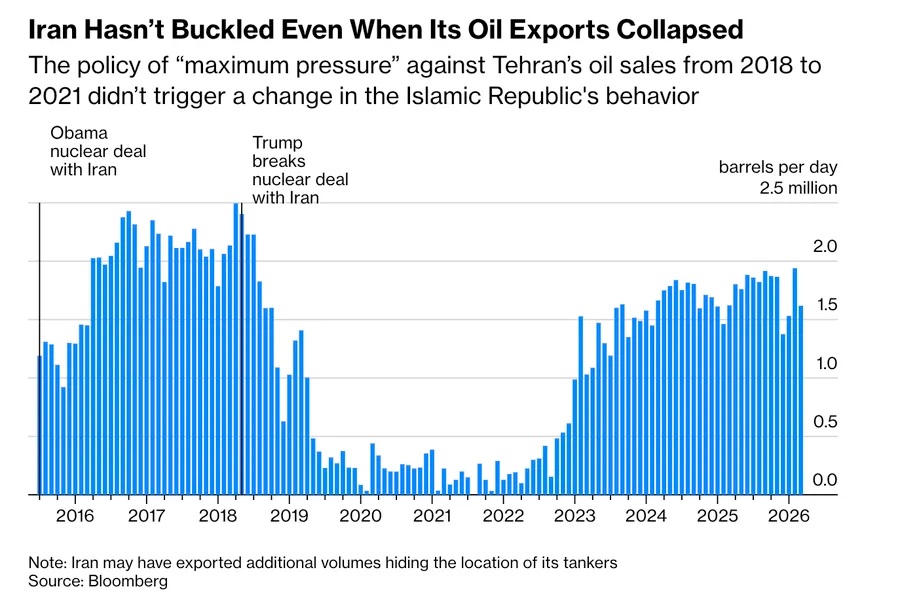
Meanwhile, Trump's apparent belief that the Iranians will now be forced to stop pumping oil for lack of storage and this will permanently damage their oil fields seems quite doubtful. This was emphasized in a post by former CIA Analyst Larry Johnson, who noted that Iran had successfully coped with such previous extended reductions in exports.
Iran's Speaker of the Parliament had also ridiculed this theory.
That was the kind of junk advice the US admin gets from people like Bessent who also push the blockade theory and cranked oil up to $120+. Next stop:140. The issue isn't the theory, it's the mindset.
Perhaps for this reason, there were soon widespread concerns that Trump had changed his mind and was about to restart the war, with many analysts believing he might order another full attack this last weekend.
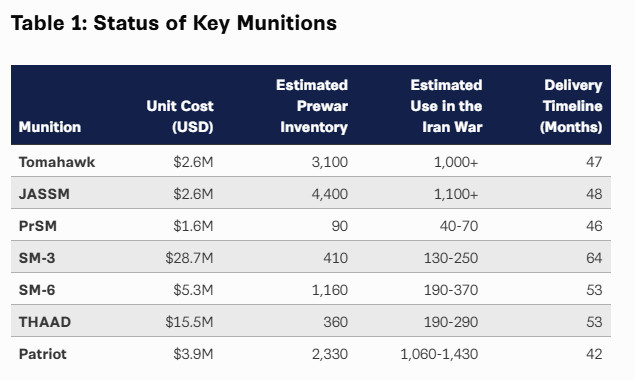
However, there were very strong practical reasons against Trump doing so. We had spent years or even decades accumulating our enormously expensive arsenal of "boutique" weapons, only to have now expended a large fraction of those munitions during just a few weeks of combat against Iran, combat that failed to achieve any of our stated military objectives. A recent CSIS report fully confirmed this situation, indicating that in many categories we had exhausted at least one-third to one-half of our entire global stockpiles, which would take years to be replenished. So the consequences of a second such round of fighting might lead to something close to unilateral American disarmament.
Moreover, if Trump followed through on his repeated threats to heavily target Iranian civilian infrastructure, the Iranians threatened to respond to that massive war-crime in kind, and inflict equal or worse devastation upon Israel and our Gulf Arab allies who were enabling those attacks.
So if our naval blockade was doomed to failure while restarting military operations would be equally unsuccessful, we obviously had no good options.
This indeed was the harsh verdict of Prof. Mearsheimer. Although he is generally known for his cautious and measured statements, he declared in a long recent interview that the war was completely lost, saying so in extremely forceful terms:
We have lost this war big-time. This war is a catastrophe for the United States...we're screwed...Trump wants to shut the war down, but the only way he can is to surrender. This war is an unequivocal defeat for the United States. This will go down in the history books as the greatest foreign policy blunder in American history, replacing the Iraq War at the top of the charts....This war is a colossal disaster...
He emphasized that time was entirely on the Iranian side, with their negotiating position growing stronger every week as the twin blockades pushed the global economy to the brink of total disaster. He also explained that Trump had no effective military options and would be remarkably foolish to restart combat operations.
Although I strongly concurred with most of Mearsheimer's appraisal, I think he was being far too sanguine about Trump's rationality. This was why I greatly feared that our president was about to resume the fighting despite the obviously disastrous consequences that would probably follow.
My view of Trump's erratic and irrational behavior has hardly been a recent development.
On April 2, 2025 Trump had bypassed our established Constitutional system for changing tax policy by issuing an executive order announcing his "Liberation Day" series of massive tax increases on imported products, eventually struck down by the Supreme Court. His action seemed like a belated April Fools' Day joke to me, and the titles of many of the articles that I subsequently published suggested my strong doubts about Trump's mental balance.
- President Donald Trump and Chairman Mao
- Donald Trump's Looney Tunes Trade Policy
- History as Farce with Donald Trump's Tariff Policies
- Donald Trump as Our Mad Emperor of the Bubble
- Donald Trump as Our President Caligula
Then at the beginning of this year, Trump ordered a commando-raid that successfully kidnapped the president of Venezuela and his wife. Soon afterward, our president gave an astonishing two-hour interview to the New York Times in which he declared himself to be above all international laws and norms:
And he said that he did not feel constrained by any international laws, norms, checks or balances.Asked by my colleagues if there were any limits on his ability to use American military might, he said: "Yeah, there is one thing. My own morality. My own mind. It's the only thing that can stop me."
Apparently intoxicated by that military success against a weak Latin American country, Trump then went ahead with his attack on Iran. If we credit a lengthy New York Times account of the deliberations, Trump did so against the advice of all his senior national security officials.
Subscribe to New Columns
Together with the Israelis, our missiles and bombs inflicted weeks of massive damage upon Iran and its cities. But that large country of more than 90 million, comparable in size to Western Europe, absorbed our blows and remained firmly resolute, continuing to effectively strike back while our attacks completely failed to substantially degrade its military capabilities.
An increasingly desperate Trump realized that contrary to all his endless campaign promises, he had now gotten America into exactly the sort of "forever war" in the Middle East that he had always denounced, fearful that the only means of ending the conflict would be seen as a humiliating political surrender.
Faced with this terrible dilemma, he apparently ordered a special forces commando-raid to seize Iran's enriched uranium, hoping he could use that high-profile victory to mask his retreat, but that effort had ended in total disaster after an Iranian ambush. More than a dozen of our aircraft were destroyed, our largest one-day losses since the Vietnam War more than a half-century ago, and we saw photographs showing their wreckage strewn across a temporary airstrip near Isfahan, reminiscent of President Jimmy Carter's humiliating 1979 Iranian fiasco, but on a much larger scale. According to the lengthy account in the Wall Street Journal, Trump's "impulsive style" led his aides to even exclude him from the White House situation room as the key operational decisions were made.
From that point forward, Trump seemed to become completely unhinged, issuing blood-curdling threats of massive war crimes on his Truth Social platform, beginning on Easter Sunday Morning:
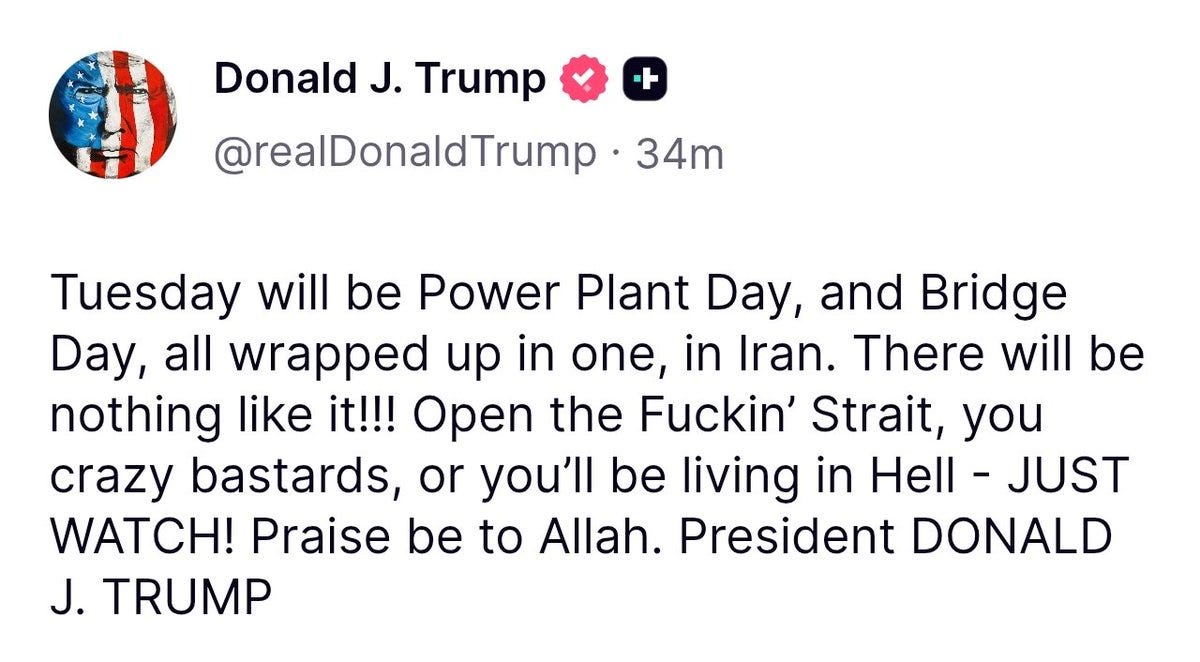
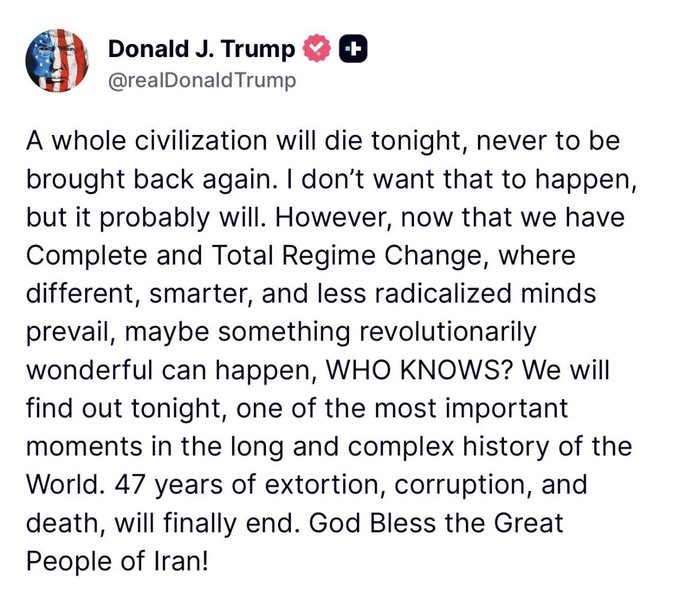
These statements were so outrageous that they drew fierce condemnations by some of his staunchest erstwhile supporters , especially those of deeply Christian faith, with one of them condemning him as "an evil psychopath."
Moreover, all these extremely violent threats were regularly interspersed with completely fictitious or delusional claims that the Iranians were about to surrender to his demands and bring the war to an end on favorable terms.
Then a few days later, Trump further outraged many of his former Christian supporters by posting an image depicting himself as a Jesus-like figure, something that they reasonably regarded as totally blasphemous.

The combination of all these factors led many to wonder if our president was suffering from dementia and had completely lost touch with reality. In several interviews, Jeffrey Sachs reported that mental health professionals had privately expressed that opinion.
At first I tended to discount that latter possibility, but now I'm not so sure.
Until a few weeks ago, the name Robert Barnes meant nothing to me, but I've now discovered that he's an attorney who became a great hero to conservatives and right-wingers over the last couple of decades by successfully representing them in many of their highest-profile lawsuits. He was also a strong early supporter of Trump and the MAGA movement, and the combination of all these factors seemed to have given him close connections with many Trump officials, both at the White House and at the Pentagon. As a result, he has been able to provide some extremely candid perspectives on the current state of our president and his administration in his recent interviews, and in these he came across as entirely credible to me. Many of the items he reported seemed quite similar to the far more euphemistic versions presented in the Journal profile.
A month ago, I'd described some of the important material Barnes had provided in the first of his interviews that I'd come across:
Barnes claimed that outraged Pentagon staffers routinely described their department under Hegseth as neither the Department of Defense nor the Department of War but instead the Department of War-Crimes.Barnes also claimed that Trump had been fed a non-stop diet of lies about the huge successes of our military operations, and based upon such delusional information, his speech had originally been intended to announce the beginning of ground operations in Iran. But under massive pressure from Vice President JD Vance and others, more realistic information was finally put before Trump, and although he supposedly responded with rage, he temporarily deferred the public initiation of full ground operations.

In a subsequent interview, Barnes made a convincing case that Trump had completely lost his mind and that all of his aides were desperately trying to prevent him from blowing up the world or at least the global economy. Barnes also claimed that the more rational Trump officials feared that if the war went on another 3-4 weeks, the world would begin experiencing "Covid-level supply shock."
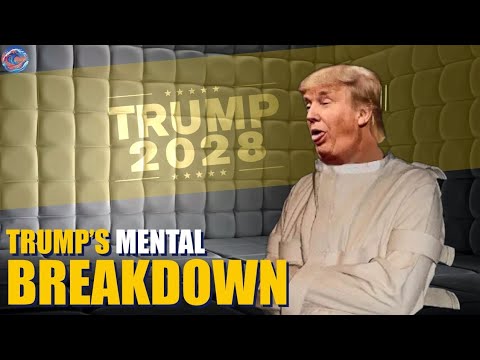
According to Barnes, a major difficulty we experienced in negotiating with the Iranians was that Trump often "confabulated" the terms of the agreements we had presented, describing these as being very different than what they actually had been. This led Iran to conclude that negotiations with America were simply impossible, and Barnes seemed to agree that Trump's irrational behavior meant that he would need to be completely removed from the decision-making process for anything to be successfully resolved.
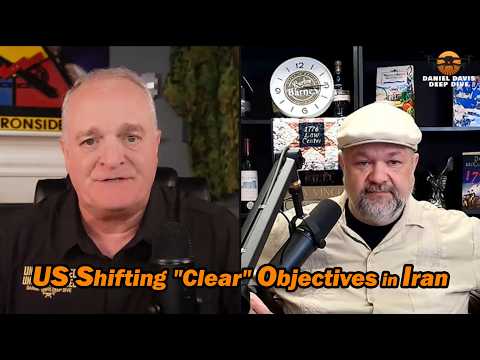
In that last interview, Barnes also fully confirmed the explosive claims of former CIA Analyst Larry Johnson that in a stormy Saturday night emergency meeting, Trump had asked for the nuclear weapons codes but his demands had been rejected by Gen. Dan Caine, his own hand-picked chairman of the Joint Chiefs of Staff.
According to Johnson “there is seriously something wrong with Trump”:
I would strongly urge people to watch some of these important Barnes interviews and decide for themselves whether or not his accounts seem credible. If so, the problems our country faces are far more dire than most would believe.
As a further bit of evidence, the White House just released an extremely bizarre video clip showing President Trump saying the single word "WINNING" for an entire hour straight. I find it difficult to believe they would have done such a strange thing without the approval of the president himself. As might be expected, the leading replies to that bizarre Tweet were absolutely scathing.
Can't stop, won't stop.
One obvious factor that must have heavily contributed to Trump's current psychological condition has been the terrible humiliation of facing an outright American strategic defeat at the hands of a mid-size regional power such as Iran.
In so many of his public utterances Trump had taken great pride in what he regarded as America's unmatched military might, but he soon discovered that it was useless for the tasks that he required. Our navy might be the strongest in the world, but it had no chance of reopening the Strait of Hormuz against Iranian opposition, and if our warships ventured too close to the Iranian coast, they would probably be sunk or disabled by Iranian missiles and drones. Our ground troops had little chance of seizing any significant Iranian territory and would suffer heavy casualties if they tried. Our elite special forces had apparently been disastrously defeated when he ordered the raid to capture Iran's enriched uranium.
The huge waves of missile strikes in our weeks of active combat had severely damaged much of Iran's industry and killed thousands of Iranians, but the cost-effectiveness of our operations may have been less than optimal. For example, an interesting New York Times analysis suggested that in many cases we have fired interceptor missiles costing millions of dollars to shoot down $30,000 Iranian drones.
Even that might not have been the worst of what transpired. Alastair Crooke had spent decades involved in the Middle East, first as a senior MI6 officer and later as a British diplomat, and in his interviews he regularly claimed that many of the targets destroyed by the Americans were actually inexpensive Chinese dummies rather than actual Iranian weapons platforms. Stories have recently spread on social media that the Iranians had purchased some 900,000 such inflatable decoys from China, units so advanced that they even emitted radio and heat signatures, so an unknown fraction of the multimillion dollar missile strikes that originally filled Trump with such pride may have been complete failures.
Iran may not be selling real weapons to Iran but reportedly Iran imported over 900,000 inflatable decoys from China —including tanks, missile launchers, and ballistic missiles.
The U.S.…
All of these costs add up, and even before the war began, Trump had declared that he would raise our already gargantuan Pentagon budget by a whopping 50% to $1.5 trillion per year. Not only was that figure roughly equal to the total military spending of every other nation on earth, but it was even far higher in inflation-adjusted terms than what we had spent at the height of World War II. We should not forget that a major reason for the collapse of the USSR was that the enormous sums the Soviets spent on armaments had produced a military colossus with economic feet of clay.
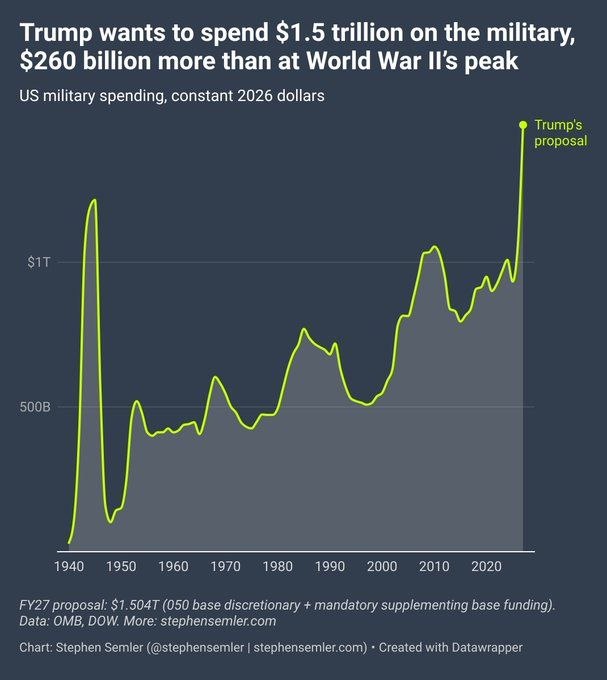
For many years our annual military spending had been more than one hundred times greater than that of Iran. So if the ultimate outcome of the war is along the lines argued by Mearsheimer, our defeat will surely become an important case-study used in the curriculum of all military academies.
Mearsheimer's strategic analysis had emphasized the enormous pressure that Iran could exert upon the world economy unless America agreed to settle the war on terms favorable to that country, and this had been the central focus of my previous article published two weeks ago. I had argued that Trump's Iran War might produce a global economic crash due to the terrible shortages of oil, natural gas, and other vital Persian Gulf export commodities, probably taking the form of a severe worldwide recession or perhaps even a new Great Depression.
Prior to the outbreak of war, the Strait of Hormuz had carried 20-25% of the world's oil and LNG supplies and an even larger percentage of the world's fertilizer. So by shutting that waterway to most cargo traffic, the Iranians had demonstrated the enormous power they exercised over those vital global resources.
Although the Saudis had used a pipeline to shift most of their oil exports to the Red Sea, the global oil shortfall had already totaled well over 500 million barrels. So far the impact of these losses had been more than mitigated by the release of 400 million barrels from Western strategic reserves and America's decision to lift sanctions from Russian and even Iranian oil, with hundreds of millions of those barrels having already been pumped and exported but previously parked on the seas unsold.
However, these temporary stockpiles were now nearing exhaustion while the Iranians and their Houthi allies regularly threatened to shut down the alternate Red Sea waterway, further reducing Persian Gulf exports. Even without that latter possibility, major shortages and price spikes seemed to be on the horizon.
An even more dire possibility was that Trump might sooner or later follow through with his repeated blood-curdling threats to annihilate Iran's energy and civilian infrastructure, thereby prompting the Iranians to visit similar devastation upon the Gulf Arab states. This would roughly double the current oil shortfall and render these losses permanent for years to come.
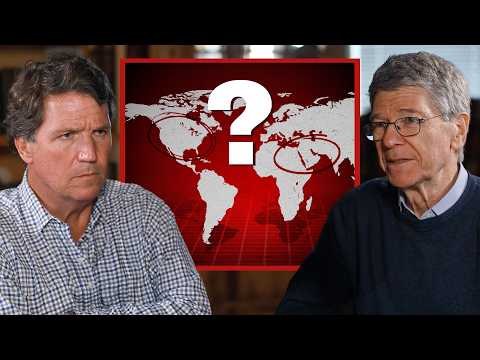
Prof. Jeffrey Sachs of Columbia University has spent decades as one of our leading international economists. In a recent two hour interview with Tucker Carlson , he explained that he had done his doctoral dissertation on the oil shocks of the 1970s, which he then published as one of the earliest analyses of those events, allowing him to say with some justice that "he wrote the book" on that topic. Although the entire interview is certainly worth watching, in a particular segment near the end he explained that we were at a fork in the road, with the wrong decision likely to result in unprecedented devastation to the global economy.
In my article, I'd emphasized that one of the strangest aspects of the terrible economic crisis that was now unfolding was that it was being almost entirely ignored by our financial markets, which otherwise might have put enormous pressure on Trump and the American government to pull us back from the brink.
Instead of properly reflecting the very real possibility of a global depression on the horizon, American stocks had instead regularly reached record highs. The likely reason that traders and fund-managers had remained so oblivious to these huge risks was that contrary to all expectations, oil prices had so far risen much less than anyone had expected when the war began.
For example, until the last week the widely quoted benchmark price for crude oil was still only about 30% higher than the very low levels from earlier this year, showing none of the massive price spikes that had been widely predicted. So a price rise that has been rather modest and perhaps only temporary helped to explain why stocks have largely ignored the conflict.
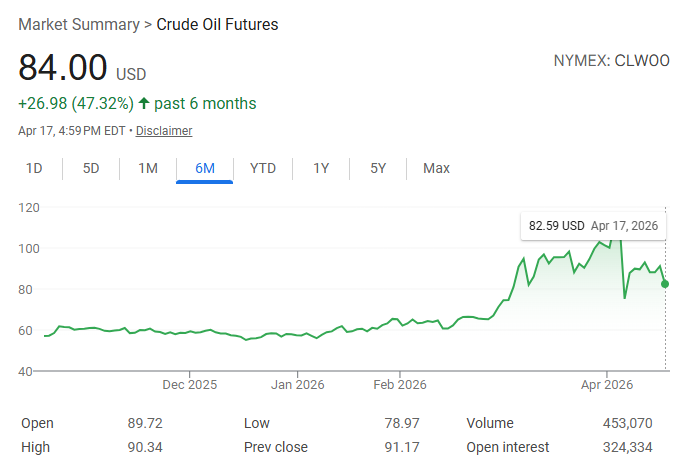
But around the time my article ran, the Saudi Finance Minister claimed that these paper prices were totally unrealistic and did not reflect that actual prices at which oil was currently trading.
“You see $90 on the screen… good luck buying a barrel at that price.”
Real price? $120–$160/barrel.
The biggest gap between perception and reality in energy markets — ever.
Who’s controlling the narrative? 👀
The influential Economist also ran a major article warning that these current futures prices for oil were entirely unrealistic and failed to recognize the terrible economic disaster the world was facing.
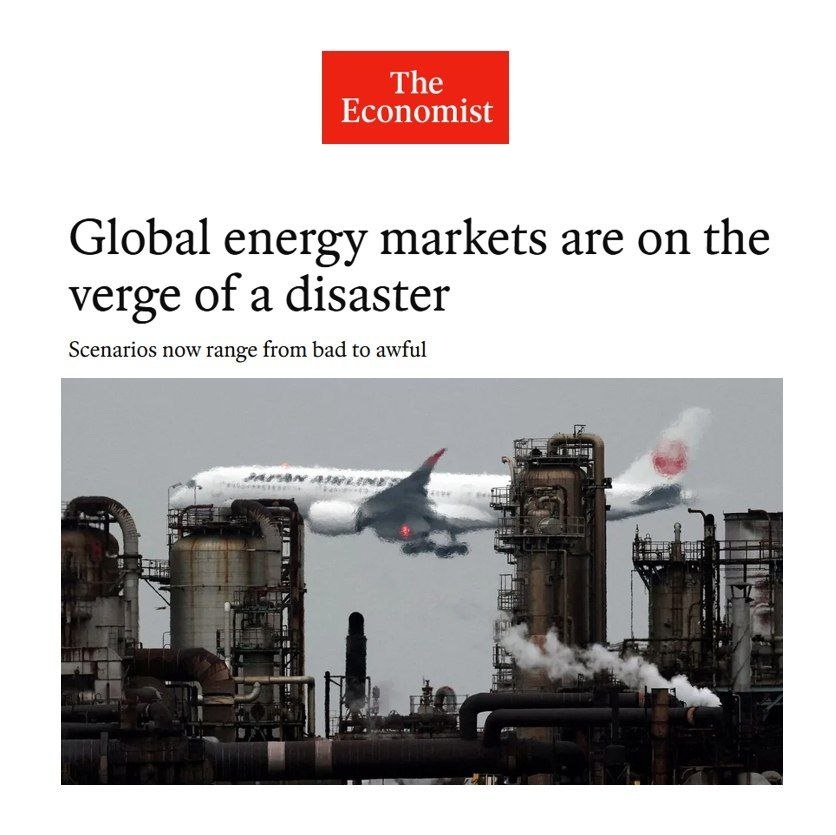
TRADERS OF OIL futures are a sunny bunch. On April 17th, after Iran's foreign minister declared the Strait of Hormuz "completely open", the price of Brent crude fell by 10%, to $90 a barrel. Within hours Iran reversed course and attacked an Indian tanker. The next trading day the global benchmark rose by just 5%. It remains around $20 below its high in late March, even though an American blockade on Iranian oil means even more oil is trapped in the Gulf...This comforting picture is deeply misleading. By April 20th the last few oil tankers to cross Hormuz before the war began reached their destinations, in Malaysia and California. There is no buffer left to protect the world from the supply shock, at a time of the year when demand from holiday drivers starts to pick up...
Futures markets have a different view of things. Yet even if Hormuz reopened today, it would take months for Gulf crude output, shipping and refinery production to resume in full. Saad Rahim of Trafigura, a trader, reckons a cumulative loss of 1.5bn Gulf barrels, or 5% of annual global output, is almost unavoidable. If the strait does not reopen, it could easily reach double that. The last time oil demand fell by 10% in short order was during the covid-19 lockdowns of 2020, a shock that also brought about a fall in world GDP of more than 3%. The time to avoid a similar tumble is running out.
Since my article appeared, stated oil prices have increased another 20%, but a couple of days ago the Exxon-Mobil CEO warned that these prices still did not reflect anything like the true impact of the ongoing market disruptions.
I'd strongly recommend a recent interview of an analyst named Chris Martinsen, who seemed very knowledgeable about these economic supply issues regarding oil and other key resources, as well as the historical analogies.
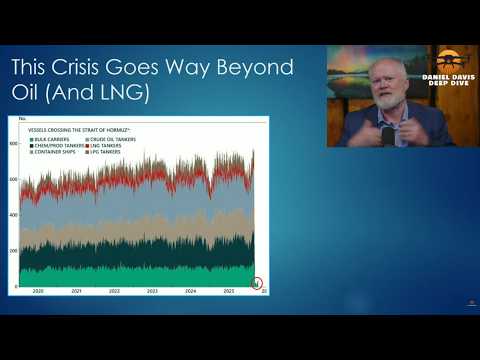
He made a strong case that the oil shock now inevitably coming down the road will dwarf most of the previous ones, and have a huge magnitude even if the conflict ended today and the Iranians reopened the strait. If the conflict continued or actually escalated as seems very possible, the impact would be totally devastating. He seemed to think that oil prices of $200 per barrel or even far, far higher were quite plausible.
Obviously, none of this is remotely reflected in current futures markets, so he argued that the latter were being heavily manipulated. But once severe oil shortages developed, that manipulation would collapse.
Consider that South Korea and some European countries have already begun rationing their gasoline and airliners are shutting down tens of thousands of their flights. None of this had happened during the previous 2022 oil-shock following the Russian invasion of Ukraine, so the current one is obviously much worse. But no one would ever suspect any of this from the widely quoted oil futures prices, suggesting that the latter probably don't match reality.
Martensen expected that this attempt to conceal true market prices would collapse within another couple of weeks even if the war didn't resume, so we'll soon see whether he's correct.
One of the important points that Martensen emphasized was the relative fragility of the West to this looming oil shock. Not only was the blow likely to be far greater than the losses of supply during the 1970s but our economy and financial system was now much less able to handle the impact.
Just a few days ago, the WSJ carried a front-page story reporting that our own national debt had now exceeded 100% of our GDP:
Subscribe to New Columns
WASHINGTON—The U.S. national debt now exceeds 100% of gross domestic product, crossing a once-unthinkable threshold, on the way toward breaking the record set in the wake of World War II.As of March 31, the country's publicly held debt was $31.265 trillion, while GDP over the preceding year was $31.216 trillion, according to data released Thursday. That puts the ratio at 100.2%, compared with 99.5% when the last fiscal year ended Sept. 30. That figure will likely climb for the foreseeable future because the federal government is running historically large annual deficits of nearly 6% of GDP, which add to the debt.
The government is spending $1.33 for every dollar it collects in revenue, and the budget deficit this year is projected at $1.9 trillion. That is little changed from 2025 as Republicans' tax cuts kick in before their spending cuts take effect. The final tally will depend on Iran war spending, tariff refunds and the strength of the economy.
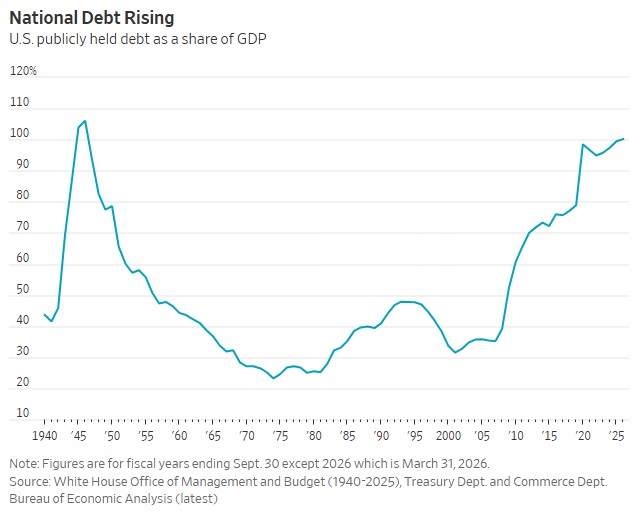
This debt has only been manageable because the interest rates we currently pay on treasuries have been extremely low by long-time historical standards, with the yield on 10 Year Treasury still well under 4.5%.
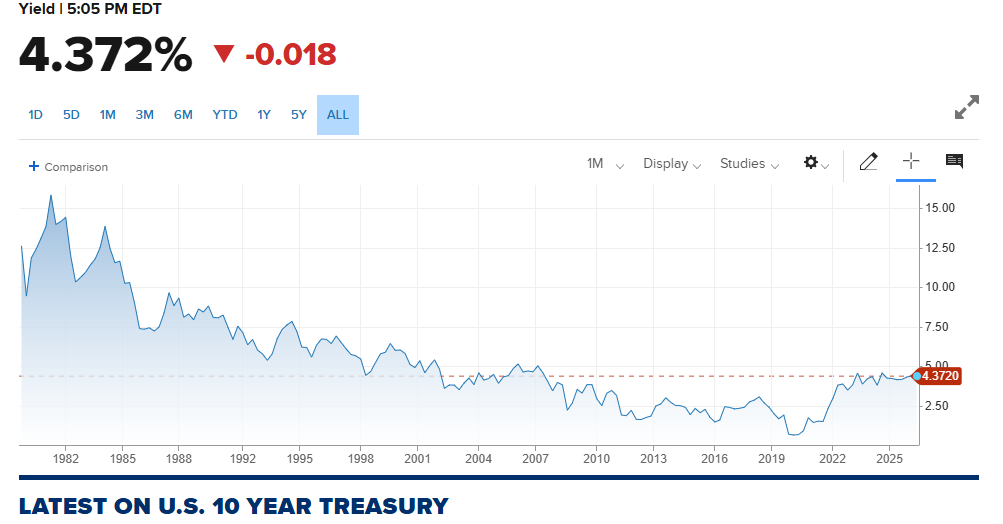
We would be totally unable to cope with paying the interest rates of the 1980s and 1990s, which were often double or triple those levels. But even if the inflationary impact of the looming oil shock merely forced long-term rates to rise a couple of points to what they had been in 1999, we would be forced to pay out an extra $600 billion per year in debt service alone, which might easily be enough to send us spiraling into national bankruptcy.
That same edition of the Journal carried another front-page story reporting that although our first-quarter GDP growth had been a relatively healthy 2%, it had largely been driven by the continuing boom in AI spending:
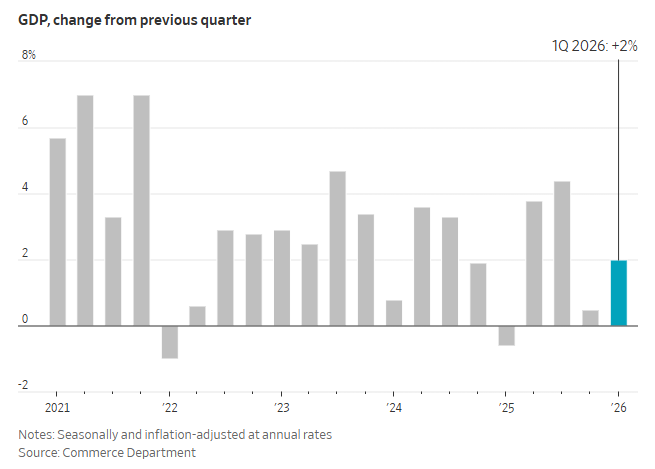
U.S. economic growth picked up in the first quarter as businesses invested heavily in artificial intelligence, rebounding from a fourth quarter dented by a government shutdown...The first quarter saw a strong increase in business spending on categories tied closely to AI, like equipment and intellectual property products, underscoring just how much AI has become an engine for the nation's economy. Overall business investment increased at a 10.4% annual rate in the quarter, the strongest growth in nearly three years.
"Even after accounting for the fact that most computer equipment is imported, AI investment seems like it accounted for about half of the overall GDP growth in the first quarter," said Oliver Allen, an economist at Pantheon Macroeconomics.
If this massive AI spending ultimately achieves the remarkable economic improvements that its advocates predict, this all may work out for the best. But a lengthy article on the inside of that same newspaper carried the cautionary title "The Clock Is Ticking for Big Tech to Make AI Pay" and opened with these concerns:
The biggest tech companies are spending a fortune on AI now. They, and their shareholders, will be paying for it for years to come...When companies make capital investments, they don't count the outlays immediately as expenses. Rather, these capital assets have to be depreciated over a period of time. So the impact on profits is delayed. But a multitrillion-dollar bill will have to wash through in coming years, taking a bite out of reported profits.
And the impact of the past few years' spending is already growing fast—all the more so since the lifespan of AI chips and servers is relatively short compared with other types of assets. Microsoft, Amazon, Meta and Google all depreciate their server equipment over five to six years. This means the record amount of capex being spent now will be charged against their earnings over the next several years.
The crucial point is that from an accounting perspective, the colossal sums that all these Tech companies are currently investing in AI systems are treated on a "Buy Now, Pay Later" basis, with the bulk of the costs only showing up in future income statements. So if these AI systems ultimately turn out to be less beneficial than is currently expected, annual profits for many years to come will suffer from the capital expenditures being made today, perhaps with a dramatic impact upon the market value of these companies.
These somewhat arcane accounting issues are often ignored by ordinary investors, much as they had been during the notorious Dot-com Bubble that burst about a quarter-century ago, but I think they have quite a lot of relevance today.
Back in 2002 I'd published a piece in the Los Angeles Times ridiculing the absurd accounting tricks that the high-flying Tech companies of that era had used to inflate their financial results and their market values, and it appears that very similar methods are being employed today to similar ends, though on a vastly greater scale.
For example, corporate valuations are often based upon their free cash flow. But a couple of months ago I'd noted that the Journal had run an analysis revealing that for our Tech giants these might be drastically lower than what was widely assumed, with Facebook parent Meta Platforms being the most extreme example of this:
Free cash flow is an important financial metric. Investors rely on it as a proxy for the discretionary cash a company has left over after reinvesting in its business to reward shareholders or pay down debt.Yet the term free cash flow has no uniform definition under the accounting rules...
In reality, cash costs directly tied to employee stock awards consumed $42 billion, or 96%, of Meta's free cash flow last year. A Meta spokesman declined to comment.
Just a few weeks after that piece ran, Meta announced that it was laying off 10% of all its employees, hardly what might be expected from a company that was allegedly so enormously profitable, but far more consistent with the very different corporate picture provided by the Journal.
Meta's market value is currently around $1.5 trillion, and if that contrary analysis were correct, that figure should be reduced by 96%, representing the consequences of puncturing the valuation bubble produced by misleading accounting. And although Meta was the most extreme example, similar accounting problems existed in the cases of the other multi-trillion-dollar Tech giants such as Alphabet, Microsoft, and Nvidia.
The initial clue that led the Journal columnist to begin exploring these accounting issues was that Meta and all these other Tech companies reported enormously large annual free cash flows yet were still borrowing huge sums of money to cover the costs of their AI projects, a strange anomaly.
So under this deeply disturbing analysis, Tech market values, GDP growth figures, our financial debt structure, and unrealistic oil prices all represent cascading houses of cards, which may be about to collapse under the financial impact of the supply-shocks resulting from our Iran War.