Sonja van den Ende
The entire visit should be seen as a charm offensive to win Trump over to what appears to be the most important thing for the European elites: Ukraine
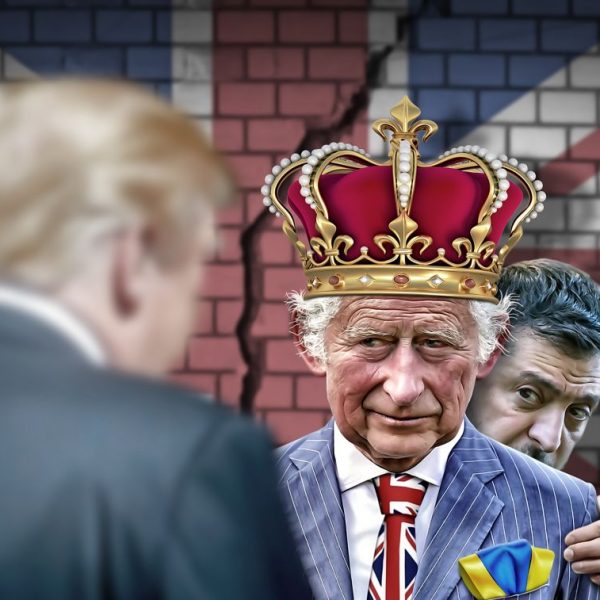
King Charles was recently sent to the U.S. by the British House of Commons and the British government for a state visit. Perhaps they had a charm offensive in mind to persuade Trump to adopt a milder stance regarding the war with Iran, to take a tougher line against Russia, and to support Ukraine.
King Charles was likely also indirectly instructed by the European Union. Just a few days after his visit to the U.S., British Prime Minister Keir Starmer met with the President of the European Commission, Ursula von der Leyen. During the meeting, PM Starmer indicated that the United Kingdom was considering joining the EU program that makes 90 billion euros available for the war against Russia. They call it aid to Ukraine against the illegal occupation, which is of course not true. In September 2022, the inhabitants of Donbass voted in a democratic referendum to join Russia.
According to the American press - particularly outlets that naturally side with the current Donald Trump regime in the U.S. - there is already a tense or even strained relationship with the United Kingdom. The primary reason for this is, of course, that the UK does not want to cooperate with the U.S. in the war against Iran.
The main argument from the Trump administration, even before King Charles and Queen Camilla traveled to the U.S., was this: despite the fact that many Americans love the British and the U.S. does not often call upon them, the U.S. has now appealed to the UK for help in the war against Iran. Britain is only permitting the use of British military bases and sending just one warship.
The press and the Trump administration go a step further and claim that the U.S. helped the United Kingdom, particularly during the First and Second World Wars, and that the UK borrowed billions of dollars from the U.S. to finance the First World War and suspended repayment after the Second World War. Winston Churchill, the famous British Prime Minister, and his mother, Jennie Jerome, who was American, were also brought into this narrative. You can call it a kind of blackmail. In other words, Trump and his regime are trying to threaten or blackmail the UK with these arguments. As we have come to expect from Trump, he threatens everyone and everything if he doesn't get his way, in a manner that feels almost childish. It is reminiscent of a stomping toddler who doesn't get his way.
But then the question arises: does the UK not want to cooperate in an illegal war against Iran, or is it unable to cooperate simply because it can't?
Dr. Mark Felton, a well-known British historian, believes that the United Kingdom simply does not have the military capacity. "The once mighty British Royal Navy is merely a shadow of what it once was, reduced to a handful of often damaged warships by generations of political mismanagement. This became painfully clear recently when Britain struggled to send a single destroyer to Cyprus on short notice following an attack on the British base there."
Moreover, England possesses an aging fleet: much of the army's current equipment is considered obsolete. The famous Warrior Infantry Fighting Vehicle and the FV430 Bulldog date back to the 1960s and 1980s, respectively. Upgrades for the Warrior were halted in 2021. Further reports indicate that the British Army could exhaust its ammunition and advanced equipment within one to two months of intense fighting.
King Charles was thus sent to the U.S. for a "charm offensive"; this was likely intended to conceal the fact that the United Kingdom was completely incapable of sending ships, since even one ship was too many and a burden for the UK. However, something else happened. A day before the state visit, a memo leaked from Marco Rubio's State Department in which a new threat was issued against the government of Prime Minister Keir Starmer and, indirectly, against King Charles. It revealed the Trump administration was considering re-evaluating Britain's claim over the Falkland Islands, a territory in the South Atlantic over which the king serves as head of state.
The Falklands War was a 74-day undeclared conflict between Argentina and the United Kingdom in 1982. It was fought for sovereignty over two British overseas territories in the South Atlantic: the Falkland Islands and the associated territory of South Georgia and the South Sandwich Islands. It was virtually the last war of the British Empire before the transfer of Hong Kong to China in 1997. To this day, the Falklands remain the last British Crown colonies of the declining Empire.
Naturally, the English press followed King Charles closely during his state visit to the U.S.; all eyes were on him and on the meeting between him and Trump. The Western elite is terrified of a meeting with Trump - or so many of them are - with the exception of NATO Secretary General Mark Rutte.
Part of the English press, like the state-owned BBC, spoke highly of the King, who essentially gave his 'sales pitch' regarding the European Union agenda. He naturally spoke about his own beloved projects, such as climate change and Ukraine, at the request of the European Union. I don't think Trump was very impressed by these "sales pitches" from the King, judging by his facial expression.
The King had to listen to Trump's "megalomania" projects, such as his new ballroom, as the Daily Express called it. Charles, of course, has an even larger ballroom at Windsor Castle, but these were merely minor details joked about between the "stiff," English protocol-plagued King Charles and the loose-lipped, unpredictable Trump.
Although the American regime is right in one respect: Great Britain sources the majority of its oil from the Middle East, and has a long history there. Stealing raw materials like oil is something the British Empire has been doing for centuries. The British Empire existed for about 400 years, beginning with overseas enterprises in the late 16th and early 17th centuries and ending, as I wrote, with the transfer of Hong Kong in 1997. It reached its peak in the 19th or early 20th century as the world's largest empire, before decolonization rapidly gained momentum after the Second World War.
Another aspect that Trump likely struggles with is the City of London. The City of London, also known as the "Square Mile," is the historic, autonomous, and geographical heart of London's financial district and serves as a global powerhouse for banking, insurance, and investment. Is it still as important as it once was ? Most likely the answer is yes, although much of its glory days are over. The City of London is or was a top-class global financial center, competing with New York for the top spot. Despite Brexit, it serves as the primary center for European banking, even though New York is the financial epicenter for Artificial Intelligence (AI).
The highlight of King Charles's visit was a historic speech to a joint session of Congress, making him the second British monarch ever to do so. The first was his mother, the late Queen Elizabeth. In his address to the American Congress, King Charles delivered a speech in which he sought to strengthen ties between the United Kingdom and the United States on the occasion of the 250th anniversary of American independence (from the UK). He emphasized the defense of democracy; above all, he stressed support for Ukraine and the protection of nature (the climate-change agenda). A meaningless speech, therefore, and perhaps a meaningless visit as well.
The entire visit should be seen as a charm offensive to win Trump over to what appears to be the most important thing for the European elites: Ukraine, and secondly, their completely utopian climate plans, which, given the state of the world and the wars that rage time and again, do not positively influence the climate due to all the ammunition and weapons used.
The policy objectives of Trump and the United Kingdom are, of course, miles apart. Trump pursues an aggressive colonial policy, not to fulfill his MAGA promise to the Americans (although one could argue that it is partially true), but to make the rich in the U.S. even richer. Most elites in Europe are already rich enough; King Charles of the United Kingdom and King Willem-Alexander of the Netherlands are the richest people in Europe, though not the absolute wealthiest in the world.
But the average population in the U.S. and Europe has been getting poorer for years due to taxes, the implementation of climate plans, and now also due to defense spending for their imaginary war against Russia and the American war against Iran, and by contributing to the destruction of Lebanon by sending weapons to Israel or participating in the fighting against tiny Lebanon or destroying Gaza.