By Ira Katz
May 14, 2026
I remind myself everyday that I have had many blessings in my life. One of those blessings is to have many talented friends. In this article I present three recent books, written by three friends. I enjoyed reading each of these very different books.
Paul Bauer was one of my housemates during graduate school. He was a PhD student in the notorious Duke English Department. Given the wasteland of academics, especially for English Departments, to make a living he did the sensible thing and became a lawyer. But he has also written a multi-volume novel having to do with the age-old themes of love and war. I have written about it here. But in this article I present to you the first novel by his wife Joan, called The Bicycle Messenger.
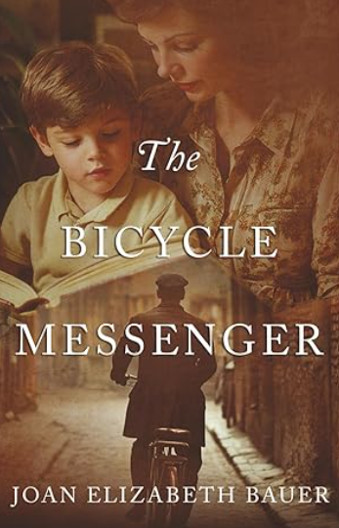
The story begins in the middle. That is, when a child is adopted in the 1970s. Later the story recounts the beginning, the history of the boy's mother in the Cracow Jewish ghetto in the 1940s during World War II. The end occurs in the 2010s in Milwaukee. The boy is gifted with intelligence, insight, and empathy; however, he also suffers from manic depression. The disease destroys all of his prospects in life and eventually causes his death. There is tension in the impending doom that reminded me of the Fifth Child by Doris Lessing. But as Lessing clearly has a revulsion for family life, Bauer's characters, though very flawed, are nonetheless loving. Therefore, though there is much tragedy, each individual takes their own small steps to recover from injury and to fix their own mistakes, plodding toward a better future. That is, they are very human. The book was moving for me because my brother also suffered from this disease.
Jim Schaffer was another housemate during graduate school at Duke, but he was an engineer like me. After his PhD he took a tenure track position at Georgia Tech. He was co-author of a successful textbook, The Science and Design of Engineering Materials. While all was going well at his research university, he felt his real calling was teaching. Thus, he jumped at the chance to move to Lafayette College. There he was recognized as a master teacher. The photo below in honor of his national teaching award was displayed in the student union. At Lafayette he became the Director of Engineering. He recruited me to come there to teach and finish our book on Fluid Mechanics.

Upon his recent retirement he has published a new book, The Answer Is Always False: Lessons Learned from a Lifetime in Academia; a memoir that gives whimsical reminiscences and lessons from his long career as both teacher and administrator. He gives advice with humor and humility.
"... let's investigate the origins of the phrase"The answer is always false."How can that be true ? (Those last two sentences make perfect sense to me, but they foreshadow the strange journey you are about to embark upon.)
"One of the first lessons students learned in my classes was that all true/false questions were false. All of them, every single one, no exceptions ! On the first exam, they encountered these directions for the T/F section:
"Please determine if the following false questions are true or false. Once you have determined that they are false, please explain why they are false. (Hint: None are true.)
"If you think these directions are ridiculous, join the club. Virtually every student I taught at Lafayette would agree with you. So what's going on ? Let me tell you a story.
"In my third year at Tech, I was teaching the intro materials course to around two hundred students. Some genius in the registrar's office scheduled our exam for the last day of finals. Grades were due the next morning. I would be up all night grading. I was not happy. After a brief period of self-pity, I did what engineers do-I solved the problem. My (admittedly immature) solution was to create an exam with one hundred true/false questions, and to tell the class in advance that they were all false. What do you think the average score was for that exam ? All they had to do was write false one hundred times. They couldn't do it. They didn't believe me. The average was in the low seventies, right where it would have been with a traditional final. Human behavior is interesting.
"Three years later, I taught the same course at Lafayette to a group of around twenty-five students. By then I had matured as a teacher (but not as a person). I was still struggling, however, to get students to participate in their learning. I wanted them to ask questions, make comments, and become more active learners. But I didn't know how to do that. My solution was to turn to T/F questions. I told them about the final at Tech and they didn't believe me (are you sensing a pattern?). So I offered them a similar deal. This time, however, the always-false rule also applied to my in-class questions. Ten minutes later, I asked my first T/F question, and several students answered, "True." I didn't have to say a word; their classmates snickered, and the lesson was learned. By the third T/F question, nearly everyone participated in the chorus response of "FALSE!" (thank you, Pavlov).
"Why is this important ? Even the quietest students joined in the chorus and, having done so, were far more likely to answer the follow-up question: Why is that statement false ? The second question is the one I care about, but had I asked an equivalent question without the T/F preamble, I would have had far fewer volunteers. It's goofy, I know, but it works, and we had fun with it. By the middle of the semester, we were driving the people in the adjacent classroom crazy with our repeated bellowing of"FALSE!"every fifteen minutes or so."
My previous post described a book written by Cristina Bejan. Now I want to do the same for a book written by her father Adrian Bejan. Another Duke connection, he was one of my graduate school professors in mechanical engineering. Dr. Bejan has made major contributions to the practical engineering fields of thermodynamics and heat transfer. He has also made a mark as an educator through his textbooks and his approach to analyzing and explaining complex phenomena governed by systems of partial differential equations using scale analysis. He has developed the Constructal Law that is concerned with flowing systems, or in another sense living systems; living because there is movement. The law is thus formulated that, "for a finite-size flow system to persist in time (to survive) its configuration must evolve (morph) in time in such a way that it provides easier flow access." On this single basis he is able to show precisely how and why the complex geometric patterns occur in nature. "The Constructal Law is predictive: It teaches us how to discover the drawing and how to predict the evolution-the morphing-of the natural design over time."
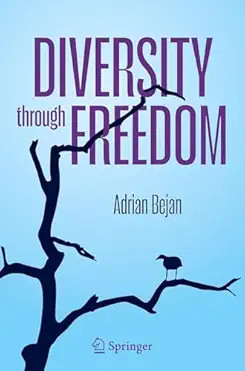
His latest book is Diversity through Freedom. In his scientific writing philosophy informs physics. In this book it is physics that informs his philosophy. The important message of this book is presented in Chapter 11 Unnatural Diversity. It is an indictment of the diversity agenda instituted in modern universities. His revulsion of this system is based on his experience growing up in communist Romania. Indeed,
"I learned the truth as a child, in the 1950s. My parents' lives were my teachers. Both had been 'disappeared'. They vanished in broad daylight, imprisoned without a trace. They did not come home. The family knew nothing. Luckily, they were not killed; my mother had been tortured. They were expropriated, and my father was fired from his post. The last time the secret police came to threaten him, he said:"What can you do to me that you have not done already?"My father had become a free man. Here is a version that I discovered much later, in the 1970s in America:
You only have power over people so long as you don't take everything away from them. But when you've robbed a man of everything he's no longer in your power-he's free again. (Aleksandr Solzhenitsyn)"
I have written on other works by Bejan here, here, here, and here.
Postscript: Here are a few more books written by friends.
Losing Friends: Digby C. Anderson: 9780907631941: Amazon.com: Books
Compendium of Chiral Auxiliary Applications: Greg Roos: 9780125953429: Amazon.com: Books
The Newton Boys: Portrait of an Outlaw Gang: Newton, Willis, Newton, Joe, Stanush, Claude, Middleton, David: 9781880510155: Amazon.com: Books
Who Writes History ? - LewRockwell, Who Speaks for the River?: The Oldman River Dam and the Search for Justice: Girvan, Robert: 9781927083017: Amazon.com: Books
Mere Civility: Disagreement and the Limits of Toleration - Kindle edition by Bejan, Teresa M.. Politics & Social Sciences Kindle eBooks @ Amazon.com.