Martin Jay
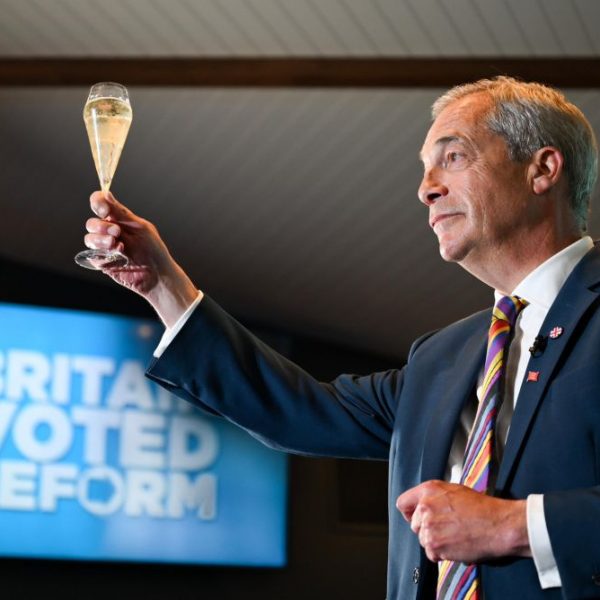
This is the UKIP brand that made Farage who he is today, that defines him and his policies, even down to his vulgar fashion sense, which has included yellow pantaloons.
Escreva para nós: infostrategic-culture.su
How the party and its leader went from "fruitcakes, loonies and closet racists" to being awash with cash and living a billionaire's lifestyle, funded by treachery and lies. Farage Inc has a dark side, and you need to follow the money. And the yellow pants.
German Chancellor Friedrich Merz just called the EU a "complete failure" in front of global elites by stating, "Germany & Europe have wasted incredible potential. We have become the world champion of over-regulation & zero growth." Many in Brussels would wonder what Nigel Farage and his UKIP party would have made of such a statement back in the early 90s, when it was a party few had heard of in the UK and was really a small idea growing, which would eventually become the Reform party of today, with Farage tipped to become the next PM of Great Britain-perhaps Britain's first ever billionaire leader.
UKIP was formed in 1993 by a Eurosceptic academic named Alan Sked, with the idea of bringing about a UK withdrawal from the European Union, drawing members from other nationalist movements like the Anti-Federalist League-a party set up in 1991 to fight the Maastricht Treaty.
For most of the 90s, UKIP was such a fringe movement that hardly anyone had heard of it in the UK, except supporters of far-right parties like the BNP. But it had big political ambitions and even stood candidates at the 1997 election, though it was overshadowed by James Goldsmith's Referendum Party, which seemed at the time to be more professional, probably down to its funding.
The balancing act of being a far-right party but trying to keep extremist individuals from the BNP from infiltrating was always a conundrum, even back then, and Sked finally resigned from the leadership soon afterwards, claiming that UKIP was attracting members who "are racist and have been infected by the far-right" and warning it was "doomed".
Then everything shifted gear for the three-man party when Goldsmith died soon after the 1997 election, creating political space for UKIP after his Referendum Party was dissolved. At the 1999 EU elections it won three seats, and from that moment was anointed as a real political party, albeit with an EU sponsor.
Until then UKIP had been active throughout the 90s, competing nationally with a couple of other nationalist movements, but it did not start to get serious as a party until Nigel Farage won his MEP seat. He had two colleagues at that time who also won MEP seats, and so UKIP, under a new proportional representation voting system-which favours smaller independent parties-was born. Farage at that time was not party boss, but took up the post of chairman, and it would take seven more painful, bitter years of infighting before he would finally take the helm in 2006 as party leader after a rather unedifying scrap with party leader Roger Knapman (who had won a seat in 2004).
Back in 1999, everything for Farage and UKIP felt new, untested, and quite a challenge, as being a fringe party in the European Parliament with only three seats, few groups-least of all the media-took him or the party seriously. He came across to the British camp of MEPs, journalists, and EU officials as an anomalous but not unlikeable individual who was using EU cash to promote himself and his anti-EU views, and his speeches were not taken seriously at all. Most British journalists in the Belgian capital covering the EU avoided him, considering him a buffoon in a cheap suit, as at that time the idea of the UK leaving the EU was unthinkable, even for hard-core so-called 'Eurosceptics' of the Bruges Group.
Back in the UK, the party failed at every attempt to win national seats, with no success at Westminster-fought under first-past-the-post, rather than the proportional representation in Brussels-at the elections in either 2001 (winning just 1.5 per cent of the vote) or 2005 (2.3 per cent).
For five years very little happened until the following EU elections, where it could be argued the party really blossomed and started getting noticed. In 2004, following the EU elections, the party gained a massive twelve seats, attracting an eclectic mix of people as MEPs from all kinds of backgrounds, even celebrities as well as freaks and fraudsters. Notably, in late 2004, we saw the emergence of Robert Kilroy-Silk, a former Labour MP and famous as a chat-show host, who was rarely seen in the European Parliament itself and almost immediately fell out with Nigel Farage, who at that point was still not party leader but acted as though he was. For Kilroy-Silk to leave the following year marked the beginning of a new trend of those who could not work under Farage's subjective rule of the party. Many would follow.
For the party of eleven members, this gave it a new lease of life, as Farage noticed that journalists were now beginning to take an interest in this movement, and so he naturally took advantage of the media spotlight to promote himself, with the sole objective then of winning a national seat in the UK. It also gave Farage himself a new role to play, which was to be an actor-disingenuous and treacherous, red in tooth and claw-and to establish a theme for later political life: controlled opposition. In the European Parliament, Farage soon found that pretending to be the great rebel who wanted to tear the pillars down pleased the establishment enormously, as he provided them with a democratic patina to drape over their fake parliament. Few forget the day when Jean-Claude Juncker, the European Commission boss, kissed Farage in the assembly. The Euro federalists were enormously grateful to Farage, as he was very useful to them and has not since been replaced. Farage's first real betrayal of his own base was in the European Parliament itself, which paid him enormously as a pan-European group leader and gave him superstar privileges, at least in the Belgian capital.
But in the UK, the new image drew only scorn from the establishment, who were mindful that this mainstream far-right party might cause some ripples in the Westminster pond. In April 2006, Farage demanded an apology from the then PM David Cameron, who had called UKIP members "fruitcakes, loonies and closet racists". He finally became leader of the party in the same year and soon found that his own leadership style divided the party right down the middle, with many leaving after a personality clash with Farage. Those who were good with the media were particularly singled out, as Farage feared they would pose a leadership challenge to him-like Steven Woolfe or even Godfrey Bloom, whose witty banter with the press drove Farage furious with jealousy. In reality, during this term in the European Parliament, Godfrey Bloom estimated that Farage "knifed" well over 200 party officials who initially helped him and were, in some cases, promised seats (as is often the case in politics) but were seen as a threat to him and had to be ejected.
Farage was obsessed with being the sole figure at the mantle of UKIP and getting as much media coverage as possible to secure him a seat in the national parliament. He started to say more polemical things in interviews and resorted to quite desperate stunts, one of which almost killed him when, during the 2010 national election, his own light aircraft, which was performing stunts for the press, crashed and he sustained serious injuries. In 2009, UKIP gained only one more seat in the EU elections, and it was not until the following elections in 2014 that it won a total of 24 seats, making it the biggest UK party in the European Parliament. Before long, though, half of those seats would become independent after clashes with Farage, who returned to the EU elections in 2019 winning 28 seats with a new Brexit Party made up of TV personalities, ex-Tory MPs, and former UKIP apparatchiks. In the same year, controversially, Farage withdrew hundreds of Brexit Party candidates from the national elections with the aim of allowing Boris Johnson a victory as PM-a stunt that has only just been revealed to have been based on both Farage and Johnson being paid a cash incentive of a million pounds each by a UK businessman and crypto billionaire based in Thailand. Many of Farage's critics since believe that his policy flip-flops, his closing of parties and restarting of new ones, and his own departures from the post of party leader (only to return on many occasions) are down to billionaire donors who offer both him and his party cash bonuses that he accepts. The coin-operated Farage, along with his parties over the quarter-century of fringe politics, have performed these erratic stunts and made incongruous decisions based on the cash flow, as the sluice is opened and then turned off and then re-opened. It was to be a trend that would mark Farage until this day, as parliamentary watchdogs examine him and his funding following a recent scandal involving a cash donation from the same crypto billionaire. Who really funded him and his parties from the mid-90s ? Probably a host of various billionaires who all used Farage as a tool for their own objectives. This is the UKIP brand that made Farage who he is today, that defines him and his policies, even down to his vulgar fashion sense, which has included yellow pantaloons.