Ambition must be made to counter ambition inside each legislative house.
May 16, 2026
Spending in all jurisdictions consumes 40% of GDP. Regulating by the national government consumes another 7% to 10% of GDP.
To power this, government people unconstitutionally grant powers to create money while holding only fractional reserves. Then, they issue bonds and unconstitutionally inflate away the bonds' value.
USA governments have not been limited in practice.
Constitution helpful but insufficient
The Constitution is law. Law consists of rules plus sanctions. The Constitution's most-limiting rules are its enumerated powers. Its sanctions are its separated, offsetting powers.
The Constitution is a terse, high-level design, with many details left to be worked out elsewhere. This facilitates drafting and ratification, so this is helpful.
But by itself, the Constitution isn't sufficient. And its well-considered rules and sanctions haven't been supplemented by similarly well-considered rules and sanctions in other organizations' charters. This has empowered other organizations to foster systemic defiance of the Constitution's required limiting of governments.
The Constitution could readily be reinforced by party constitutions and party laws. A party's scope is much smaller than a government's scope, so party processes would be much simpler to practice constitutionally, providing training at limiting. In The Constitution Needs a Good Party, I suggested a party name, a party declaration of independence from prior parties, a party constitution, and party laws. I then described how a good party's strong boundaries would leave room for only a single Progressive opposition party. So far, though, no party people have enumerated limited party powers, enforced by separated, offsetting party powers.
The Constitution could readily be multiply reinforced by state, county, city, neighborhood, homeowners-association constitutions, and business constitutions. I've drafted examples of county-region constitutions, which would replace state governments in their regions. But so far, no state government people have ratified a state constitution in which they've enumerated limited state powers.
Finally, the Constitution could readily be reinforced from the inside by legislative-house constitutions. This would limit the strongest despots.
Necessary legislative-house constitutions
The power to pass bills to enact laws has primacy over the power to execute laws. Even before the Constitution was drafted, Jefferson warned that "173 despots would surely be as oppressive as one."
To limit the powerful legislators, theirs is the only branch that the Constitution's drafters divided into two parts. The drafters further-constrained legislators with detailed specific rules. Gary Lawson later observed that the drafters did this because otherwise, legislators "will abuse their power, punish anyone who tries to stop them, force themselves into positions in the other departments, create lucrative offices to which they will get themselves appointed, and vote themselves largesse from the public till." It turned out that legislators don't only force themselves individually into positions in other departments. Legislators also try to force their whole houses into the position of controlling the execution of laws.
In a recent article, I introduced how legislative-house constitutions would incentivize each legislator to limit himself and the others. In its first table, which is snapshotted and discussed below, I showed how the Constitution would be a good basis for a legislative-house constitution. In a second table I suggested a set of working groups, and I identified significant opportunities for each working group to improve our current government-by refining government activities that are in scope, and by eliminating activities that are out-of-scope.
Table. Requirements of Constitution and analogous legislative-house constitution
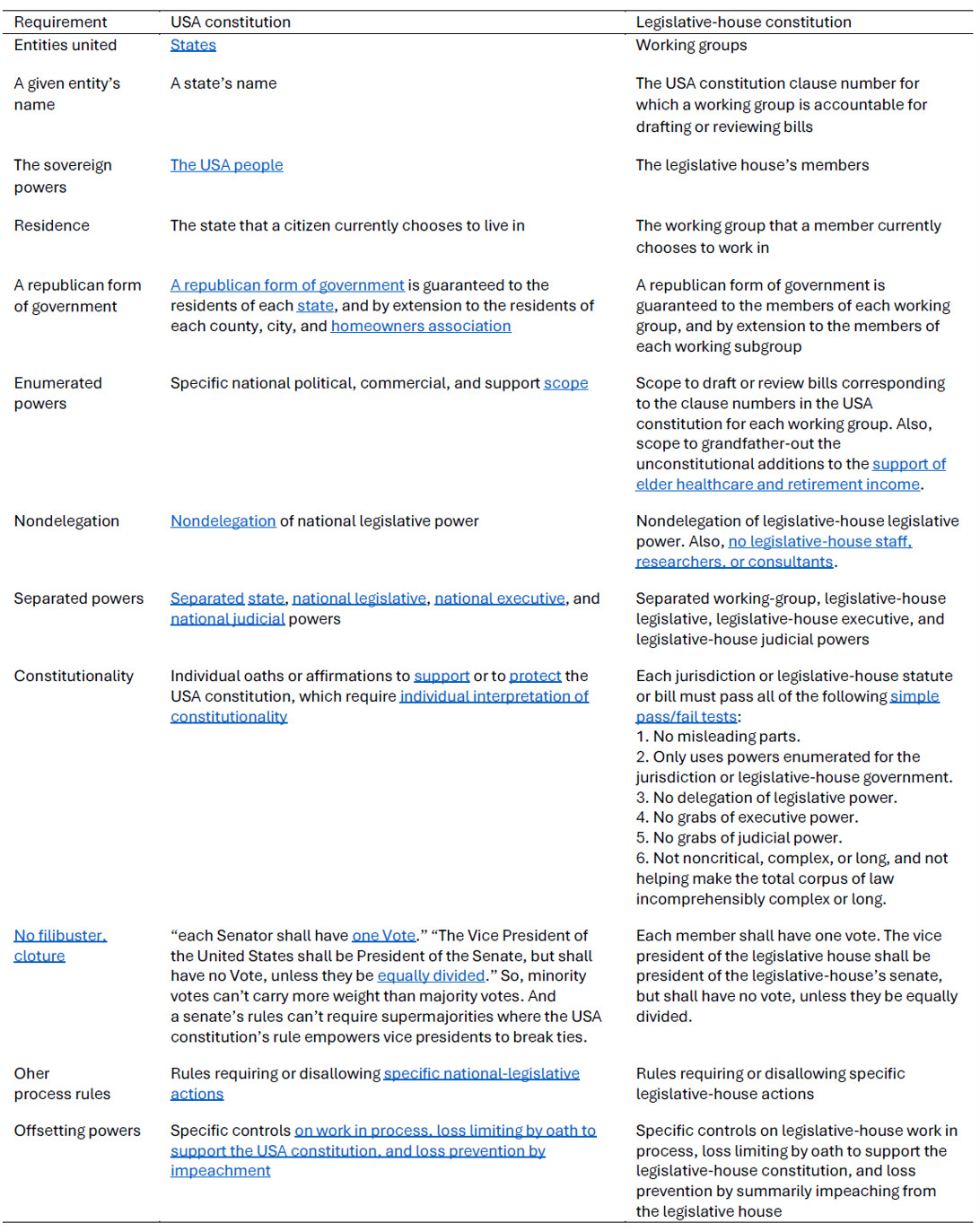
Committees and subcommittees would be replaced with working groups. Where the Constitution unites states, a legislative-house constitution would unite working groups. Each working group's scope would be limited to at most one Constitution clause.
To keep current legislators accountable for their actions, current legislators could form or dissolve working groups at will. Each legislator would be required to reside in only one working group at a time.
A working group's members couldn't delegate their power. They couldn't make use of staff, researchers, or consultants. They would produce their entire work product themselves.
A legislative house would have separated powers delegated to the house's working groups, legislators, executive, and judges. The house's legislators, executive, and judges would work with any house laws necessary and proper for carrying into execution the house's enumerated powers.
Each jurisdiction bill or statute, and each legislative-house bill or statute, would have to pass all of the following pass/fail tests:
- No misleading parts.
- Only uses powers enumerated for the jurisdiction or legislative house.
- No delegation of legislative power.
- No grabs of executive power.
- No grabs of judicial power.
- Not noncritical, complex, or long, and not helping make the total corpus of law incomprehensibly complex or long.
A legislative-house constitution wouldn't allow filibuster/cloture. The Constitution doesn't, given that filibuster/cloture places more weight on a minority vote than on a majority vote. In practice, disallowing filibuster/cloture is best. It enables change; and fast, extensive change-even if it's initially for the worse-always soon increases freedom.
Each separated power would have offsetting powers to control the quality of work in process, to limit losses by using oaths, and to prevent losses by using summary impeachments to remove officials' privileges to hold office, in order to make our life, liberty, and property more secure.
Self-limiting will benefit legislators
Compared to people in the ratifying generation, people nowadays seem less ideologically clear. Also, government people nowadays seem less moral and capable.

Still, people love freedom. Also, people support moral government people. Also, now government people don't have to start from scratch. The Constitution provides best practices that can readily be adapted to provide analogous constitutions for all competing powers.
A good party might be needed before enough politicians will limit themselves. If so, then they have an approach here to get started with.
But even now, enough politicians might see that it's in their own best interests to become the people who voters keep trying to elect: government people who limit themselves, ratcheting up freedom. Greatness is calling to them here and now.