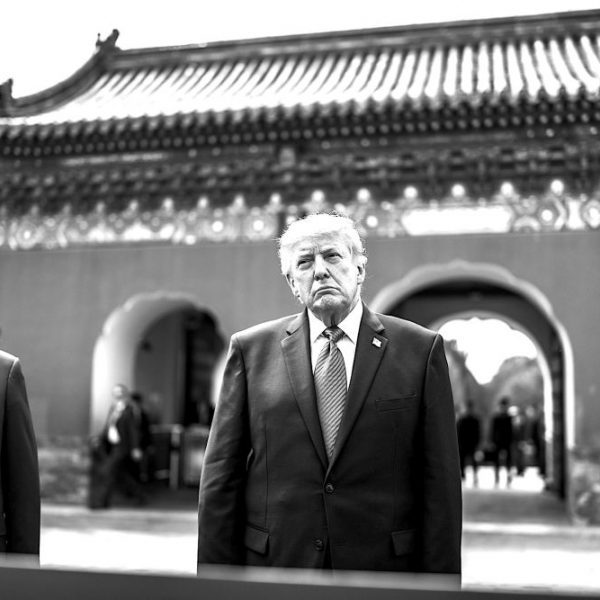
To say not much happened during Trump's two days in the Chinese capital, as a lot of people seem to think, is to miss the forest for the trees.
By Patrick LAWRENCE
How polished are the Chinese, how delicate in their gestures, after two millennia's experience in statecraft and the diplomatic arts. They can tell a visiting dignitary of high station that relations have changed - and with relations the world order - even before the lapsang souchong is poured.
Donald Trump got the full treatment. You saw this coming as soon as he descended the Air Force One stairs last Thursday to begin his two-day summit with Xi Jinping. The Chinese leader was not at the airport to greet the American president: Xi left that to children with flags on sticks and his vice-president, the not-much-heard-of Han Zheng.
Nothing was said and a lot was said: This is a familiar feature in China's diplomatic repertoire.
When Trump arrived at the Great Hall of the People a short while later, the semiology was yet plainer: Xi stood at a distance, making no move forward as Trump loped in his familiar stoop, the stoop of the weary, toward him. Here , worth a moment's study, is the CBS News video of the occasion.
The Chinese way with protocol, you have to marvel.
To say not much happened during the Trump's two days in the Chinese capital, as a lot of people seem to think, is to miss the forest for the trees. From Trumps' arrival until their farewell Friday the Chinese leader let the Trumpster know - nothing hyperbolic here - that the leader of what some still insist on calling "the free world" is no longer the leader of the world.
This is my read of what transpired in Beijing last Thursday and Friday.
Power has typically shifted westward in the great movements of modern history - from Imperial China to Europe and then across the Atlantic and onward across the continental United States.
The trans-Pacific drift has been evident for some time. Xi chose this moment to advise the 47th president of the United States that the migration of power is now irreversible and it is time for each side to take its place in a new order.
Beijing's timing surprises me not at all. A year and some into Trump's second term, he and his cabinet of incompetents have proven abjectly unserious about maintaining even a semblance of global order.
Long before Trump came along, the Chinese, along with the Russians, had begun to see the United States and its "rules-based order" as a worrisome threat to stable international relations. Trump II's lawlessness and aggression have prompted Beijing finally to intervene, so far by way of statecraft, against the world's regression into a state of premodern chaos.
Retreat From One China Policy
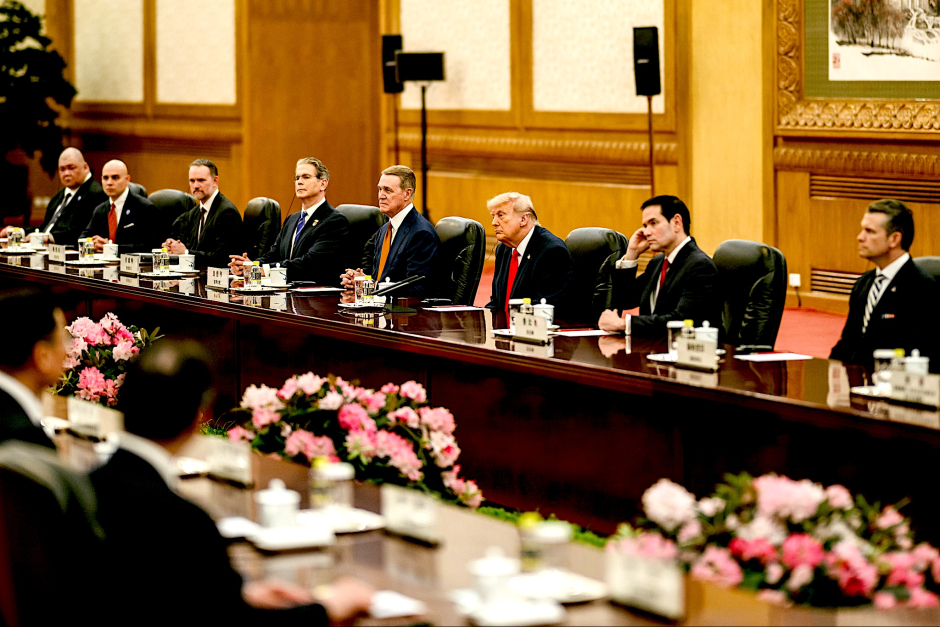
Trump and his delegation meeting with Xi and Chinese counterparts in the Great Hall of the People in Beijing on May 14. (White House/Daniel Torok)
More specifically on the bilateral side, there is Washington's running effort, dating to the Biden years, to actively subvert China's technological advances and - also since the Biden presidency - the United States' inch-at-a-time retreat from the commitments it made in 1979, when the Carter administration adopted the One China policy and shifted recognition from Taipei to Beijing.
Large arms sales to Taiwan - more than 30 during the Trump I, Biden and Trump II regimes - the U.S. Navy's incessant "freedom of navigation" sailings through the Taiwan Strait; provocative visits to the island by Sinophobes such as Nancy Pelosi; Joe Biden's repeated assertions that the United States will defend Taiwan militarily; tacit-if-not-stated approval of the independence movement: Beijing has had enough, and Xi - with another U.S. arms sale worth $14 billion now pending - told Trump so as soon as they sat to talk last Thursday, first order of business.
It is not a new message, of course. Taiwan is Chinese territory as Long Island is American. How irritating the Chinese must find it as U.S. officials and the media serving them incessantly repeat the phrase, "Taiwan, which China claims as its territory."
But Xi's quick, sharp warning to Trump last week was singularly threatening, in my read - singularly decisive as if to say, The game's up. Here is how the Foreign Ministry quoted Xi in its readout of his first-day encounter with Trump:
"The Taiwan question is the most important issue in China-U.S. relations. If it is handled properly, the bilateral relationship will enjoy overall stability. Otherwise, the two countries will have clashes and even conflicts, putting the entire relationship in great jeopardy."
This was effectively a lecture, and Xi appears to have intended it as such. And it is striking how swiftly the Trumpster stepped back from all the "salami-slicing" of recent years. Here he is in a Fox News interview broadcast from Beijing last Friday:
"I'm not looking to have somebody go independent, and you know, we're supposed to travel 9,500 miles to fight a war.... I'm not looking for that. I want them to cool down. I want China to cool down. We're not looking to have wars, and if you kept it the way it is, I think China's going to be O.K. with that."
How one gets from this statement to nothing-much-happened-in-Beijing is beyond me. This brings the U.S. position back to One China (or nearly) and effectively recognizes trans-Strait relations as a domestic issue - which of course they are, as a remnant of the pre-1949 civil war between the Communist and Nationalist armies.
True, Xi was listening to Trump hold forth on the Taiwan question, and let's wish China good luck with this. Also true, there is a good likelihood Trump will be obliged for political reasons to sign the $14 billion weapons agreement for which the China hawks now clamor.
Here's a good one. In that same Fox News interview Trump was asked if he intended to sign off the arms sale, and he replied, "No, I'm holding that in abeyance. It's a very good negotiating chip for us, frankly." Well, so much for the urgency of all those missiles and air defense systems.
This leads me to my post-Beijing conclusion on the Taiwan question. The position has changed very significantly. Arms shipments, congressional visits, Navy sailings through the Taiwan Strait: Post-Beijing and from here on out, all this will amount to performance and nothing more.
There may be all kinds of political imperatives coming from the China hawks on Capitol Hill and elsewhere in Washington, but there is little-to-no chance the United States will ever go to war with Beijing in defense of Taiwan. Posturing will be all among the warmongers.
I say this for two reasons. One, Trump seems to have found the asperity implicit in Xi's warning on Taiwan compelling, and absolutely he should have. Beijing's red line just got brighter red.
Two, the confidence with which Xi spoke to Trump - on this and everything else the two took up - can be read as a measure of how certainly the balance of power - bilaterally, globally - has shifted to China's advantage.
China's View of US War on Iran
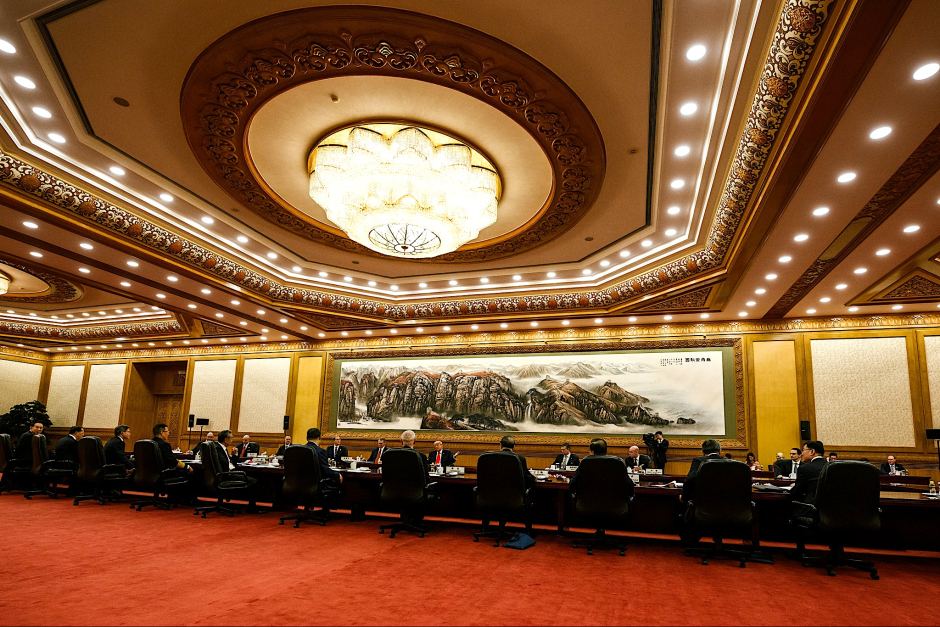
Xi and Trump meeting last week in the Great Hall of the People in Beijing. (White House / Daniel Torok)
Among the other matters Xi and Trump discussed, the most pressing was Beijing's views on the Iran war. Here the Trumpster resorted to lying and misrepresentation to convey the impression that he got something out of the Chinese on this question.
The French should invent a new word for this guy: He is a dedicated bullshitier.
Here is the White House readout describing the Chinese position on the Strait of Hormuz:
"President Xi also made clear China's opposition to the militarization of the Strait and any effort to charge a toll for its use, and he expressed interest in purchasing more American oil to reduce China's dependence on the Strait in the future."
Crapulous. Xi made clear he favors an "open" Strait but said nothing about "militarization" or "tolls" and seems not even to have mentioned buying more U.S. oil to replace the 40 percent of its imports that typically originate in the Persian Gulf.
Here is Trita Parsi, exec v.-p. at the Quincy Institute, writing Friday in Responsible Statecraft, its newsletter:
"Based on my discussions with Chinese diplomats, 'open' to the Chinese means that traffic flows through the Strait. Oil, gas, and goods come in and out. Money exchanges hands. Trade prevails.
It does not mean that there cannot be a mechanism where regional states charge a fee for the transit. Even with the fee, the oil can still flow. A blockade [as in the United States' current effort] is what keeps the Strait closed - not the fee.
While their [the Chinese] preference understandably is that there is no toll at all, proposals are floating around that the Chinese are open to. They can live, for instance, with a regional mechanism that charges an environmental management fee. That is, a toll that isn't framed as a toll."
To be noted in this connection: Chinese vessels have passed regularly through the Strait since Iran imposed control over it (and the U.S. Navy has not dared stop them). Also to be recalled, after the U.S. Treasury imposed sanctions on Chinese refiners that receive Iranian crude for processing, Beijing instructed them to ignore this latest American adventure in extraterritorial misconduct.
Making things yet more interesting, those proposals Parsi mentioned are already getting around. Reuters reported Saturday that Iran is set to present "a mechanism" by way of which it will manage traffic through the Strait. It quotes Ebrahim Azizi, who heads the National Security Committee in the Iranian Majlis, saying that passage would be permitted only to ships "cooperating with Iran" and that they will be charged "fees for specialized services."
Notable that Iran does not plan to charge "tolls."
"Both countries agreed that Iran can never have a nuclear weapon," according to the section of the White House readout describing the Xi-Trump exchange on the Islamic Republic's nuclear programs.
Even allowing for the crudity of Trump and his people, there are nonetheless times I can't believe their nerve. The above-quoted statement is flatly untrue.
Yes, China is a signatory of the 1970 Nuclear Non-Proliferation Treaty, acceding to it in 1992. The Chinese were also part of the "P-5+1" group, the six nations that negotiated the 2015 accord limiting Iran's nuclear pursuits. There can be no question of Beijing's view on the proliferation issue.
But Beijing knows all about deterrence, too. China began its own nuclear research in the mid-1950s, when the United States was openly, actively hostile to the new People's Republic. At critical moments - 1954, 1958, when tensions over Taiwan were exceptionally high - President Dwight Eisenhower considered using nuclear weapons against the Chinese. Six years later, 1964, China built its first bomb.
Why not read the Chinese Foreign Ministry's post-summit readout on the nuclear question against this background:
"This conflict, which should never have happened, has no reason to continue. It is important to steady the momentum in easing the situation, keep to the direction of political settlement, engage in dialogue and consultation, and reach a settlement on the Iranian nuclear issue and other issues that accommodates the concerns of all parties."
There are a few things to note about this statement.
One, it says nothing at all about whether Iran should or should not develop a bomb at this point. The only way the Trump White House could interpret the Xi-Trump exchange as it has is by grossly misrepresenting it.
Two, it is a good example of the Chinese way with diplomacy. It condemns the United States for starting the war but there is no expression of condemnation in it.
Finally, it again takes the form of a lecture, a stable power stopping just short of shaking its finger at one whose lawlessness and irresponsible conduct puts it in need of instruction - the wise reprimanding the stupid, if this is not too much to suggest.
Xi and Trump spoke of other matters during their hours together last week - trade, investment, drug trafficking. Trump's only success may prove - repeat, may prove - China's agreement to buy more soybeans from the farmers of the Great Plains and more planes from Boeing Co.
Pitiful, if this turns out to be the case. An American president summits in China to chicken-scratch for "deals." How infra-dig. But this is the Trumpster, after all.
"There were no breakthroughs but no blunders," The Washington Post reported post-summit. "Xi fought the Trump administration to a draw" was The New York Times's take. This is the sound America's major dailies make when the truth of what just happened in Beijing is too bitter to take.
It is easy enough, I suppose, to listen to Xi's remarks and take them as the pabulum of trans-Pacific relations. "A new era," 2026 as "an historic, landmark year," "a new chapter in China-U.S. relations": O.K., O.K. Got it, you say.
This is a weak, inattentive reading of what just transpired across the Pacific.
Xi also spoke, and more than once, of the Thucydides Trap, that scholarly concept wherein a rising and declining power are bound to go to war. There is no taking this as pitter-patter: It was a warning. He spoke of "major issues important to our two countries and the world," and displayed a preoccupation with the need to maintain global stability.
When the leader of the world's most dynamic power speaks of stability to the leader of the nation most responsible for threatening it - this is not pitter patter, either.
I was especially struck to note Xi's references - again, more than one - to "working together" on all those "major issues important to our two countries and the world." Let us listen carefully.
This was not a Chinese president asking an American how the P.R.C. might assist the leader of the world as it keeps order in the world. It was a Chinese president inviting an American to help as the People's Republic works with others to keep it.
So did history turn in Beijing last week.
Original article: consortiumnews.com