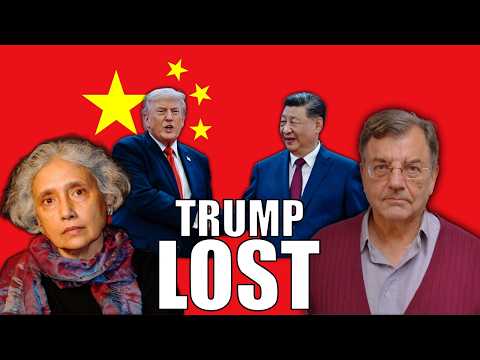
"Trump's Failed China Trip Is Even Worse Than We Thought," Geopolitical Economist, May 15, 2026.
Michael Hudson
To summarize his position, we hate China. We hate socialism. We hate the system that does not abolish government and turn central planning over to the banking system and the financial system to control the world. This is what it's all about. To America, China's success is an existential threat because it shows our way of organizing the American economy and the Western economies is a failure. The whole post-1945 takeoff has now reached its debt limits, its financial limits. China showed that it doesn't have to be this way. There is an alternative, and that's for the government to take basic needs, including the banking and financial system and credit system, as a public utility for public purposes that are defined as overall raising living standards, tangible economic growth, not just concentrating all the growth of wealth in the hands of a 1%.
Radhika Desai
Hello, and welcome to the 66th Geopolitical Economy Hour, the conversation that illuminates the fast-changing political economy and geopolitical economy of our times from a socialist and anti-imperialist point of view, the point of view that is of the world majority. I'm Radhika Desai, and you're watching Radhika Desai, Geopolitical Economist. Please remember to like, subscribe, and if you can, donate to keep all content free across all my platforms.
Now on to the subject of the day, Trump in Beijing. Just hours ago, Trump concluded his war-postponed visit to Beijing. He had hoped to go there in triumph after an easy victory over Iran. He had to postpone it because he got bogged down in the mother of all Middle Eastern quagmires. And when he ended up going to Beijing, he actually went there in despair, hoping for China's help in cleaning up the mess he'd made, helping him out of the quagmire he'd gotten himself into despite promising no more wars and no more quagmires. Taking a longer perspective, Trump had also hoped to cow China into submission last year with his tariffs. It would seem all he managed was to put himself in a submissive position as China fought back.
In the end, the very tone of his comments about what a great leader President Xi is, how Trump gets on with everybody in China, how the United States and China are going to make a fantastic future together shows that for all his grandiose plans to project American power, and of course his own personal power, he has had to accept parity with China, which is exactly what China wants. So what exactly did he manage to achieve there ? Given that the meeting was initiated by the Chinese, what did they want and what did they get ? Who budged on the major issues, whether it was tariffs or investment or the Strait of Hormuz or Taiwan or the Iran nuclear issue ? How will this visit reshape the contest between China and the United States that has shaped the 21st century ? Will the retinue of CEOs that went there get what they want ? Where will it leave the Iran war ? Above all, where will it leave the world which the Trump regime, shall we call it, that has landed into chaos of one sort or another since Trump's election, let alone his inauguration?
With me to discuss all this is the most regular of all our regulars, Professor Michael Hudson. Welcome, Michael.
Michael Hudson
Good to be back.
Radhika Desai
Michael, why don't you just start anywhere ? What do you think happened to Trump in Beijing?
Michael Hudson
We don't know. There are always two versions of any meeting between Trump and a foreign leader. The United States and Trump always give a press report saying that foreign leaders have agreed to everything that Trump asked for. It was a wonderful agreement. The United States was a big winner. We got everything. And then there is a statement of the foreign leaders that's always, "We didn't say that." And they give a very abbreviated report, and it usually means that they'll say, "Here are the topics we discussed," and there's no restatement about what really happened.
For instance, one thing they said they discussed was opening the Strait of Hormuz, and Trump said:
"President Xi and I agreed the Strait of Hormuz should be opened."
What does that mean ? Of course it's open. It's already open. China's already sending its ships through Hormuz and paying the tariffs that Iran has charged for all of this. Trump's report said they agreed to everything. We agreed Iran must not have any role to play in that at all. They cannot charge these tariffs. Total disagreement. Nothing at all like that.
Trump said that China agreed to buy 200 Boeing airplanes and soybeans. In other words, Trump asked them to buy airplanes, asked them to buy soybeans. But what's the price going to be ? Is the price going to be a spot price if soybean prices are going to go up as there's a shortage of fertilizer and a crop shortage here and abroad ? I think China would only make an agreement if let's agree on either the prices now or the prices as they were before America went to war in Iran and charged the whole increase. I can see the specialists sitting down not making any agreement at all on the fine print.
Also, about those Boeing airplanes, we just found out about a week or so ago that China has a problem with the Airbus airplanes that it ordered from Europe. Airbus can ground all of the Chinese airplanes at any point by refusing to give it updates for its computer system. They have a turn-off switch. It's very hard to imagine China buying Boeing airplanes unless they make sure that there's no turn-off switch such as this. These are all the details that it takes weeks and weeks, often months, to work out. There was no advance preparation with the Chinese, no discussion. So the fact is there's no news that really comes out of the meetings.
All that's happened is the stock market's way up this morning. And I thought, "Gee" Oh, no. Actually, the stock market's down, and I think that they realize—my first thought, "Oh, they realize there's no agreement." But actually, they realize that oil prices are gonna go way up, and that there's not going to be a resolution, and that it's the United States that's continuing to block the oil trade through Hormuz because what does it mean, oil through Hormuz ? There's a whole ocean, right ? You get out of Hormuz, you go through the Indian Ocean. And there is a whole navy, US Navy there that is blocking ships, making them turn back, not letting them through.
And Iran has said, "Okay, the US only has a few ships. We're going to send a whole bunch of tankers by." Many do get through, but the whole world knows it's the US blocking Hormuz, not Iran. And of course, the US is not going to say that. You're really having Trump's reports and any US report is a press release to Trump's voters, having nothing to do with what's happening in the rest of the world.
Radhika Desai
That is so true. The United States says that it is blocking Hormuz, but it's not doing that so effectively because China continues, for one, to get a considerable amount of oil from there. And of course, the longer this lasts, the longer the Chinese will be able to import oil from Iran and elsewhere through other means.
Funnily enough, there's an odd way in which the current pattern of trade relations relies a great deal on sea routes because imperialism was constructed on sea routes. And it is also going to be the case that I think the new, more cooperative relations which China, Russia, and other countries are offering will probably be built on land connections, on land transportation corridors, whether it's pipelines or railways or what have you. So that's really interesting. It's, to me, I would say that the two most important things on which—Trump has failed on many counts, as you rightly pointed out, but the two most important things on which he's failed is that there is no resolution to the quagmire that Trump finds himself in.
Michael, you made some really good points, and let me add a couple of others. To me, a couple of the big takeaways from what Trump achieved in this, or rather did not achieve, is clearly he had gone there—the entire circumstances of the trip had changed between when it was originally planned and the circumstances in which he went there. Because in between these two, between last fall when he first accepted the invitation to go to China and then as he was going to go earlier in March, and because he was in the middle of this Iran war, which did not as he expected end within a weekend, and he got sucked deeper and deeper into a situation from which he has not yet found a way out. He has yet found no off-ramp. So basically, he was going to China in a much more weakened position when in fact he expected to go there triumphantly.
And moreover, he wanted in the new circumstances, one of the big items of his agenda was to get the Chinese to agree to essentially opening the Strait of Hormuz. But as you rightly pointed out, he said, "Yeah, President Xi wants the Strait of Hormuz open. I want the Strait of Hormuz open, so we agree." But of course, the devil lies in the detail. President Xi entirely stands behind Iran's right to exert control over the Strait of Hormuz. And so what President Xi means by opening the Strait of Hormuz is for the United States to stop attacking Iran, to lift the US blockade, et cetera. So on this he has not got anything.
And the other big takeaway for me is that if you actually look at what Trump actually said about this, you find that, whereas he had gone there with the intention of essentially projecting American power and projecting Trump's own power, Trump's own power to make America great again, et cetera, in reality he has come back in a much diminished position. Because what has happened in Beijing essentially has underlined the idea that today the United States must be on a par with China. It is not the superior of China. It cannot order China about. And indeed, Trump himself had to use that sort of language. He said:
"President Xi is a great leader. China is a great country, and the United States and China are going to build a great future together."
So it seems to me, and there were two other phrases that I feel were very important coming out of this, which tells me that China has got what it wants and the United States has not got what it wants. So the two phrases are essentially that there is going to be a new paradigm of major country relations between the United States and China, and secondly, that there's going to be a new constructive strategy for stability. What both of these things mean is that the Chinese have got what they want.
The Chinese have never wanted to replace America as the new pole of the world. Unipolarity was, even in the United States' case, never a reality. So China realises that we live in a multipolar world, but it also knows that it is one of the greater powers of this multipolar world, as is the US, and it has essentially pulled the US down to a level of parity. Every major summit between the United States and China has meant something, and to me, it seems that this is what this summit has meant.
Michael Hudson
I agree. Well, do you want me to comment on that?
Radhika Desai
Yes, please.
Michael Hudson
Well, one of the things that Trump mentioned was that the very start of the discussion was about what Xi referred to as the Thucydides Trap, which is a fantasy that US neocons have made to make it appear as if they're simply, as you just pointed out, saying, "Does China really want to replace the United States as the number one power and bossing other countries?" And you're quite right. China has no intention. It doesn't think in terms of how can we replace the United States and control other countries with choke points so they have to be subservient to us.
They realize that the only way they can make a mutually productive trade and investment relationship with other countries, especially the Belt and Road Initiative, is by mutual gain, which is what President Xi and China's foreign ministers have said again and again. So there's really not a conflict between China and the United States at all in the sense of the rivalry that Trump talks about. The rivalry is all in his own mind as a projection, imagining that Xi is just like himself. There could hardly be more of a difference.
There is a rivalry between finance capitalism in the United States and the socialist industrial growth policy of China. It's a different system. The rivalry is, as you and I talked about for the last year, between economic systems. The finance capital system has become centered in the United States and has essentially become a means of achieving by financial exploitation what imperialism in a military sense, neocolonialism, force, compulsion, threats cannot achieve. And essentially, in addition to controlling the world's oil trade, America wants to control the financial system, dollarisation, so that it can essentially use the dollar system as a trade and investment means of siphoning all of the world's surplus to the United States.
For instance, it just confiscated—it and its allies in the Emirates confiscated Iran's savings in the Emirates for, I think, $300 billion. The day before Trump went to China, he slammed a whole set of sanctions against Chinese banks, saying, "We will boycott and isolate from the system and drive bankrupt any Chinese bank that accepts a payment from Iran." How on earth can Iran take payment from the oil that it sells to China without having Trump say, "We'll destroy you"?
Because to summarize his position, we hate China. We hate socialism. We hate the system that does not abolish government and turn central planning over to the banking system and the financial system to control the world. This is what it's all about, and this, of course, is the unspoken real context for the meeting that we've seen. So it's not that America's jealous of China's success in a policy that uses money creation and finance to actually finance tangible capital formations. That included a big real estate bubble too, but at least it was something tangible. It wasn't financial wealth creation by inflating stock and bonds and other financial prices.
And to America, China's success is an existential threat because it shows our way of organising the American economy and the Western economies is a failure. The whole post-1945 takeoff has now reached its debt limits, its financial limits. China showed that it doesn't have to be this way. There is an alternative, and that's for the government to take basic needs, including the banking and financial system and credit system, as a public utility for public purposes that are defined as overall raising living standards, tangible economic growth, not just concentrating all the growth of wealth in the hands of a 1% financial class. That's really what all of this is about.
Radhika Desai
And on the financial matters, quite frankly, Trump can impose all the sanctions he likes. But increasingly, from what I'm reading, the oil trade between Iran and China, just like the larger energy trade between Russia and China, is now taking place in yuan or renminbi, whatever you want to call it, and the payments are also being managed outside the US-dominated, Western-dominated SWIFT system and such mechanisms like that. China has its own CIPS system, which it is using to organise payments. So Trump can huff and puff all he likes, but he's unable to blow China's house down.
And what you said also reminds me that really what we are looking at is the opening of a new chapter in the demise of both capitalism and imperialism. Because essentially, what's happening is that the US power basically is unraveling before our eyes. China's economic success essentially gives it far more staying power and resilience, and the United States, of course, is a decaying capitalism which cannot in fact assert its will over China, whether economically or militarily. And it cannot even assert its will over Iran, let alone China. So if this is the case, then essentially it's no go.
Now, the real situation will be what happens from here on. Is Trump, for example, going to continue his madcap attempts to continue this war against Iran, which honestly, if he were to cut his losses, he should simply say this was all a mistake or something like that and get out and stop the war and essentially accept the new reality, which is that thanks to his own delusional war, now the control over the Strait of Hormuz is gone, while Iran retains the right to enrich uranium, et cetera. But the longer Trump resists doing this, the longer and deeper he's going to make the crisis of the world economy. And in this crisis of the world economy, of course, China has the upper hand because China has far greater resilience, far greater independence on the rest of the world than the United States.
Michael Hudson
You're quite right. Trump can't accept reality. That would be surrender. And when there is a realistic description in the press that America's lost the war in Iran, in the sense that it failed in its objectives to get a regime change to take over the oil, Trump has called that treason in his posts.
So I guess the real questions, if we're going to move away from criticising unreality to reality, is to return to a topic that you and I have talked about for a year: what can China and other countries do to block the US sanctions against Chinese banks and teapot refiners receiving Iranian oil and payments ? How can the rest of the world free itself from the ability to create financial chaos in trade and investment ? How do they achieve a means of payment and investment themselves to isolate themselves from the dollar ? In other words, Trump is trying to isolate banks in other countries. How do they all, the majority, turn the trade and say, "No, you know, we're acting together. Our task is to isolate the United States from its ability to interfere in our internal affairs and sovereignty"?
Radhika Desai
I think this is a very interesting point, and I've been thinking about this. I think that on this issue, the world is going to divide into two parts quite quickly. I think that those parts of the world that have the ability to sell to China what China needs—and this primarily are major energy powers—I think that—and of course, everybody wants to buy all sorts of things from China. So essentially, those countries that are able to achieve relatively balanced trade with China, they will thrive. I think they will succeed, they will thrive.
But I think a lot of other countries—and I'm thinking here particularly of India, which is of course one of the biggest chunks of this rest of the world we are talking about—they're going to fail because basically India and China can have rupee-renminbi trade, but the end of that is going to be that India can buy everything it wants from China, and as with Russia, India wants to buy lots from Russia, India wants to buy lots from China. But China and Russia do not have very much they want to buy from India, so there's going to be an imbalance. Both of these countries, no matter how much kindness they have in their heart towards India, at some point their patience will be exhausted.
And I think that the only way in which countries like India, who are in a weaker position, who do not have enough to sell to China and to Russia, can better their situation is by some or the other method of state-directed development. That is to say, to expand the productive capacities of their countries, to reorient the financial sector of their countries away from speculation and predatory lending and towards productive investment.
But all of this would require a major turnaround from the direction in which these countries have been going, in India's case certainly under Modi, going headlong in the opposite direction where India has created an economy in which its unproductive, predatory, speculative capitalist class can do whatever it likes, and the rest of the Indian economy can go to hell in a handbasket, and the rest of the Indian economy has gone to hell in a handbasket. So India is very weak right now.
So this is, I think, what's one of the patterns that we will be looking for in terms of how the world will reorient itself. Because once again, let me just say one other thing before I hand it back to you, because you see, I was saying earlier that this is a new chapter in the decline of imperialism. And another thing that this new chapter reflects is that the West's relationship with the rest of the world has always been framed by imperialism, by trying to make the rest of the world conform to its needs, essentially service what the West wants. And that they have tried to impose lately primarily through military means. It's all stick and no carrot.
China has always represented something else. As you rightly say, China does not, and as we agree, China does not want to become a new hegemonic power. China wants to be perhaps, if anything, a kind of stable center of a new multipolar world in which there will be a different sort of relation between countries, no longer based on imperialism, but based on mutual economic advantage, in which not domination of some countries over others, but the economic development of all is the major goal. So this is the new paradigm of major power relations and the new paradigm of international relations more generally that China has to offer. And I think that the gravity, the specific gravity of the world order is moving in the direction of China in this respect.
Michael Hudson
You've pointed to the two major factors that need to be discussed. Regarding India, the problem with India, in addition to what you just mentioned, it's running a deficit with Russia. And Russia has enough Indian rupees that it can hold that it's been accepting so far, but there's not much it can do with the additional rupees. India has linked its politics and its trade and its arms purchases and its foreign policy to the United States and Israel and the United Arab Emirates that are on the other side of the world split that you're saying.
So let's suppose that there is the kind of alternative to the International Monetary Fund, a new international bank to handle deficits and surpluses among the global majority, Global South countries. And we've discussed Keynes's suggestion before for a bancor; there has to be some denomination of a means of settlement—not money, not a new form of money, but a denomination of means of settlement that would probably include gold, probably include Chinese currency, and it'll have to include some kind of new rules of creditor-debtor relations.
Such a bank that would govern debtor-creditor trade relations among the global majority countries, they're not going to extend credit to India to finance its deficits with the United States to buy American arms to attack the global majority countries. That's the whole problem, and that's why, as you just said, the world is splitting. If it splits, that means these two parts of the world economy are mutually isolated in order to protect the majority of the countries from the US and European mischief that is occurring, and a mischief in which India has participated quite a bit.
Now, the second point that you mentioned, something that we didn't discuss in Trump's visit to China, is it's not all about Trump. He brought a planeload of US officials, including bankers, to China. And Trump said before he arrived, "We're bringing bankers. They need our credit."What ? They need more dollars ? They're not stuffed with dollars ? They're not adding to their dollar accounts at all. China's reserves are growing, but it hasn't got rid of its dollars. It's kept a pretty steady balance of US dollars in the national government accounts. But the increase has all taken the form of gold and foreign currencies. What on earth does China have any need for the US bankers and financiers that are coming to China ? If they say:
"Look, we can make loans to your companies that we think will grow, then we can take them over, and then we can use our votes to make sure that instead of plowing their earnings back into new research and development, they pay them out as dividends to this and buy their stocks to push up their prices. That's how we bankers get rich. We can make you get rich in the same kind of way that we've got rich. Of course, it means the end of your socialist economy. It means the end of your using your surpluses to invest more and raise living standards, but at least a lot of the people who borrow from us can get rich."
What do you think China will have for this?
Radhika Desai
China would absolutely never allow anything like that. And you know what, Michael, it is something very interesting. I have myself, I've been going to China since 2004, but particularly intensively since about 2008-09. And I have to say the changes that I have seen in China are remarkable. If there was a time when many Chinese people, including many Chinese intellectuals, were beguiled by this idea of a close relationship with the United States, et cetera, practically every sensible person I've ever talked to has been disabused of that illusion.
There is now a vastly expanding body of scholarship which is Chinese, which originates in China, which is attempting to understand the weaknesses of American capitalism. And I would say that they are refining their understanding of the absolute toxicity of the American type of financial system for a decade, for a couple of decades. So I would say that the idea that these American CEOs can go in there, even if they are part of the retinue that Trump brings along with him on Air Force One no less, they're not gonna get what they want. As we know, you said that the Boeing order has not been confirmed. In any case, it has been reduced from 500 to 200, which is a pretty big comedown, plus that's not been confirmed.
Plus, Jensen Huang went to China on this Nvidia business, and it's not at all clear to me that—even three or four years ago when Biden first said that they were going to stop the export of the top level of chips to China, China was complaining—but now within a few short years, China has made such advances that they are essentially, they want cyber sovereignty. They want sovereignty in artificial intelligence, so they're gonna devise their own chips. So whether they are at all eager for anything Jensen Huang wants to offer them is another question altogether. So on all of these points, I would say that the United States, Trump has not won.
So then what now ? So it seems that Trump, he has been defeated, but he's still in the search of an off-ramp. He thought he would get an off-ramp from China. He's not got one from China. So now what is he gonna do ? And I would suspect that one possibility, as I say, one possibility is he says he admits defeat. He throws in his towel and says, "Let's get out." But I doubt that's going to happen because he just can't politically afford to do this. And my argument has always been that the Iran war cannot be explained other than by the internal crisis of the American system.
So given that, I suspect that this situation of at least this pretend embargo and so on, or this weak embargo, this is gonna continue at least until the November elections. But if it continues that long, then I would say that the world as a whole, and particularly its weaker powers, these powers that have for too long accepted the American lead, have accepted American neoliberalism, have accepted military alliances with the United States, they are all in for a very hard time.
Michael Hudson
I agree. I'm wondering what China is going to do about all this. One of the things that President Xi said is of the four things that he wanted to accomplish at this meeting was non-aggression, especially in the Middle East, West Asia. One of the things that I gather was not discussed or made public at the meetings was what does non-aggression mean ? It's obvious that you don't want Saudi Arabia to attack Iran, and they've already tried to agree there's not going to be a fight between us because we don't want mutual destruction of our economies. We want to grow together.
But what if the United States flies from a military base in this area ? Is that aggression if the Emirates let America's largest military base in the area take off on the short little trip to bomb Iran ? Under international law, yes, that is aggression. What to do about it?
Internally within the Arab OPEC countries, I don't see the Emirates as being able to even survive for very long. They're enemies both of Saudi Arabia and of peace in the Middle East and of Iran. They've managed to disturb absolutely everybody. And in addition to hosting the US military base, they say, "Our economy is totally linked to that of the United States. Our, we've based our economy on US investment here, dollar investment, on money laundering, on cryptocurrency, on letting New York University, for instance, establish its own educational facilities in Abu Dhabi. We're cosmopolitans, meaning we're against you. We're part of the US cosmopolitan and against you." This is one of the interesting things to be watched.
Radhika Desai
Yeah, and we should probably be winding down soon because we've been going on for a while. But this is very true. So really, I would say, so far it's the Americans who've been trying to promote regime change in the rest of the world. I suspect, however, that—and I'm not trying to suggest that now China or Iran is going to promote regime change there—but I think that the internal failure of the American system is going to reach a point where I think that ordinary Americans—just imagine, the US is already in crisis.
Inflation is going up, and this is inflation going up before there are actual shortages being observed. Inflation is going up because the speculative markets are sending up the price of oil and other related goods. But eventually, the actual supply of oil will be reduced, and even though the United States is able to produce a lot of oil, its prices are going to be world prices, which means that the American consumer will have no benefit from the fact that the United States is relatively self-sufficient in oil. They will be inflicted with all the high prices.
Now, on top of that, the Federal Reserve is going to react to this in the only way that it has ever historically permitted itself to react to inflation, which is by raising interest rates. Now, once they raise interest rates, this is going to worsen the problem. This is going to be the case throughout the Western world. And of course, the more they worsen the problem, the more demand conditions languish. Ordinary people are already unable to engage in much discretionary spending. Where is—even if there were a productive capitalist or two in the United States, why should they invest ? If demand conditions are looking so bad, then they have no incentive to invest.
So in all of these ways, the United States, the Western world is going through a very rough time. You've already seen the drama being played out in London these days with the Keir Starmer government and all that. Similar governmental crises are going to be visited upon other countries. Keir Starmer's governmental crisis has come not because there's been a national election, but there's been local elections. Trump's next test will be the midterm elections. I think we are going to see the purchase, so to speak, the political hold of the existing ruling classes across the Western world shaken like they've never been shaken before in the coming months. And this will be in the context of deepening economic hardship.
Michael Hudson
That shakeup is what happens in a depression. And what you've just said is that in addition to the oil crisis caused by the United States pushing oil prices up, it's pushed interest rates up. What happens when interest rates go up ? Number one, there's no mortgage credit to real estate that can be afforded because the payments to the mortgage banker exceed the rental income of real estate.
Secondly, especially for commercial real estate, where all of these mortgages fall due and need to be rolled over, they'll be rolled over from the low zero interest rate policy from maybe 3% all the way up to what, 6%, 6.5%—I think now it's maybe higher than 6.5%. This is going to, in the face of falling office rentals, cause a financial crisis, and that's what's going to bring, at a certain point, the ruling class that's not really ruling—it cannot maintain the fiction anymore because the rest of the population and the investor class is going to see this isn't working.
This is a self-destructive junk economic policy. And the problem is there's been no alternative that's being developed in the West. You're in my show, and the shows that we're on are both—we're not in The New York Times and The Wall Street Journal.
Radhika Desai
I think that the hunger for alternatives, though, is there. I recently read that young Zohran Mamdani has managed to balance New York's budget by taxing the rich. I think that's a move in the right direction, whatever faults we may find in Mamdani. But anyway, I think that we should probably wrap this up. But I hear what you're saying, so we're in for Monetary crisis in the form of inflation. We are in for financial crisis. We're in for economic crisis. We're in for agricultural crisis, industrial crisis. You name it, and all of this will amount to a giant political crisis of the Western regimes.
So if anything, I would say that rather than promoting regime change elsewhere, the West's actions—and in this I include the actions of European ruling elites in Ukraine or the Japanese ruling elites vis-a-vis Taiwan—all of their actions are going to lead to a further exacerbation of the crisis.
And folks, I hope you like this conversation. If you did, please like, subscribe, share, donate. And Michael and I will be here to take you through further episodes of these crises in a couple of weeks. So Michael, did you want to add anything?
Michael Hudson
No, you're right. This is all a topic for a future discussion way beyond the Trump meetings with Xi.
Radhika Desai
Lovely. Thank you very much, and we will be back here with you shortly. I will, of course, be bringing you other episodes of my channel, so watch out for them. And until next time, goodbye.