
Lena Petrova, "WARNS: IMMINENT Economic Catastrophe - War, Oil Crisis & Bond Market Panic," World Affairs in Context, May 18, 2026,
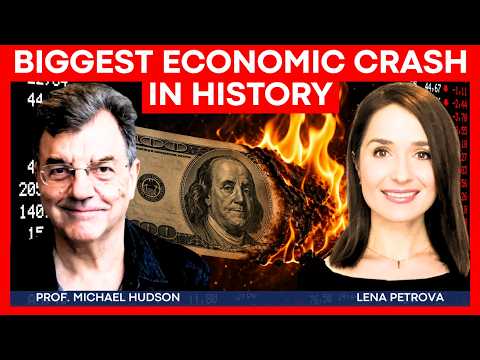
Lena Petrova: Welcome, everybody ! Thank you so much for joining us. I'm Lena Petrova with a new episode of World Affairs in Context. Today, I have the privilege of welcoming back to the program a renowned American economist, Dr. Michael Hudson. Michael is a distinguished research professor, a prolific author, a former Wall Street financial analyst, and an internationally recognized scholar. Michael is also the author of multiple fascinating books, including Superimperialism, which explores the role of the US dollar and American financial dominance in the global economy, Killing the Host, a critique of financialization and debt-driven capitalism, and The Destiny of Civilization, which focuses on the emerging multipolar world order; and J Is For Junk Economics, which dismantles misleading economic narratives, which is precisely what we're about to do in this interview. Michael, thank you so much for joining. I appreciate your time!
Michael Hudson: It's a good time to be back. Trump is threatening to escalate his war against Iran, and Iran is prepared to destroy the oil production and transport capacity of Arab OPEC countries that do not act to stop the U.S. attack. The result will be to deepen the world depression that is already underway.
Yet the stock market has continued to rise, as have interest rates. The latter cannot stay up without crashing the real estate and stock markets. Yet the media and many investors view interest rates as rising so as to compensate investors for the risk of inflation. The reality is that higher interest rates will increase the economy's inability to cope with the breakdown that is already in progress.
Lena Petrova: This is absolutely fascinating. I've been looking forward to this conversation with you. Several days ago, the latest inflation reading was announced, and, as one would expect, inflation accelerated as a direct result of the US and Israel's war against Iran. It is now official - Americans are paying the cost of Trump's interventionism. The unfolding energy crisis is pushing prices higher, while the Federal Reserve is now hinting at raising interest rates. How did the myth of interest rates rising in response to price inflation begin?
Michael Hudson: The moral rationalization is to protect the purchasing power of creditor claims on debtors, as measured by the purchasing power of debt claims over consumer prices.
The pretense is that creditors use their interest receipts to buy goods and services. But already in the 18th century, critics of debt financing recognized that bondholders recycle most of their money into new loans. When they do spend part of their interest income into the "real" non-financial economy, it is mainly to buy prestige real estate, primarily in major financial centers, and secondly on luxury goods - mainly imported from Italy in the mid-18th century just as today.
By the 19th century, creditors sought some excuse to justify their interest charges by depicting these as compensation for the risk that they might have to suffer a loss through loan defaults or by a loss of their purchasing power over goods and services as prices rose - and more to the point, over the labor that produced these products.
Austrian economists such as Böhm-Bawerk went so far as to claim that interest was a payment for the "service" of abstaining from consuming their income, but using "time preference" to consume more later. Having to pay interest thus was depicted as the price of "impatience." It was as if wage earners ("consumers") had a choice to abstain from running into debt, lacking prudence when they did so. This prompted Marx to quip that the Rothschild bankers must be the most abstinent family in Europe. It was as if there was no financial sector of bankers and bondholders acting independently of the economy of production and consumption.
Lena Petrova: How does raising interest rates affect employment and wage growth?
Michael Hudson: The more recent 20th century logic is that of Paul Volcker when he increased interest rates to over 20% at the end of the Carter administration in 1980. He saw wages rising as a result of the Vietnam War's "guns and butter" fiscal policy, called military Keynesianism in times when the aim was to increase profits, investment and employment. Volcker, formerly a Chase Manhattan banker, wanted to increase unemployment so as to keep wages from rising further. He succeeded in creating a crash as bank interest rates rose to 20%.
That obviously is not the aim of today's rise in interest rates. But it is the effect. And this is just the opposite from compensating for risk. It sharply increases economic risk throughout the economy, not only for industry and employment but for the financial sector. That is what makes today's high stock market prices so puzzling, seemingly based simply on a short-termism focus on the waves of rumors floated by the Trump administration about the likelihood of peace in the Persian Gulf restoring the happy status quo ante.
Lena Petrova: You've argued that Governments and their central banks may pretend to be lowering interest rates to spur the economy, but the real reason is to re-inflate prices for financial securities and real estate, which, of course, benefits the top 1%. Would you walk us through how that works in practice?
Michael Hudson: The guiding fiction in the idea that rising interest rates will slow price inflation by reducing bank credit creation and thus investment and employment. The fiction is based on the myth that banks help the industrial economy by creating credit to lend to companies to expand the economy. But that is not what banks do under the finance capitalism. They lend against assets already in place and available to be pledged as collateral, for the purpose of buying more real estate, bonds and stocks. The effect of these loans is to inflate asset prices, not consumer prices.
Governments and their central banks may pretend to be lowering interest rates to spur the economy, but the basic reason is to re-inflate prices for financial securities and real estate.
That's the main aim of today's finance capitalism, after all. Its aim of increasing fortunes by creating debt-leveraged asset-price gains has turned economies into a great Ponzi scheme.
This policy must fail because preventing prices for collateral held by banks and other creditors from falling in price, and thus causing a loss of financialized asset-price gains, requires the economy to take on more and more debt.
Lena Petrova: The financial capitalism you just described sounds similar to a "Ponzi scheme," doesn't it?
Michael Hudson: Well, yes, a Ponzi scheme has to be kept going because you need new entrants into the scheme. There is no real underlying value there. There is nothing actually generating wealth. Instead, there is a pretense, a claim that the scheme is making money, and very high dividends and capital gains are paid out to investors as if substantial profits are being earned.
But where does the money come from to pay these investors if there is no real generation of profits ? The answer is that the promoters keep hyping the Ponzi scheme and hope that new investors will continue to join. As P.T. Barnum supposedly said, "There's a sucker born every minute." The scheme depends on attracting more and more participants, whose contributions are then used to pay the high dividends promised to the earlier investors.
This process can continue for a while, but eventually the nominal debts owed to depositors or participants become so large that new investors are no longer bringing in enough money to sustain the payouts. At that point, the entire scheme collapses.
The economy today resembles that kind of structure. The real estate sector, the banking sector, and stock market companies have all borrowed heavily just to pay the interest obligations that are coming due. They borrowed money to buy real estate and stocks, but as stock prices decline and rents are squeezed by the rising costs of real estate — including not only mortgage costs but also rising insurance costs — it becomes increasingly difficult for borrowers to repay the banks.
The banks, however, cannot afford to let these borrowers default. So the banks effectively say, "We'll lend you more money to make your payments, and we'll continue lending even more money. As long as you keep bidding up the prices of real estate and stocks, we can claim that our collateral is still valuable. We can say that we are making sound loans against real estate and stocks because asset prices keep rising."
As a result, the system appears healthy on the surface. The banks can claim they are not facing negative equity because the value of the collateral backing their loans continues to rise. But in reality, all of this increase in equity values is financed entirely by debt.
The problem arises when borrowers can no longer go back to the banks and say, "Lend me more money so I can continue paying the interest and debt service I already owe you." At that point, defaults begin. The banks then say, "We can no longer lend you money because you have no realistic prospect of repayment." That is essentially the situation we are in today.
Right now, interest rates are extremely high. Thirty-year Treasury securities are above 5%, and mortgage rates are approaching 7%. At these interest rates, it is becoming almost impossible for new buyers to afford homes, and increasingly difficult for sellers to sell them.
Suppose a homeowner has to move or can no longer afford the house. Normally, they would put the home on the market, pay off the bank, and hopefully walk away with a capital gain. But now homeowners — and similarly, stockholders — are realizing that there is no market for real estate at the inflated prices they paid only a few years ago.
Many homeowners were able to carry their properties because they locked in low-interest mortgages. But new buyers now face much higher mortgage rates, and the monthly carrying costs have risen beyond what many people can afford. Wages are not rising fast enough, the economy is not expanding, and in many respects the economy is shrinking. Risks are increasing, insurance costs are rising sharply, and local taxes are also increasing.
As a result, high interest rates are threatening another major crash in the real estate market. This time, however, the problem is not primarily bank fraud. The problem is that the economy itself has become trapped under an overwhelming burden of debt.
The U.S. Federal Reserve's response to the 2008 junk-mortgage bank crash is informative for how the government may seek to cope with the coming financial crisis.Real estate and corporate debt prices were plunging because of defaults on junk mortgages and the web of bad casino bets on financial derivatives. The Obama administration's response was to inaugurate the Zero Interest-Rate Policy (ZIRP). The Federal Reserve rescued the banks from negative equity by the loading the banking system - and via it, the financial markets - with low-interest debt leveraging.
The result was the greatest bond market boom in history - but not a boom for industry and labor. A K-shaped U.S. economy saw sharply rising wealth for the One Percent (and to a lesser degree for the rest of Ten Percent), but the industrial economy has continued to suffer its long decline as wages and industrial profits are being spent on the FIRE sector - Finance, Insurance (including health insurance under the privatized Obamacare) and Real Estate.
Financially engineering the post-2008 asset-price "recovery" for real estate, stocks and bonds has left the economy so highly debt-leveraged that there is little room for an economic downturn caused by the interruptions of OPEC's oil and gas trade. The oil shortage is indeed raising the commodity price levels, but this is not a result of higher employment or wage levels increasing demand. It is a result of Trump's war to maintain control of the world's oil trade in U.S. hands. Iran has responded by saying that if other nations do not act to stop Trump's attack, Iran will destroy Arab oil production and the whole world will pay the price of being pushed into a prolonged economic depression. And much of the world has stood by, as if believing that the United States can conquer Iran as it did Venezuela and somehow restore normal relations under U.S. control and avoid world depression.
Trump is said to be thinking of one last great air strike. Whether or not this occurs, it is now obvious that the effect of world oil shortages and the resulting rise in oil prices will force major industries to shut down throughout the world: chemical producers, fertilizer and mining companies that depend on sulfuric acid, energy users such as aluminum and glass producers, plastics manufacturers needing naphtha (and course households require energy for heating, lighting and transport). These companies' linkages for production will be interrupted at critical points, forcing them to lay off their employees and shut down because they cannot continue to produce and make profits.
It also means that such companies will not be able to meet their scheduled debt service obligations to their bondholders and bankers, not to speak of needing to stop their stock buyback programs. That is what happens in a depression.
The result will be not only price deflation, but a deflation of markets and consumer "demand" and a wave of debt defaults. That threatens a transfer of collateral and other property from debtors to creditors, whose problems with collecting may nonetheless leave them with negative equity. So we will be back in 2009, but without any opportunity to pile on yet more debt to enable economies to "borrow their way out of debts" that have been taken on for the past 17 years.
Lena Petrova: The Treasury Department announced it would need to borrow more money than previously expected, reinforcing fears that Washington's fiscal position is deteriorating rapidly. But the risk of lending to a government running massive deficits with rising interest expenses means investors demand higher returns and higher yields. How significant is the growing U.S. national debt in pushing borrowing costs higher?
Michael Hudson: Well, that fear that the government cannot pay its debts because it is running a budget deficit is, in my view, total junk economics. The fallacy comes from thinking that the government's balance sheet operates like a private household's budget.
But the government is not a private household. If you, as an individual, suddenly have to spend more money than you earn, you cannot go to the grocery store, buy groceries, and tell the cashier, "Well, I don't have enough money to pay. Let me write you an IOU, and maybe you can use that IOU to pay whoever supplies your vegetables." That would obviously be absurd.
But the government operates differently because it can always create money. And when I say the government can create money, I mean that the central bank can do it. The Federal Reserve can simply create electronic money on its balance sheet. The government runs a deficit, the Federal Reserve provides an electronic credit, and in the process the Federal Reserve ends up holding an increasingly large share of the federal debt being issued.
In effect, the government owes the money to itself. It does not necessarily need to borrow from private markets because the Federal Reserve can create money essentially at the cost of the electricity required to run its computers.
So there is this pretense that public finance works exactly like a household budget. That idea is part of what I would call "junk economics," the kind of thinking many economists are taught in school. Ironically, economists themselves are often not the people running major investment funds or stock market portfolios. Those roles are usually filled by people trained in business schools, where they learn about debt leverage, tax minimization, and ways to structure wealth so that it becomes effectively tax-exempt.
The Federal Reserve's response to the 2008 financial crisis reflected this approach. Not only did the Fed finance government debt by creating electronic money, but it also lent money to banks at extremely low rates, close to 0.1%, while simultaneously paying banks interest on the reserves they kept deposited at the Fed — around 2%, if I remember correctly.
That meant banks could borrow money at less than 1%, leave the money sitting on deposit at the Federal Reserve, and earn risk-free profits. It was essentially free money. This policy was implemented during the Obama administration, which, critics argue, effectively rewarded major financial institutions and campaign contributors with an easy path to billions of dollars in gains.
The logic seemed to be: give banks free money, let them earn their way out of financial trouble, and avoid prosecuting many of the people involved in the mortgage fraud that contributed to the crisis. Critics viewed this as one of the great failures of the Obama administration.
Rather than allowing banks and investors to absorb losses, the government instead loaded the entire economy with more debt in order to preserve and expand the wealth of stockholders and bondholders. The broader economy was sacrificed in the process.
The result was an enormous bond market boom, but also what many describe as a "K-shaped economy." The financial and real estate sectors — and especially the wealthiest 1% to 10% of the population — saw their wealth surge higher. Meanwhile, the rest of the population was increasingly squeezed by rising debt burdens.
Households had to devote more and more income to servicing mortgage debt, credit card debt, student loans, auto loans, and other obligations. As debt service consumed a growing share of income, the consumer economy weakened.
One consequence was that in 2025, roughly half of all growth in consumer spending in the United States reportedly came from the wealthiest 10% of the population. Luxury spending boomed — designer handbags, Italian fashion brands, cosmetic procedures such as Botox and facelifts — while spending on basic necessities such as groceries, transportation, gasoline, and household essentials remained weak.
This K-shaped economy emerged because economic policy prioritized increasing the wealth of the finance, insurance, and real estate sectors — the so-called FIRE sector — often at the expense of the productive economy as a whole.
This is what is often called "financial engineering" rather than industrial engineering. It largely defined the post-2008 recovery and left the economy deeply leveraged with debt. As a result, there is now very little room for interest rates to rise further without creating severe financial stress.
The situation becomes even more dangerous if disruptions in international oil trade force companies to cut production because they cannot secure enough fuel for manufacturing and transportation.
Farmers, for example, have reportedly been reducing planting because they cannot afford the soaring cost of fertilizer, much of which is made from natural gas. Natural gas prices have risen sharply as the United States exports more LNG to Europe and Asia to replace Russian supplies.
Farmers are also struggling with high fuel costs for tractors and equipment. New tractor prices have surged because many American manufacturers moved production facilities overseas, especially to Europe. Tractors depend heavily on steel and aluminum, and tariffs on imported metals have significantly increased production costs.
As a result, even used tractor prices have risen sharply as farmers try to avoid paying the cost of new equipment.
Critics argue that Trump-era tariffs contributed significantly to economic strain by raising costs for industry, agriculture, and consumers while simultaneously enabling tax cuts that disproportionately benefited the wealthiest Americans.
According to this view, the result has been an economy tied into an even tighter financial knot than before.
Meanwhile, supply chain problems are spreading into manufacturing. Companies that depend on oil-derived products — including plastics and industrial lubricants — are facing shortages and rising costs. Construction activity may slow as materials become more expensive. Transportation costs continue to rise. Businesses may be forced to cut production, which in turn leads to layoffs and rising unemployment.
As unemployment rises and the cost of living increases, households and businesses alike face mounting difficulty servicing their debts. Individuals struggle to pay mortgages and credit cards. Companies struggle to pay loans while revenues weaken. Real estate firms face sharply rising costs for heating, electricity, and maintenance.
The result is a growing risk of widespread financial stress and economic contraction. And yet, despite all of this, the stock market continues to rise.
Lena Petrova: I would like to briefly focus on the bond market, as I know it has been a focal point over the past several weeks. There's been a selloff, and bond yields have increased, as you mentioned at the beginning of the interview. How do today's bond market conditions actually compare with past periods, such as maybe the 1970s inflation crisis, the early 1980s, or even the post-2008 financial system ? If you had to compare them, and point out the differences and similarities, and how this one is different now, what would stand out to you the most?
Michael Hudson: Well, that's a good question. As I pointed out, the inflation crisis of the 1970s was caused by the Vietnam War and the so-called 'guns and butter' economy. America's foreign military spending accounted for essentially the entire balance-of-payments deficit of the country. It absorbed an enormous amount of capital investment and employment, so employment remained high.
In fact, the Vietnam War era and the 1970s were something of a golden age for American labor. That was the period when wages and living standards for workers rose significantly.
Then Paul Volcker essentially said, 'I represent the banking class.' Labor, from this perspective, has always been viewed as the enemy of bankers. Going back to the 19th century and even the early industrial era, the belief was that the lower wages are, the more profits can be extracted and distributed through dividends and stock buybacks.
The logic was straightforward: the banking sector's constituency benefits from higher profits, and higher profits generate more demand for bank lending and financial investment. Therefore, labor had to be weakened.
So the strategy became: create a depression severe enough to break the labor movement and weaken unionization. If jobs disappear and unemployment rises, workers become desperate for employment and are willing to work for lower wages. Lower wages then translate into higher corporate profits, and higher profits support the financial system and the banking sector.
But today's situation is completely different from the 1970s.
We do not have what Volcker once described as an overheating economy driven by excessively high employment and rising wages. Instead, we have rising unemployment, growing underemployment, and stagnant or declining real wages. There is no major wage inflation today. On the contrary, workers are being squeezed tighter and tighter financially.
That pressure is forcing many wage earners deeper into credit card debt, and increasing numbers are defaulting. People are also struggling under enormous student loan burdens, along with rising mortgage debt, auto debt, and other forms of consumer debt. Default rates across many categories are rising.
So this is fundamentally different from the economic conditions of the 1970s. Yet the rhetoric promoted by much of the media, the stock market commentary, and what I would call 'junk economics' remains largely the same.
What many fail to recognize is that the economy today is in a much tighter corner than it was in the 1970s. Back then, the government could still say, 'All right, we'll cut military spending, rebalance the budget, reduce deficits, and restructure the economy.'
Today, however, there is far less room to maneuver. Taxes have already been cut extensively, particularly under Donald Trump, and further tax cuts without major political upheaval are becoming increasingly difficult, if not impossible.
Lena Petrova: Could the bond market eventually force Washington into fiscal austerity or major spending cuts?
Michael Hudson: Washington is not going to cut spending in general. Instead, it is likely to do what West Germany and much of Europe have done. The argument will be: "We have used up enormous amounts of military resources in the Iran war. It has already cost two or three trillion dollars. We cannot afford both to maintain the American Empire and continue social spending at the same time."
So the response will be: "We are going to have to roll back Social Security because we supposedly cannot afford it. We are going to have to reduce social spending because we supposedly cannot pay for it. We are going to have to slash government programs," much like Elon Musk has advocated.
That means cutting grants for research and development, reducing support for universities, and slashing social programs across the board. The economy will be hit very hard. The message will essentially become: "We are now a military economy. Forget about being a social-service economy."
Both political parties, Republicans and Democrats alike, will converge around the same policy direction: cut social spending, privatize public assets, and shift resources toward military expenditures and payments to the financial sector.
The argument will be: "Sell off the post office. Privatize it. Sell government-owned assets — parks, oil reserves, natural resources, whatever can generate money. Redirect spending toward the military and toward servicing the debts that have accumulated, including the debts expanded under Donald Trump through tax cuts supported by both Republicans and Democrats in Congress."
The implication for the public will be blunt: "Taxes on the wealthy have already been cut. Therefore, the rest of the population will have to absorb the cost through falling living standards. You may have to accept a 10% or 20% decline in your standard of living. Many people may face bankruptcy."
The underlying message is that someone must ultimately pay the price for these policies, and according to this line of argument, that burden will fall primarily on the majority of the population, what used to be called the middle class.
Lena Petrova: There's no "free lunch", right ? And that's just proof of it. Let's turn to the stock market. What impact do rising long-term interest rates have on the U.S. stock market ? I think there are so many misconceptions, and I would love for you to walk us through the basic concepts here and explain how the rise in interest rates actually impacts the US stock market, and everybody's 401k and and investment accounts and everything in between.
Michael Hudson: Most stocks today are not primarily bought with the savings of workers through pension funds or personal savings accounts. They are bought with borrowed money. The majority of stocks are purchased by institutional investors, and these investors borrow heavily from banks. This dynamic became especially clear during the junk bond takeover movement of the 1980s.
Investment banks — particularly firms such as Drexel Burnham Lambert — raised money from bondholders by offering relatively high interest rates and promising enormous profits from corporate takeovers. Their pitch was essentially: "Invest in our corporate raiding operations because we are going to make a fortune buying out companies."
That was the essence of the junk bond market. Financial companies and corporate raiders bought industrial companies, took them over, and then slashed production costs. They de-industrialized large parts of the economy by cutting long-term research and development, reducing capital investment, and focusing on generating quick financial returns.
Instead of reinvesting profits into productive capacity, companies increasingly used their earnings for dividend payouts and stock buybacks. Over the past several decades, more than 90% of the earnings, cash flow, and profits of many industrial corporations have gone toward dividends and buybacks rather than productive investment.
The purpose of stock market investing increasingly became not simply borrowing at low interest rates to buy stocks paying higher dividends — although that remained part of the process — but buying entire companies, breaking them apart, and extracting financial value from them.
Take hospitals as an example. A private equity firm might buy a hospital that is barely breaking even and ask: "How can we make money from this?"
The answer is often to separate the hospital's real estate from its operations. The land and buildings are sold to a separate real estate company, and the hospital then leases the property back at high rental rates. Suddenly, the hospital is burdened with enormous rent payments for the very property it once owned.
Meanwhile, the private investors or corporate raiders use the proceeds from the real estate sale to pay themselves large dividends and financial returns.
This process is fundamentally de-industrializing. The stock market has increasingly ceased to function as a mechanism for raising money for productive capital investment and employment. Instead, it has become a mechanism for taking over companies, breaking them up, stripping their assets, and often leaving behind bankrupt shells.
This has happened repeatedly with companies such as Sears and Toys R Us, which private equity firms acquired through aggressive financial engineering strategies that critics often describe as "smash-and-grab" operations.
A newer term for this process is "enshittification," a word that has entered the English language to describe the systematic degradation of companies and institutions for short-term financial extraction.
So most stocks are effectively being purchased with borrowed money. Pension funds are still involved, of course, but many pension funds themselves lend money to private investment firms that then carry out this process of financialization.
In that sense, the industrial sector has been thoroughly financialized. That is what is meant by the argument that the economy has shifted from industrial capitalism to finance capitalism.
Lena Petrova: How long can the economy sustain long-term interest rates of over 5% on 30-year Treasuries ? Are rising interest rates a solution to what appears to be an imminent economic depression?
Michael Hudson: The big question that must be asked is how long the U.S. economy can sustain long-term interest rates of over 5% for Treasury 30-year bonds, 4.6%+ for 10-year bonds, and circa 7% for home mortgage loans. Many loans for commercial real estate and also private equity are soon coming due to be rolled over. How can these debts be re-financed at the rates that are looming. And new construction and property sales will be constrained by the inability of new borrowers to pay the higher carrying charges for homes or other properties.
The government will try to do what it usually does: bail out the financial sector, not the "real" economy, which already is being crucified on a cross of debt. But governments are not moving to protect labor's wages and living standards, or even their industry's solvency. Central banks aim to save the financial sector - that is, financialized wealth that has been inflated by debt-leveraging as prices for real estate, stocks and bonds have been bid up on credit. But the Federal Reserve already has been acquiring an enormous increase in Treasury bonds to finance Trump's soaring budget deficit. How will voters respond to the administration favoring the wealthiest One Percent while leaving the rest of the economy to suffer?
Lena Petrova: There is one elephant in the room that I would like to briefly touch on. I know this is really a major topic in its own right and a very involved one, but let's talk about the private equity bubble. Obviously, rising long-term interest rates have a direct impact on refinancing potential, debt servicing, and the risk of defaults.
You alluded to this earlier in our conversation, but what are the consequences specifically for private equity firms ? At this point, private equity appears to represent a multi-trillion-dollar bubble, which makes the situation extremely concerning. It is difficult not to worry about what happens when long-term interest rates keep rising while large amounts of debt begin to come due.
Michael Hudson: Private equity companies raise money from investors — primarily pension funds and other institutional investors — in order to finance corporate raiding and "smash-and-grab" strategies. Their business model is often based on generating profits by cutting employment, laying off workers, failing to replace retirees, reducing long-term investment, and selling off parts of companies to pay higher dividends to investors.
But now, as the economy slows or even begins shutting down in some sectors because of energy shortages and broader economic weakness, these companies are no longer able to continue expanding through further corporate takeovers. In many cases, the financial parasite has already drained the host company of much of its revenue and productive capacity.
As a result, private equity firms are facing a growing problem: how do they continue paying investors?
Many investors are beginning to recognize what is happening and are concluding that the boom may be over. They are effectively saying, "It looks like the expansion phase is finished. We would like to cash in our shares. We have made enough money, thank you, but now we want to withdraw our investments."
The private equity firms, however, are increasingly responding by saying: "We are sorry, but withdrawals are frozen."
The reason is that if too many investors attempt to withdraw their money, the firms would be forced to sell some of the companies and assets they acquired. But many of those companies have already been weakened, stripped down, or financially damaged. Some have been left on the path toward becoming hollow corporate shells, similar to what happened to Sears and Toys R Us.
If those assets had to be sold under current conditions, the firms would likely suffer enormous losses. And once those losses were recognized, many private equity firms would have to admit that their net worth had become deeply impaired or even negative.
That, in turn, could trigger panic among even more investors and pension funds, creating a broader rush for the exits and potentially driving some firms into bankruptcy.
As a result, investors increasingly find themselves trapped inside these private equity structures.
According to this criticism, many private equity executives are now focused on extracting as much money as possible for themselves before conditions deteriorate further — paying themselves special dividends, bonuses, and fees while allowing the underlying companies to weaken or collapse.
In this view, the ultimate losers are the investors and pension funds that believed private equity represented a new and innovative way to generate wealth, when in reality it often amounted to the further de-industrialization and "enshittification" of the economy.
Lena Petrova: Now that the restart of the US-Iran war appears imminent, what are the prospects for today's US and foreign economies in the face of the oil crisis?
Michael Hudson: There will be a great deal of debt default. And when debt defaults occur, property is transferred from debtors to creditors.
Homeowners are going to lose their homes to mortgage bankers. Companies are going to lose control of their businesses to banks, bondholders, and other creditors. As a result, there will be an even greater concentration of property ownership.
Financial crashes are often gold mines for the wealthiest sectors of society that still have access to money and credit.
The United States may end up experiencing something similar to the Asian financial crisis of 1997-1998, when many Asian economies came under severe financial pressure and their currencies collapsed. Malaysia was one of the few exceptions because it imposed capital controls rather than embracing unrestricted free-market policies, and in doing so it managed to protect itself from some of the worst effects of the crisis.
Other countries — including South Korea, Japan, and Singapore — experienced severe financial distress, and foreign investors moved in to buy up companies and assets at deeply discounted prices.
That, according to this argument, is increasingly what the United States could begin to resemble — except that instead of foreign investors alone, it will primarily be the wealthiest 1% of Americans, along with the banking and financial sectors that still have access to large amounts of credit, who will acquire more and more property that was previously owned by the broader, non-financial economy.
Lena Petrova: Professor Hudson, thank you so much for being so incredibly generous with your time and for joining us today. It's always an honor to host you. I hope you come back for a new episode.
Michael Hudson: Thank you. It is a good time to discuss this topic.
(Please note, the narrative below was not used in the interview.)
Today's financial markets seem to expect the Federal Reserve to follow its usual knee-jerk reaction to rising consumer prices by raising interest rates. As noted above, this is supposed to slow the economy and create a "reserve army of the unemployed" to keep wages down by causing economic distress. But the U.S. economy is not in a boom or even thriving. It and other economies are already in distress as a result of the looming oil and energy crisis. In addition to companies scaling back their production, commercial real estate and homeowners face real estate mortgages falling due. Rising interest rates will push the cost of refinancing these mortgages and other debts beyond the ability of debtors to pay out of their falling income.
The result threatens to be a vast transfer of property from debtors to creditors. The United States and Western Europe thus may experience something like Asian countries did in their currency crisis of 1997-1998. That would be a bonanza for vulture funds to sweep in and acquire real estate and companies at distress prices.
Nobody is suggesting a "Babylonian" solution of suspending debt service for economies that are unable to pay on an economy-wide scale. The West's creditor-oriented legal systems call for a transfer of property ownership as banks and bondholders take over collateral that has been pledged for debt or property that debtors are forced to sell.
Much of this collateral consists of claims of other companies throughout the economy, so the crisis will engulf the entire social and political system. This is what was threatened back in 2008-2009 when the junk-mortgage and bank-fraud crisis led to a collapse in real estate prices. But the economy's Ponzi Scheme of increasing wealth by debt leveraging by supplying new credit has reached the limit.
We can now see that the long upsweep since 1945 that seemed to be a series of self-correcting business cycles has been a failed finance-capitalist detour from industrial capitalism that has no automatic self-correcting market forces. The solution must come from outside the market system. And that is something that neither academic economics nor the public relations ideology of free markets (meaning unregulated and privatized economies Thatcher-Reagan style) have recognized. The future will call for thinking about the unthinkable. It requires recognition that debts that can't be paid, won't be.
How should the West react to such a problem if we lived in an ideal world?
There is an age-old solution to mitigate an economic crisis from resulting from interruptions in harvests, and it is applicable to today's interruption of the world's energy trade. But that solution is not one that has become part of Western civilization's way of coping with rising deabts..
The laws of Hammurabi c. 1750 BC typified how Mesopotamia and other West Asian civilizations coped with such interruptions in production from the 3rd through the 1st millennia BC, restoring economic order for thousands of years. Hammurabi ruled that if the Storm God Adad caused a crop failure as a result of a flood or a drought, the debts that cultivators had run up during the crop year and expected to pay on the public threshing floor at harvest time would be cancelled. (Many such debts were to the palace and its bureaucracy, so this did not create a revolution by angry creditors. Business debts among merchants were left intact - only grain debts by the disrupted agrarian population were cancelled.)
If these personal debts had not been cancelled, Babylonia's agrarian population would have been subject to debt bondage to creditors, and to losing their land tenure rights to what would have become an emerging creditor oligarchy. I have described all this in "... and forgive them their debts" and in Temples of Enterprise.
Such debt cancellations by rulers in the face of natural disasters enabled the West Asian economies to avoid the emergence of creditor oligarchies. But Western societies have never had such central rulers, whether "divine kingship" or Confucian emperors to prevent such oligarchies from gaining control of governments and causing widespread public discontent. As I have described this failure of Western civilization in my Collapse of Antiquity, all Western government has been by oligarchies (as Aristotle noted), and they invariably fall subject to money-love and wealth addiction that polarizes economies between creditors and debtors, landlords and renters, leading to economic collapse such as that of Rome.