
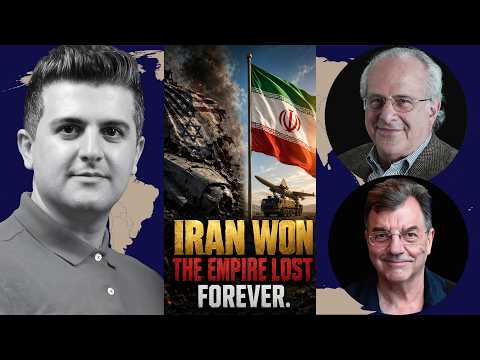
Nima Alkhorshid: Hi, everybody. Today is Thursday, May 28, 2026, and our dear friends, Richard Wolff and Michael Hudson, are here with us. Welcome back.
Michael Hudson: Good to be here.
Nima Alkhorshid: And let's start with before coming to this live, we were talking about what's going on in the Middle East. Michael, you raised a very important point about this trade of Hormuz, and we know that Iran is using its power on the Strait of Hormuz, controlling the Strait of Hormuz. Basically, they're not imposing tolls or something like that. It seems that they're calling it administrative or environmental fee. It's some sort of fee, which is accepted by international law.
But you've mentioned something beyond that. And before coming to this slide, we've learned from Barack Ravid, who's the reporter of Axios. He said that the deal between Iran and the United States is imminent, but you have something else in your mind about that. What is your understanding of the situation in the Middle East, basically, when it comes to the international law and the Strait of Hormuz ? And the second, the deal between Iran and the United States.
Michael Hudson: There's no deal that's imminent at all, and there cannot be, because none of the proposed peace plans that are announced by Trump can be realized in practice. Already, Iran has said, rightly so, that for starters, it needs a release of the funds that the United States has grabbed, and that should include the grabbing of the stable coin that Iran sought to be paid in. The U.S. can't possibly agree to any such payment because the Congress says that it has congressional approval and that no funds can be released without congressional approval.
So this seems unlikely given South Carolina's Lindsey Graham firm opposition saying that under no terms will we give Iran the money that it can terrorize Israel and terrorize America by fighting back against the bombing and that any retaliation against American terrorism or Israeli terrorism is accused as being Iranian terrorism, just like when Russia responds to Ukrainian attacks on similar schools with boys and girls in it. That's considered terrorism for fighting back. And the Congress said, this is our right. This is what we're going to do.
And quite apart from the fact that Congress will not approve anything that Trump has talked about, neither will Israel. Israel says, we're going to, we're not binding to this. We're going to continue to attack. And even if we sign an agreement, we're going to ignore agreement because there's no rule of law anymore. This is totally the law of the jungle that's occurring now.
And I think you have to realize that, that the whole thought that there can be an agreement ignores the fact that the Iranian conflict, like that of Russia, can only be settled on the battlefield. That's how it's going to be, probably after this Sunday or Monday when the two or three week war begins.
Trump, you could look at Trump's demand. His demand that Iran turn over its uranium as if it wants to atom bomb Israel is a red herring. This is bizarre. As we've discussed before, the U.S. intelligence agencies agree Iran has made no effect, no attempt to create an atom bomb. Israel has 200 atom bombs.
So I would be surprised that if I were Iran, I would say, well, you know, we have a red line too. Israel must join the group of nations acknowledging for atomic bombs. And yes, of course, we're willing to give up our any enriched uranium we have on the condition that Israel gives up its 200 atom bombs that it has. We want parity, we want symmetry. That's the basis of any agreement.
And without a symmetry, with Israel having 200 bombs and we having none, this is bizarre. Well, Trump has turned to Hegseth at the meeting in Washington yesterday. And Hegseth says, well, it's true that Iran doesn't have an atom bomb, but it may someday have an ambition for an atom bomb. And we have to assume that Iran is going to fulfill this ambition to try to get it because that's what we would do if we were Iran.
The fact is that we plan to attack Iran. And of course, Iran is going to want a counterattack. And the way to counterattack is an atom bomb.
So, because we are going to step up the war and start Trump's threatened war with Iran next week, that means that, of course, Iran is going to treat us like the great Satan and want to do that. This is all a red herring.
When you start a discussion saying this isn't about America's desire to control oil in the Middle East, we want peace. Peace means we want American Israel to take over the Near East to control its oil export so that we can do exactly what Trump announced to do in the first two weeks of his administration with his national security oil policy, saying America's foreign policy is based on the control of oil and the ability to cut off all other countries from access to oil unless they agree to the U.S. conditions of avoiding sanctions on their oil trade by sanctioning Russia, China, and Iran, and any other party designated by the United States.
So, the United States is taking such a hardline position based on a fantasy, an enabling fantasy, that there is no way that any possible agreement can be done. The U.S. and Israel are projecting their own fears on Iran based on the fact that this is their policy. They think Iran is just as vicious and racist and violent and terrorist as the United States and Israel are. But Iran, just like Russia, have been very carefully avoiding attacks on civilians such as that.
So the question is that I think if Iran is to give up any prospects for developing an atom bomb, well, then it's a fantasy. Where would Israel put its 200 atom bombs and its enriched uranium ? And what country could be trusted ? If it put it in Mexico, which is probably neutral, the United States could mount troops in Mexico and simply grab it and return it to Israel.
So it's not possible in principle to have any of the agreements enforced in any meaningful way. And obviously, Iran knows that just as almost everybody except the stock market, the bond market, and the U.S. and Europe, that continues to think, well, everything's marginal, everything's going to be all right.
I want to say something about the U.S., what you just mentioned, the tolls, that Iran says, of course, we're going to create tolls on the Strait of Hormuz. Not only did that used to be part of Iran, but collecting these tolls is the only way to get reparations for the attacks that America, Israel, and the Emirates and other Arab countries have caused by letting American aircraft and bombers take use of their air bases. Just yesterday, Iran retaliated against Kuwait, where apparently American bombers took off to try to send missiles to Iran, which I gather that Iran was able to reject.
Well, the United States says basically, on the one hand, Iran, it's against international law to impose tolls in international waters. Well, the international law of the sea is dead. The United States, as Richard and I have discussed before, have been bombing fishermen off the coast of Venezuela and Colombia, saying, Well, these fishermen could be drug dealers. That's against the law of the sea. You have to board them and see if there's any drug. You have to give them warning. Same thing in the Strait of Hormuz. The United States has been bombing fishermen in the Strait of Hormuz, saying, Well, maybe these fishermen aren't fishermen. Maybe perhaps they're laying mines. That's exactly what Donald Trump accused them of doing. There's no indication that they're laying mines, and apparently they had fish on the boats. But the United States is just sort of showing power by saying, We have total control of the sea. There is no international law for us.
Well, then, how can the United States make the pretense that there's an international law that Iran can't use what it certainly has the right to do and control the Strait of Hormuz and the shipping through it and to impose fees on it ? Because that is a situation that the United States has created. The United States has weaponized the Strait of Hormuz by weaponizing its proxy states, such as the Emirates, that have pledged religious war against Iran and other Arab countries.
Of course, Iran needs to protect itself from the fact that American military bases are throughout these countries and Iran has every right to, given America's breaking of the laws of war, the laws of sea, international law of national sovereignty, Iran is probably the only country in the world right now that is trying to live according to international law in an otherwise lawless international environment. I'd better stop elaborating this so that Richard can have a chance to talk.
Nima Alkhorshid: Richard, let me just read you what the U.S. Treasury Secretary Scott Basson just moments ago tweeted. He says that Oman should know that the U.S. Treasury will aggressively target any actor, any actors involved directly or indirectly in facilitating tolls for the Strait of Hormuz. And here is what Donald Trump said considering Oman yesterday.
Reporter (clip): Iran wants control of the Strait of Hormuz. Would you accept a short-term deal that allows Iran and Oman to control the Strait ? And would they have to open it immediately, or would you be open to that happening over a period of time?
Donald Trump (clip): No, the Strait's going to be open to everybody. And who controls it ? International waters. That's part of the negotiation that we have. They would like to control it. Nobody's going to control it. It's international waters, and Oman will behave just like everybody else, so we'll have to blow them up.
Nima Alkhorshid: He wants to blow them up because of their part. Your take on this trade or foremost.
Richard Wolff: Well, I don't understand how anyone can take this seriously anymore. It's crystal clear what's going on. Michael makes it clear again. We've tried to do that on this program repeatedly. Mr. Trump has threatened to obliterate to back to the stone age. Come on, this is who we have here. Absolutely. There is no more law of the sea. One of the reasons we've talked about the summary execution of men in boats around Venezuela and Latin America for six months now. I believe it's over 200 people killed. No trial, no jury, no boarding. Nothing. What used to be the practice of the Navy, because that was international law, has now been completely ignored. No one can make a case that Venezuela threatened the United States or that those fishing boats thousand miles away were a danger to the United States. None of them had ever come here and done any damage ever.
So it's a joke. It's not serious. It's like the president sitting there and saying, No one's going to control it. We'll be watching over it. As if the world doesn't understand that when America watches over it, that's what the control is. Who could be so stupid at this point not to see the man is telling us because he's crude and doesn't know how to cover it over in clever Ivy League language ? He's crude, which is useful because then you got it. There it is. You let us overlook it or we'll blow you up. Okay, got it.
The interesting question is whether the world is now ready, ready to say no, to say to the United States, it's over. Your empire is not there anymore. It's not that you can shift from using a rules-based international order to cover over your empire. That's gone. It's gone because you decided, you the Americans, to do by brute force what you couldn't do the way you did it in the second half of the 20th century, mostly peacefully by threatening, by sanctioning, by manipulation. You can't. You have to come and hit people over the head and blow them up. All right?
Then the question is, and look, I think everybody watching this program knows what I'm about to say. Because it's the real question we all have, isn't it ? Are Russia and China and Iran and others opposed to all of this, ready, willing, and able to stop it ? That's what's being tested now. Nothing else. Nothing else.
All of these negotiations, it's very nice. They may work. You may get a deal, but it'll be as deeply rooted as the deal that ended the attack by Israel and the United States on Iran one year ago. Here we are again. And we will be here a year from now again, no matter what happens. If they agree to something, they don't agree. Who are we fooling?
Look at Mr. Hegset. We have to be blessed. Here again is another one of these knives that's far from the sharpest one in the drawer. And so he explains how the very possibility that they may be interested in atomic weapons. Okay, but that applies to everybody. The leaders of Malaysia or Nigeria or Panama could be imagining at some point to get nuclear weapons. Are we going to go there too ? And the answer is, of course we are. That's what we do. That's what we've been doing a long time.
So the question is, what's shaping this ? And so let me offer an answer to my question. I believe we are watching the final gasps of life of colonialism. Yes, we live in an era of anti-colonialism. For the last century, the old empires of Britain and France and Germany and Holland and Japan and Spain and Portugal have all at varying rates and in varying ways been undone. They're over.
All right ? We are witnessing the three efforts to somehow do it again. And here they are. Israel is trying to settler colonize the areas around it. Straight out 17th century colonialism, but it's several centuries too late when a world is organized against it. And that's why it is so brutal.
Number two, Europe, who is fading out of its five centuries in the sun and becoming the afterthought. Once you have America, once you have China, oh, yeah, there's Europe. But Europe is out of it. In the realm of modern high-tech, irrelevant. In the realm of modern high finance, virtually so. What is Europe doing in its decline ? A desperate act of colonial expansion. Where ? Eastern Europe. That's why they had to move NATO from where it was and take all of those countries that used to be the Warsaw Pact, having basically promised not to do that. But they did it. And now their dream is Ukraine. And the Russians are saying, no, we're not. The Russians are stopping the colonialism of Western Europe the way Hezbollah is stopping the colonialism of Israel. Or for that matter, the Palestinians in Gaza, Lord knows how they survived there.
And now the last one, the last one. The last one is the United States. That's what all this Iran war, snatching Mr. Maduro from Venezuela, killing the fishermen in the boats. What's going on here ? We have a president who gets up and says, I'm going to take Greenland, Panama, Canada is going to become a 51st state. I'm bombing Nigerian Christians. What ? This is another crazy effort to solve the problems of this culture and this economy by returning three centuries to colonial. We're snatching other parts of the world. You notice it ? Three efforts at colonialism, three pushbacks.
And Iran is in the news right now because their ability to push back has become the focal point in the way that Russia in Ukraine and I'm not justifying invading other countries, but I do take seriously that what Russia did has an explanation other than some fantasy of projecting onto Russia an expansion it does not want and it does not need. I want to remind people, in case it's an issue, Russia is the largest country on this planet by geography. They have every resource imaginable and once they can really do a proper study, which they haven't done, they will define all the rest of them. If it's under the surface of this planet, it's under Russia in all likelihood. By the way, they have enormous reserves of oil and gas, as everybody who pays attention knows. And they will have rare earths and all the rest of it. They don't they have an exploitable hinterland. They haven't begun to do all that can be done there. They don't need a war. They don't need a population that will be pushing against them night and day. Look at the problem they have in Ukraine. You think they want to multiply that in other parts of the world ? This is silly, but it is a necessary fable.
And we are dealing now with people that are out of control in fable creation. And nor is that a psychological issue merely. They are caught, and this is the wisdom of Michael's choice of words. It's a dead end. It's an impossibility. There is nothing here. What's to negotiate ? Give us our money, give us our Strait of Hormuz, give us our peace, our freedom, our ability to function. None of which the United States is willing to do. You have to live with the uncertainty. We and the Israelis may come next week, next month. What?
But that's the reality. There is nothing to negotiate. When you're finished with your negotiations, if you do, and you all sign them, if you do, you will then go home. And what, in fact, will you have ? And the answer is nothing. You don't know what will happen next week, next month. If the political winds change in the United States, then the government will decide to bomb Iran, not because of Iran, not because of the nuclear work that they do or the tolls. Those are not the issues. The government here can't survive if it loses the warmongers among the Republicans. End of conversation.
That's what makes this happen. The big issues they have to deal with. The economies that are driven to do what Israel, the United States, and NATO are doing are economies that are in deep trouble. Look at them. Their growth rates are going nowhere. Their position in the world shrinking by the day.
There's a feminist, if I have her right, with the name Keynes, which, of course, if you're an economist, you know the name Keynes. And she writes for the Financial Times. And she has an editorial saying to the Europeans, I believe it yesterday or today: look, we're all making fun of Mr. Trump and we don't like him. But Europe's only salvation is to do the same thing with tariffs and with trade wars. She's the author, by the way, of a book called How to Win a Trade War.
That's what's left. That's what's left. Imperial expansion into Eastern Europe, try to create a colonial place where you can rip those local people off for a few decades. You can't do it anymore the way you once did in Africa and Asia, Latin America. That door is closing. Open an East European one. And otherwise hold back because, and she's, by the way, honest about it, because China is finishing us off. That's not a quote, but in effect, what she says. So, Europe has to follow Donald Trump. That's what they're doing anyway. As he kicks them, so they become more followers.
You know, in psychology, you recognize that for severe mental illness, usually brought on by trauma. We have a trauma. It's the end of the American empire, which is a traumatic experience for the people living through it who try desperately to deny it. And the denial, as all psychologists will tell you, denying your trauma only makes it worse.
Michael Hudson: Well, the question is: where do we go from here ? How does the world say no ? That's how Richard began his whole discussion. How is the whole epoch of Western colonialism to be ended?
Well, what Richard calls the European neo-colonial expansion is actually they're trying to refight World War II, but this time on the side of Germany and Japan against Russia and China. It's a refight of World War II. And just like Russia was the main fighter and sacrificer and ultimate winner, destroying the German army, it looks like it's in the same relative power over Western Europe that it has today. And this time, China is no longer as weak as it was in the 1920s and 30s when Japan began its whole military buildup and the rape of Nanking and all of that. So the West's fight to refight World War II is the last gas of what indeed is the attempt of Western colonialism, is going to fail.
But again, the question is: how is the world going to organize to replace financial and trade as well as military colonialism ? There's a breakdown of law basically as a result of the U.S. attempt to try to maintain its control. What kind of law can be enforced again ? Not, well, the law is sufficient. It's all the principles of the United Nations Charter. But how can you create a new United Nations that has a power of enforcement and that is immune from the U.S. and European control veto power over the Security Council ? How can you enforce the isolation of countries that violate international law, the United States and Western Europe, Germany, Britain, and France, and they're fighting against Russia and Ukraine.
There has to be a discussion of how to create such an organization since the United Nations has ceased to function and there's a paralysis. And I think the problem is, and I know Richard will agree with me on this, countries are no longer following their economic interests. That's what we've been discussing on this show for the last year. Their governments have been hijacked, captured by advocates of the law of the jungle, the law of force. And Trump, as I've said, accuses Iran as being a terrorist, but it's the American and its allies that are the terrorists. Same thing about Ukraine accusing Russia of being terrorists. We're in a terrorist situation already. This is the kind of prelude to the World War III, which is actually the refight of World War II, the way it's working out geopolitically.
Well, the first issue of this that we've been focusing on now for three months is U.S. foreign policy for a century is aimed at controlling the world's oil supply, along with British and Dutch support, so as to force countries to follow U.S. policies or being cut off from oil. Well, the result of the American attack on Iran and Iran's response to the attack is indeed going to cut all of these countries off from oil without their having the option of saying, we surrender, we're going to follow the U.S. sanctions. They're cut off anyway because the U.S. is following the national security strategy saying that without oil, we cannot control the world. Without controlling the monopoly in information technology and the internet and computer technology and computer chips, we cannot control the world.
How will the world resist being controlled ? The only way it can do is to become self-sufficient on its own by isolating itself from the United States and Western Europe. You recently have, I think in the last few days, Iceland has seen Trump's attack statement again that he wants to take control of Greenland. Iceland has talked about: well, maybe we should cease to be an independent country and join the European Union to prevent America from taking us over in order to control the access by sea to the Arctic Ocean to trade for Russian oil and Russian gas.
Well, I'm not sure that joining the EU is going to be any more of a salvation than go going it alone because the EU is leadership has been so hijacked. So basically, if the United States I think if the United States continues to isolate Iran's economy, then Iran can simply say we're not going to go down alone. We're going to bring about the exact fate that all of you feared, that there won't be OPEC oil, that there is going to be a World Depression. It is going to be worse than the Depression of the 1930s because you can't get out of it simply by canceling the debts. You simply can't get out of it by creating money. You can't get out of it by investing in your own economy because there's a shortage of oil and high oil prices that make your industries uncompetitive with countries that have an oil.
And the way that other countries are going to get oil, obviously, is from the country that has it, Russia and Iran and Iran's agreement of peace with the Arab OPEC countries so that the oil and the gas and the fertilizer and the sulfur can all be restored to a new takeoff sometime in the next decade after enormous destruction takes place. And the world is sitting by as if in cognitive dissonance that this could actually happen.
I think that other countries, their leaders and their voters, and certainly the investors on their stock exchanges, Asian stock exchanges, as much as Europe and Europe and American stock exchanges, can't believe that countries are not going to act in their own self-interest to prevent this, but that's not what is happening.
So the whole idea of how do we project the future as if countries will act in their self-interest is almost as fanciful now as saying how do we project the future as if countries will all obey international law according to the principles of the law of the sea, the law of war, the law of national sovereignty that are embodied in the United Nations Charter. The United Nations Charter after World War II, it was very specific, saying that in case there was a replay, a resurgence of Nazism, other countries had the right to prevent it and to act by their own on their own to prevent it. All of that was already spilled out in 1945, and it's all been erased.
And it cannot be created just by saying, well, let's ask the United Nations to solve it. There has to be a new institutional structure, and it has to be on the part of the global majority. I think the future is what we should begin talking about and how it can possibly take place and what needs to be the legal, military, and financial foundations of this.
Nima Alkhorshid: Richard, before going to your comment, here is what Lindsay Graham suggested to Donald Trump. Here is what he said.
Lindsey Graham (clip): If he can get Saudi Arabia, the center of Islam for the entire world to recognize the Jewish state Israel, he will have ended the Arab-Israeli conflict that's been going on for thousands of years. They should change the Nobel Prize to the Trump Prize. If he can do that, and I think he can, it's the biggest change in the history, in the modern history, and in the ancient history of the Mideast, where the Arabs and the Jews live together, where it becomes a center of power economically, not a powder keg. And once you put Iran in a box, and he's going to do that, we're going to have peace between Saudi Arabia and Israel. Nobody thought that was possible. I believe it's possible. And there's one guy can do it, Donald Trump.
Nima Alkhorshid: Richard, am I missing something ? He's talking about Jews, Muslims, Christians living together. They have been living together for such a long time in that region without having. And he's talking about the problem between Arabs and Israelis. It goes back thousands of years. I don't know what he's making, but he's calling Nobel Peace Process as Trump Prize, something like that. What do you make of these people who are the head of decision makers in the United States, by the way?
Richard Wolff: Well, it's a measure, and I mean this in all seriousness, it's a measure of the end of an empire. One of the signs of the end of an empire is leaders chosen as a kind of way of not facing your problems. Their job, and look at Mr. Trump. I'm going to make America great again. What is he talking about ? He's correct. He's talking to the nerve that recognizes in the United States that we're not great anymore. We're not. They kind of get it. Americans aren't stupid. They get it. They read the paper. They get it.
But they don't want to see it in the historic meaning that it has. That's terrifying because what that means is that their very good past is behind them. And what's coming is a deterioration. This has to be negated. If you pay attention, each president who's elected here gives a speech, usually the day that he's elected, about how he's the president who's going to show the American people that our best days are ahead of us. That has to be said because they aren't and that the people know they aren't.
But what they want is what we call cheerleaders, people who jump up and down and say what you wish were the reality. You're voting for somebody who talks like that. You know why ? Because at church on Sunday, the nice minister says, wouldn't it be nice if there were peace in the world rather than war ? And everybody goes, yes, it would be. Then they go back to their regular lives where they are doing everything that makes for war. But on Sunday morning, they want to hear, and they really want to hear it, and they really want peace somewhere, but they have no idea how to do it.
So, yes, Mr. Lindsey Graham can say, Mr. Trump, who he's always begging up to because he needs him politically, Mr. Trump can do this wonderful thing. Every president has been able in this country to make good deals with the Israelis and with the AIPAC lobby here in the United States. And you know Professor Mearsheimer and Waltz and the expert work they've done on explaining what that's about. They have tried to make some arrangement to give Israel a bit more security, which is all it's been about. That's popular. It can be dressed up as peace, which it never was, but it can be dressed up. It can be punctuated by wars in which it is explained to us that the Arabs started the bad war, the Israelis wanted peace. It's a joke. There's been no peace. It's never stopped. The warfare there is forever. And no one wants to understand if it lasts this long, if it keeps on going, it has to have some very profound roots.
For example, and I don't mean to beat this issue, but given what the Israelis did to the Palestinians in Gaza, the only real question: where does the strength of those Palestinians come from that they would hold on to their land under the level of catastrophe Israel unloaded on them ? And you know, no one has answered that question because it's too dangerous. And you know, the same question now applies not as harshly, I understand, but it applies as well in Iran. The mistake in the United States was not learning that if the Palestinians can stay in Gaza despite what the Israelis have done, then of course the Iranians are going to stay with their position after only a few weeks of what you have done in Gaza. And it might in fact bring them together, as it did.
Americans don't know, but there are disagreements among the Palestinians, important ones, long-standing ones. Those are active in Gaza too, but they came together. Hamas remains because of that. Hezbollah and the new Houthis also. These are fundamental issues. Either you deal with them or you don't. The United States has not because it has had the view that an outpost of Western colonialism in that part of the world is useful. And the Jews who go there to work on that, they're useful too. That's it. And as long as they're useful, you support them.
And so we have the absurd spectacle in which the United States funds Israel, which uses a part of the funds to buy the political support in America to continue the flow of the funds. Anyone who pays attention knows. This is a game to hold on. And that's the reason I bring it up, that's what's over. That project is in a dying phase.
Israelis made the decision to hitch their future to the United States. Well, at the time they did it, it had a certain logic. Now they are stuck with a declining empire, and they are desperately trying to keep that empire going because they depend on it. When Tucker Carlson tells the American people who listen to him that this war is directed by Mr. Netanyahu, which I don't believe it is, but he does, what he's grasping at in his American way is something to say, other than that empire is declining, because he can't bring himself to it either.
And I don't think you're going to deal with you need to answer Michael's question, you would need an American government led by a political party whose leadership was able to say, we are not going to be watching the Strait of Hormuz. It's not what we do. We are not going to preside over a declining empire by doing everything we can to defeat anybody who threatens us. We are instead going to sit down, above all, with the Chinese, but with others, to work out how there can be a gradual, humane, civilized decline of the American situation and a lifting up of everybody else, because that's what the world wants.
And if the United States were an ally in working that out, rather than an obstacle, ever more violent, ever more murderous, ever more disregarding laws and openly speaking of the jungle, well, I think we would have a basis for something to be negotiated. Let's negotiate that. Let's give the American people who want it a gradual worked-out decline. Otherwise, what we are working our way towards is a cataclysmic decline, a cave in, a collapse.
Michael Hudson: I don't think the solution can come from anything that the U.S. or Europe can do or even be a part of. Again, what I just mentioned, the UN Charter said that if Nazism were to re-emerge or if Japan or Germany were to resume militarization, which is what they're now doing, then the victors of World War II are authorized to take all the necessary steps to stop it.
Well, I think that any treaty signed by Iran is going to have to specify the consequences of Israel or the United States attacking one of its neighbors or Iran again. It has to stop ethnic and racist genocide, just as Russia has to stop Ukrainian and German and English racist genocide in Ukraine against the Slavs, calling them cockroaches, the same terminology that Israel uses for the Palestinians. The idea that people not of your ethnicity or nationality are not human beings exempts you from all international law and all the civilized behavior that's been developed as international law for the last five centuries. That's what Nazism was, and it's what it still is today in Germany, France, Britain, Israel, and Japan, countries that are all following this position.
So Iran and Russia and Japan will need their own equivalent of NATO's Article 5 to protect other countries from Iran, Russia, and China.
Nima Alkhorshid: You mentioned Japan instead of China.
Michael Hudson: No, Japan is to protect people from Japan. It's rearming. It wants American atomic missiles. I can understand China saying the minute Japan gets an atomic missile in a U.S. base or Japanese bank, there will be no more Tokyo. There will be no more Osaka. We are solving the Japanese problem forever.
And I think that we're in given the spread of atomic war, the United States says that every country in the world needs its own atom bomb to protect itself from us, unless you can prevent us from using our atom bombs. That's really what it's come down to. And that's what nobody's willing to acknowledge in the recent breakdown of the agreement. So that's the standoff.
But I think the U.S. itself is going to almost self-terminate its attacks now, because unlike the Minsk agreements that were made when Europe and the United States wanted to take the time to rearm Ukraine, the U.S. troops, the U.S. is already as rearmed as it's going to be. It already has its navy there. It already has its air bases there.
But they can't be used without being defeated militarily by Iran that is now protected by China and Russia. That's the standoff. Trump and Israel believe if that's the standoff, then just let's do it right now because it's going to be even worse next year. So that's what makes the war and the disaster that'll come to it inevitable in the next few weeks.
Richard Wolff: Well, my own judgment is, and I admit there's hope here because, you know, for all the psychological reasons it might be sitting in my mind, there's hope here that there will be people who can see clearly eventually that this is the end of the colonial project. We are at the end of a century of anti-colonialism. It's come down now to the last of the big ones, the American Empire.
It was understood. You know, the United States is four and a half percent of the world's population. You cannot have an enduring arrangement, and it's amazing that we've had it for a century anyway, in which four and a half percent of the people sit and, how did Mr. Trump put it, will be watching the other 95 percent. This is a joke. And now the joke is no longer funny because the Chinese and the Russians and the Indians and the Brazilians, no, no, no. And you're not going to prevail. The United States is not going to be able to prevail. That is a wild fantasy. And it's been indulged because of the peculiarity of the destruction out of World War II.
But that period is now very much behind us. And there can be a leadership emerging here who says honestly to the people what Michael said, but changed in this way. If we don't find a way to coexist, then we are going to be in a terrible place in the months and the years and the decades ahead. You don't want to leave that to your children, do you ? And you can do something now, but you will never do it with people like Trump and Hegseff and Lindsey Graham because these are crude cheerleaders who think that America is this superpower which simply needs to throw off its shackles to bring everybody into line. These are children brought up by a terrible moment in our history into a position of leadership from which they have to be removed because they can't. It's too late for them, just as it's too late for the project they're trying to keep alive.
Michael Hudson: I want to say one sentence on the problem of ending colonialism. The major supporters of colonialism are the colonies themselves. Their client oligarchies want to maintain colonialism because colonialism has ruled through their client oligarchies. That's many of the BRICS countries. This is what is stopping the former colonies from fighting back. They're U.S. and European-backed client oligarchies. So this is not only an international war, it's a class war as well.
Nima Alkhorshid: Well, well said. Thank you. Thank you so much, Richard Michael, for wrapping up this podcast beautifully. And see you soon.
Richard Wolff: Take care.
Nima Alkhorshid: Bye-bye.
Transcription and Diarization: Editing & Review: ced
Photo by Mehrab Sium on Unsplash