By Milan Adams
Preppgroup
June 13, 2026
What once sounded impossible has become the subject of growing debate. In a world increasingly shaped by shortages, crises, and expanding emergency powers, some fear that the next battle for control may not be over money or energy, but over something far more essential: food itself.
For generations, people understood something that modern society gradually allowed itself to forget. True wealth had very little to do with numbers displayed on computer screens or with the promises printed on paper. Real security was tangible. It could be stacked on shelves, buried beneath layers of earth, preserved inside jars, hanging in smokehouses, or walking around inside a fenced pasture. Families who had survived wars, economic depressions, devastating droughts, and entire decades of uncertainty understood that food itself represented freedom. It was not merely something purchased at the supermarket. It was insurance against chaos, protection against hunger, and perhaps the only form of wealth that retained its value when everything else collapsed. Long before refrigerated trucks and sprawling distribution networks became the backbone of modern civilization, people depended upon their own gardens, livestock, orchards, and skills to survive. They planted seeds because previous generations had taught them that difficult times were never as far away as most people imagined.
The Great Depression left scars that remained visible long after the economy recovered. Families who endured those years remembered standing in bread lines and watching neighbors lose everything they possessed. Many swore that they would never again allow themselves to become entirely dependent upon systems beyond their control. The same mentality existed among those who lived through wartime rationing. They understood that governments, no matter how powerful, could not always guarantee abundance. Consequently, root cellars, preserved vegetables, fruit trees, chickens, rabbits, and smokehouses became ordinary parts of everyday life. None of these practices were considered unusual or extreme. They represented common sense passed down through generations that had learned survival through hardship rather than convenience.
As decades passed, however, prosperity transformed attitudes. Supermarkets expanded, transportation networks became more efficient, and global trade created the illusion that shortages belonged exclusively to history books. Entire generations grew up believing that shelves would always remain full and that supply chains were as permanent as the ground beneath their feet. Few people stopped to consider how dependent modern civilization had become upon systems so vast and interconnected that even minor disruptions could trigger consequences extending thousands of miles beyond their origin. Preparedness slowly became associated with pessimism. Those who stored extra food or devoted time to growing their own crops often found themselves labeled eccentric or paranoid. Yet history has repeatedly demonstrated that societies tend to rediscover forgotten wisdom only after crises force them to remember what previous generations already knew.
The financial collapse of 2008 served as a harsh reminder that stability itself could disappear with frightening speed. Millions of people watched savings evaporate, homes vanish, and lifelong careers collapse almost overnight. In the years that followed, interest in self-sufficiency quietly began to re-emerge. Backyard chickens became increasingly common, heirloom seeds regained popularity, and homesteading communities expanded rapidly across the country. More families began asking questions that their grandparents would have considered perfectly ordinary. How much food should a household store ? What would happen if transportation networks experienced major disruptions ? How vulnerable had modern civilization become after decades of replacing local production with centralized distribution systems that prioritized efficiency over resilience?
At roughly the same time, federal and state agencies were becoming increasingly interested in food security. Official explanations seemed entirely reasonable. Emerging diseases, climate instability, population growth, and international tensions all represented legitimate concerns capable of affecting agriculture. Policymakers argued that stronger monitoring systems and improved coordination between agencies were essential for maintaining stability during future emergencies. Most Americans accepted such arguments without hesitation because the language surrounding these policies sounded practical and reassuring. Protecting supply chains, preventing outbreaks, and ensuring resilience appeared to be responsible objectives rather than causes for concern. Nevertheless, some observers began noticing that history had often demonstrated how extraordinary powers introduced during uncertain times had a tendency to expand far beyond their original purpose.
State regulations concerning poultry and livestock attracted particular attention among researchers and preparedness advocates. North Carolina became one example frequently discussed because registration requirements extended even to owners possessing a single chicken. Wisconsin implemented livestock premises registration programs, while similar policies emerged in Michigan and Indiana. Officials consistently maintained that these measures existed to combat disease and protect agricultural industries. Supporters argued that comprehensive records allowed authorities to react quickly in the event of outbreaks. Critics, however, questioned why isolated hobby farms and families raising only a handful of animals required the same level of oversight applied to massive commercial operations housing thousands of livestock.
The Registry Nobody Paid Attention To
Individually, none of these regulations appeared especially alarming. Most citizens remained completely unaware of them, and those who were aware generally dismissed them as little more than bureaucratic inconveniences. Yet researchers who followed agricultural policy closely began observing broader patterns that seemed difficult to ignore. Registration requirements were no longer confined to enormous industrial farms responsible for supplying food on a national scale. Instead, they appeared to be reaching steadily downward, encompassing smaller producers and even ordinary families maintaining modest homesteads. Backyard flocks, fruit orchards, rabbits, goats, and private gardens increasingly found themselves included within systems originally justified as safeguards against disease and supply disruptions. To critics, these developments suggested that authorities were becoming interested in creating something far more comprehensive than simple disease prevention.
From their perspective, effective control had always depended upon information. Governments could not coordinate resources they could not identify, and no emergency response system could function efficiently without accurate records and inventories. The argument itself was logical, yet it also raised uncomfortable questions regarding how such information might eventually be used during extraordinary circumstances. History provided numerous examples demonstrating that powers established for one purpose often evolved into something entirely different once severe crises emerged. During wartime, governments had repeatedly assumed authority over industries, transportation systems, and strategic resources. Rationing became normal. Production priorities shifted. Private property rights frequently became secondary to what officials considered the national interest. Citizens generally accepted these measures because survival itself appeared to be at stake.
The events of September 11, 2001, had already demonstrated how dramatically public attitudes could change under the influence of fear. Policies that would have encountered fierce resistance during ordinary times suddenly became acceptable when presented as necessary safeguards against extraordinary threats. Entire bureaucracies expanded, surveillance systems grew more sophisticated, and emergency powers evolved in ways few Americans would have predicted only a decade earlier. Many scholars later observed that societies possessed an extraordinary ability to normalize exceptional measures once those measures became associated with safety and security. It was not difficult to understand why some researchers believed similar principles could eventually extend to food, particularly as concerns regarding supply chains and global instability became increasingly prominent.
When Executive Order 13603 was signed in 2012, relatively few Americans paid attention to its contents. Most headlines described the order as a routine update involving national defense resources preparedness. Supporters insisted that it merely modernized existing authorities dating back decades and argued that such planning represented common sense rather than evidence of anything sinister. Critics viewed the matter differently. They pointed out that the significance of emergency powers had rarely depended upon how they were explained during times of peace, but rather upon how they might be interpreted when circumstances deteriorated. Food resources fell under the responsibilities assigned to the Department of Agriculture, and while supporters emphasized the administrative nature of these provisions, skeptics warned that history consistently showed how temporary necessity had a tendency to become permanent policy.
Several key concerns repeatedly appeared within preparedness communities and independent research circles:
- The gradual expansion of registration systems beyond large commercial producers and into private homesteads and hobby farms.
- The increasing tendency to describe agriculture and food supplies as components of (national security) rather than purely private property.
- The historical precedent demonstrating that severe emergencies often transformed rights previously considered untouchable into privileges subject to government priorities.
By the mid-2020s, global events seemed to reinforce those concerns. Supply chain disruptions, inflation, geopolitical tensions, labor shortages, and extreme weather events exposed vulnerabilities that many experts had spent years warning about. Images of empty shelves that once seemed unimaginable suddenly appeared on television screens around the world. Basic goods became difficult to obtain in certain regions, transportation networks experienced unprecedented strain, and governments began discussing strategic reserves and emergency preparedness with increasing urgency. International organizations warned about declining water resources, rising populations, and the possibility that climate variability could affect agricultural output on a scale not seen in generations. Against this backdrop, the concept of food as a matter of national security became increasingly accepted among policymakers, even as critics warned that emergencies had historically provided fertile ground for the expansion of authority.
According to rumors that would later circulate among preparedness circles, a series of classified exercises allegedly conducted during the early 2030s explored scenarios involving prolonged droughts, cyberattacks against transportation infrastructure, cascading failures within supply chains, and simultaneous crop losses affecting multiple regions. The existence of contingency planning itself was hardly surprising. Governments had always prepared for worst-case scenarios. What attracted attention among independent researchers were the fragments of language that reportedly surfaced years later through retired officials and leaked documents. Buried among technical terminology were references to concepts such as (resource prioritization), emergency acquisition frameworks, and strategic distribution systems. None of these phrases necessarily implied sinister intentions, but for those who had spent decades studying the expansion of emergency powers throughout history, they sounded disturbingly familiar.
Some observers noted three developments that appeared particularly troubling:
- The creation of increasingly detailed databases capable of identifying producers of every size.
- The growing classification of food resources as critical infrastructure.
- The assumption that future crises could justify extraordinary measures considered unacceptable during normal times.
Most Americans, however, remained focused on ordinary life. Elections came and went. Sports dominated headlines. Social media controversies occupied public attention, while celebrity scandals generated endless debates. Few people cared about obscure agricultural regulations or executive orders hidden beneath thousands of pages of legal language. The overwhelming majority believed that modern civilization had evolved beyond the shortages and hardships endured by previous generations. After all, supermarkets remained open, trucks continued arriving, and the machinery of abundance appeared to function as reliably as it always had.
What almost nobody realized was that events unfolding throughout the following decade would expose just how fragile that assumption truly was. The warnings that had once been dismissed as exaggerated speculation would begin resurfacing under circumstances that few had anticipated, and by the summer of 2032, rumors emerging from several western states would ignite fears that some people had quietly harbored for years. Entire farming communities would find themselves confronting whispers of inspections, emergency declarations, and a rapidly expanding network of authorities determined to account for every bushel of grain, every head of livestock, and every acre capable of producing food. The stories sounded unbelievable at first, little more than the kind of rumors that flourish whenever uncertainty spreads through frightened populations, but within months even the most skeptical observers would begin to notice that something unusual was happening behind closed doors, and that the language of preparedness was slowly being replaced by something far more unsettling.
The rumors that spread during the summer of 2032 were initially dismissed as the product of fear, misinformation, and the tendency of uncertain times to give birth to extraordinary stories. Few people outside rural communities paid much attention when reports began circulating about unusual inspections and emergency agricultural directives appearing across regions already struggling with drought and severe reductions in crop yields. News organizations devoted most of their coverage to economic instability, increasingly volatile energy prices, and international tensions that seemed to worsen with each passing month. Meanwhile, among farming communities and preparedness circles, conversations that had once been considered fringe topics began attracting the attention of individuals who had never before questioned the resilience of the system. Stories emerging from isolated counties spoke of officials conducting detailed inventories, requesting updated production estimates, and encouraging cooperation in anticipation of what were described as temporary resource management measures. Publicly, authorities maintained that these efforts were necessary to prevent shortages and maintain stability. Privately, however, distrust began spreading among people who had spent their lives producing food and who increasingly felt that they were being viewed less as independent citizens and more as assets within a larger machine.
By the beginning of 2033, severe drought conditions affecting multiple agricultural regions had become impossible to ignore. Reservoirs reached alarming levels, irrigation restrictions intensified, and crop failures in several states forced governments to consider measures that only a few years earlier would have been politically unthinkable. Grain reserves began shrinking, transportation costs surged, and supermarkets in certain metropolitan areas experienced intermittent shortages that generated waves of panic buying. Images of empty shelves once again dominated television broadcasts, though this time the disruptions appeared far more persistent than those experienced during previous crises. Officials attempted to reassure the public by insisting that contingency plans were functioning as intended, but confidence had already begun to erode. Citizens who had spent years dismissing preparedness suddenly found themselves purchasing generators, storing food, and rediscovering skills that previous generations had never abandoned.
For homesteaders and small-scale producers, however, the situation felt increasingly different. Farmers who maintained large commercial operations often possessed direct relationships with state agencies and agricultural organizations, allowing them access to information unavailable to the general public. Smaller producers lacked such connections and relied instead upon rumors, local networks, and fragmented reports that painted an increasingly disturbing picture. Stories emerged of emergency agreements encouraging producers to prioritize regional supply needs over private contracts. Livestock owners reported receiving questionnaires requesting detailed information regarding herd sizes and production capacities. Others claimed that inspectors had become unusually interested in storage facilities and long-term reserves. Although no evidence suggested widespread confiscation, many people sensed that the atmosphere itself had changed. Words such as cooperation and voluntary compliance appeared repeatedly in official statements, yet beneath the surface lay an unspoken understanding that circumstances were becoming increasingly serious.
Historians would later compare the mood of those years to earlier periods marked by rationing and scarcity. During both World Wars, citizens had accepted extraordinary measures because survival demanded sacrifices that few would have tolerated under normal conditions. Governments exercised powers once considered temporary, and populations adapted with remarkable speed. The lessons of history suggested that fear and necessity often altered the boundaries separating individual rights from collective priorities. What distinguished the crisis of the early 2030s, according to some analysts, was the unprecedented amount of information available to authorities. Never before had databases been so comprehensive, satellite imagery so precise, and digital records so extensive. Entire sectors of agriculture had become interconnected through systems capable of monitoring production with extraordinary accuracy. For those who had spent decades warning about the gradual expansion of oversight, these developments appeared to confirm fears that had long been dismissed as exaggerated.
By the winter of 2033, whispers regarding unofficial quotas and emergency procurement agreements had become widespread enough to attract the attention of investigative journalists. Most mainstream outlets avoided the topic, dismissing such claims as speculation, yet independent researchers continued uncovering documents suggesting that contingency plans had been expanded significantly during previous years. Some retired officials openly acknowledged that governments had always maintained strategies for securing resources during national emergencies. Such admissions were hardly shocking in themselves, but they fueled growing anxiety among communities already struggling with uncertainty. In many rural areas, trust between citizens and institutions deteriorated rapidly. Farmers who had once viewed government agencies as partners increasingly regarded them with suspicion, while authorities grew frustrated by what they perceived as dangerous misinformation spreading throughout preparedness networks.
The Quiet Return of Old Survival Knowledge
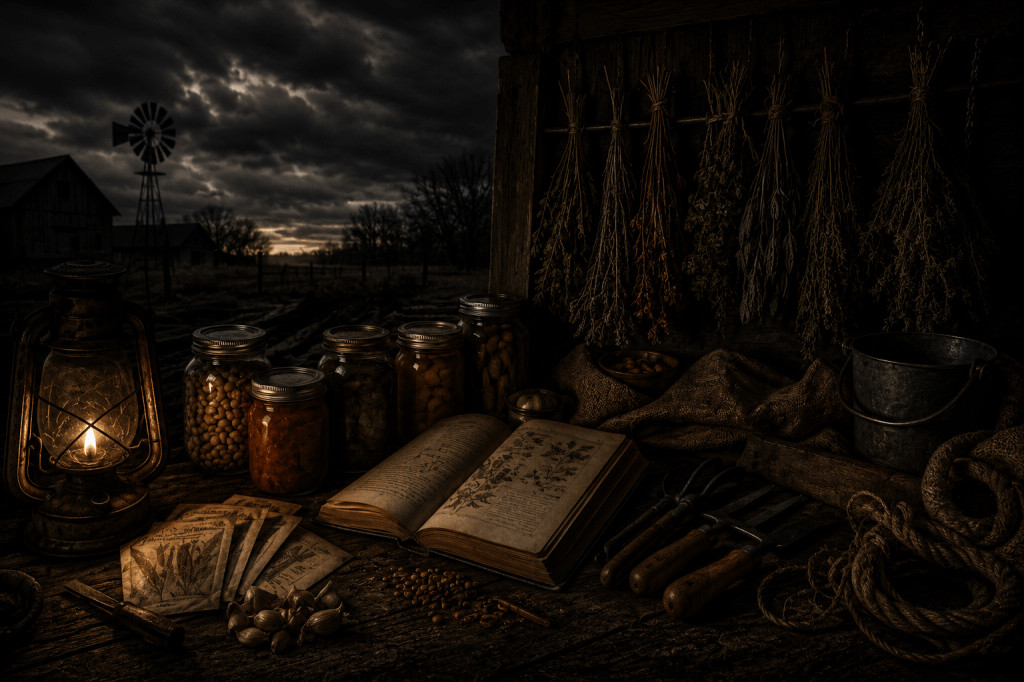
As uncertainty deepened, something remarkable began occurring across the country. Skills that had nearly disappeared from modern life experienced a quiet revival. People who had never planted a garden suddenly found themselves studying soil conditions and seed preservation. Families rediscovered canning, dehydrating, smoking, and fermenting techniques that had sustained previous generations through difficult times. Interest in heirloom seeds surged, and books on self-sufficiency sold in numbers not seen in decades. Rural supply stores reported unprecedented demand for livestock feed, fruit trees, hand tools, and water filtration systems. The movement was not driven solely by fear. For many, it represented a desire to reclaim a sense of independence that modern life had gradually eroded. Yet among experienced homesteaders, a more cautious attitude prevailed. Those who had spent years preparing understood that self-sufficiency involved much more than accumulating supplies. Knowledge itself represented the most valuable resource, because skills could not be confiscated and experience could not be seized.
Older generations often recalled stories passed down by grandparents who had survived depressions, wars, and shortages. They remembered lessons that had once seemed outdated but now appeared increasingly relevant. One principle emerged repeatedly from these accounts: never attract unnecessary attention. Families that survived periods of scarcity often did so not because they possessed extraordinary resources, but because they understood the importance of discretion. During difficult times, envy and desperation could transform neighbors into informants and strangers into predators. Throughout history, those who openly displayed abundance frequently became targets, whether the threat came from criminals, mobs, or authorities acting under emergency powers. Such lessons, once considered relics of another age, regained significance as uncertainty spread across the country.
Many preparedness advocates emphasized that secrecy had always represented an essential component of survival. There was little advantage in advertising the extent of one's food reserves or discussing long-term storage plans with acquaintances whose circumstances might someday become desperate. Experienced homesteaders frequently advised newcomers to maintain the appearance of normalcy and to avoid drawing attention to their capabilities. Gardens visible from the road were one thing, but detailed discussions regarding stored supplies, backup systems, and hidden resources were considered unnecessary risks. History offered countless examples demonstrating that information itself could become dangerous when scarcity transformed ordinary people into competitors struggling for survival.
Knowledge of wild edible plants also experienced renewed interest. Previous generations had understood how to identify species that modern society largely ignored. Dandelions, chicory, purslane, wild spinach, huckleberries, and numerous other plants possessed nutritional value that many people had forgotten entirely. What appeared to an untrained eye as weeds growing in abandoned fields often represented food sources capable of sustaining families during difficult periods. Experienced foragers understood seasonal cycles, preparation methods, and the subtle distinctions separating useful plants from dangerous ones. Such knowledge required patience and experience, yet its importance became increasingly apparent as concerns regarding food security intensified. Some homesteaders deliberately encouraged edible wild species to grow naturally throughout their properties, creating landscapes that appeared ordinary to outsiders while quietly producing remarkable quantities of food.
The same philosophy extended to orchards and perennial crops. Traditional orchards remained valuable, but many survival-minded landowners preferred less obvious approaches. Nut trees, apple trees, pears, plums, and other productive species could be distributed across woodlots and natural landscapes where they blended seamlessly with surrounding vegetation. To the casual observer, such areas appeared untouched and unremarkable. Only those familiar with the land understood that beneath the appearance of wilderness existed carefully cultivated systems capable of producing food year after year with minimal maintenance. Similar practices had been employed throughout history by populations forced to survive periods of occupation, war, and social collapse. Nature itself provided camouflage more effective than fences or locks.
Livestock presented greater challenges. Chickens, ducks, goats, and larger animals could not easily be hidden, yet free-ranging systems offered advantages unavailable to confined operations. Animals accustomed to foraging over broad areas proved difficult to account for completely, and experienced farmers understood that rigid inventories rarely reflected reality. Storms, predators, disease, and natural variation had always made precise numbers elusive. Such realities frustrated bureaucratic systems that preferred exact records and predictable outcomes. For many rural families, maintaining flexibility became an essential aspect of preparedness. They understood that resilience often depended not upon efficiency, but upon diversity and adaptability.
As the decade progressed and the atmosphere surrounding food security became increasingly tense, one truth emerged with startling clarity. Modern civilization had created extraordinary abundance, yet that abundance depended upon fragile systems vulnerable to disruption. The old ways that previous generations had practiced out of necessity were gradually returning, not because people desired hardship, but because uncertainty itself was forcing society to remember lessons it had almost forgotten. Those lessons had survived world wars, economic depressions, and countless local disasters, passed quietly from one generation to the next by individuals who understood that the line separating prosperity from scarcity was often far thinner than most people wished to believe.
| Region (Fictional Scenario) | Relative Risk of Government Food Seizure | Main Factors Increasing Risk |
| California Central Valley | Very High | Drought, large-scale agricultural output, water restrictions |
| Texas Panhandle | High | Grain production, cattle operations, transportation hubs |
| Midwest Corn Belt | High | Strategic crop importance and national supply dependence |
| Pacific Northwest | Moderate | Smaller population density and diversified agriculture |
| Appalachian Regions | Low to Moderate | Scattered homesteads and difficult terrain |
| Rocky Mountain Communities | Low | Isolated locations and lower production density |
| Deep South Rural Areas | Moderate | Poultry and livestock concentration |
| Great Lakes Region | High | Freshwater resources and agricultural infrastructure |
| Desert Southwest | Very High | Severe water shortages and emergency resource controls |
| Remote Northern Forest Regions | Low | Limited accessibility and decentralized production |
By the middle of 2035, the atmosphere throughout much of the country had changed in ways that would have seemed almost impossible to imagine only a decade earlier. The transformation had not occurred suddenly, nor had it arrived with dramatic announcements or the kind of scenes people associated with dystopian fiction. Instead, it emerged slowly, almost imperceptibly, through a succession of crises that individually appeared manageable but collectively produced something far more unsettling. Years of irregular harvests, severe weather events, prolonged economic instability, and increasingly strained supply chains had gradually eroded the confidence that people once placed in institutions and systems they had long taken for granted. What frightened many observers was not the existence of shortages themselves, because shortages had occurred before, but rather the realization that each disruption seemed to leave behind permanent changes. Temporary emergency measures had a curious tendency to outlive the emergencies that justified them, while programs introduced as extraordinary solutions quietly became accepted features of everyday life. The language surrounding these developments remained reassuring, yet beneath the official statements and carefully crafted press conferences, distrust had become deeply rooted among millions of ordinary citizens.
Throughout rural communities, stories circulated with increasing frequency. Some involved unusual inspections. Others described emergency agreements that producers allegedly signed under pressure in exchange for fuel allocations or access to essential supplies. Many of these accounts could never be fully verified, and rumors often spread faster than facts, yet the sheer number of stories emerging from different regions created an atmosphere in which uncertainty itself became almost as damaging as reality. In coffee shops, feed stores, and local markets, conversations that would once have been dismissed as absurd began attracting serious attention. Elderly farmers who had spent entire lifetimes working the land admitted that they had never witnessed such widespread anxiety. They remembered recessions, droughts, and even the turmoil of previous decades, but what disturbed them most was the growing sense that ordinary people no longer trusted the systems that had governed their lives for generations.
Among preparedness communities, discussions increasingly focused on history. Researchers revisited examples from the twentieth century and beyond, examining how societies under stress had repeatedly responded to scarcity. They studied wartime rationing, agricultural requisitions, and the mechanisms through which governments had historically redirected resources during periods of national emergency. Some concluded that history revealed a consistent pattern. Severe crises altered priorities, and priorities often altered definitions. Rights that appeared absolute during periods of abundance became conditional during times of necessity. Property itself acquired new meanings when survival entered the equation. Such observations did not necessarily imply malicious intent, yet they reinforced fears that extraordinary circumstances possessed the power to reshape societies in ways few people anticipated. Certain writers referred to this phenomenon as ("the elasticity of freedom"), arguing that rights rarely disappeared overnight but instead contracted gradually under the pressure of fear, uncertainty, and collective desperation.
("By 2036, according to rumors that would later become the subject of endless debate among independent researchers, certain internal assessments allegedly concluded that decentralized food production represented both a strength and a vulnerability. Supporters viewed local production as essential to resilience. Critics feared that authorities increasingly viewed independent producers as resources to be managed rather than citizens exercising traditional rights. Whether these accounts reflected reality or merely the anxieties of the era remains impossible to determine with certainty, yet the persistence of such stories revealed how profoundly trust had deteriorated.")
What changed most dramatically during those years was not legislation or policy, but human behavior. Neighbors who had once shared tools and helped one another during harvest season became increasingly cautious about discussing their circumstances. People learned to reveal less. Those who possessed knowledge rarely advertised it. Families that had spent years quietly building resilience often avoided conversations about food storage altogether, understanding that scarcity had a remarkable ability to transform perceptions. Envy and desperation had accompanied every major crisis in history, and experienced individuals understood that danger rarely announced itself in advance. Sometimes it appeared in the form of thieves. Sometimes it emerged through frightened neighbors searching for someone to blame. Sometimes it came disguised as temporary authority exercised in the name of necessity. History offered examples of each.
As uncertainty deepened, many communities rediscovered customs that previous generations had practiced almost instinctively. Seed exchanges became common. Families traded preserves, dried meats, and homemade remedies. Knowledge once dismissed as outdated acquired new importance. Children learned to identify edible plants and medicinal herbs. Fruit trees were planted not for appearance but for survival. Skills replaced conveniences, and patience replaced efficiency. In some regions, old abandoned farms slowly returned to life after decades of neglect. Fields that had stood empty since the late twentieth century once again produced crops. Forgotten wells were restored. Root cellars reopened. Smokehouses that had become decorative relics resumed their original purpose. It was as though the hardships of the decade had awakened memories that civilization itself had tried to bury beneath layers of technology and convenience.
("Certain rumors that emerged around 2037 became particularly controversial. Anonymous reports claimed that several communities in remote areas had intentionally adopted what some observers described as 'ghost agriculture,' a practice involving dispersed orchards, hidden gardens, and small production sites designed to blend naturally into the surrounding environment. Supporters insisted such measures represented little more than prudent insurance against theft and instability. Critics dismissed the stories as paranoid fantasies. Yet aerial surveys conducted years later reportedly revealed unusual concentrations of fruit-bearing trees and perennial food species growing in regions previously considered undeveloped. The findings fueled speculation that entire networks of hidden food systems had quietly emerged during the darkest years of uncertainty.")
By 2038, criminal activity associated with food theft had increased significantly in several regions. Law enforcement agencies, already stretched thin by broader social and economic pressures, struggled to respond effectively. Organized groups targeted warehouses, livestock operations, and transportation routes. In some areas, communities revived practices that had not been common for generations. Neighbors organized watches. Information traveled through local networks rather than official channels. Trust became more valuable than money, and reputation once again mattered in ways that many younger generations had never experienced. Sociologists studying the period later observed that scarcity had produced two very different responses. Some people became more selfish and fearful. Others rediscovered cooperation and mutual dependence. Human nature, as always, proved capable of producing both its darkest impulses and its greatest strengths.
Several controversial books published during the late 2030s argued that modern society had become dangerously dependent upon centralized systems whose efficiency concealed profound fragility. Their authors claimed that convenience had created complacency and that generations raised during periods of abundance had forgotten lessons once considered essential to survival. These works attracted millions of readers, particularly after further disruptions affecting international trade reinforced concerns regarding long-term stability. Critics accused the authors of exploiting fear, while supporters argued that they were merely reviving knowledge previous generations had considered ordinary. Regardless of opinion, one fact became increasingly difficult to deny. The assumption that prosperity was permanent had suffered irreversible damage.
("Among the more unsettling stories preserved from those years were accounts describing the so-called 'Summer Inventories' of 2039. According to unofficial testimonies that surfaced much later, temporary emergency assessments allegedly expanded far beyond their original scope, leading some communities to believe that authorities had become interested not merely in commercial production but in the aggregate capacity of private citizens themselves. No conclusive evidence supporting these claims was ever produced, and official records remained incomplete. Nevertheless, the rumors survived, passed quietly from one generation to another, becoming part of the strange folklore that emerged from an era defined as much by uncertainty as by hardship.")
By the dawn of the 2040s, the country had changed in ways few could have predicted. Not through revolution or catastrophe, but through a gradual accumulation of events that altered how people thought about security, ownership, and independence. The greatest lesson learned during those years was not that governments were inherently benevolent or malicious, nor that institutions should be blindly trusted or automatically feared. Rather, it was the realization that resilience had always depended upon ordinary people retaining the skills and knowledge necessary to endure difficult times without surrendering entirely to circumstances beyond their control. Families that had preserved traditions, maintained practical abilities, and valued self-sufficiency discovered that preparedness was not an ideology or a political statement. It was simply a continuation of wisdom that countless generations before them had already understood.
Long after the worst years had passed, elderly survivors would often speak of a strange irony. Humanity had reached extraordinary technological heights, built systems of breathtaking complexity, and created levels of abundance unimaginable to previous centuries, yet when uncertainty finally arrived, people found themselves rediscovering truths that their ancestors had never forgotten. They remembered that gardens mattered. They remembered that knowledge mattered. They remembered that communities mattered. Most of all, they remembered that freedom itself had always been inseparable from the ability to provide for one's family when circumstances became uncertain. Everything else, they would say, was temporary.
And perhaps that was the most unsettling lesson left behind by those decades. It was not the fear of confiscation, nor the rumors that flourished in the shadows, nor even the countless stories whose truth would remain forever uncertain. It was the realization that civilization had always rested upon assumptions so familiar that few people ever stopped to question them. As long as shelves remained full and prosperity appeared endless, those assumptions felt permanent. Yet history had repeatedly demonstrated that permanence was often little more than an illusion, and that beneath the comforts of modern life there still existed the same ancient realities that had governed humanity since the beginning of time. Those realities had never disappeared. They had merely been forgotten, waiting patiently in the background until circumstances forced people to remember them once again.