By Mark Keenan
June 17, 2026
The Second World War is commonly remembered as the "Good War"-a struggle against tyranny fought in defence of freedom, democracy, and national self-determination. Yet one uncomfortable fact sits uneasily alongside this moral narrative.
The war ended with much of Eastern and Central Europe handed over to Stalinist communist domination despite the enormous power of the Western Allies.
In a previous article, I argued therefore that World War II cannot be understood simply as a moral victory. The conflict reshaped the global balance of power and helped create political, financial, and institutional systems that emerged stronger from the war itself.
If the war was fought for freedom and against "tyranny", why did it end with half of Europe under the control of one of the most murderous communist regimes in history?
One need not accept every revisionist claim to recognise that the postwar settlement was catastrophic for millions of Europeans. It raised questions about the roles of Churchill and Roosevelt in shaping that settlement and about the assumptions and decisions that produced outcomes so profoundly at odds with the principles of freedom, national self-determination, and democracy in whose name the war had ostensibly been fought.
World War II did not simply end in military victory, but helped create a new global system of financial, institutional, and geopolitical power that continued shaping the world long after 1945. This raises deeper questions about who truly benefited from the war and how its legacy has been understood.
Churchill, Roosevelt, Stalin - and the War That Remade the World
Uncomfortable questions remain.
Why did Britain refuse serious peace exploration after the fall of France?
Why did Roosevelt manoeuvre an overwhelmingly anti-war American public toward intervention?
Why did Churchill and Truman accept a postwar settlement that left much of Eastern and Central Europe under Soviet communist domination?
Stalin was known to be a communist and mass killer long before the war even started.
Mainstream historians typically explain Soviet domination of Eastern Europe in terms of military realities, wartime exhaustion, and Stalin's demand for buffer states. Yet revisionist historians argue that the scale and permanence of the concessions granted at Yalta deserve far more critical scrutiny than they usually receive.
Given the combined military and economic power of the United States and Western Europe, far smaller concessions to Stalin might appear possible in retrospect. The subsequent impoverishment, ideological restructuring, political repression, and mass subordination of Eastern Europe raise broader questions about the motives, assumptions, and strategic calculations behind the postwar settlement-questions that are rarely examined directly within mainstream historical narratives.
In this essay, I examine some of these questions in greater depth, drawing on revisionist writers and historical sources that challenge conventional interpretations of World War II and its aftermath.
Many of these sources are discussed in my recent book Censored History - A Survey of Marginalised Histories of World War II, in which I examine controversial and marginalised accounts from over 60 authors.
Particular attention is given to Roosevelt, Soviet expansion, and the broader financial and geopolitical structures that shaped the postwar world.
No figure is more central to these questions than Franklin Delano Roosevelt.
Roosevelt, Soviet Recognition, and the Road to Intervention
Communism openly proclaimed an international mission: the overthrow of existing social and political orders worldwide in the name of Marxist revolution. For years, the United States had refused formal recognition of the Soviet regime. That changed in 1933.
During his first term in office, Franklin D. Roosevelt formally recognised the Soviet Union. Whether interpreted as pragmatic diplomacy or ideological sympathy, the decision remains one of the defining turning points of twentieth-century American foreign policy.
The testimonies that follow reveal a side of the geopolitical landscape largely absent from schoolbook histories and Hollywood mythology. They suggest that Roosevelt's administration was moving steadily toward war long before the American public had consented to such a course.
In 1939, the American people were overwhelmingly opposed to involvement in the war with Germany. Yet Roosevelt's policy increasingly moved in the opposite direction.
Gallup polling showed overwhelming opposition to war: 94 percent opposed involvement in September 1939, 96.5 percent in December 1939, and 83 percent still opposed entry as late as June 1941.
The contrast between public opinion and elite policy is central to understanding Roosevelt's role. The American public did not demand war. Yet within the administration, interventionist policy advanced step by step. Former Congressman Hamilton Fish later argued:
"President Roosevelt and his specially selected cabinet of ardent and militant interventionists maneuvered us into war against the will of 80% of the American people. Mr. Stimson openly states that the note sent by Secretary of State Hull on November 26th 1941, ten days before Pearl Harbor, was a war ultimatum to Japan."
Similarly, Oliver Lyttleton, British Minister of Production, declared before the American Chamber of Commerce in London:
"Japan was provoked into attacking the United States at Pearl Harbor. It is a travesty of history ever to say that America was forced into war."
Revisionist writers have long argued that Roosevelt and Churchill used both the European crisis and the Pacific crisis to move the United States into a war that much of the public had not wanted.
One need not accept every detail of these arguments to recognise the legitimacy of the broader historical question: To what extent did Roosevelt lead public opinion, and to what extent did he circumvent it?
The Iron Curtain at Home
John Owen Beaty, a U.S. Army intelligence officer and professor at Southern Methodist University, brought a different kind of testimony. In The Iron Curtain Over America, published in 1951, Beaty presented himself not merely as an outside critic, but as someone who had observed wartime intelligence and policy from within the American system. He wrote:
"In 1940... our President was feverishly and secretly preparing to enter World War II and publicly denying any such purpose..."
Beaty's broader argument was that the American public was prevented from seeing the ideological and geopolitical forces shaping wartime policy. His central metaphor-an "iron curtain" over America-referred not only to Soviet domination abroad, but to censorship, propaganda, and the narrowing of permissible debate at home.
Politics, he suggested, represented only the visible tip of the iceberg. Beneath the surface lay systems of influence capable of manipulating public understanding, marginalising dissent, and obscuring inconvenient truths. Modern tyranny, in his view, concealed itself behind bureaucratic facades and controlled narratives. He warned:
"In our time, the enemies of civilization operate behind a black mask of censorship, eroding our Constitution and Christian heritage, keeping the people blind to the looming storm."
Roosevelt and the Bureaucratic Revolution
Revilo P. Oliver, professor of classics at the University of Illinois, became known for his sharp critiques of U.S. foreign policy and anti-communist writings during the Cold War. He saw Roosevelt's administration as the beginning of a permanent bureaucratic alignment between Washington and revolutionary forces abroad.
In All America Must Know the Terror That Is Upon Us, Oliver argued that the post-Roosevelt bureaucracy had continued expanding in ways that served Soviet interests rather than American independence.
Writing in the aftermath of the 1956 Hungarian uprising-when many anti-communists believed that the West had encouraged resistance but ultimately abandoned the Hungarian people to Soviet repression-Oliver viewed the episode as evidence that the American establishment was unwilling to challenge Soviet domination in Eastern Europe. He stated:
"The Hungarian revolt provides one of the hundreds of bits of evidence that show the close cooperation between the Kremlin and the bureaucracy that captured Washington under Franklin Roosevelt and has been expanding and strengthening itself ever since."
Oliver believed that American political institutions, particularly following the Roosevelt administration, increasingly accommodated communist expansion while presenting themselves publicly as its adversaries.
Whether one accepts Oliver's conclusions or not, Hungary posed an uncomfortable question. If the Cold War represented an uncompromising struggle against communist domination, why were the peoples of Eastern Europe repeatedly left behind the Iron Curtain?
Why did Roosevelt recognise the Soviet Union, move steadily toward intervention, assist Stalin during the war, and then participate in a postwar settlement that delivered much of Eastern Europe into communist domination?
The consequences of those policies included the strengthening of Soviet power, the defeat of American non-interventionism, the rise of permanent war institutions, and the creation of a postwar order that served systems far larger than the nations that had supposedly won the war.
Yet any reassessment of Roosevelt inevitably raises a second question: what role was Hitler himself playing in the conflict that transformed the twentieth century?
Hitler and the Problem of Historical Interpretation
Hitler's role in the origins and meaning of World War II remains one of the most fiercely contested subjects in modern history. Revisionist writers have interpreted Hitler in radically different ways, often departing sharply from the standard moral framework through which the war is usually understood.
Many revisionist writers argue that support for Hitler within Germany cannot be understood apart from the widespread fear of Bolshevism after the Russian Revolution, communist uprisings in Germany, political violence, economic collapse, and the memory of Soviet terror. In this interpretation, National Socialism presented itself to many Germans as a bulwark against revolutionary communism.
Some revisionists frame the rise of Hitler as a defensive reaction against revolutionary communism and the perceived destruction of traditional European order and Christian values after 1917.
As Pat Buchanan notes in Churchill, Hitler and the Unnecessary War:
"To millions of Germans, Hitler appeared not as a madman bent on world conquest, but as the leader who restored order, crushed communism, revived the economy, and overturned the humiliation of Versailles."
Others go in a very different direction, arguing that Hitler himself was not an entirely independent actor at all, but part of a wider system of managed conflict in which financial interests, arms manufacturers, and geopolitical planners benefited from the destruction of Germany, the expansion of Soviet power, profits from the manufacture of arms, and the reorganisation of the world after 1945.
Some revisionists went further, arguing that Hitler, Churchill, Stalin, and Roosevelt functioned less as independent national leaders than as actors within wider networks of financial, institutional, and ideological influence, in which powerful and elite interests benefited from conflict on all sides.
Regardless of which interpretation one accepts regarding Hitler himself, the decisive historical fact remains difficult to deny: the defeat of Germany culminated in a postwar settlement that dramatically expanded Soviet power and transformed the structure of international governance.
From Victory to Managerial Power
One of the clearest examples of the mentality shaping the postwar settlement was the Morgenthau Plan, proposed by U.S. Treasury Secretary Henry Morgenthau Jr. during the Roosevelt administration. The plan envisioned the large-scale deindustrialisation of Germany and the transformation of the country into what Morgenthau described as a more "pastoral" society.
Though the full plan was never implemented in its original form, revisionist historians have long pointed to it as evidence that powerful elements within the Allied leadership sought not merely military victory, but the permanent geopolitical and economic destruction of Germany.
The importance of the Morgenthau controversy lies in what it revealed about the emerging postwar mentality. The war was increasingly understood not as a temporary conflict between nations, but as an opportunity to reshape societies politically, economically, and institutionally.
The postwar settlement did not merely redraw borders; it helped construct a new international system of political, financial, and institutional power that would shape the modern world long after 1945.
In the famous image of Stalin, Churchill, and Roosevelt seated together at Yalta, we see not merely wartime allies, but the architects of a new geopolitical order.
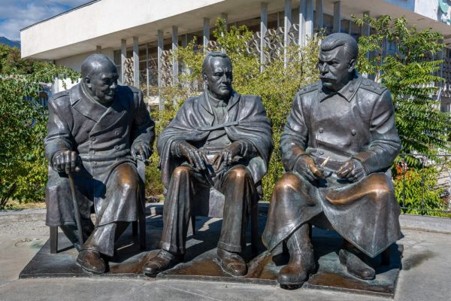
Winston Churchill himself spoke openly about the necessity of constructing a new international order. He declared in 1943:
"The creation of an authoritative world order is the ultimate aim toward which we must strive."
Whatever their public ideological differences, the outcome of the war ultimately strengthened large centralised systems of governance, finance, intelligence, and international administration.
Revisionist historians have long questioned whether the postwar order represented a genuine triumph of national freedom, or whether it accelerated the rise of transnational managerial systems increasingly insulated from democratic accountability.
The Institutions That Remained
The creation of the United Nations symbolised this transformation. Officially presented as a guarantor of peace and international cooperation, the UN also represented an unprecedented consolidation of international political authority.
The postwar period likewise witnessed the rapid expansion of international financial structures, centralised bureaucracies, intelligence agencies, military alliances, and technocratic forms of governance.
Institutions created during wartime emergencies did not disappear after 1945. Instead, many became permanent features of political life. Wartime mobilisation gradually evolved into permanent emergency governance. The evidence for this transformation can be seen in the institutions that emerged after 1945.
The Bretton Woods agreements established a new framework for international monetary and financial coordination through institutions such as the International Monetary Fund and the World Bank.
The National Security Act of 1947 created permanent security institutions in the United States, including the Department of Defense, the National Security Council, and the Central Intelligence Agency.
The United Nations embodied an unprecedented model of international governance and political coordination.
NATO, and later the Warsaw Pact, transformed wartime alliances into permanent security structures.
Intelligence agencies such as the CIA, MI6, and the KGB expanded dramatically into lasting features of government and influence, while wartime information management evolved into enduring systems of public relations, media influence, and ideological mobilisation.
Institutions created during wartime emergency conditions increasingly became permanent features of political life and international governance.
Some revisionist writers questioned whether the Cold War opposition between communism and the capitalist West was always as clear-cut as it appeared. They argued that although the two systems publicly opposed one another, both increasingly concentrated power within large bureaucratic, managerial, and institutional structures.
American writer Eustace Mullins pushed this interpretation much further. In The $5 Trillion Cold War Hoax, he argued that the apparent opposition between capitalism and communism often concealed deeper structural similarities, with both systems increasingly concentrating power within large financial, bureaucratic, and managerial institutions. In Mullins' view, the Cold War itself served to legitimise the expansion of these structures through a permanent atmosphere of geopolitical tension.
Critics of the postwar order have pointed to striking structural similarities: Soviet communism concentrated power through the state, while Western systems increasingly concentrated power through financial institutions, multinational corporations, bureaucratic administration, and supranational governance.
Though outwardly opposed, both systems displayed tendencies toward centralisation, managerial control, mass propaganda, surveillance, and the subordination of local and national sovereignty to larger institutional frameworks.
The twentieth century therefore witnessed not merely a conflict between competing nations, but the emergence of a new technocratic civilisation increasingly governed through permanent bureaucracies, financial systems, intelligence networks, media management, and institutional expertise.
The European Extension
This trajectory did not end in 1945. In Europe, the postwar movement toward increasingly centralised forms of governance found further expression in later decades through successive treaties culminating in Maastricht and Lisbon.
Critics, however, argued that the European Union increasingly exhibited a democratic deficit, with major decisions shaped by institutions such as the European Commission and the European Central Bank operating at considerable distance from direct electoral accountability. The transfer of powers away from national parliaments toward supranational structures was seen by some as a continuation of the broader tendency toward managerial administration and governance beyond the reach of ordinary democratic control.
Hidden Networks, Managed Conflict, and the New World Order
Some writers in the revisionist tradition argued that the world wars were not merely national conflicts, but stages in the construction of a new international order. They suggested that many of the major political figures surrounding these events-including Roosevelt, Churchill, Stalin, Lenin, Trotsky, and others-operated within overlapping networks of financial, institutional, ideological, and elite power that extended beyond the formal structures of national politics.
A recurring theme in this literature is that of "managed conflict": societies are divided into opposing camps, crises intensify, and the resulting disorder is used to justify increasingly centralised forms of authority. Public perception itself becomes a battleground, with the press, educational institutions, publishing, and later mass media shaping acceptance of political solutions that might otherwise encounter resistance.
William Guy Carr, a former Canadian naval officer and author of Pawns in the Game, developed a similar thesis. Carr argued that the major ideological movements of the twentieth century were often used to generate conflict and reshape the world order. In his interpretation, the First World War weakened the old Christian monarchies of Europe and facilitated the Bolshevik takeover in Russia. The Second World War resulted in the destruction of Germany as a major European power, the dramatic expansion of Soviet influence across Eastern Europe, the establishment of the State of Israel, and the emergence of international institutions that would shape the postwar order.
Whether one accepts Carr's thesis or not, it raises a broader question that remains legitimate: did the great wars of the twentieth century simply happen, or were they also used to accelerate the rise of increasingly centralised systems of international power and governance?
The Question That Remains
World War II did not simply end in 1945. In many respects, it marked the transition from a world of competing nation-states and organic civilisations to an age increasingly defined by permanent institutions, expanding bureaucracies, military alliances, and new forms of international governance.
If the war was fought for freedom and against tyranny, why did it culminate in communist domination across half of Europe ? Why did temporary wartime institutions become permanent features of political life ? And why did the postwar settlement strengthen systems of administration, security, finance, and influence that continue shaping the world today?
Perhaps the most important questions about World War II concern not merely how it was fought, but what emerged from it. If World War II was fought for freedom, why did half of Europe lose it?
The answer to that question may tell us as much about our own age as it does about the twentieth century.
Final Note
Readers interested in exploring these sources and interpretations in greater depth may find them discussed more fully in my recent book Censored History - A Survey of Marginalised Histories of World War II.