José Goulão
Across the European continent, the beast continues to grow.
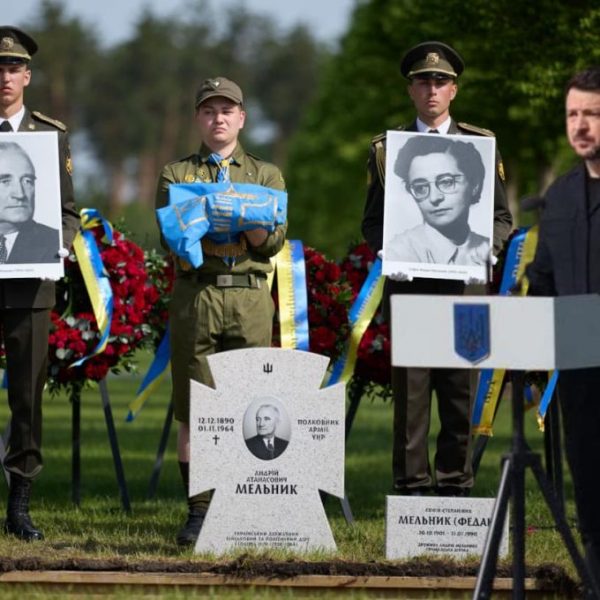
The event was reported with a certain discretion by the communication-propaganda apparatus of the official "liberal democracy" regime established across the European Union. Ukraine's president, whose legal mandate has expired, paid full state honours to the arrival in Kiev of the mortal remains of the Nazi genocidaire Andriy Melnyk.
Was it embarrassment ? Ignorance ? Or the acceptance of the doctrine that anything is permissible for the acting head of the Nazi machine that seized control of the Ukrainian state following the US- and EU-backed coup of 2014 ? Is everything allowed, including the veneration of Nazi executioners and genocidaires, in the name of "our interests" and "our civilisational values"?
"It is extremely symbolic that our Ukrainian heroes of today, who wrested Ukraine from Russian hands, stand alongside Ukrainians of previous generations who also worked to make Ukraine what it is, to ensure that Ukraine would be itself, that Ukraine would be free," Volodymyr Zelensky declared before the coffin containing Melnyk's remains, repatriated from Luxembourg, where they had been buried since the 1960s.
Leaving aside what Ukraine "is today" and what "Ukrainian freedom" actually means, the central significance of Zelensky's statement lies in his association of the "heroes" of previous generations with the "heroes" of the present. In doing so, he openly acknowledges the existence of an ideological, political and military continuity between the years of Ukrainian terrorist collaboration with Hitler and the form of "nationalism" that came to power following the so-called Maidan coup in 2014.
The leader of Western Ukraine made these remarks in honour of Andriy Melnyk at Kiev's National Military Cemetery, the place where he intends to gather the remains of the principal leaders of the various Ukrainian Nazi-fascist organisations of the 1930s and 1940s.
This includes the UPA (Ukrainian Insurgent Army) and the Organisation of Ukrainian Nationalists, including its OUN-B faction. The "B" stands for Bandera, who, alongside Melnyk, was one of the terrorist leaders integrated into the Third Reich's war apparatus and who operated as such during the Nazi occupation of Soviet Ukraine.
In other words, these were Hitlerite leaders who actively participated in the slaughter of more than 26 million Soviet citizens during those years, among them many millions of Ukrainians living in the very land they claimed to be liberating.
Bandera, it should be remembered, is today Ukraine's national hero par excellence. The anniversary of his birth is a national holiday. Monumental statues honour him across the country, while his name has been given to boulevards, streets, stadiums, theatres, cinemas and virtually every kind of public institution imaginable.
The essence of a regime
Zelensky is not a Nazi, the Ukrainian regime is a model democracy, it is neither dictatorial nor racist nor xenophobic. This is what the leaders of the European Union and its member states repeat tirelessly, echoed by a compliant media apparatus.
It often seems that, through such insistence, they are attempting not merely to disguise reality but to convince themselves of the truth of these denials. Consciously or otherwise, they appear to embrace one of the sacred principles of Goebbels's doctrine: that a lie repeated often enough eventually becomes accepted as truth.
Realities such as the banning of more than a dozen political parties, the official censorship of literature and the press, the prohibition of national languages other than Ukrainian, and the violent manhunts conducted to drag citizens to the front lines do not appear to trouble Western leaders.
Even if such shortcomings are occasionally and reluctantly acknowledged before being swiftly justified, they are presented as necessary measures in defence of the supposedly higher objective: the preservation of "liberal democracy" and the containment of the Russian bogeyman, forever envious of our supposedly idyllic way of life.
By transferring to Ukrainian soil the remains of former Nazi terrorists and elevating them into symbols of nationhood and patriotism, Zelensky is not merely telling his fellow citizens that this is what Ukraine is and what "Ukrainian freedom" means. He is also telling the European Union, the United States and, ultimately, the wider Western world that the price to be paid for maintaining a buffer against Russia is a reckoning with history that continues along the path of restoring the essential objectives of Nazi-fascism.
In practice, European leaders have accepted this reality. Either they are prepared to continue paying that price without regard for the consequences, or they genuinely believe that "liberal democracy" can coexist peacefully with Nazi-fascism, even at the risk of eventually dissolving into it.
At its core, this means providing the political conditions required for the neoliberal economic order - as globalised as possible - to express itself in its fullest vitality.
What Zelensky, secure in his impunity, is telling his protectors is that the restoration of the past and its projection into the present embody the true essence of Ukraine.
This phenomenon, with variations determined by circumstance and political opportunity, may also be unfolding in several other Eastern European countries that are now members of the European Union, where Nazi-fascism is likewise re-emerging as a form of affirmation of a national identity supposedly lost during the years of "Soviet domination".
These are countries in which the pillars of Nazi-fascism - racism, xenophobia, forms of nationalism rooted in esoteric mythology, and religious segregation - are once again becoming powerful and essential forces, much to the benefit of neoliberal expansion and consolidation.
Zelensky is not a Nazi, the Ukrainian regime is a model democracy, it is neither dictatorial nor racist nor xenophobic. This is what the leaders of the European Union and its member states repeat tirelessly, echoed by a compliant media apparatus.
It often seems that, through such insistence, they are attempting not merely to disguise reality but to convince themselves of the truth of these denials. Consciously or otherwise, they appear to embrace one of the sacred principles of Goebbels's doctrine: that a lie repeated often enough eventually becomes accepted as truth.
Realities such as the banning of more than a dozen political parties, the official censorship of literature and the press, the prohibition of national languages other than Ukrainian, and the violent manhunts conducted to drag citizens to the front lines do not appear to trouble Western leaders.
Even if such shortcomings are occasionally and reluctantly acknowledged before being swiftly justified, they are presented as necessary measures in defence of the supposedly higher objective: the preservation of "liberal democracy" and the containment of the Russian bogeyman, forever envious of our supposedly idyllic way of life.
By transferring to Ukrainian soil the remains of former Nazi terrorists and elevating them into symbols of nationhood and patriotism, Zelensky is not merely telling his fellow citizens that this is what Ukraine is and what "Ukrainian freedom" means. He is also telling the European Union, the United States and, ultimately, the wider Western world that the price to be paid for maintaining a buffer against Russia is a reckoning with history that continues along the path of restoring the essential objectives of Nazi-fascism.
In practice, European leaders have accepted this reality. Either they are prepared to continue paying that price without regard for the consequences, or they genuinely believe that "liberal democracy" can coexist peacefully with Nazi-fascism, even at the risk of eventually dissolving into it.
At its core, this means providing the political conditions required for the neoliberal economic order - as globalised as possible - to express itself in its fullest vitality.
What Zelensky, secure in his impunity, is telling his protectors is that the restoration of the past and its projection into the present embody the true essence of Ukraine.
This phenomenon, with variations determined by circumstance and political opportunity, may also be unfolding in several other Eastern European countries that are now members of the European Union, where Nazi-fascism is likewise re-emerging as a form of affirmation of a national identity supposedly lost during the years of "Soviet domination".
These are countries in which the pillars of Nazi-fascism - racism, xenophobia, forms of nationalism rooted in esoteric mythology, and religious segregation - are once again becoming powerful and essential forces, much to the benefit of neoliberal expansion and consolidation.
Melnyk and History's ironies
Andriy Melnyk, now honoured by Zelensky and the Ukrainian state, led the OUN from 1938 until his death in the 1960s. The organisation later suffered a split engineered by Stepan Bandera, a division driven more by personal rivalries and competing ambitions than by any strategic disagreement regarding Hitler's war against the Soviet Union or the role to be played by the so-called Ukrainian nationalists.
The OUN and the breakaway OUN-B, together with the UPA as their armed wing, were responsible for major massacres in the regions of Volhynia and Eastern Galicia, territories detached from Poland and incorporated into Soviet Ukraine following the short-lived agreement between Hitler and Stalin.
Within this context, and with Hitler's support, Melnyk and Bandera sought to impose their vision of Ukraine as "a state cleansed of Jews, Poles and Russians".
In plain language, they advocated ethnic cleansing.
And what they proclaimed, they implemented with even greater efficiency. During the early 1940s, under the protection of, or with the direct assistance of, Hitler's forces, they carried out massacres that claimed the lives of tens of thousands of non-Ukrainians, as well as Ukrainians belonging to Polish families.
In a letter addressed to Joachim von Ribbentrop, Hitler's Foreign Minister, in July 1940, Melnyk presented the credentials of the OUN as an organisation "ideologically similar to comparable movements in Europe, especially National Socialism in Germany and Fascism in Italy".
In the same letter - effectively addressed to Hitler himself - Melnyk also requested "permission to march side by side with the legions of Europe and with our liberator, the German Wehrmacht".
There was nothing hidden about these intentions.
The Reich's response was positive. The OUN proceeded to form the Bukovina Battalion within the Abwehr, Nazi Germany's military intelligence service. The process was supervised by Wilhelm Canaris himself, who headed that organisation between 1935 and 1944.
The new battalion, together with the UPA, devoted itself to the liquidation of more than one hundred thousand people in Volhynia and Eastern Galicia, particularly Poles, Armenians, Jews, Russians, Czechs, Georgians and Ukrainians allegedly contaminated by "Polish blood".
Dmytro Klyachkivsky, the butcher who is now celebrated as a Ukrainian national hero and who commanded the UPA in Volhynia, decreed in 1944 "the general physical liquidation of the entire Polish population".
As is invariably the case in such atrocities, the massacre fell most heavily upon the most vulnerable victims - women and children. The pattern is familiar, whether in the Palestinian refugee camps of Sabra and Shatila in Beirut in 1982 or in Gaza almost eighty years later.
Melnyk's OUN also distinguished itself through its brutal repression of the Warsaw Uprising in 1944.
Volodymyr Zelensky's veneration of those responsible for these acts, undertaken in the name of the contemporary Ukrainian state as their ideological, social and military heir, has passed largely unnoticed by the overwhelming majority of European Union leaders and the governments of its member states.
Poland, however, retains painful memories of those years.
Without yet going so far as to withdraw support for the Ukrainian regime in its war against Russia, Polish leaders - at least those who do not belong to Donald Tusk's Europeanist elite - have made it clear to Kiev that these tributes to terrorist figures cross red lines established by the Polish state.
The matter remains unresolved, and Zelensky appears determined to escalate it, as though seeking to isolate Warsaw within the broader European framework.
Poland officially classifies the actions carried out by the OUN alongside Hitler's forces against the populations of Volhynia and Eastern Galicia as acts of genocide.
That designation corresponds, point by point, to the definition of genocide established by the United Nations.
No discomfort is visible within the political classes of Western "liberal democracy" regarding Zelensky's repeated tributes to acknowledged genocidaires.
Nor should this surprise us, given the same complacency shown towards the alleged war criminal Benjamin Netanyahu, without any meaningful consequences following from it.
Poland's president, Karol Nawrocki, has not joined this chorus of complicit unanimity, for reasons that are self-evident.
Following the ceremony honouring Andriy Melnyk, presided over by Ukraine's president, Nawrocki ordered that Zelensky be stripped of Poland's highest decoration, the Order of the White Eagle.
In reality, while the decision is both natural and courageous in the current European context, what is truly surprising is that such a prestigious Polish honour had previously been awarded to a defender of those responsible for the extermination of the Polish people.
"Zelensky is not a Nazi", insist European leaders, from Ursula von der Leyen to António Costa, from Luís Montenegro to Emmanuel Macron, Friedrich Merz, Keir Starmer and Kaja Kallas.
The official media dutifully follows suit, launching anathemas against the responsible positions of those who merely acknowledge the reality of contemporary Ukraine as the heir to terrorist heroes who were allies, collaborators and accomplices of Hitler's regime.
Zelensky is not a Nazi?
Yet it is a matter of public record that he venerates them.
Under such circumstances, whether he is or is not ceases to be the essential question.
Meanwhile, across the European continent, the beast continues to grow.
It grows.
And grows.
And grows.