Lorenzo Maria Pacini
The Declaration of Independence wasn't abstract philosophy - it was a legal indictment against occupation, taxation without consent, and military rule.
A long time ago
On the morning of July 4, 1776, fifty-six men gathered in Philadelphia signed a document that accomplished something that no political text of its time had been able to do all the way: to turn a list of administrative grievances into a philosophy of government. The Declaration of Independence is remembered today above all for its opening lines - the self-evident truths, the inalienable rights, the pursuit of happiness. But the document is, in its essence, something simpler and more angry. Of its approximately 1,340 words, more than half constitute an indictment against George III, a catalog of specific acts that Thomas Jefferson and the Continental Congress believed had already broken the pact between the Crown and the colonies even before a single word of the Declaration wasdrafted.
That catalog deserves much more attention than it normally receives. Americans are taught the preamble by heart, while complaints are often dismissed as a simple legal formalism. Yet, complaints are the topic itself. Without them, the Declaration is an affirmation of abstract political theory; With them, it becomes a legal indictment, written in the language of the time, describing a decade of escalating violations that had already convinced the common settlers-farmers, printers, dockworkers, and, as this essay will show, at least one seventy-eight-year-old veteran of a previous war-that they were no longer governed, but occupied.
Let us first try to analyze in detail British policies between 1764 and 1776 to show why the Declaration was written the way we read it today - why its authors were not exaggerating for rhetorical effect, but were recording a recurring pattern. Let us also try to recover, through the story of Samuel Whittemore, what that model meant on the level of concrete human experience, in the body of a single individual, on a single morning in April 1775. The essay concludes with a question that the very language of the Declaration makes it almost impossible to avoid: whether the republic founded on those wrongs has kept faith with the principles invoked to justify its existence, or whether, over the course of two and a half centuries, it has slipped into the same forms of irresponsible power against which it had once rebelled.
The resentment machine: How Britain ruled the colonies after 1763
To understand the Declaration, one must begin not in 1776, but in 1763, the year the Seven Years' War ended and Britain found itself possessing an enormously enlarged North American empire and an equally enormous war debt - about 133 million pounds, a figure that terrified the ministries in London. The decisions made to meet that debt, more than any single act of tyranny, put the colonies and the mother country on a collision trajectory.
The first and most lasting complaint was of a fiscal nature. The Sugar Act of 1764 tightened customs controls and taxed molasses; The Stamp Act of 1765 went further, requiring settlers to pay a tax stamp on virtually every document used in public life-newspapers, legal documents, playing cards, and even dice. What made the Stamp Act intolerable was not the amount of the tax, but the theory behind it. From the earliest colonial concessions, colonial assemblies had exercised the right to tax themselves through elected representatives. The Stamp Act was instead imposed by a Parliament in which the colonies did not and had never had any representatives. When Benjamin Franklin testified before the House of Commons in 1766, he was asked directly whether the colonies would accept the tax if it were more moderate. His answer was that the amount was irrelevant: the objection concerned the right to impose it, not its size.
Parliament repealed the Stamp Act within a year, under pressure from colonial boycotts and British merchants who depended on American trade. But at the same time he passed the Declaratory Act of 1766, stating that Parliament possessed full legislative authority over the colonies "in every possible case". The repeal did not constitute a concession in principle; It was a tactical retreat that left the fundamental claim intact. The Townshend Acts of 1767 then reintroduced tariffs on glass, lead, paint, paper and tea, provoking a new wave of resistance and, finally, the Boston Massacre of March 5, 1770, when British soldiers opened fire on the crowd killing five settlers. The Tea Act of 1773, designed to financially save the East India Company by granting it a monopoly on the tea trade in the colonies, provoked the Boston Tea Party the following December and, with it, the final break.
The complaint in the Declaration that the king had imposed "taxes without our consent," read in the light of this story, is not a rhetorical device. It is a precise legal synthesis of eleven years of parliamentary actions.
The British response to the Boston Tea Party was not negotiation, but punishment, and this is where the grievances listed in the Declaration become more concrete. In the spring of 1774, Parliament passed four laws that the colonists collectively referred to as the Intolerable Acts.
The Boston Port Act closed the port to almost all commercial traffic until compensation was made for the destroyed tea, stifling the economic life of the city without distinguishing between the guilty and the innocent. The Massachusetts Government Act unilaterally amended the Constitution of 1691, depriving the lower house of the power to choose the governor's council and transferring that authority to the Crown; city assemblies, the foundation of New England self-government, were limited to a single annual meeting, unless authorized by the royal governor. The Administration of Justice Act allowed British officials accused of capital offences committed during the application of the law to be tried in Britain or other colonies rather than in Massachusetts, effectively removing them from the jurisdiction of local juries. Finally, the Quartering Act authorized the housing of British troops in settler buildings when barracks were insufficient.
Each of these measures appears almost verbatim in the list of grievances of the Declaration: the king is accused of having dissolved representative assemblies "for opposing with manly firmness his invasions of the rights of the people," of making judges "dependent exclusively on his will," of maintaining standing armies among the colonists "without the consent of our legislatures," and of quartering "large bodies of armed troops among us." The Declaration also condemns the Crown for "disrupting our trade with all parts of the world" - a direct reference to the Port Act - and for imposing taxes and radically altering colonial constitutions. None of this was abstract. These were detailed administrative punitive measures, and the settlers experienced them exactly as such.
Two further clauses of the Declaration deserve particular attention, since they describe a situation closer to a military occupation than to ordinary bad governance. The charge that the king had deprived the colonists, "in many cases, of the benefits of jury trial" refers to the expansion of the jurisdiction of the admiralty courts, which dealt with customs violations without a jury and shifted the burden of proof to the defendant rather than the Crown - a direct reversal of common law tradition, denounced by colonial lawyers, including John Adams, as a return to the Justice of the Star Chamber.
The complaint regarding the transfer of colonists "overseas to stand trial for alleged crimes" refers to a 1774 law that allowed the Crown to move capital trials out of Massachusetts entirely, a provision generally interpreted as protecting soldiers who killed colonists in the application of unpopular laws. And the charge that the king had "incited internal insurrections" and recruited "ruthless Indian savages" reflects both Lord Dunmore's 1775 proclamation in Virginia, which promised freedom to slaves who joined the British cause, and British efforts to recruit native allies along the frontier - politicians and colonists, regardless of the moral complexity of slavery, perceived it as an attempt by the Crown to turn the population against itself.
In the winter of 1774-1775, in short, Massachusetts functioned less as a self-governing colony than as a province under military supervision, with the assembly drained of power, the courts compromised, the harbor closed, and British troops headquartered in Boston under General Thomas Gage. It was this condition-not an abstract philosophical dispute over the nature of sovereignty-that produced the colonial militias known as minutemen and prepared the ground for April 19, 1775.
Information gathered by General Gage in April 1775 indicated that the Massachusetts militia had stockpiled weapons and gunpowder at Concord, about twenty miles northwest of Boston. On the night of 18 April, he sent about seven hundred British regular soldiers, mainly grenadiers and light infantry from several regiments, including the 47th Infantry Regiment, with the aim of seizing or destroying that depot. Paul Revere and William Dawes rode early to warn the populace. By dawn, about seventy colonial militiamen had gathered on Lexington Green. A gunshot - it is still not known for sure by whom it was fired - started the fight, which left eight settlers on the ground. The British continued on to Concord, found most of the supplies already transferred, and fought a second engagement at the North Bridge before beginning the long march back to Boston.
That march turned into a continuous battle. The colonial militias, alerted by horsemen and bells in dozens of towns, took up position behind stone walls, trees and barns along the road, opening fire on the retreating column for much of the afternoon. By the time the exhausted British troops reached the safety of Charlestown that evening, they had suffered about 250 casualties to about 90 Americans. It was along this road, in the town of Menotomy -present-day Arlington, on the outskirts of the Concord route-that one of the most extraordinary individual episodes of the war took place.
Samuel Whittemore, the old man who refused to give up
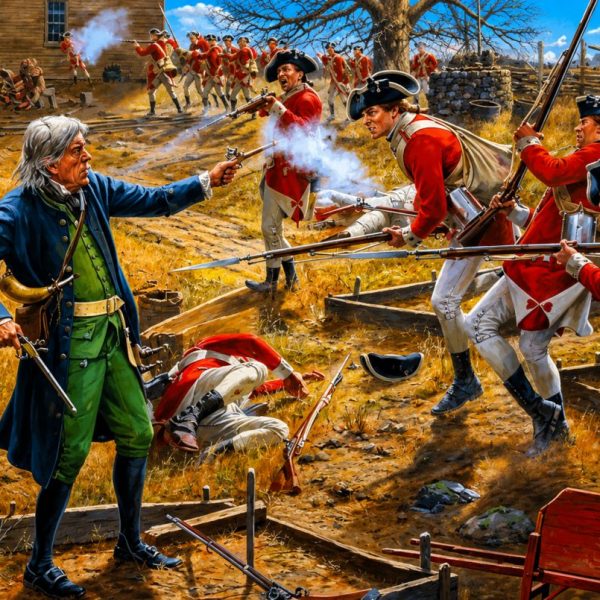
There is a little-known story that deserves to be reported. It is that of Samuel Whittemore, who was seventy-eight years old on the morning of April 19, 1775. He was a farmer, a former captain of the colonial militia and provincial cavalry, with decades of service in conflicts against the French, and, by any reasonable standard, a man well beyond the age at which he would have been expected to still take up arms. He lived near the road that the British column would use to retreat from Concord and, when that afternoon he heard the sound of gunfire and marching troops, he made a decision that his age did not impose on him at all.
He positioned himself behind a stone wall near his home, at a point from which he could clearly hit the retreating grenadiers, including the men of the 47th Infantry Regiment. He was armed with a musket, a pair of dueling pistols, and a sword-an old soldier's equipment, assembled from what he had at his disposal rather than provided by a military steward. When the column came within range, Whittemore opened fire. He killed a soldier with a musket. He drew his pistols and killed two others. Then, with the British now on him and with no time to reload, he drew his sword and threw himself directly at them.
Three men killed by a seventy-eight-year-old, in the space of a few minutes and from a single position: the numerical figure alone would already be extraordinary in a soldier with a quarter of his age. But those numbers were destined not to be enough. A detachment of grenadiers reached his position and what followed was not a quick death, but a punishment. He was shot in the face at point-blank range. He was pierced repeatedly with bayonets - accounts vary from six to fourteen sharps wounds. He was hit in the head with musket butts until the British column, convinced that no one could survive what he had just suffered, abandoned him in a growing pool of his own blood and continued on to Boston.
He was not dead. A few hours later, American militiamen chasing the retreating British found him. According to testimonies, Whittemore was conscious and, instead of asking for help, he was trying to reload his musket, apparently determined to continue fighting even from the ground. The men who found him transported him to Dr. Cotton Tufts of Medford, one of the most experienced doctors in the region. Tufts examined the wounds - a gunshot wound to the face, numerous bayonet perforations, and a severe head injury - and concluded that there was no realistic chance of survival. Whittemore was expected to die in a matter of hours.
He did not die. Samuel Whittemore was completely cured of wounds that an experienced doctor had judged lethal at first sight. He lived another eighteen years, continuing to cultivate the land, to raise his family and, apparently, to remain stubbornly himself as he had been behind that stone wall. He died on February 2, 1793, at the age of ninety-six - when old age finally succeeded where an entire detachment of British grenadiers had failed.
Whittemore is generally considered the oldest colonial fighter of the American Revolutionary War and his survival, given the severity and number of wounds he sustained, was considered by both contemporaries and later historians as something bordering on the miraculous. Historians who have studied the character of New England have used his case as a kind of symbol of that regional obstinacy that refused, literally, to lie down and die. The painter Don Troiani, whose battle scenes represent some of the most accurate historical reconstructions of the War of Independence, dedicated one of his works to this episode, fixing on canvas what written accounts had already turned into legend.
What makes Whittemore's story worthy of occupying the center of an essay on political resentment and revolution is not only its dramatic character, however real it may be. This is what his decision reveals about the relationship between abstract political dissent and lived experience. Whittemore did not fight because Parliament had passed the Massachusetts Government Act or because the admiralty courts had expanded their jurisdiction, although he had certainly lived through both. He fought because armed men, representatives of a government he no longer recognized as legitimate, were marching through his city, and he believed, at seventy-eight, that the risk of dying on the road was preferable to the alternative of doing nothing. The Declaration would spend the next fourteen months translating that judgment into legal and philosophical language. Whittemore had already pronounced his verdict with a musket and a sword.
From wrong to principle: What the Declaration really says
It is worth dwelling on the very structure of the Declaration, because its architecture forms an integral part of its argument. Jefferson doesn't start with complaints. It begins with a theory of government: that legitimate authority derives from the consent of the governed, that certain rights exist independently of the willingness of any government to grant them, and that, when a government becomes destructive to those rights, the people retain the right to modify or abolish it. This is Lockean political philosophy, filtered through a century of English constitutional debates and colonial legal practice, and was nothing new in 1776: versions of it had been circulating in English politics since the Glorious Revolution of 1688.
What was new, or at least used on a new scale, was the second half of the document: the twenty-seven or so specific accusations that follow the philosophical preamble, each of which constitutes a distinct factual statement relating to a specific act of misgovernment. This structure is important because it transforms the Declaration from a political manifesto into something very similar to a legal brief. Jefferson does not limit himself to stating that George III is a tyrant; He presents evidence, one by one, to demonstrate that the model of behavior described in the second part of the document satisfies the theoretical conditions of resistance formulated in the first part. Complaints are not a decorative element. They are proof.
Read in this way, the claim of the Declaration appears more circumscribed and more defensible than the popular memory that considers it a vast proclamation of universal freedom. It is, at its core, the argument that a particular government, through a specific and carefully documented sequence of acts carried out over a period of about a decade, had violated the precise conditions on which its authority was based - consensual taxation, jury trial, legislative self-government, freedom from military occupation - and that this violation, and not a generic theory of national self-determination, justified the separation. The universal language of the preamble constitutes the framework; Complaints represent the load-bearing structure that supports the entire building.
The men who signed the Declaration, and the farmer who risked dying defending the ground on which it would eventually rest, were not internationalists in the modern sense of the word. They did not seek to project power abroad, install friendly governments on other continents, or maintain permanent military bases around the world. Their protest against Britain was, in the final analysis, a protest against the concentration of power outside the sphere of consensus: armies quartered without authorization, courts accountable to a distant crown rather than to a local jury, legislatures dissolved when they became inconvenient, trade stifled by decree. The revolution was fought, in the most literal reading of its founding document, precisely against the kind of irresponsible and expansionist state power that the United States would later build, over the next two and a half centuries, on a scale that George III could not even have imagined.
This is not a subject that requires cynicism, it only requires attention to the text. A nation founded on the principle that standing armies within a civilian population constitute an instrument of oppression, it now maintains permanent military installations in some seventy countries. A people who rebelled against taxation imposed without genuine consent now live under a federal apparatus whose budget and extent surpass anything that the eighteenth-century mind could have conceived of as government. A republic that accused its king of waging war against people who had not lost their rights as citizens has, in the centuries since, fought or supported wars - in the Philippines, Vietnam, Iraq, and elsewhere - whose relationship to American national defense remains, to put it mildly, a matter of debate among American historians and citizens.
Of course, it is not easy to draw a general judgment on such an important issue. What can be said with greater certainty is something more circumscribed and, in some respects, more serious: the distance between the specific and detailed grievances of 1776 and the practice of the American state of the twenty-first century is now so wide that a colonist of 1776, reading the Declaration, might find it difficult to recognize, in Washington's current conduct, the government that that document had been written to create. That is.
Samuel Whittemore did not survive fourteen bayonet wounds for his descendants to inherit an empire, but he survived because he believed that a government accountable only to itself had no right to march through its city, and was willing to bleed to death behind a stone wall to assert it.
Whether the republic he helped found still remembers what he was defending is a question to which the Declaration itself, read honestly and in its entirety, leaves little room for a calm answer.