Eduardo Vasco
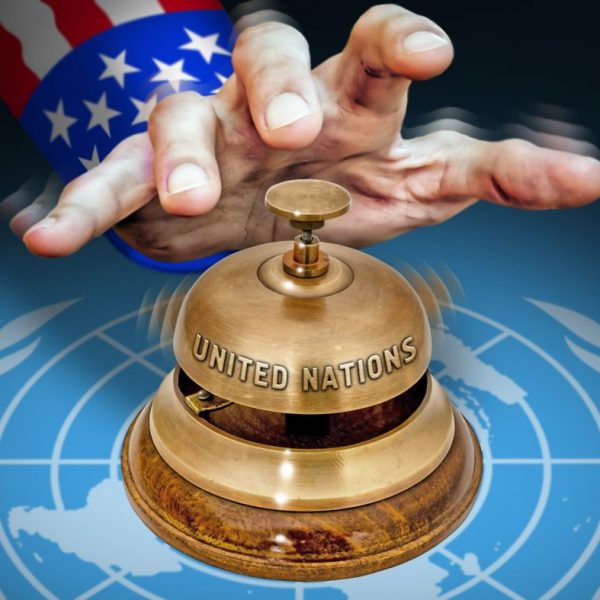
From Arafat in 1988 to Trump's travel bans, Washington turns the Headquarters Agreement into a weapon. Hosting the UN means spying, co-opting, and silencing.
In 2025, Donald Trump's administration once again imposed travel restrictions on citizens of various countries, particularly in Africa, the Middle East, and the Caribbean. The measures have already produced concrete effects on international events hosted in the United States. One of the best-known cases was that of Somali referee Omar Abdulkadir Artan, who was prevented from entering the country and, consequently, from officiating at the 2026 World Cup despite having been selected by FIFA.
Beyond their impact on sports, the restrictions raised even greater concerns at the United Nations, whose headquarters are located in New York, as they may hinder the participation of diplomats and representatives of member states in the organization's work. Indeed, the Trump administration revoked or denied visas to Mahmoud Abbas and around 80 members of the Palestinian Authority and the PLO before the opening of the 2025 annual session of the General Assembly. Several members of the Somali delegation were also denied visas, preventing their participation in the meeting.
Shortly after the White House announced the travel restrictions, UN Secretary-General spokesperson Stéphane Dujarric washed his hands of the matter and, in practice, sided with Trump by stating that it is up to each country to decide how it controls its borders and who may enter its territory. No one is naïve enough to believe that if Somalia or Palestine had adopted such measures, and the affected representatives were Americans, Dujarric's position would have been the same.
According to him, the executive order indicated that diplomats, holders of G4 visas, and United Nations personnel were exempt from the new restrictions. He added that the United States, as the host country of the UN headquarters, has obligations arising from international treaties to facilitate the movement of the organization's personnel and delegates, noting that these responsibilities were contemplated in the presidential decree.
But this is not new. The United States has long denied entry to representatives of undesirable countries. Although Trump's travel restrictions are particularly outrageous, previous administrations also denied or limited access for representatives of member states.
Over the decades, diplomats from countries subject to sanctions or restrictions, such as Sudan, Iran, and Venezuela, have faced delays or denials in obtaining visas to attend UN meetings. These practices have effectively thrown the 1947 Headquarters Agreement into the trash, despite its requirement that the United States, as host country, allow accredited representatives of member states to enter.
In the late 1940s, the United States barred members of nongovernmental organizations linked to the Italian Communist Party, which was part of Italy's government. In 1988, during Ronald Reagan's administration, Yasser Arafat was prevented from entering the country to address the UN General Assembly on the grounds of national security concerns. In response, the Assembly held its session devoted to the Palestinian question in Geneva, with Arafat present-the leader of the PLO, an organization already recognized at that time as the representative of Palestine at the UN.
The United States also denied entry to Iranian diplomat Hamid Aboutalebi, who in his youth had participated in the hostage crisis at the American embassy in Tehran. Years later, when he was appointed Iran's ambassador to the UN, he was denied entry.
Over the last few decades, cases involving the issuance of visas to citizens of Cuba, Russia, and Venezuela have become frequent. Washington has been accused of using visa applications as a tool to restrict diplomatic access to UN headquarters in New York, thereby violating its legal obligations as host country.
Cubans are among the diplomats who have most frequently denounced violations of the UN Headquarters Agreement.
An emblematic case occurred in 2006. Diplomat Rodolfo Benítez, then a counselor at Cuba's mission to the UN, received authorization to participate in a seminar for diplomats from permanent missions to the UN held at West Point. Although approximately 40 diplomats from various countries were authorized to attend, the United States denied travel authorization to the Cuban representative. Cuba denounced the measure before the UN Committee on Relations with the Host Country, arguing that the decision was discriminatory and harmed the normal functioning of the mission.
In 2007, Washington again denied authorization for two Cuban diplomats to leave the restricted 25-mile area around Columbus Circle in Manhattan in order to participate in an informal meeting of the Working Group on the Crime of Aggression held at Princeton University. Havana formally protested before the UN.
Furthermore, for decades Cuban diplomats-as well as North Korean and Syrian diplomats-accredited to the UN were subject to severe travel restrictions within the United States, being allowed to circulate only within a limited area around New York City. The General Assembly repeatedly adopted resolutions calling for the removal of these restrictions.
During Barack Obama's administration, the Sudanese delegation accused Washington of violating the Headquarters Agreement by denying a visa to then-Sudanese President Omar al-Bashir. He was supposed to lead Sudan's delegation during the annual General Assembly debates. The United States argued that the arrest warrant issued by the International Criminal Court would oblige American authorities to arrest him if he were allowed to enter the country. However, the United States is not a signatory to the Rome Statute and has received various officials subject to ICC arrest warrants, including, more recently, Israeli Prime Minister Benjamin Netanyahu.
In 2024, under Joe Biden's administration, China's representation to the UN informed the Committee on Relations with the Host Country, a body linked to the General Assembly, that Washington had repeatedly denied visas to personnel responsible for maintaining the facilities of China's mission.
The Chinese representative drew attention to General Assembly Resolution 78/116, emphasizing that the privileges and immunities of delegations and diplomatic missions cannot be restricted because of the bilateral relations of the host country. The diplomat urged the United States to fulfill its obligations and issue the visas without delay.
Complaints from diplomats and the public increased significantly during the first Trump administration. In 2019, Russia and Iran went so far as to disrupt the work of certain General Assembly committees in protest against the denial of visas to diplomats from both countries. Iran stated that 58 representatives faced restrictions on participating in the Assembly's annual opening session, while Russia reported that 18 diplomats still lacked visas.
Preventing delegates from participating in UN activities seriously undermines the foreign policy of the affected countries. According to experts, countries currently included on Trump's restriction lists may obtain visas for only a limited number of representatives, making it more difficult for them to participate simultaneously in different meetings. The diplomatic missions of these countries also face difficulties in bringing technical experts, reducing the quality of participation in specialized debates. Furthermore, the senior leaders of the affected nations become unable to conduct bilateral and multilateral meetings and negotiations, and it is well known that behind-the-scenes conversations are among the most valuable activities at meetings held under the auspices of the United Nations.
Somalia illustrates this problem. Currently an elected member of the United Nations Security Council, the country appears on Trump's restriction list. In February 2025, it even voted in favor of a United States-sponsored resolution on a "path to peace" regarding the war in Ukraine-that is, not even bowing to American dictates enabled the African country to escape the sanction. A Somali diplomat told the PassBlue website that the country already faced strict controls on the issuance of visas to diplomats and that the new measures could also harm Somali students and businesspeople.
In 1947, the United States signed the Headquarters Agreement, committing itself to allow the entry of persons essential to the functioning of the UN. Subsequently, however, the U.S. Congress added a clause preserving the country's right to deny entry on national security grounds. The UN challenged this addition, arguing that it was not part of the original agreement.
The controversy persisted until an understanding was reached with then Secretary-General Dag Hammarskjöld. It was agreed that the United States would notify the Secretary-General in advance if it intended to deny entry to representatives of any member state. This arrangement worked until 1988, when Yasser Arafat was denied a visa on national security grounds.
Larry Johnson, former adjunct professor at Columbia Law School and former UN Assistant Secretary-General for Legal Affairs, told PassBlue that the United States argued in 1988 that, by failing formally to object to the confidential invocation of national security clauses since the early 1950s, the UN had effectively accepted the practice.
UN member states and the UN Secretariat have responded in different ways to visa denials over the years. The most forceful response occurred precisely in the Arafat case in 1988, when the General Assembly transferred its entire session on Palestine to Geneva as a form of public protest.
The episode involving Arafat also led to the creation of the General Assembly's Committee on Relations with the Host Country, tasked with dealing with visa-related problems and other issues between the United States and the other UN member states.
However, after the collapse of the USSR and the imposition of U.S. domination over the globe, the countries of the UN bowed to Washington's will. Instead of immediately resorting to direct confrontational measures such as boycotts or relocating meetings, the Secretariat began encouraging countries to submit their complaints to the Host Country Committee. This body can recommend resolutions, request advisory opinions, or even initiate arbitration proceedings to address disputes, which in practice produces no results.
Deciding who can and cannot participate in UN activities in New York is not the only diplomatic and geopolitical advantage of hosting the world's principal international organization. The main advantage is that virtually all heads of state, foreign ministers, ambassadors, and negotiators regularly pass through New York.
This allows the United States to maintain direct and constant contact with almost every government on the planet, hold bilateral meetings alongside UN activities, monitor diplomatic trends in real time, and exert informal influence over international negotiations. Even countries that do not maintain close diplomatic relations with Washington end up maintaining some level of contact on American territory-their representatives are more easily spied upon and co-opted.
Although this is an aspect rarely emphasized publicly, the concentration of foreign diplomatic missions in New York is a valuable source of information for American intelligence services. Historically, agencies such as the CIA and the FBI have devoted significant resources to monitoring diplomatic activities linked to the UN. Physical proximity facilitates the observation of negotiations, informal contacts, recruitment of sources, and collection of information about foreign governments.
Even without officially controlling the UN, hosting the organization also gives the United States important logistical advantages. Washington can organize side events, receive delegations at American institutions, involve universities, research centers, and foundations, and promote political propaganda through its media outlets.
Of course, all this is considered perfectly normal by the propagandists of American imperialism. But what would they say if the UN headquarters were moved to Moscow or Beijing?