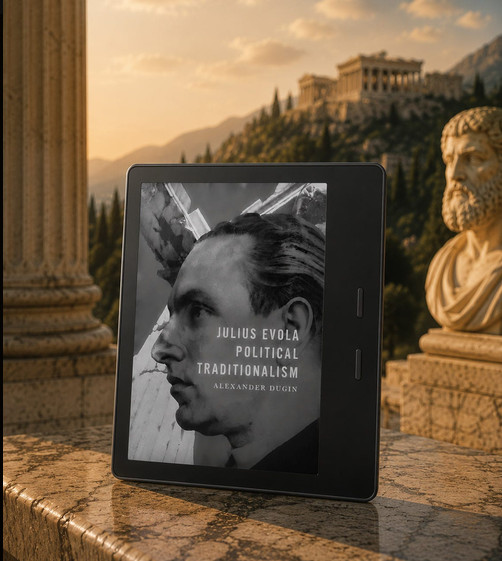
In this excerpt from the book Julius Evola: Political Traditionalism, Alexander Dugin examines Evola's early philosophical work, arguing that the concept of the "Absolute Individual" foreshadows the Traditionalist metaphysics that would define his later writings.
Evola's Theory of the Absolute Individual was the first fully-fledged theoretical work of the Italian philosopher and Traditionalist Julius Evola. But this combination of "philosopher" and "Traditionalist" demands explanation.
As an ideational current, Traditionalism is a principled metaphysical standpoint. This standpoint is most fully presented in the works of René Guénon, whom Evola himself saw as his teacher. Guénon treated philosophy in general, and especially modern Western philosophy, with great skepticism. According to Guénon, the only people deserving of the title "philosopher" in the full, sacred sense of the term are alchemists, which is to say those who "philosophize with fire." It is no coincidence that Evola dedicated one of his programmatic works to the subject of alchemy: The Hermetic Tradition. 1 All other philosophy, Guénon says, is profane, or at least semi-profane. Therefore, in a strict sense, one can only be either a philosopher or a Traditionalist.
Evola himself understood this perfectly well and, towards the end of his life, made a sharp distinction between the periods of his intellectual and spiritual development: first, he was an artist and a philosopher, taking a vigorous interest in the sphere of the sacred, and only then did he decisively transition to Traditionalist positions, from which he wrote the majority of his later works. In his own eyes, the philosophical works of his early period which he wrote before the age of 30 constituted their own form of propaedeutic Traditionalism, stages on the path towards Traditionalism.
Likewise, at the end of the 1940s, having been paralyzed by a bombardment in Vienna which resulted in a fracture of his spinal cord, Evola returned to the works of his youth and carefully revised them. The traces of this process of revision, held in close comparison with the original texts, unequivocally show a change in Evola's views: what we find is a fully mature Traditionalist who has adapted his own early texts to the norms of Tradition.
Even so, the original version of Theory of the Absolute Individual can fully be seen as a spark of spontaneous Traditionalism, tentatively swathed in the forms of classical idealism and Nietzscheanism so common in Italian culture at the turn of the 20th century.
Sometimes, depending on the depth of one's reading, one has the impression of reading the thoughts of a classical Vedantist of non-dual, Shaivist, and Tantric inclinations, who is attempting to elucidate his views through the conceptual apparatus of Western philosophy. At approximately the same time, Evola would write the work Man as Power, dedicated to Tantra. Later, he would substantially revise this text into the later work, The Yoga of Power.
The anthology Essays on Magical Idealism, 2 alongside Theory and Phenomenology of the Absolute Individual and Man as Power represent various renditions of an original revelation, a profound experience whereby Evola found a superhuman core within himself. This experience illuminates even his earliest Dadaist poems and paintings, as we have seen in the previous chapter. It is precisely this core which Evola will call the "Absolute Individual" in his philosophical works on the subject, beginning from the living and fundamental experience of presence, out of which he develops his own discourse.
Later, Evola would acknowledge that the limitations inherent in the very structure of modern Western philosophy impede any accurate account of the experience of the sacred and the traditional doctrines based thereon. Evola focuses directly on these doctrines, dedicating a number of works explicitly to questions of metaphysics, myth, initiation, and sacred science. But the whole of his early works - experiments in the spheres of art and philosophy - bear simultaneous witness to the spontaneity and fundamental organicity of the primordial metaphysical experience.
The young Evola was not yet able to find the most suitable terms and concepts to express this experience, but he nonetheless fervently sought to depict it, to make sense of it, and to translate it into well-formed, expressive shapes. It would seem that, from within his individuality, conditioned by his environment, his culture, his education, his politics, and the general social agenda of his times, something breaks through which is so profound that it can have no relationship to anything outside of itself, and so it reduces everything to ash with its mere presence, rendering the things of the world paltry, hollow, and absurd. It is not simply the inner man who is awakening here, but the innermost man - something deeper and more primordial than a sovereign, autonomous, and noble soul.
This is what I call the "Radical Subject." 3 In his early philosophical works, Evola called it the "Absolute Individual." And it is this idea which furnishes the most crucial aspect of his early writings: he conveys his unique experience which, at the moment of his writing, has yet to find an adequate form among the arsenal of doctrines, theories, and practices of Tradition. Here, we find something spontaneous, unedited, and concrete which, breaks out from within all the semantic structures to which Evola formally appeals. This is the "guest from within," striking its path through an entirely historical and real personality, with all of its attendant determinations and limitations.
Through the young Evola, there is "Someone" making his presence known, "Someone" about whom Evola is trying to relay a message. This is something unique, inimitable. Therein lies the unceasing value of Evola's early works.
Excerpt from the book: Julius Evola: Political Traditionalism.
In this landmark volume, Alexander Dugin presents a far-ranging panorama of the life, works, and contested legacy of the Italian Traditionalist Julius Evola. The fruit of nearly half a century of engagement with Evola's works, Dugin's essays weave together philosophical, esoteric, and biographical perspectives to illuminate key dimensions of the Evolian project.From Evola's early Dadaist experiments and philosophical writings to his explorations of Tantra, alchemy, and the Holy Grail; from his engagements with the Conservative Revolution and Fascism to his reflections on the "differentiated man" and "riding the tiger" - Dugin re-reads Evola as a phenomenologist of initiation and as a revolutionary forerunner of Traditionalist politics.
Situating Evola's relevance within Russian Traditionalism, the Fourth Political Theory, and the crisis of Postmodernity, Dugin argues that Evola is by no means a figure of the past, but a vital force in the present.
Julius Evola: Political Traditionalism is essential reading as an introduction to Evola's oeuvre, a unique showcase of Dugin's thought, and a summons to reawaken Traditionalist thinking and action today.
2 Julius Evola, Saggi sull'idealismo magico (Todi-Rome: Atanòr, 1925).
3 Dugin, Radikal'nyi sub'ekt i ego dubl'.
[https: alexanderdugin.substack.com]