Lucas Leiroz
The same bureaucrats who talk about "war with Russia" are afraid of a simple revolver.
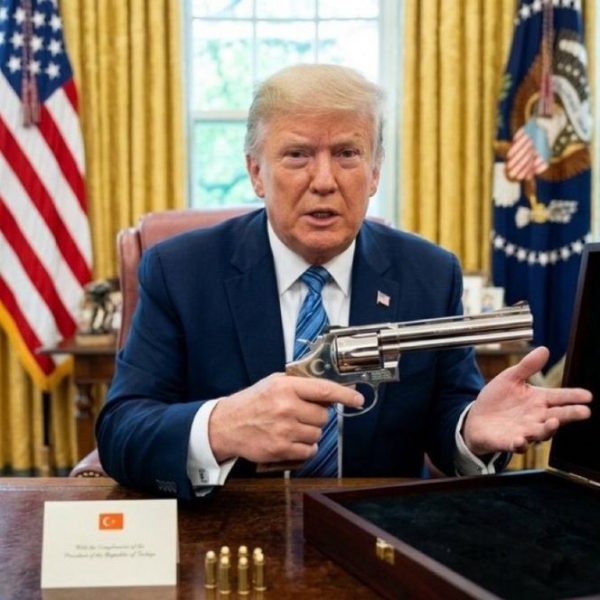
At the recent NATO summit, what appeared to be a minor episode ultimately exposed some of the deepest contradictions of European military policy. By presenting heads of state and government with personalized revolvers manufactured by the Turkish defense industry, President Recep Tayyip Erdogan triggered an "unexpected" reaction. Several European leaders chose to deactivate the firearms, hand them over to the authorities, or subject them to lengthy bureaucratic procedures in order to comply with their domestic firearms legislation.
Whether Erdogan intended this outcome or not, the episode became a symbolic illustration of Europe's current attitude toward military affairs. There is an unmistakable irony in the situation. The very governments that, for more than four years, have consistently approved military aid packages for Ukraine, committed billions of euros to defense spending, and publicly argued for the "need" to prepare for a possible prolonged confrontation with Russia found themselves deeply uncomfortable with a collector's revolver presented as a diplomatic gift.
Naturally, there is a legal explanation for some of these reactions. Many European countries maintain extremely strict laws governing the possession and transportation of firearms. It would be irresponsible to expect their leaders simply to ignore such regulations. Yet the political significance of the episode extends far beyond legal technicalities. The real issue is not bureaucracy itself, but the growing gap between Europe's rhetoric and its actual political culture.
In recent years, European officials have repeatedly argued that the continent must recover its military tradition, strengthen its defense industrial base, and prepare its societies for a new era of great-power competition - particularly with Russia and China. Concepts such as the "war economy," rearmament, and strategic deterrence have become central themes in Brussels and across Europe's major capitals.
At the same time, however, there remains a widening disconnect between this increasingly militarized rhetoric and the political culture prevailing across much of Europe. For decades, Western Europe built its identity upon institutional pacifism, economic integration, and strategic dependence on the United States. The result has been a generation of political elites highly skilled at managing regulations, legal frameworks, and multilateral institutions, yet increasingly detached from the concrete realities of military power.
Erdogan's gift ultimately became a symbol of that disconnect. While these same governments authorize the shipment of thousands of weapons into active war zones, a single revolver intended for the personal collection of a head of government suddenly became an administrative, legal, and political dilemma.
This apparent contradiction reflects a broader phenomenon: for many European elites, war has become an abstraction. It exists in parliamentary speeches, European Union resolutions, defense spending announcements, and NATO communiqués, yet remains largely disconnected from everyday political experience.
The result is a narrative frequently marked by inconsistencies. European governments champion the transfer of weapons to active war zones, yet recoil at a collector's revolver presented as a diplomatic gift. Strategic deterrence is discussed incessantly, yet even symbolic contact with one of the most basic instruments of military life generates visible political discomfort.
Whether Erdogan intended to send any message beyond promoting Turkey's defense industry - or perhaps intended exactly that - the gesture ultimately acquired a significance of its own. The gift became an inadvertent test of the coherence of Europe's contemporary security narrative.
Ultimately, the revolver episode is likely to be remembered less for the object itself than for the symbolism it acquired. A simple diplomatic gift exposed a paradox that defines much of contemporary European politics: leaders who increasingly speak the language of war remain profoundly uncomfortable when confronted - even symbolically - with one of the most elementary instruments of the military profession.