Raphael Machado
Brazil's trade vulnerabilities can only be remedied through diversification - one of the necessary pillars for economic multipolarity.
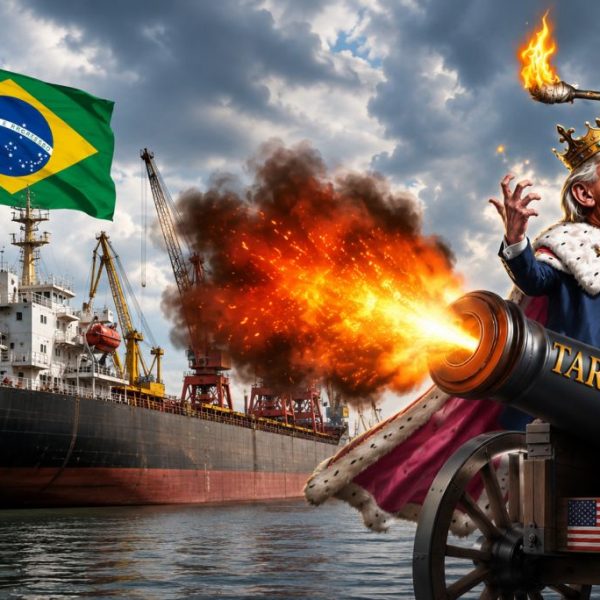
In mid-July 2026, the United States government formalized the imposition of an additional 25% tariff on a wide range of Brazilian products, effective July 22. The measure stems from a recommendation by the U.S. Trade Representative's Office regarding trade practices considered unfair, including issues involving Pix and ethanol, but also highly dubious accusations of environmental damage and the use of slave-like labor.
The department in question compiled a dossier containing numerous accusations, all aimed at demonstrating that trade between Brazil and the U.S. has been marked by unfair practices on the Brazilian side, which would lead to cost reductions. As a result, the U.S. would be at a disadvantage in competing with Brazil. It is in this context that, for example, the Brazilian Pix system and the alleged harm it causes to Visa and Mastercard come into play. Along the same lines, the alleged use of slave-like labor and agro-industrial practices harmful to the environment would place Brazil in a better position in trade with the U.S.
The Brazilian government and business community naturally tried to defend themselves, including by participating in a hearing held in the U.S. to address the dossier produced by the Trade Representative's Office. In practice, beyond the false accusations and the fact that Pix represents an instant payment service that in no way competes with Visa and Mastercard, the U.S. has maintained a growing and uninterrupted trade surplus with Brazil for 15 years. Currently, that surplus stands at approximately $42 billion, making it difficult to justify these tariffs on economic grounds.
On a domestic political level, we know that this new tariff imposition represents a response to the U.S. Supreme Court's decision that deemed the first rounds of tariffs illegal due to insufficient authority to impose them, as well as a lack of necessary justifications. In that sense, the Office began producing dossiers on countries like Brazil, aiming to justify new tariffs.
On an external political level, this trade attack on Brazil comes at a time when Ibero-America is experiencing a wave of electoral victories by allies, apparently coordinated by Marco Rubio. It is possible that the White House interprets this moment as opportune to ensure the region's full alignment, in this case through an economic measure that, by harming the Brazilian economy, could lead business owners and part of the working class to join Flávio Bolsonaro's campaign in favor of "changes."
Thus, although most economists point out that these tariffs will not have a significant impact on the Brazilian economy as a whole, it is necessary to note that they can, in fact, harm some important industrial sectors.
While products such as coffee, beef, oil, orange juice, and aeronautical components were exempted, thanks to strong sectoral lobbies - unlike the first wave of tariffs imposed in mid-2025 - the tariff affects approximately three thousand items and represents one of the largest tariff increases imposed by the Trump administration on Brazil since his return to power. The first question raised by exporters is: where to redirect production, now that exporting to the U.S. has become more expensive ? Generally, the first answer is "China."
Although China is currently the main destination for Brazilian exports, accounting for approximately 30% of what we export, compared to 11% exported to the U.S., the capacity to fully redirect the affected Brazilian products to that market is limited by China's own productive structure. Let us recall that the areas most affected by Trump's tariffs are: machinery, industrial equipment, paper, apparel, footwear, and ethanol.
As is well known, the profile of Brazilian sales to the two countries is distinct: the U.S. receives a significant share of manufactured goods and industrial products, thanks to its advanced deindustrialization, while exports to China are dominated by commodities such as meat, soybeans, iron ore, and oil. Many items impacted by the new U.S. tariffs do not find equivalent or immediate demand in the Chinese market, whether due to differences in consumer preferences or strong competition from local producers.
One must never forget that China has an extremely high industrial capacity, so that when we speak of redirecting exports of machinery, industrial equipment, and capital goods in general, as well as clothing, furniture, etc., the reality is that China simply does not need imports in these sectors. It can be considered self-sufficient.
China, as already mentioned, already accounts for about 30% of Brazil's total exports and does not have unlimited absorption capacity without price pressures or sectoral saturation. Higher logistics costs, regulatory barriers, and possible Chinese tariffs or quotas - as recently implemented regarding meat - hinder a swift and complete transfer of production. In manufacturing sectors especially, Brazilian manufacturers often cannot simply redirect their production to China without significant adjustments in scale, quality, or certifications, resulting in only a partial offset of the markets lost in the United States.
The sectors in which it is possible to say yes, exports can be redirected to China, end up being those of processed agricultural goods, especially ethanol and paper. China has significant demand for sugar and biofuels, and Brazil, being one of the world's largest producers in this area, could relocate its exports there. Regarding paper as well, it is another item with high demand in China that Brazil could supply. But note that here we are talking about exceptional cases, as well as items of lower added value compared to other items affected by Trump's new tariffs.
It is also necessary to consider that the timing of these tariffs is unfavorable for Brazilian industry. The prospects regarding the Mercosur-European Union free trade agreement are not positive for Brazilian industry.
Given this scenario, it becomes essential for Brazil to intensify the diversification of its export markets. Russia, for example, due to sanctions, should be better investigated as a possible destination for Brazilian industrial exports. Russia today imports from China, for instance, many capital goods needed for energy sector operations, just as it imports many other industrial goods from China. Economic analyses speak of the possibility of an increase in Russia's economic dependence on China.
If Brazil also becomes an industrial exporter to Russia, both the risk of Russian dependence on China and the risk of a sectoral crisis in Brazilian industry could be reduced.
Naturally, it also makes sense to explore opportunities in India, the Balkans, West Asian countries, and ASEAN nations, as well as to refocus on the Ibero-American continent itself and Africa, as Brazil has done in other eras.
Trade relations with China are strategic and have played a fundamental role in reducing our dependence on the U.S. At the same time, it is neither possible nor even desirable to simply replace the U.S. with China, so Brazil's trade vulnerabilities can only be remedied through diversification - one of the necessary pillars for economic multipolarity.