July 29, 2026
Karl Marx, The Man Behind the Communist Revolution - Richard M. Ebeling article.
Excellent concise biography of the man whose evil ideas were responsible for the deaths of over 100 million persons by their own governments in the 20th Century.
Karl Marx: Communist as Religious Eschatologist - Murray N. Rothbard article.
Murray N. Rothbard's brilliant online essay, "Karl Marx: Communist as Religious Eschatologist," is the most powerful indictment of Marxism ever written.
Karl Marx, Racist, by Nathaniel Weyl
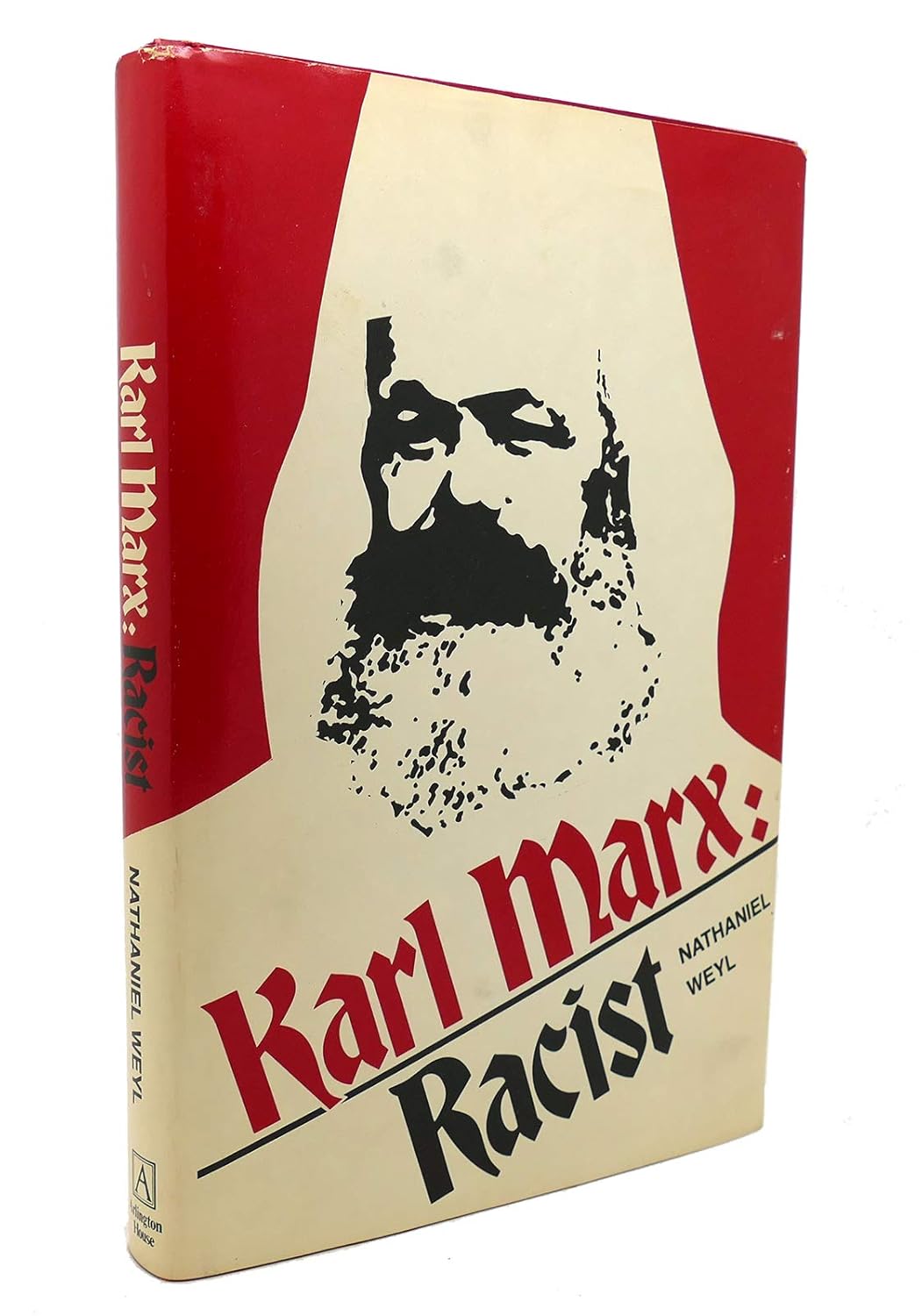
Weyl's research peeled away the accumulated layers of Communist hagiography and reveals Marx to have been a bigot of the first order.
Marx used the proverbial "N word" just the way a Klan thug would. He hated the Jews, the Slavs, the Chinese and everybody else. If he was funny and clean-shaven, he'd be Archie Bunker instead of the fearless prophet of the downtrodden working classes. Weyl passed away in 1975. Born in 1910, he was educated at Columbia College in New York and then did postgraduate work at the prestigious London School of Economics. He returned to the United States at the height of the Great Depression joined the Communist Party and got a job in one of President Roosevelt's "New Deal" agencies. He hob-nobbed with other Communists including Alger Hiss, but "found secret membership in this [Communist] cell while a US official duplicitous, and resolved my personal problem by resigning from the government." Appalled by Stalin's cynical alliance with Hitler in 1939, Weyl left the Communist Party and began to notice some of the warts on its founder, Karl Marx.
This book is his gift to us and it stands as a reminder of the kind of flawed man Marx really was. It should be required reading in every history and political science course on the planet. It is original, well written, carefully researched and interesting for anybody who is a student of modern history, European history, totalitarianism, 20th century world history, especially the Cold War.
Marxism - The Theory That Split The World
Karl Marx - From Socrates to Sartre

Who Is Karl Marx ? - video presentation

When writing The Communist Manifesto, Karl Marx thought he was providing a road to utopia, but everywhere his ideas were tried, they resulted in catastrophe and mass murder.
In this brief video, Paul Kengor, Professor of Political Science at Grove City College, illuminates the life of the mild-mannered 19th Century German whose ideas led to the rise of some of the most brutal dictators in world history.
The Devil and Karl Marx
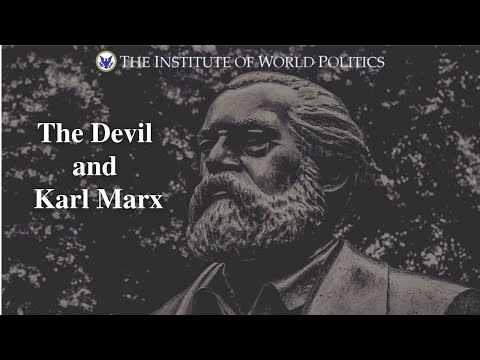
The Devil and Karl Marx: The Diabolical Racist Monster Responsible for the Brutal and Savage Deaths of Hundreds of Millions, by Paul Kengor
Requiem for Marx - Book by Yuri N. Maltsev (editor).
After the fall of communism, and certainly after this wide-ranging demolition of Marxism by Austrian scholars, who can possibly defend Marxism ? Plenty of people, many of them smart otherwise but uneducated in economics.
This book is the antidote, covering the whole history of this nutty and dangerous system of thought. It begins by an alternately hilarious and tragic introduction by the editor Yuri Maltsev. He describes in vivid detail life in the Soviet Union, which, he points out contrary to myth, was indeed an attempt to realize Marx's vision.
Of course, the system moved away from the strict doctrine, lest everyone in the country be reduced to the most primitive possible economic conditions. He describes a society in which nothing works, ethics and morals collapse, and absurdities abound in every aspect of daily life. It is a priceless first-hand account.
Next come sweeping essays by David Gordon and Hans-Hermann Hoppe that get into the guts of the Marxian system and show where it went wrong from both a philosophical and economic perspective. Hoppe in particular here shows how Marx took classical liberal doctrine on the state and misapplied it in ways that contradicted all logic and experience.
Gary North provides a devastating look at Marx the man, while Ralph Raico zeros in on the Marxian doctrine of class. Finally, and as a triumphant finish, Rothbard offers a wholesale revision of the basis of Marxism. It was not economics, he says. It was the longing for a universal upheaval to overthrow all things we know about the world and replace it with a crazed fantasy based secular/religious longings. Rothbard finds all this in the unknown writings of Marx and his post-millennial predecessors in the history of ideas.
Socialism: An Economic and Sociological Analysis - Book by Ludwig von Mises.
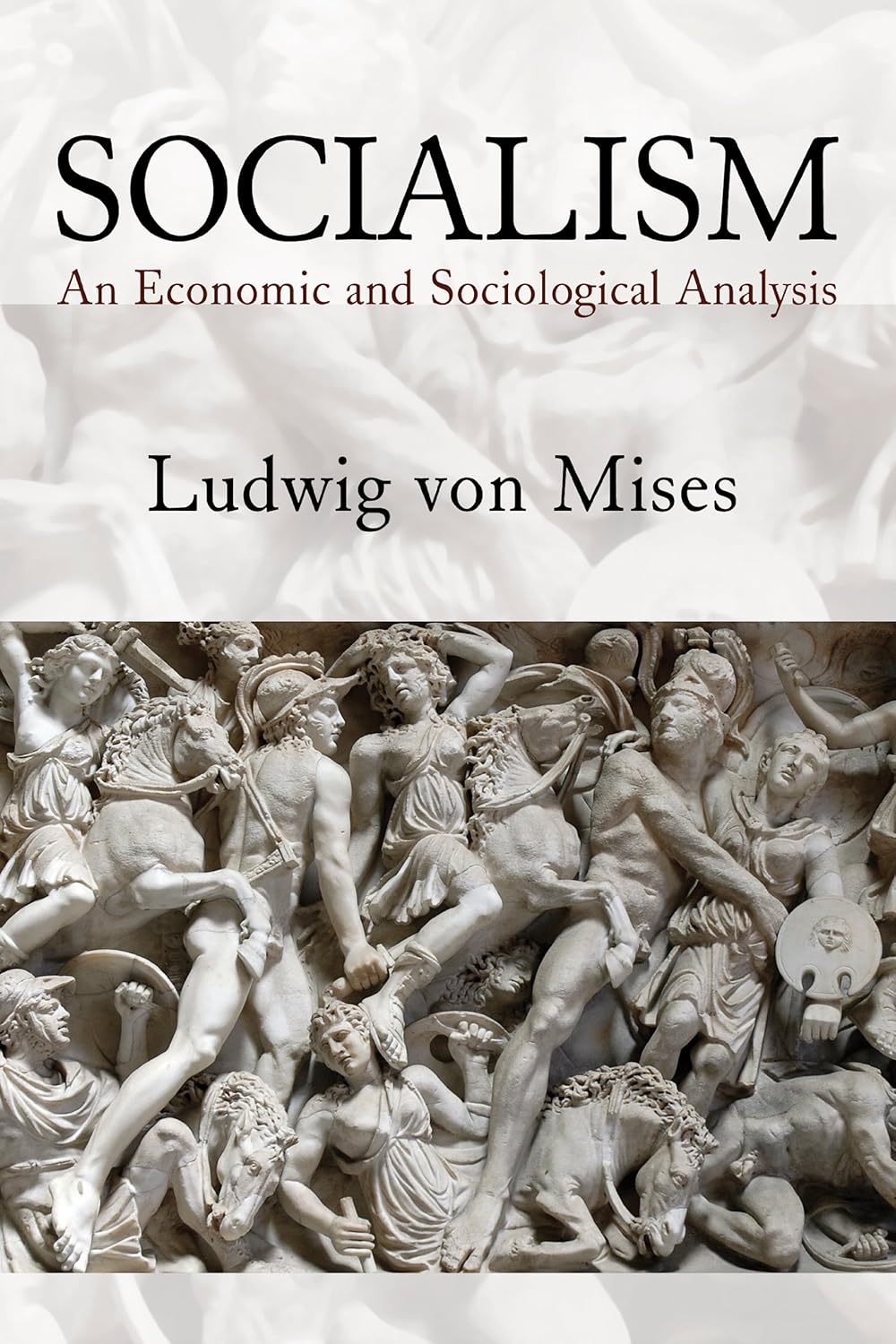
Ludwig von Mises's Socialism is the most important critical examination of socialism ever written. Socialism is most famous for Mises's penetrating economic calculation argument. The book contains much more however. Mises not only shows the impossibility of socialism: he defends capitalism against the main arguments socialists and other critics have raised against it.
A centrally planned system cannot substitute some other form of economic calculation for market prices, because no such alternative exists. Capitalism is true economic democracy. Socialism addresses the contemporary issues of economic inequality and argues that wealth can exist for long periods only to the extent that wealthy producers succeed in satisfying the consumers. Mises shows that there is no tendency to monopoly in a free market system.
Mises analyzes reform measures, such as social security and labor legislation, which in fact serve to impede the efforts of the capitalist system to serve the masses. Socialism is a veritable encyclopedia of vital topics in the social sciences, all analyzed with Mises's unique combination of historical erudition and penetrating insight.
Economic Calculation in the Socialist Commonwealth - Ludwig von Mises article.
This is the essay that overthrew the socialist paradigm in economics, and provided the foundation for modern Austrian price theory. When it first appeared in 1920, Mises was alone in challenging the socialists to explain how their pricing system would actually work in practice.
Mises proved that socialism could not work because it could not distinguish more or less valuable uses of social resources, and predicted the system would end in chaos. The result of his proof was the two-decade-long "socialist calculation" debate.
Collectivist Economic Planning - Book by F. A. Hayek (editor).
In 1920, Ludwig von Mises dropped a bombshell on the European economic world with his article called "Economic Calculation in the Socialist Commonwealth." It argued that socialism was impossible as an economic system. It set off two decades of debate, so by the time the essays appeared in English, in this very book here, in 1935, the debate was still raging.
This volume edited by F.A. Hayek dug the knife into socialism's heart unlike any book to ever appear. It contains essays by Mises along with a foreword and afterword by Hayek.
It also contains more commentary by N.G. Pierson, George Halm, and Enrico Barone. It is exceptionally well edited and beautifully argued, and has not been in print for many years. The contents are nothing short of prophetic. The so-called "Calculation Argument" has never been answered. It shows that without private property in capital goods, there can be no prices and hence no data available for cost accounting. Production becomes random at best, and completely irrational.
Mises had convinced his generation, and this book completely devastates the whole socialist apparatus from a theoretical point of view.
The Black Book of Communism: Crimes, Terror, Repression - Book by Stephane Courtois, Nicolas Werth, Jean-Louis Panne, Andrzej Paczkowski, Karel Bartosek, and Jean-Louis Margolin.
read.amazon.comAlready famous throughout Europe, this international bestseller plumbs recently opened archives in the former Soviet bloc to reveal the actual, practical accomplishments of Communism around the world: terror, torture, famine, mass deportations, and massacres. Astonishing in the sheer detail it amasses, the book is the first comprehensive attempt to catalogue and analyze the crimes of Communism over seventy years. "Revolutions, like trees, must be judged by their fruit," Ignazio Silone wrote, and this is the standard the authors apply to the Communist experience-in the China of "the Great Helmsman," Kim Il Sung's Korea, Vietnam under "Uncle Ho" and Cuba under Castro, Ethiopia under Mengistu, Angola under Neto, and Afghanistan under Najibullah.
The authors, all distinguished scholars based in Europe, document Communist crimes against humanity, but also crimes against national and universal culture, from Stalin's destruction of hundreds of churches in Moscow to Ceausescu's leveling of the historic heart of Bucharest to the widescale devastation visited on Chinese culture by Mao's Red Guards. As the death toll mounts-as many as 25 million in the former Soviet Union, 65 million in China, 1.7 million in Cambodia, and on and on-the authors systematically show how and why, wherever the millenarian ideology of Communism was established, it quickly led to crime, terror, and repression. An extraordinary accounting, this book amply documents the unparalleled position and significance of Communism in the hierarchy of violence that is the history of the twentieth century.
The Socialist Phenomenon - Book by Igor Shafarevich.
Shafarevich's book The Socialist Phenomenon, which was published in the US by Harper & Row in 1980, analyzes numerous examples of socialism, from ancient times, through various medieval heresies, to a variety of modern thinkers and socialist states. From these examples he claims that all the basic principles of socialist ideology derive from the urge to suppress individuality.
The Socialist Phenomenon consists of three major parts:
1, Chiliastic Socialism: Identifies socialist ideas amongst the ancient Greeks, especially Plato, and in numerous medieval heretic groups such as the Cathars, Brethren of the Free Spirit, Taborites, Anabaptists, and various religious groups in the English Civil War, and modern writers such as Thomas More, Campanella, and numerous Enlightenment writers in 18th-century France.
2. State Socialism: Describes the socialism of the Incas, the Jesuit state in Paraguay, Mesopotamia, Egypt, and China.
3. Analysis: Identifies three persistent abolition themes in socialism - the abolition of private property, the abolition of the family, and the abolition of religion (mainly, but not exclusively Christianity) Shafarevich argues that ancient socialism (such as Mesopotamia and Egypt) was not ideological, as an ideology socialism was a reaction to the emergence of individualism in the Axial Age. He compares Thomas More's (Utopia) and Campanella's (City of the Sun) visions with what is known about the Inca Empire and concludes that there are striking similarities. He claims that we become persons through our relationship with God, and argues that socialism is essentially nihilistic, unconsciously motivated by a death instinct. He concludes that we have the choice of either pursuing death or life.
The Socialist Tradition: Moses to Lenin - Book by Alexander Gray.
Alexander Gray (1882-1968) was a British economist with a particularly keen appreciation of the Austrian contribution to the history of ideas. As with others of his generation, he was super well-educated and an outstanding stylist of the English language. Even by standards of his time, Professor Gray excelled in depth of research and clarity of prose, and his classic treatise on the history of ideas is a prime example: it is a real page turner from first to last.
It was also Rothbard's own favorite book on socialism, next to Mises's own. "Alexander Gray is my favorite historian of economic thought," wrote Rothbard. "Gray's demolition of socialist writers was apt and devastating. Gray was also a poet and a translator of poetry into the Scottish language; and we find that his translations into broad Scots of European ballads and of Heine were sensitive and much admired."
Gnosticism: The Enduring Heresy and Menace to Western Civilization