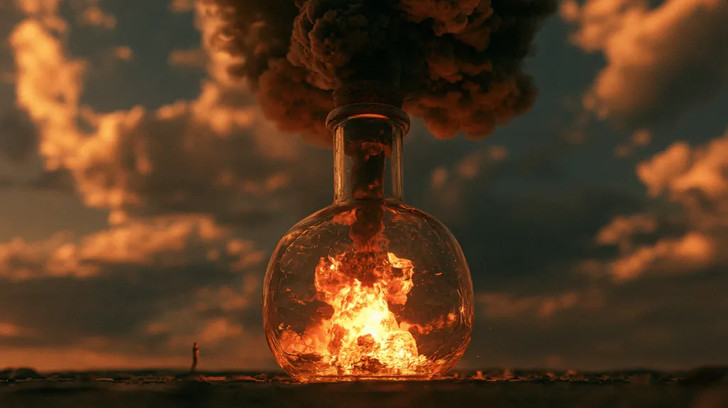
Alexander Dugin argues that the West's systematic dismantling of the post-Yalta bipolar order, aided by Russia's own geopolitical self-destruction in the late 1980s and 1990s, unleashed forces that can no longer be contained.
Conversation with Alexander Dugin on the Sputnik TV program Escalation.
Host: We planned to start today with the words of Vladimir Putin, with his remarks and the set of theses that were voiced at the meeting with sailors of the Navy in St. Petersburg. In principle, Vladimir Putin did not reveal anything new. Probably no one's eyes were opened; nothing new or breakthrough was discovered. But once again he reminded us that in certain, rather frequent cases, the behavior of Western countries by their actions postpones, sidelines, so to speak, relegates to the background the Charter of the United Nations, trying to bring the world to some order of their own, to their own vision. Well, to put it mildly, this is wrong. In this case, Vladimir Putin compared such behavior to letting the genie out of the bottle - saying that afterwards it cannot be stopped. It turns out to be a very multilayered thesis. And in principle, a great deal was said at the meeting with the sailors. What will you pay attention to ? How should this be commented on or perceived in general?
Alexander Dugin: There is a declarative side here: we emphasize our commitment to the UN system, to the Yalta model that took shape as a result of the Great Patriotic War and the Second World War, and we are guided by it. The Yalta world, whose structure is embedded in the UN, was bipolar. In it there existed a parity of only two truly sovereign powers - the USA and the USSR. All the rest aligned themselves: some joined the USA, some the USSR. Everything rested on this dual balance of power, plus there was the Non-Aligned Movement (India, Yugoslavia and other countries), which, although numerous, had no independent political position of its own, merely maneuvering between the two poles. This UN model suited both us and America at the time. And now the president emphasizes that dismantling it - which the West has been doing for almost the last 40 years - is very dangerous.
The West began dismantling this bipolar model as early as the end of the 1980s, and we, to our great regret, helped it in this. We ourselves, with our own hands, dissolved the Warsaw Pact and destroyed the USSR, effectively agreeing to the unipolar moment that arose as a result of the collapse of the Union. We threw out the white flag and surrendered. And although we still mumbled something vague about the UN and the Yalta world, no one took it seriously any longer. The West set about rebuilding the world model under its unipolar system - under a "league of democracies" and other institutions. To our great regret, until Vladimir Vladimirovich Putin came to power we participated in this, effectively releasing this genie from the bottle. We ourselves committed geopolitical suicide, allowing the genie of unipolarity to break free.
From that moment - almost 40 years ago - the UN as a real system of international relations no longer exists. We defend it as phantom pain, as something in which we were at least second, if not first. After our self-liquidation - the geopolitical suicide committed by Gorbachev, Yeltsin, the liberals and the entire state as a whole - what was left for the West to do ? The bipolar world disappeared, one of the poles self-destructed, and only unipolarity remained. The West began fitting the system of international law to the so-called "rules-based order."
But then something went wrong for the West. This transformation of international law met with resistance. And that resistance became Russia - precisely Putin's Russia, and not that Russian Federation which had originally capitulated. After all, the RF was built around the white flag of capitulation in all its institutions, having accepted the ideology, politics, values, education and worldview of its geopolitical enemy. We simply surrendered into captivity.
And it is unsurprising that they treated us that way. But Putin said: "I do not want to be a slave and a province of the West" despite everything - despite the fact that it seemed as if we had lost, but we had not lost. And he began to strengthen our sovereignty.
In parallel with this, China went by a completely different model. It almost fitted itself into this West, pretending that it fully recognized its rules: in the economy it submitted, in politics it preserved its positions a little, but on the whole it was ready to become part of the global world. And suddenly it turned out that China had its own cunning plan - unlike us. It consisted in making use of the methodologies of the West's unipolar world, copying them (in essence, simply stealing everything) and building power on the basis of its own advantages: demography, industriousness, perseverance and the working capacity of the gigantic Chinese population. All of this was successfully transferred inside the country, and when the West woke up, an enormous competing civilization already stood before it. Once again unipolarity was called into question.
It turned out that thanks to Putin's uprising against the status of a province - and in the 1990s we had practically become a province of the West, and we were being offered the chance to enjoy that status - the uprising of the Russian province began, and it continues to this day. And China went a different way and thereby found its own distance in relation to the West. Let us add to this two other vigorous fundamental forces - Shiite Iran and the DPRK, which did not bow their heads. Thus the first sketches of a multipolar world appeared, with which we are working now.
And suddenly we discovered that with the existence of these four poles, which are no longer provinces (or at least do not recognize themselves as such) and are fighting unipolarity, there still exists the organization of the UN. It was never reformed under the unipolar world. I do not think that anyone seriously believes that this phantom pain of the bipolar world left after Yalta can really be saved. But at least it is a kind of diplomatic cover for building an entirely new system on the basis of BRICS. However, that former UN system still exists and already has no previous meaning.
The West continues to push toward unipolarity, and Trump - despite hopes that he would behave differently - did not become an alternative, fully continuing the course toward unipolar hegemony. BRICS is still finding it hard to create its own system, although work on this is being conducted. Therefore I think that the UN is simply an intermediate moment. Before transitioning to a new multipolar system of international law, we preserve the remnants, the rudiments, the phantom images of this already non-existent bipolarity in order to continue resisting the unipolar model.
But the genie has been released. And the most unpleasant thing is that it was released not only by enemies - the West - but by us as well. We liquidated ourselves. You understand, when a person commits an act of suicide, he sins twice: before himself, because he has no right to surrender so easily, and before God. Suicide is a terrible sin. This is the terrible sin that the Soviet Union, its political leadership, committed when it abolished itself and handed power over to a pure colonial administration of liberal Westernizers. Herein lies the main problem.
Host: If one looks at the contemporary geopolitical situation, it is difficult to imagine it without such a phenomenon as the social networks of Dmitry Anatolyevich Medvedev. People treat them differently, but to a certain extent this is both a release of steam and an extremely clear, precise signal that sounds like an extreme. A signal that on the territory of Russia a great state still exists and is developing - not the weakest, with nuclear weapons and a powerful economy. Medvedev, pardon the colloquialism, "in a lad's way" reminds of the consequences that will inevitably come, and that one should not joke with the great Russian world. There exists an official diplomatic line of the top officials, where everything is expressed quite diplomatically, and there is also such an approach. Where am I leading with all this: are there even now in the Western world those with whom one can negotiate ? We see who heads European diplomacy - for example, Kaja Kallas, toward whom one can have different attitudes, although her level of education and competence is noted critically even within the EU itself. Against the background of other Russophobic statements one cannot help but admire the work of our domestic diplomats, who are forced to choose their words carefully, while Dmitry Anatolyevich can say everything directly and without cuts.
Alexander Dugin: You know, one must not forget that Dmitry Anatolyevich Medvedev is not simply a former president of the Russian Federation, although that is also very important, but he is also the deputy head of the Security Council. And many think that he is the deputy of Shoigu, who is the secretary. No ! This position was specially introduced for him as the authorized representative of the president in the Security Council. He is effectively the alter ego of the president in the Security Council. This is a most important, key position in the country. And when such a person... At first I myself was a little shocked by the vocabulary in which he describes what is happening. But - it must be said that when you speak about respect, about the work of our diplomats, here everything is directly the opposite.
He pours abuse - if one may put it that way - not only on Ukraine, but also on Western diplomacy, threatens England with completely terrible punishments. And in fact this man, for all the harshness of the polemic, describes things as they really are. While the diplomats describe what is not. The diplomats proceed from the premise that we must live in friendship, but in reality a war is going on. Medvedev reminds us that we are at war with the European Union, with Britain, with a Nazi state that has no right to call itself that, but is a terrorist formation like ISIS (an organization banned in the RF). For him Ukraine is exactly the same terrorist formation which, as Dmitry Anatolyevich says, metaphorically has no right to exist. And that is how it is.
Medvedev speaks from the point of view of the Security Council, from the point of view of the real self-awareness of our state. We are in a state of war with the West. I already explained at the beginning why: because we have now risen up against its hegemony. The West treats us as rebels who have carried out a geopolitical revolution and declared: "We no longer submit to you." They say: "How so ? You are part of us, your elite lives in the West, you are our branch, and here you are raising a rebellion." From our point of view, we are rebels against Western hegemony. We are at war with them, and they do not reckon with us and want to inflict a strategic defeat on us. This war affects the entire country, because enemy drones reach any strategic depth, and no one can distance himself from it.
And how are we to name our enemies ? If we stand on ceremony, then imagine the Great Patriotic War: "Respected Goebbels, deeply respected Hitler, our partner Göring, our negotiator Himmler." We did not speak that way ! Medvedev says that Kaja Kallas, the British leadership, NATO and Ukraine must be called by their proper names. During the war the Germans were called the fascist vermin, and after the victory we became more cautious and began speaking of "respected German comrades." When we win in Ukraine, then we will transfer our vocabulary into a decent form. But for now we behave as if we are addressing "comrades Himmler and Hitler" - this is absurd.
To our great regret, part of our diplomacy and political elite - especially those who still have serious assets in the West - continues to speak with the enemy in the language of frightened vassals. Medvedev, however, speaks the language of reality. He is crude, but that is probably how people think and feel who head ministries and agencies that have been restructured on a wartime footing. I will not repeat Medvedev's formulas, but he certainly does not use phrases like "respected partners," "wonderful Kallas" or "the splendid prime minister of Britain." He calls them by harsh names. I think a Russian person himself understands perfectly well or can look at his publications, because this is a direct description of reality. And against the background of this description, what our diplomacy is engaged in sometimes looks ambiguous.
Host: It turns out that the level of world diplomacy is falling - take at least the level of preparation of the new Western leaders such as Kaja Kallas, which is noted even in Europe itself. Our diplomats meanwhile try to keep within the usual frameworks, to maintain the norms of a cultured and adult attitude. Or are we seeing completely new geopolitical realities taking shape, to which the old patterns are no longer applicable?
Alexander Dugin: An excellent question, and I propose that we talk about it in more detail after the break. But briefly I can say: we sometimes pick up criticism from Trump or someone in the West directed at Zelensky or Kaja Kallas. It looks as if during the Great Patriotic War we were following the internal conflict between Goebbels and Himmler and reasoning: look, what a fine fellow Himmler is, he has exposed Goebbels ! That is, we try to fit ourselves into the agenda of a system with which we are in a state of absolute and direct ideological war, and we look for some sympathies there.
But can one call this high culture and excessive politeness ? I propose that our listeners themselves think whether this is really a manifestation of diplomatic skill or whether this phenomenon has another name. We will certainly talk about this in more detail in the second part.
Host: Continuing the topic, Alexander Gelyevich [Dugin]: on the question of the level and principles of contemporary diplomacy. I do not even know what word to choose - perhaps this is already some kind of "meta-postmodern" diplomacy ? Or are the old principles still laid at its foundation and continue to work, because many international lawyers say: there is nothing else, nothing better has been invented, and it is impossible to work outside these frameworks ? Moreover, periodically we observe that in certain directions dialogue does nevertheless succeed. For example, on questions of countering threats in the sphere of information and communication technologies - here some contact is preserved. After all, in the new digital realities different countries and political forces see both colossal opportunities and those very common threats.
Alexander Dugin: Here we face a whole series of genuinely serious questions. First: how can one speak of digital security or cybersecurity with those with whom we are at war and who represent the main threat to us ? With those who hack and penetrate our networks in order to inflict a strategic defeat on us ? This is a direct analogue of the situation during the Second World War. It would have been extremely strange for the Hitler regime and the Stalinist leadership, while fighting a hot war, to discuss what common problems and challenges they supposedly shared.
Both Medvedev and Peskov openly tell us that we are in a state of war with the West. We are fighting it in Ukraine, while the West allows the Ukrainians to strike at any depth on our territory, supplies them with weapons and money, and by the 2030s intends to enter this war in full force. No one is even thinking about negotiations - we are being offered capitulation, which we categorically reject. Trump tried to slightly correct this hard NATO course, but apparently could not, or did not try very hard, and now this question has already been removed from the agenda.
And it is under conditions of real war that we talk about some kind of "polite diplomacy." It seems to me this is either feeblemindedness on our part or a failure to grasp something fundamental. How can one wage war and, right up to victory, offer a hand of friendship to the very people with whom we are engaged in direct struggle ? We will win - and only then will we extend a hand of friendship, or perhaps we will not, because that is still a long way off. There is an old rule of international politics: when the guns speak, the diplomats fall silent. While the guns are roaring, one must first determine how they will settle matters among themselves and where we will draw the line of our victories.
Dmitry Anatolyevich Medvedev says that it is necessary to destroy not merely the "Nazi scum," but the entire geopolitical instrument itself; Ukraine as a terrorist entity must be liquidated. And only when the guns fall silent - and perhaps not even immediately after that - do the diplomats come into play. Our present-day diplomats, however, live in some other reality: simultaneously before the war and after it, in the former unipolar or invented world. They treat our enemy as if he were simply a competitor, an opponent, a partner, or a respected leader. And the point here is not about Lavrov at all.
Lavrov conducts an absolutely correct policy and does so impeccably. Acting, as it were, along our lines, yet time and again - especially in the consciousness of our political elite - diplomacy is perceived as a respectful attitude toward Kaja Kallas, toward the new prime minister, as praising Anchorage to the skies, which was merely an unsuccessful episode in our attempt to stop the war. There were no results there, there are none, and there could not have been any. But this provokes a kind of hysterical rapture among part of our elite: while publicly supporting the state line, inwardly and secretly they condemn the special military operation.
It is precisely this doublethink - when we are at war and not at war at the same time - that leads to the absurd situation in which the deputy chairman of the Security Council, Dmitry Anatolyevich Medvedev, speaks one language, while others speak the completely opposite one. This is cognitive dissonance, a split in the state's consciousness. One half of the consciousness is fighting, while the other is trying to negotiate.
In the classical understanding, diplomacy operates when it proves impossible to reach agreement and war begins. And after the war ends, a period of diplomacy begins again. We, however, are trying to conduct war and negotiations in parallel, but that does not happen and will not work. Let us first finish fighting, complete what has been started, establish our precise borders and lines where they are supposed to be, and only then negotiate. The deepest flaw of our society lies in the fact that part of the elite remains captive to the colonial archetypes of the 1990s, which they disguise as diplomacy and secular politeness.
That is the first point. Second - and this is perhaps even more important - we completely fail to understand the West with which we are dealing. This is not the modern West, not the West of the modern era, but the postmodern West. And postmodernity completely changes diplomacy. You say that international law has no alternatives ? If one turns to the theory of international systems of Barry Buzan and Richard Little - I teach at MGIMO and know perfectly well what I am talking about - they show how diplomacy and international law change depending on the real balance of power in different epochs. Earlier religious factors operated, then secular sovereignty in the modern era, the so-called Westphalian system.
But now an entirely different global reality is emerging; the transition from modernity to postmodernity gives birth to completely different rules. Our diplomats, however, live by concepts forty years out of date. The world with which we are trying to deal no longer exists - neither politically, nor philosophically, nor even economically. We have fallen behind in our understanding of the West. Not behind ourselves, but precisely in understanding the adversary: we do not really know where we are going, although it is already clear that the West is heading in the wrong direction, is not taking us with it, is at war with us, and seeks to inflict a strategic defeat upon us. Not a single Western politician conceals this any longer, and moreover they try to achieve it with our own hands - with the hands of that part of our people which has succumbed to the hypnosis of the West, I mean the Ukrainians.
Such is their plan. And we treat this West as if it were the nineteenth century or the era of the Yalta world of the mid-twentieth century. But that West no longer exists, and we take absolutely no interest in the real adversary; we make no attempt to understand what he actually is. We do not read Gilles Deleuze, Félix Guattari or Jacques Derrida, regarding this as entertainment and an exotic hobby for a narrow stratum of high-brow intellectuals. Yet this is by no means exotic.
Postmodernity is the transition from the philosophy of modernity, which in the West has lasted about five hundred years. Postmodernity is a most serious paradigm. It is connected with science, politics, culture, philosophy, gender, psychology, the conception of matter and of man, the transition from the individual to the dividual, and the new post-humanist agenda. All of this in the West is not merely developing vigorously, but is being integrated into military technologies.
We, however, encounter all of this each time as if for the first time. Military operations begin in Ukraine, we go out with three drones, and a whole swarm comes against us. And for years we try to grasp what we have collided with. These are network-centric wars, the theory and practice of which - the so-called NCW (Network-centric warfare) - were openly described by the Pentagon as early as the end of the 1990s. This is the pure implementation of the philosophy, sociology and technologies of postmodernity into military affairs. The same thing is happening in diplomacy.
When Zelensky, Macron, Merz and Kallas gather together - this is an act of establishing new postmodern dividual contacts: a ritual of the new diplomacy. Epstein's island, to which representatives of the American and European elites travel - this is also a form of the new postmodern reality. Everything connected with Trump and his model of behaviour is pure postmodernism: twenty times a day he defeats the Iranians, immediately threatens them, and then declares that he is going to negotiate. This is pure Tarantino!
Many of us watch Lynch or Tarantino, regarding this as exotic quirks and irony. But irony is a very serious thing. Look at whom we are fighting. At the head of Ukraine stands a man whose speeches and movements - if one recalls the frames from "Kvartal 95" - lie beyond the bounds of comprehension. And nevertheless this man, who at best is a a dirty, low-grade clown, is elected president, and the entire world elite fusses over him. What is this?
In classical modernity politicians were supposed to look solid; they had a moral-ethical code and definite behavioural canons, especially in diplomacy. But that old politics no longer exists. We can play at it, but we will find ourselves in complete isolation. You know, it is as if everyone around were playing hockey, while we insisted that it was football or chess - they would simply beat us to death with their sticks and pucks while we clung to our chess and draughts.
The diplomacy on which our benevolent rational policy pins its hopes no longer exists. Conducting a dialogue with constantly changing, fluid phenomena and flows is by no means the same as negotiating with constant entities. The idea of not being true to oneself is the immersion of everything in pure becoming. The beginnings were already present in modernity, but in postmodernity this has reached its absolute apogee.
We are fighting someone we do not know. And we are negotiating with someone we do not understand. We do not know who Peter Thiel is; we do not fully understand even Elon Musk. His father Errol comes to us, we talk about everything under the sun except the main thing - what the world with which we are connected, with which we are at war, actually represents. We pose the questions incorrectly. Everywhere and in everything.
We are not really fighting the true adversary, because Ukraine is a simulacrum behind which stand far more serious structures. And we are negotiating with the wrong people as well, because we have not the faintest idea who is at the other end. I have already recounted how Zbigniew Brzezinski once said that chess is a game for one. And we still consider it a game for two. For the West chess has already been a game for one for fifty or sixty years, while for us it is still a game for two.
Let us prove that it is a game for two. But for that one must at the very least win the war with the West. At the very least win the war with NATO. And not simply resolve the question in Ukraine. At present the popular opinion is that once we liberate Donbass - however long it may take - everything will stop. For us, perhaps, it will stop, but for the enemy this is not the end. For them these demarcation lines are absolute nonsense. What do our 150 million people mean to them on such a vast territory that is merely an object of desire ? I am convinced: we have no chance whatever of ending this war without winning it. Simply none.
And this is precisely what Medvedev is talking about, what our military see, what the few intellectuals who really understand the situation see, and what our entire fine Russian people feel - with the exception of those who live in a clouded consciousness and have not gone far from those same Ukrainians. Hence the number of terrorist attacks, because only people with an analogous mentality can be recruited. And this is a terrible thing. With this kind of irresponsible diplomacy and absurd statements about "our partners" and "the deepest respect" for murderers and maniacs we undermine our historical self-awareness. The people sense the falsity and trust such a discourse less and less. The people fully trust the authorities and Putin, trust the army, but do not trust this discourse.
It is unclear why, during a sacred people's war that can end in anything - the end of humanity, of the West, or of ourselves - the illusion of carefreeness is preserved: nothing terrible, everything is fine, now we will stroll along Patriki, take a selfie, and everything will be normal. The only explanation for this illusion of "dead time" is that at some point new waves of people will be needed for the front, and for the moment they are being kept in reserve. You know, in biology there is an experiment: in an anthill only a small part of the ants really work, while the rest merely create the appearance of vigorous activity. But the moment the working ants are removed, part of these idlers and shirkers immediately join the work. It seems to me that those rear-area ants who are not being touched for the time being will be mobilised when the main resource is exhausted.
Only this can explain the strange speeches from above that try to convince us that everything is fine, that "the Western partners themselves do not like this idiot Zelensky," recognise Russia's power and are ready to come to an agreement, but something "is preventing them." This is an absolutely irresponsible discourse. We are waging a direct, head-on civilisational war with a West that we do not fully know and do not call by its true name as the enemy in all its depth. To be in battle in such a half-awake state is mortally dangerous.
That is precisely why we need to orient ourselves by the discourse of Dmitry Anatolyevich Medvedev. I myself in private life almost never use obscene language, but in substance one must take one's bearings from him. His discourse is the bringing of everything into focus. There is no superfluous aggression or emotion in it; he has not simply "flipped out" - he speaks the way things actually are. And it is not just anyone who is saying this, but a former president and the deputy of the supreme commander-in-chief in the Security Council - the most important institution in wartime. His texts must be treated with the utmost seriousness. Perhaps they should be stylistically adapted to literary Russian, but he expresses himself so sharply precisely because otherwise he is not heard. He wants to convey the truth to people. And this is the truth of the state, the truth of our people, and the truth of our history.
(Translated from the Russian)