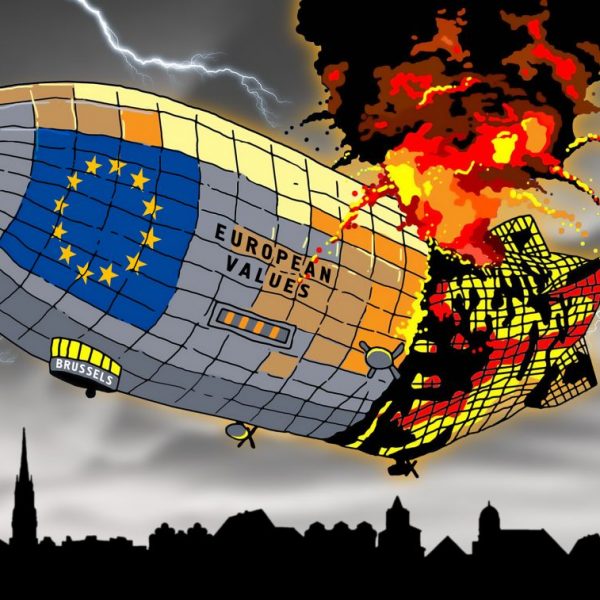
Lorenzo Maria Pacini
Europe's dream of a common army was stillborn in 1954 - and keeps dying.
We've often heard talk of a "European army," "common defense," and "European NATO," but information on these topics has almost never been clear or precise. In the collective imagination of European citizens, European defense is a vague, gray, undefined concept that leaders invoke when they need to appear strong against the enemy, but then deny when it comes time to act in concrete operational scenarios. A sort of armed ghost that finds no peace. We will try to explore the castle where this ghost resides, to understand whether the European Union will truly be able to sustain the wars it wants to fight.
A ghost that returns
In the spring of 2025, an Italian member of parliament submitted a bill to the Chamber of Deputies to ratify a treaty signed in Paris on May 27, 1952. The text established the European Defense Community, providing for a European army with a common uniform and military code, a single budget, and a supranational Commission empowered to decide on matters of war and peace. That treaty never entered into force. In August 1954, the National Assembly of the Fourth French Republic postponed its ratification-technically without rejecting it, but politically burying it. The fact that in 2025 a European parliament finds itself debating the resurrection of a document that has been clinically dead for seventy years is something that deserves to be taken seriously, not as a legal curiosity but as a symptom.
The symptom is this: Europe still lacks its own defense, and continues to realize this only when the protection of others fails. The return of the 1952 treaty coincides with a double shock. Since February 2022, conventional war has returned to the continent with the outbreak of the Russian-Ukrainian conflict; since January 2025, Donald Trump's return to the White House has made the U.S. security guarantee-on which the Union has relied for seventy years-uncertain and, at times, openly hostile. The sequence is familiar, because it repeats itself. In 1950, it was the Korean War that showed the United States could look elsewhere; today it is the Pacific, and before that, Washington's declared disinterest in European security. In both cases, Europe discovers its own military vulnerability at the very moment its guardian power looks away.
This article traces the trajectory of the common defense project through four phases-the failed founding, the long period of intergovernmental dormancy, the illusion of post-Lisbon integration, and the return of the repressed-and advances a specific argument. The vision of a European army has, in each of its phases, harbored a core of genuine political interest: the idea that Europe can decide autonomously on the use of force. But that core has remained consistently unimplemented, and not due to a series of contingent misfortunes. It has been neutralized by two structural conditions that have accompanied its entire history, acting like the two jaws of a pair of pliers. The first is internal: the Union's constitutional architecture, built around the intergovernmental sovereignty of member states in matters of defense, whereby every military decision requires unanimity and no European institution possesses its own autonomy to exercise in the strategic sphere. The second is external: the continent's subordination to a hegemonic power, first in the form of benevolent tutelage, then in the form of an inability to emancipate itself from it. The two jaws do not act separately. They reinforce each other: internal fragmentation necessitates external protection, and external protection renders internal unification superfluous-and indeed undesirable for the guarantor. It is within this stranglehold that the European army project was stillborn in 1954, and it is within the same stranglehold that it risks being reborn dead today.
This analysis draws on recent scholarship that has brought the issue back to the center of the debate, as well as on a comparison with long-term historical experience. But the interpretation proposed here is not the prevailing one. Dominant historiography attributes the repeated failures to a recurring and almost consolatory factor: a lack of political will. The argument goes: if only Europeans truly wanted it, a common army would be created. This explanation suffers from the flaw common to all explanations that reduce a structural phenomenon to a character flaw. Political will is not lacking due to laziness; it is lacking because the system is designed in such a way as to prevent it from emerging-and to make it rational, for each actor, not to generate it. Demonstrating this-that European military impotence is not an accident but a systemic outcome-is the objective of the following pages.
An army born already subordinate
From the very beginning, the European defense project emerged within a framework that shaped its purpose. In March 1948, the United Kingdom, France, and the three Benelux countries signed the Treaty of Brussels, the first postwar multilateral collective defense agreement: a pact of mutual assistance in the event of armed aggression in Europe, modeled on Article 51 of the United Nations Charter. Its official purpose was economic and cultural cooperation; its real purpose was defense. But even its genesis reveals the contradiction that would accompany the entire endeavor: the pact designed to contain a possible resurgence of the German threat was transformed, within a few months, into a tool for rearming Germany against the Soviet threat.
The decisive turning point came in 1949. Twelve nations, including the five signatories of the Brussels Treaty, signed the Washington Treaty and founded NATO. The phrase with which Lord Ismay summed up its purpose-to keep the Russians out, the Americans in, and the Germans down-is more than just a quip. It is the very foundation of European security for the next seventy years. The continent delegated its defense to a structure in which the decisive power was not European, and accepted the renunciation of an autonomous military capability as a condition of its protection. Every subsequent plan for a European army would have to reckon with this fundamental reality: Europe had traded strategic autonomy for security, and the provider of that security had no interest in restoring that autonomy.
It is against this backdrop that the European Defense Community takes shape. The catalyst was the Korean War, which broke out in June 1950. Washington pressured France to allow Germany to be rearmed so it could contribute to the defense of the free world. For Paris, the request was a nightmare: the reestablishment of a German army, just five years after the Liberation, amounted to a diplomatic defeat. Jean Monnet then devised a response that was both ingenious and ambiguous, which Prime Minister René Pleven presented as his own. If Germany could not have a national army, it would have a European army: German contingents would be dissolved into a supranational force with a single uniform, under a common command, and without an autonomous German general staff. German rearmament was thus made acceptable by transforming it into European integration.
Herein lies the first fact that conventional wisdom overlooks. The EDC did not arise from an autonomous drive toward European political unity, but as a technical solution to a problem imposed from the outside: how to rearm Germany without alarming France, and thereby satisfy a U.S. demand. The most ambitious project of military supranationalization ever conceived in Europe is, at its core, a stratagem for managing hegemonic pressure. This does not diminish its value-the idea of an integrated army governed by democratic supranational institutions was, and remains, of extraordinary interest-but it reveals its inherent fragility. A structure built to absorb external pressure depends, for its own stability, on the persistence of that pressure.
It is worth pausing to consider what the 1952 treaty actually provided for, because it serves as a measure of how much Europe has since lost. The EDC integrated all the armed forces of the participating states into a common army, with a single uniform and military code, subject to a unified command [Treaty on European Collective Defense, Title I]. Executive power was entrusted to a nine-member Commission, accountable to a Council representing the states and a Parliamentary Assembly representing the citizens, under the judicial oversight of a Court of Justice [Treaty on European Collective Defense, Title II]. Funding was provided through a common budget, and the Community was granted exclusive competence over defense industrial policy to ensure the supply of military equipment [Treaty on European Common Defense, Title IV].
The crux of the matter is precisely this: the CED endowed a supranational political community with the capacity to decide on existential issues-war, peace, the lives of soldiers-through democratically legitimate institutions. It was not a coalition of temporarily seconded national armies, like NATO or United Nations missions. It was an army that belonged to a political body endowed with its own will. From a theoretical perspective, the EDC opened up a conceptual space that political science took decades to name: that of autonomous armed forces beyond the nation-state, anchored not to a sovereign demos but to a plurality of peoples.
But the very treaty that opened this space immediately closed it off on the external front. The EDC was designed to operate in close coordination with NATO: in the event of an attack, European forces would come under the command of SACEUR, the Supreme Allied Commander Europe-that is, de facto, under U.S. command. The European army was thus born as a European pillar of NATO, not as an alternative to it. Its autonomy was limited to peacetime and organizational matters; at the decisive moment-the use of force against an aggression-the chain of command extended all the way to Washington. This is the fundamental paradox: the most advanced project for European military autonomy incorporated, as a condition of its very existence, strategic subordination to the hegemonic power. Not a correctable flaw, but the political price of its very conceivability.
Between 1953 and 1954, the treaty was ratified by four of the six signatories: the Netherlands, Luxembourg, Belgium, and Germany-the latter at the cost of a constitutional reform demanded by the Adenauer government. Italy did not oppose the treaty but delayed its ratification, hoping to use it as a bargaining chip to secure Trieste. It was France-the very country that had proposed the treaty-that brought the whole effort crashing down. In August 1954, the National Assembly approved a procedural motion postponing ratification indefinitely, without ever voting on the substance of the treaty.
The classic explanation for the failure identifies two causes: the lack of support from member states for federal projects and the changing security environment. Defense, it is said, is a matter of high politics; states do not cede military sovereignty to supranational entities as readily as they integrate coal and steel. Egon Bahr summed up the French position in a memorable phrase: France was ready to die for France, not for the EDC or for Europe. Meanwhile, Stalin's death in 1953 and the consolidation of NATO as a permanent defense structure had lessened the urgency: why build a European army if NATO already guaranteed security?
This interpretation captures the immediate factors but misses the underlying logic. To present the failure as the sum of national reluctance and a diminishing threat is to stop at the surface level of causality. The real question is another: why did national reluctance prevail precisely on the issue of defense, and why did the diminishing threat render the EDC superfluous rather than making it easier ? The answer lies in the pincer movement. The EDC required states to cede military sovereignty-the most intimate form of sovereignty-in exchange for strategic autonomy that, by its very nature, they would never have obtained anyway, since ultimate command remained with SACEUR. In other words, the states were being asked to give up something real-national control over their own forces-to obtain something fictitious: a European autonomy already mortgaged by the Atlantic alliance. From a rational calculus, the trade-off was disadvantageous.
And NATO made that trade-off not only disadvantageous but pointless. As long as there existed a structure that guaranteed defense without demanding the surrender of political sovereignty-because NATO is an alliance of sovereign states, not a federal community-the European army became a costly and politically burdensome luxury. The existence of the American security umbrella was not the neutral context within which the EDC failed; it was the cause of its failure. The external constraint (the availability of an alternative form of protection that did not require integration) and the internal constraint (the reluctance of states to cede sovereignty) worked in tandem. Without one, the other would have been manageable: if American protection had not existed, the cession of sovereignty would have seemed an acceptable price to pay for security. But the umbrella was there, and it made national sovereignty an asset that could be preserved at no apparent cost. The failure of the EDC was not a lack of will; it was the rational choice of actors situated within a structure that rewarded non-integration.
The outcome shaped the entire subsequent course of events. In 1955, Germany joined NATO; with the 1957 Treaties of Rome, European integration took an economic direction, bypassing defense. The lesson learned was that of "spillover": integrate what is easy first-markets, customs, currency-in the hope that integration would spill over into high politics. But defense never spilled over, because no American umbrella covered the coal market, whereas one did-and continued to do so-for security. The very area where external subordination was greatest was precisely where integration did not take place. This is no coincidence. It is the hallmark of the pincer movement.
To be continued...