Lorenzo Maria Pacini
What Ceuta and Melilla have set in motion will not end anytime soon.
Something is happening
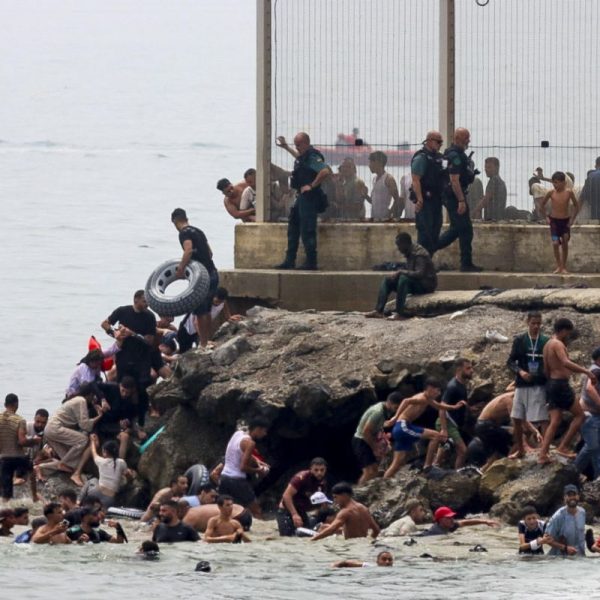
Warning: Something is happening. The events in Ceuta and Melilla in early August 2026 are no coincidence. The preliminary death toll stands at at least seventy-two; the Madrid government reestablished border control within forty-eight hours and repatriated nearly all those who had entered illegally. The political reaction, however, was disproportionate to the actual facts on the ground. Twenty-two heads of government wrote to Ursula von der Leyen to accuse Spain of mismanaging the EU's external border; Pedro Sánchez responded with a letter describing his partners' reaction as "asymmetrical" and lamenting that European solidarity has been eroded by prejudice, misinformation, and the pursuit of political consensus. A Chinese commentator, writing in the Global Times, interpreted the episode as the opening of a new fault line within the EU.
The image of a rift is effective, but it must be handled with caution. It does not describe a migration crisis; it describes a political crisis that uses migration as raw material. The distinction matters, because it shifts the focus of the analysis from migration flows to the balance of power within the EU.
- Data Versus Perception
It's best to start with the numbers, because that's precisely where the narrative turns on its head. Frontex reported a 37% decline in irregular crossings into the EU during the first half of 2026. The western Mediterranean route-the one crossing the Strait of Gibraltar-is the only one bucking the trend: approximately 7,860 detections, up 17% year-over-year, driven primarily by departures from Algeria. However, this remains a tiny fraction of the overall picture. The eastern and central Mediterranean routes, with a combined total of over 30,000 detections, continue to account for the bulk of arrivals, albeit in sharp decline.
There is also a legal aspect that dispels concerns about free movement. Ceuta is subject to a special regime within the Schengen Area: anyone entering it must still pass through border controls before reaching the mainland. Spanish authorities have reiterated-and the Commission has confirmed-that none of the irregular entries into Ceuta have resulted in a transit to the rest of the Union. The concern over "Schengen security" invoked by the twenty-two governments, when measured against these facts, remains without practical foundation.
This leads to the first thesis of this paper: the reaction of European partners is not proportional to the threat, but to political expediency. An episode that is marginal in quantitative terms has been treated as a continental emergency because migration, in Europe, has ceased to be a matter of administrative management and has become a battleground directly linked to elections and the transfer of power.
- Three Structural Issues
Three long-term tensions are at play in the Ceuta crisis. The first concerns the gap between the political arena and administrative effectiveness. European migration policy is increasingly shaped by electoral calculations and less and less by the ability to solve problems. The Italian precedent is instructive: Rome invested substantial financial and diplomatic capital to outsource the identification and detention of asylum seekers to Albania, drawing accusations of human rights violations despite the negligible number of people actually processed. The measure functioned as a political signal, not as a mechanism of governance.
The second tension pits open internal borders against poorly controlled external borders. Schengen is one of the most tangible achievements of European integration: labor mobility, cultural exchange, and a concrete experience of continental citizenship. But when the burden of arrivals falls unevenly on border states, the very space that symbolizes the union becomes its point of friction. The Pact on Migration and Asylum, which came into effect in 2026 with a single screening procedure at external borders, was designed to redistribute this burden; the crisis in Ceuta shows just how fragile its political stability still is.
The third tension is that between proclaimed values and their political sustainability. Since the postwar period, Europe has built part of its identity on the protection of human rights and dignity. This is not merely rhetorical: in Spain, it took on a specific legal form when, in June 2026, the Tribunal Supremo ruled that summary pushbacks cannot be applied to those attempting to reach Ceuta and Melilla by sea, thereby mandating the standard procedure. Every time the cost in terms of public order and resources increases, the gap between moral imperative and real-world pressure widens, creating a space where forces that promise to "shut the door" thrive.
- Variable-Geometry Solidarity
The most politically revealing fact is not the wave itself, but who used the wave and how. The letter from the twenty-two was coordinated by Giorgia Meloni and Mette Frederiksen, two leaders at ideological opposites who converge on a restrictive line; both invoked consequences for Madrid's cooperation within the Schengen Area. Opposing them is Sánchez's left-wing government, which touts the benefits of legal immigration for the Spanish economy and labor market; it finds itself isolated at the very moment it is under the greatest pressure. European solidarity, in other words, is either activated or suspended depending on the political stance of those invoking it.
It is worth testing the opposite argument. One could argue that the twenty-two governments did not act out of opportunism, but out of genuine concern: a porous enclave would set a precedent, and preemptive firmness would be an act of responsibility. The argument captures some truth. However, it falls short on two verifiable points. Ceuta's special Schengen status renders the fear of spillover to the peninsula legally unfounded, and the numbers on the western route remain marginal compared to the others. When the political reaction is greatest where the material risk is minimal, the simplest explanation is not strategic prudence: it is the electoral payoff of displaying firmness.
It is worth recalling that this situation has an almost mirror-image precedent. In May 2021, approximately 9,000 people entered Ceuta after Moroccan police deliberately relaxed controls during a period of diplomatic tension between Rabat and Madrid; the European Parliament spoke at the time of the exploitation of minors. The pattern repeats itself: Morocco uses migratory pressure as a bargaining chip, while Europe reacts downstream on the domestic front rather than upstream in its relationship with the transit country. Von der Leyen admitted this in a roundabout way, warning that the Union will not tolerate the use of migration as a tool for exerting pressure and deferring the issue to a strategic discussion in October.
Scenarios on the Horizon
Over the next twelve to eighteen months, three trajectories are taking shape. The first, and most likely, is a stalemate without a solution: the Pact comes into full effect, the numbers remain manageable, but every single incident continues to spark clashes among member states, because what's at stake is not the flow of migrants but domestic consensus. One indicator to watch is whether the October discussion will yield a burden-sharing mechanism or merely a declaration of principle.
The second trajectory-less likely but not out of the question-is a coordinated hardening of positions: Meloni and Frederiksen's restrictive line becomes mainstream; the moderate center adopts it to avoid losing votes; and the protection of rights is reduced to a mere formality. The third scenario, currently unlikely, is a rebalancing toward shared management-possible only if a structural agreement with transit countries were to strip migration of its function as a diplomatic lever. None of the three paths eliminates the rift: two widen it, while one keeps it under control without closing it.
The strategic implication is that the Union has largely resolved the quantitative problem that overwhelmed it in 2015, but not the political problem that stemmed from it. As long as a hard line yields more than cooperation, migration will remain for Europe not something its member states must manage together, but something over which it is in their interest to be divided.
But there is more, and it is far more dangerous: this event may mark the beginning of something genuinely dangerous, perhaps even epochal-such as a European revolution among deeper political factions, or, to use rhetoric dear to Americans, a struggle between different types of "Deep State."
What Ceuta and Melilla have set in motion will not end anytime soon.