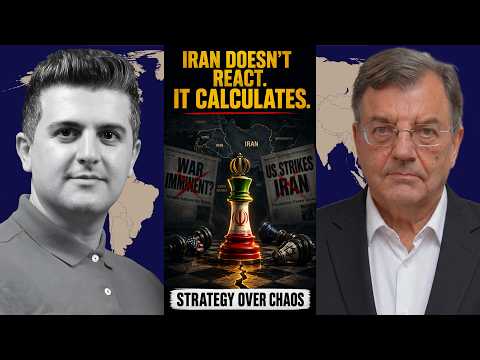
Nima Alkhorshid: Hi everybody, today is Thursday, July 30th, 2026, and our dear friend Michael Hudson is here with us. Welcome back, Michael.
Michael Hudson: It's good to be back, and especially on a day like today when everything's exploding.
Nima Alkhorshid: Exactly. And let's start, Michael, with what was reported on NBC. And it says Donald Trump lost his temper during a security meeting, shouting and cursing out of frustration over the military options presented to him and the lack of progress toward a deal with Iran. And this is the situation we're in. And you know what's going on with the chaos in West Asia. The attack—Saudi Arabia is attacking on two fronts, basically. And they attacked Iraq. And before that, they were attacking Yemen. Yemen responded. And on the part of the United States and Iran, there were Iranian attacks on Jordan. And then last night, we've seen the United States responding, retaliating, and then Iran retaliating again and attacking Jordan and other countries. And Kuwait, they attacked Kuwait and Jordan. This is what's going on, Michael. And as I've mentioned, the options for Donald Trump—one of them is the military option, the other one is talking and negotiating. What is your understanding of the case of Donald Trump and the situation he has created for himself?
Michael Hudson: Well, apparently he's been losing his temper for the last six months or so, not only against the military, but against the economic advisors and the political advisors. And what he's angry at is the military's been explaining to him what your military commentators on your site have been saying: that from the very beginning, there was no way in which the United States could defeat Iran for a number of reasons. For one thing, Iran is focused on taking out the radar systems of all of the surrounding U.S. military bases. And that's prevented the United States from knowing exactly where the missiles are coming from and how to put in place defense systems. Trump said, "We only had seven minutes to respond in the case of the attack on Jordan." Well, they used to be able to tell a lot longer than that.
But the most important thing is the whole U.S. strategy is Trump's psychodrama that if—and it's a psychodrama of the United States, Ukraine also—that if we can just hurt civilians enough—if in violation of the laws of war saying you hit military targets, not civilians—if we hit civilians, they will be—as in the case of Russia—they'll be so unhappy and hurt that they'll say, "Can't we change the regime and get a regime that the United States will accept, that is favorable to the U.S., so it'll stop bombing us and killing our women and children and civilians?"
Well, the Iranians have shown since 1979 that they can stand up [to] this. And the army said: this is not going to hurt Iran. The only way of defeating Iran is to hit military targets. When you hit the population, the effect is just going to drive them together and [they'll be] saying, "We don't want any part of this. The U.S. is the enemy. And no matter what, there's no way we're going to surrender to the U.S. army and military that's hurting our civilians so much."
So hurting civilians doesn't help. And how do you hit the military targets that Iran has spent three decades—more than that—in putting all over the enormous country that it has in all sorts of places—with decoys all around of false missile launchers ? There's no way that the U.S. military can take them out. Plus, the military's running out of bombs and missiles, and if it expends what it has left on Iran, it won't be able to defend Israel or Ukraine or Western Europe from the simultaneous war on two fronts that it's fighting between both Iran and Russia.
So Trump is furious at that. And he's furious at the fact that from the very beginning, he started a war without spelling out, well, what are the objectives ? Well, the first thing that von Clausewitz said: war is a continuation of economic policy. What is the economic policy ? There's only one policy that Trump has been spelling out since the first administration. Beginning in 2018, he said, our aim for the Middle East—West Asia—is to make the Arab monarchies pay for the war, especially Saudi Arabia. We want to recover all of the expenses we're paying there from Saudi Arabia and the Emirates, just as we want to help Ukraine and Europe recover all the expenses of our war against Russia in the Ukrainian battlefield.
So that's his philosophy. And this war that he's fighting is developing and expanding into a war against the Arab OPEC members just as much as against Iran. And that's what they see. They're stuck. What can they do ? Because all of their savings—of Saudi Arabia and the Emirates—are invested in the United States financial system. So, the United States at any time can simply say, "Well, we're recovering the costs of our war by sequestering your savings, just like we did against Iran." That's their nightmare of what's happening. They're paralyzed. What can they do?
Well, that's why Iran is so insistent in saying: no matter what happens, we must control all of the tanker traffic through the Strait of Hormuz now, and we'll continue after the war to do it because this war is going to be a military threat as long as the United States has a presence in the region—not only a military presence, but a financial symbiosis with the Emirates, with Saudi Arabia, with these governments. And it's that symbiosis that we have to end. And that's why Iran has been bombing the Amazon data centers and other Google and Microsoft and Meta data centers. It wants to end the whole linkages between the region's symbiotic relationship with investors in the United States and the part-ownership and the whole plans for the United States to expand its attempt to create an information technology and automatic intelligence monopoly by saying, "Well, we can't build electric plants and provide energy here in the United States because we don't have the time to build new utilities and we don't have the water to cool the plants. We have to go where the energy is." And the energy is in West Asia. The energy is in the Emirates and Saudi Arabia.
Well, the problem is they don't have water either. This is the whole dilemma for these monarchies, but also for Iran: how do we stop this symbiosis and get the whole influence of the United States out of the region ? Because as long as the Arab countries have their hopes for making money and getting rich in America's financial markets, their hearts are going to be with U.S. foreign policy—militarily and politically—and we're screwed.
Nima Alkhorshid: What do you make of the sort of behavior we're witnessing from Saudi Arabia ? For example, they're somehow expanding the war. We know the pressure on their economy because of the Strait of Hormuz, the closure of the Strait of Hormuz, the blockade in the Red Sea. On the other hand, you've mentioned they're going to pay for whatever the United States is spending with this war in West Asia. And they're going to pay for that. And they know that, while their economy is somehow suffering a lot because of the war. And why is that happening with them, and just expanding the war, which is not going to benefit them?
Michael Hudson: They recognized this already a few months ago. Trump said he was going to begin his attack on Iran. And Saudi Arabia said, "We can't let you use our territory or bases as a takeoff point to attack Iran because Iran will attack us. So we're blocking our bases." That made Trump suspend his initial plans for the war earlier this year and have a workaround to avoid Saudi Arabia. So they already stopped him once and they got Kuwait to agree with them to both jointly saying: you can't use your bases in either of our countries or fly over them.
So Mohammed bin Salman (MBS) realizes that they're stuck. On the other hand, he realizes that America holds all of Saudi Arabia's savings hostage more or less, and there's that traditional fight of Sunni Wahhabi Islam against the Shia religion of Iran. And there's that element too. And Saudi Arabia continues, when all is said and done, to throw in its lot with the United States.
Well, and not only against Iran, but a long time ago, they fought against Yemen to conquer Yemen. And that's led the Yemenis—the Houthis, their group of the Yemenis—to fight back. And they're able to stop the 5% of world oil that's exported by Saudi Arabia through the Red Sea, in addition to the 20% that goes through the Strait of Hormuz. And Saudi Arabia has already been trying not only the last year, but for many years, to defeat the Yemenis and prevent their ability to attack Saudi Arabia—unsuccessfully. And it has to be a losing fight.
So, what's going to happen ? Well, at some point, the war is going to come to an end. And the aftermath of all wars usually is political. I think we've discussed before in your show how World War I ended with removing the monarchies of Europe, not only in the defeated countries, but also in the victorious countries. Monarchies were replaced by parliamentary oligarchies calling themselves democracies, but they were replaced.
Well, let's imagine what kind of political backwash there's going to be when this oil war by the U.S. against West Asia and Russia ends. I think you're going to have a lot of the sheikhdoms and monarchies be replaced—by what ? Probably Iran will emerge victorious. You're seeing the whole negotiation and fighting between Iran and Oman right now over, "How are we going to control shipping through the Persian Gulf, through the Strait of Hormuz?"
Well, Iran is not going to share it 50-50. It's going to say: this whole war has injured us. We only have one way of stopping the war. The war is not against you. It's against us. We are going to control the strait. We are going to get the money. We'll share some portion of it with you, that's up to negotiation, but not very much.
The argument is who gets what right now. And I'm not sure how Oman can solve. And the problem is that Iran can always say: well, you used to be part of Iran, once upon a time. That situation may be restored at some future date. What do you think?
Nima Alkhorshid: Yeah. I think the problem, Michael, between Iran and Oman is basically, the case of the strait, which is influenced. The United States is trying to influence the Omani government in order to get as much as possible from the deal, from what's going on between Iran and Oman. But Iran is not going to back down. This is the problem. They want to control the entry and the exit in the Strait of Hormuz. That is crucial for them. Not because of the economy, because of what they gain by charging these vessels or ships. It's all about security.
It's so important because without the Strait of Hormuz being used and all these GCC countries being used, the United States would not, you know, couldn't start this war the way it started. They use all these military bases in GCC countries. And together with the Strait of Hormuz—by the way, most of these weapons and radars were using the Strait of Hormuz to send all these weapons to these countries. Iran says: no, that's not going to happen.
This is the reality between [them]. And as time goes by, you see the rhetoric on the part of—or the policy, the strategy on the part of Iranians is getting harder and harder. It's getting, you know, toward Oman. We know that they had, for such a long time, the relationship between Iran and Oman was so good. And right now, it seems something is coming to the surface because of the strait. And I don't see Iran backing down, Michael, to be honest.
Michael Hudson: I think there's a perception, both in Iran and the United States, that everything goes to an extreme. And the extreme here is there can only be one winner, either Iran or the United States. And the military is telling Trump: Iran has all the cards. There's no way that we can win. And if we just say, "All right, if we can't win, let's just paralyze everything. Let's just close everything down and stall."
Well, the longer they stall, the deeper they make the inevitable world depression and breakdown that's going to occur no later than this autumn because the oil isn't being shipped. The gas isn't being shipped. And the result is that you can only release so much oil from the national [Strategic] Petroleum Reserve before the reserve runs out. Or if Trump says, "We've got to keep oil prices down and gasoline," he means gasoline prices for the vacationers that are driving in August and September before the November elections. We've got to keep gas prices down so even if we deplete so much oil from the salt caves in which the United States has stored its petroleum reserves, if we sell so much oil—and a lot of it's being exported to Europe to keep down the prices—so if the oil goes below say, 70 billion—the limit of what the caves can hold—the caves will collapse. And Trump will say, "That's okay if they collapse. Let's hope they don't collapse until after the first week in November, the first Tuesday when there are the elections taking place. By then, I'll be in."
So for him, everything is timed for the November election. And he'll let the economy of the United States be pushed into absolute crisis after election day—the midterm election day—in order to try to maintain the hold of the Republican Party, and specifically his MAGA group within it, against the Democrats who are pledged to start impeachment proceedings against him and bring in an entirely different regime change.
So the regime change that Trump wanted to bring about turns out to be in the United States, not Iran. That's the irony of all this. Just like you will conquer a great country—the country Trump is conquering is the United States, not Iran.
Nima Alkhorshid: What's going on, Michael, with the Iranian behavior ? We are witnessing something new. They're changing their strategy. Their strategy was defensive. But it's getting somehow preemptive as time goes by. Because there were attacks on Jordan. And again, The New York Times reported that yesterday there were some attacks on this port in Egypt. And they call it the Damietta Port, in Egypt. Two ships, American ships, were attacked. And The New York Times just came out and said that Iran is behind those drone attacks. Because if the United States is using the blockade to attack Iranian ships, to hit Iranian ships, and they're going to find the American ships, it seems to me that if this story that The New York Times just put out is right or is correct, and then Iran is going beyond the old strategy they had before. How do you see that?
Michael Hudson: Well, I think it had the right strategy.
Nima Alkhorshid: The game about the economy, Michael, sorry for interrupting you. The whole game is turning into a, you know, the economy is, they're fighting each other considering their economy. They're putting pressure on the Iranian economy. Iran wants to do the same to the United States. And how is this economic war going to go on, in your opinion?
Michael Hudson: Well, Iran has a higher tolerance for economic punishment than the United States because it's been living with this for a long time and has shown its resilience. The United States is not a resilient economy because it's so debt-leveraged; it's living on the brink of insolvency for businesses, for labor, consumers, for local governments. And militarily, Iran's policy is realizing that the best defense is offense. And in the United States, the reports are: look, Iran did just what you described—a surprise attack on Jordan. Well, what is surprising about this ? The U.S. has continued to attack Iran with acts of war by blocking its oil exports outside of the Strait of Hormuz. That's an act of war. America's been at economic war with Iran all this time, preventing its exports. An economic war is just as serious as a military war.
So Iran realizes that, and it's also looked at the dynamics between Russia and the United States in their fight in Ukraine. And Russia has always so far been, we will do a proportionate attack. You can mount a surprise attack on us again and again and again, and we will react proportionally.
Well, Iran has gone beyond that. It said: we're not going to just do proportionally. Proportionally won't stop "you get to decide what you can attack with us and what our proportional attack will be." If you attack us, we're going to do what normally is done in war. We will attack you as strongly as we can. And it's because we are the superior military power at this point since your missiles are depleted, your radar is destroyed, your early warning systems don't work, your missile systems are not able to defend the U.S. bases and areas against our drones and missiles. You don't have the defense. All of the military advantages are on our side, as I think your own generals have been telling you, Mr. Trump.
So, you can walk into a guaranteed losing war. But you know, you came to office saying you want to be a new Napoleon for our era. Well, remember what happened to Napoleon when he attacked Russia and again when he attacked Britain and lost at Waterloo. This is going to be your fate. Yes, you're going to end up like Napoleon. I'm not sure you'll be in exile. If it won't be in Elba, maybe it'll be in Israel, as all of your corrupt behavior has led to threats of imprisonment. But you're going to end up not in the way of Napoleon that you'd imagined when you picked him as your role model.
Nima Alkhorshid: Yeah. The other point is, Michael, is the future of American bases in the region, and not only with GCC countries, but also in Jordan. The New York Times reported that hundreds of Jordanian political, legal, and public figures have signed an open letter demanding the withdrawal of U.S. forces from Jordan because they're getting hit by Iranian drones and missiles. So, what is the point ? What is the gain for them?
Michael Hudson: The gain for whom?
Nima Alkhorshid: For the Jordanians, for all of these countries [that are fighting a war that nobody's benefitting from.]
Michael Hudson: They don't want to be hit. They know that if the king of Jordan, and his bureaucracy, throws what he controls into the U.S. camp, that the whole majority of Jordanian citizens are not Jordanians—I mean, the Jordanian population are not Jordanians. A lot of them are Palestinians, a lot are Indian, or a lot are Shiites. It means that if Jordan continues to side with the United States and make itself a target for Iranian retaliation, there's not going to be a monarchy anymore. The monarchy will become either part of Iran or as an Iranian client state in one way or another, probably opening it up to votes for the population at large, which, of course, will have the sympathies not exactly with the monarchy any more than would be the case in the Emirates or Saudi Arabia, which is the similar minority.
Jordan and the Emirates and the kinglets of West Asia were all a product of World War I and World War II, when the Ottoman Empire was carved up, and Britain and France, the two great European colonial powers, redrew the political boundaries of this region and installed client monarchies, client oligarchies, client aristocracies—all of that. We're finally seeing the undoing of the mess that the European colonial powers created after World War I, and then when the British and French empires were absorbed into the American financial empire after World War II, the United States. All of this is, I think, destined to be swept away in the backwash of what's going to happen as the ultimate settlement of the war that's now really just gaining momentum on a global level.
Nima Alkhorshid: Michael, how do you see the pressure ? Because there are two ways of putting an end to the war. One of them is the United States running out of weapons, missiles, interceptors, and finally deciding to get out. The other one is the economic pressure on the United States, the way that the Strait of Hormuz, maybe the chaos with the blockade on Saudi Arabia, would put pressure on that. And we have two wars, two active wars right now. One of them is in Ukraine, the other one is in the Middle East and in West Asia. Is that going to be the battlefield that would decide about the future of that, or the economy going to hit the United States harder before that happening?
Michael Hudson: It'll be an economic crisis that occurs at some point where there is a break in the chain of payments. There's no way of knowing exactly when the crisis is going to occur. What America's been experiencing since 2009—when Obama came into office and bailed out the banks from the real estate junk mortgage crisis—the United States has been in a slow crash. And it's kept its economy going by debt-leveraged asset price inflation, fueled by the Federal Reserve pouring money, financing the budget deficits caused by Trump's tax cuts, into the financial sector. The Federal Reserve has financed all of the budget deficit, including the prospective trillion-and-a-half-dollar military spending budget that Trump has proposed.
All of this has been created by the Federal Reserve printing the money to buy Treasury securities from the financial sector, pumping money into the banks and the financial sector to create money. And what do banks lend money for ? Not for industrial development, not to increase the economy's productivity and profits, but they lend it against real estate, stocks, and bonds to bid up the prices, hoping that the prices from all of this debt-leveraged asset price inflation—the zero interest-rate policy for many years—are going to provide the real estate and stock companies and companies that owe bonds with the money to pay the banks the interest and carrying charges on their foreign debt.
Well, all of that's on a knife edge right now. And the interruption of economic activity that's caused by the oil shortage, especially for diesel fuels, for American transportation, and the shortage of fertilizer for American agriculture and farms—bankruptcies are going way up—and for the electricity companies and for all of these oil-dependent industries, especially the airlines that have been cutting back many of their routes because of the rising price in the kerosene-type of airline fuel.
All of these special fuels besides gasoline are really where the squeeze is going to lead to closedowns. Truckers cannot afford to operate on the current rate. You're already having private sector truckers that are operating on a sort of piecemeal basis. They won't be able to make any earnings. Farmers are not able to continue planting at their planned rates and make a profit on producing wheat, corn, soybeans at the current prices when they have to pay such high prices for their own diesel fuel, for harvesting equipment, for fertilizer, for all of the inputs that are being interrupted by the war in the Persian Gulf.
Nima Alkhorshid: Michael, do you feel that there are people in the establishment in the United States that still believe that they can do the same to Iran and Russia as they did to Venezuela?
Michael Hudson: That is exactly what the Treasury Secretary, Scott Bessent, has said. He had a wonderful interview with, I think, CNBC, where he explained that Venezuela is the model for exactly what he wants to do in Russia. He said, "It's all about keeping the dollar as the center of American foreign policy."
He [Bessent] said: why did we go to war in Venezuela ? Because they weren't using the dollar. They were pricing their oil in currencies other than the dollar. Not only that, but they were spending these oil proceeds not in buying U.S. products, but in buying products from countries other than the United States. So, when we went into Venezuela, we did two things. We confiscated their oil. We had all of their oil proceeds invested and sent into a U.S. Treasury bank account under my direction as Secretary of the Treasury. And we've made sure that this bank account is spent in the United States on U.S. products. Well, we can do the same thing for Iran.
And Trump immediately came out after Bessent's interview and said: yes, Bessent is right. If we can conquer Iran, we're going to take over Iran's oil. And we have a plan. If we conquer Iran's oil, we're going to set up a Treasury account. And we're going to let Iran export the oil—but all of the oil proceeds are going to be priced in dollars. And the dollars are going to be in a Treasury account managed by the United States. And we're going to spend all of the money in this Treasury account either on U.S. exports or investment in the United States, and to pay the United States for the seemingly infinite costs of our military expenditures that were required to defeat Iran.
And he [Trump] said, that's why we can't agree to the Memorandum of Understanding from June 17th that I signed in the way that Iran understood it. Iran was supposed to get some token payment—either with a $12 billion, was it $6 billion, was it $3 billion—some payment of the $100 billion that the United States has directed its allies to confiscate, including South Korean confiscation of allies that it transferred all the money it seized from the Iranian accounts into the Emirates and all this money is in the Emirates.
Well, Trump said, first of all, the Emirates want to keep this money for themselves as their reparations for Iran defending itself by attacking the bases and the Emirates that attacked it. But also, the fact is that any money that is held in the Emirates account that they agree to repay Iran, whether it's $3 billion or $6 billion or $12 billion, all that's going to be an account that I, Donald Trump, will control. And all this money is going to be spent on American supplies—medical supplies, food imports. It's all going to be spent in the United States, nowhere else.
And Bessent, in his interview, said: and we can do the same with Russia. We will convince Russia that, yes, we can resolve the war in Ukraine that NATO is waging against you. We can stop the attacks, but you'll have to agree that if your exports of oil and natural gas increase, you'll have to agree to spend the proceeds in the United States. And that is the basis of U.S. strategy.
And that's the real corner into which the United States economy has painted itself. It's no longer able to create its own industrial prosperity and investment and living standards at home. It's deindustrialized. It's privatized its infrastructure. It's financialized the economy, making money by interest and economic rent, not by profits on actual tangible capital formation and factories and their machinery and means of production.
So, it's painted the only way that the United States can support its living standards and the debt service that it has to pay is to exploit other countries. And Bessent and Trump, again, have spelled out exactly what this strategy is. They're very open in it. They say: we have to achieve a world monopoly in the form of choke points. Oil is the number one choke point we have. If we can control oil, we can make sure that as much oil as is exported, the United States is going to get much of the economic surplus.
And he [Trump], in one of the speeches he gave a few weeks ago, saying, take Saudi Arabia and the Arab Emirates. If we control the Strait of Hormuz, if we can replace Iran as controlling this, we will charge all oil traffic 20% of the total value of the oil that is being exported. Imagine 20% of all the OPEC oil that's being exported will go to the United States as compensation—reparations for the United States protecting it, is what Trump said. We were the guardian angel.
Well, I think that Saudi Arabia and the Emirates no longer think of America as their guardian angel. But the United States, that's really what this fight over Hormuz is about—who is going to control it ? And Iran has said very explicitly, it responded: if we don't control it, then you're going to control it. And we will only charge the modest amount that we have been charging for ships going through the Strait of Hormuz, which is only one-seventh as large as what you're charging.
But then, after Trump came out and said, "We're going to charge 20%," the Iranians said: well, at least you've said one thing that we agree with, Mr. Trump. You've agreed that international law does not prevent charging a transit fee for traffic through international waters. You had claimed that we can't collect the fee because the Strait of Hormuz is an international water. And countries that have signed the United Nations Conference on the Law of the Sea say that, well, these countries that signed UNCLOS were grandfathered in.
So Suez can charge a fee, the Panama Canal can charge a fee, the Turkish can charge a fee for the Dardanelles—which, by the way, they raised 15% last year in their annual increase in the fee through their international waters. But Iran never signed this UNCLOS agreement, nor did the United States. Well, but Iran said: thank you for at least acknowledging the right for countries to be able to charge the fee that these other major countries do. And we're going to charge it, and it'll certainly be more affordable for the other West Asian countries—for Saudi Arabia, the Emirates, Bahrain. It'll be more affordable for them to have us charge our relatively modest fees. And that's going to be the only way we're going to get reparations or even recover the money that these countries have seized from our accounts. Better to pay us than to pay the much steeper demands that Trump has said he's going to charge you if the United States conquers us and takes over the Strait of Hormuz.
So the war of the United States against Iran is an oil war. And for Trump, the objective of the oil war is to control the Strait of Hormuz, and presumably the Red Sea also, in order to use it to extract money to pay the United States to help support its economy for the revenue and the affluence, the flow of foreign money that is no longer being produced by the United States economy domestically itself.
Nima Alkhorshid: Just informing our audience that there was breaking news that Saudi Arabia is attacking Yemen or hitting some targets in Yemen. It was false. The sound is caused by thunderstorms above Sana'a. No attack is happening as we talk. So, the report was false.
And Michael, let me bring something important out. Because there is new footage that came out after, you know, I think it was yesterday or the day before, you know, it was after the funeral—or before the funeral of Lindsey Graham. The video was published by CNN. It shows how Lindsey Graham is describing the situation before the war is starting, describing the situation and calling and talking with Jake Sullivan, the National Security Advisor of Joe Biden, describing [to] him the situation with the war on Iran and how the Arab states are somehow in the background. They're waiting for Iran to collapse and they're going to come in as well. Here is what he said, Michael.
Lindsey Graham (clip): Able to deliver. To be honest with you, I think about three to four weeks we should have them in a spot where they start losing control of some cities. And what we're trying to do is just get a few cities to fall and the next month, get the Arabs more openly involved tomorrow or by the end of the week and just have almost irreversible momentum.
Nima Alkhorshid: Yeah. He said in three to four weeks they're going to collapse the cities one by one and they're going to start with two of them. Then the Arabs are going to come out and they're going to in the open because they were supporting behind the scene. But he [Lindsey Graham] says they're going to come out and going to express themselves and everything [is] going to go one after another.
We're going to bring down the government in Iran. This is what was said. And right now, there is, in my opinion, some sort of panic for countries like Saudi Arabia because they don't know what to do with the new face of the Middle East—the new face of West Asia. Iran is coming out of this chaos and this conflict more powerful than it was before the war started. This is not something acceptable for GCC countries, in my opinion. That's why they're in some sort of panic. How do you see the future of these countries, [the] GCC countries, as time goes by ? Are they going to shift ? Are they going to consider maybe China as an alternative for them in the region ? Or to balance economically between the United States and China ? Is that possible with the current situation ? You know, they have everything in the United States, in New York. And shifting from the United States to the East is going to be so difficult, in my opinion, at the current situation, at this particular moment.
But as time goes by, how do you see the future ? How do you see right now the situation with them, with their economy ? And as time goes by, how is that going to be possible for them to shift if they decide to do that?
Michael Hudson: Well, the way you phrased the question, Nima, is, what would a sovereign country do in this situation ? Well, there's no question that if Saudi Arabia and the Emirates had sovereign power over what to do with their own export earnings and with all of the investments that they've built up since 1975—ever since the petrodollar system went in—if they had their own choice, of course they'd say: how do we make money ? We make money where the economic growth is. We may make money on debt-leveraged stock appreciation in the United States, but ultimately the only way you can really make money on a sustained basis is by economic growth. And the economic growth is not occurring in the West, not occurring in the United States, and has certainly been stifled in NATO Europe. It's occurring in China, potentially Russia, if the war with the United States is over with it, and by Africa as it throws off its former colonial rulers in France and other countries. So, of course, we're going to do just what China's doing. We're going to invest all of our sovereign wealth funds and our personal funds in the Asian market.
Well, the problem is they don't have sovereign power. Because what do you think the United States would do if Saudi Arabia began to say: well, you know, we'll pull out a little bit, maybe only $2 trillion from the American market. And China has offered some wonderful investments. We will supply China with oil and we have an investment partnership with China, much along the same lines that we have investment partnerships drawn up with your automatic intelligence companies. But that's really where the growth is because the artificial intelligence systems of China, the internet, all of the computer industry—this is Chinese technology because they've used their profits from their economy and from their computer systems in research and development in contrast to the U.S. companies, which many of whom are now collapsing. They've [U.S. companies] used their profits for stock buybacks and to pay higher dividends to their stockholders to push up their stock prices.
Well, China doesn't have a financial stockholding class or an independent financial class. That's what makes industrial capitalism, or the industrial socialism of China and Asia, so much more productive than the finance capitalism of the United States that makes money financially at the expense of the industrial sector—which is why the United States and Europe are deindustrializing, not industrializing.
So, obviously, the materialist approach to history [says], "Well, countries are going to put their money where the economic incentives are highest." But they're not allowed to. That's what the United States has created: a system of control preventing Saudi Arabia, the Emirates, Bahrain, Qatar from using their oil export proceeds for any economy outside of the United States. That's what Bessent and Trump have been explaining very explicitly.
There is no shame in this, no attempt to conceal it. They've come right out and said that's the basis of American foreign policy. And I have an article that I'll be publishing, I think, next week through Democracy Collaborative and on my website explaining, giving all of the quotations that we've been talking about and all of my analysis of this.
This is the whole plan on which American international strategy and foreign policy are based on. Other countries must pay us tribute of one form or another. They have to transfer their economic surpluses to the United States—their trade surpluses, their financial surpluses—to benefit our economy, not themselves, and certainly not other economies, such as China's economy or other countries whose sovereignty we oppose and against which we impose trade and financial sanctions, as we've been doing.
So, will Saudi Arabia and other American allies in the Persian Gulf obey the U.S. sanctions saying, well, you know, we've imposed sanctions on, and we will confiscate any money that you try to put in China or Singapore or other countries not in the United State. We'll confiscate because we've said you can't trade with them. What are you going to do about it?
Well, in the past, the United States had its military bases there, and all it has now are its American embassy there. So the American Embassy will say: well, if Saudi Arabia wants to invest its money in China, maybe it needs a regime change. Same thing for other countries.
So these countries will be under attack if they try to exert their own national sovereignty. Well, of course, the whole principle on which the United Nations was based in 1945 was the principle of guaranteeing national sovereignty to every nation. The United States, as we've discussed before, said: our national sovereignty is aimed at promoting our own prosperity, and our prosperity is threatened by the national sovereignty of other countries not recycling all of their export and investment income to our economy, but spending it in other economies.
That's what is going to lead to this oil war ending in a whole reconstruction, a whole new international economic order that's going to enable all countries, including the Arab OPEC countries, to exert their national sovereignty of deciding what to do. But it's going to be a bloody fight. In that sense, you can look at the fight against Iran and against Russia, the two oil producers that the United States has not grabbed as it did in Venezuela. This whole fight is really just beginning to flower into an economic dimension of World War III that's going to be fought throughout the rest of this year, certainly all of next year, deciding: can other countries break free of the international trade and financial system that's become a tributary system for the United States economy ? Can we really have a set of international relations that provides not free trade, but the open trade, open investment for all countries?
That's going to be what the great political fight is about. And the United States says, well, there's no alternative to the dollar-oriented order. De-dollarization won't work. And the rest of the world, the global majority—the Global South, Iran, Russia—are saying, well, there is an alternative. We do have to set about deciding it. And it looks like Iran, Russia, and China are going to be the three countries that are designing these alternatives and inviting the BRICS countries and the rest of the world to join in this system that they are putting in place.
Nima Alkhorshid: Yeah. Thank you so much, Michael, for being with us today. Great pleasure, as always. Please hit the like button, helping us [reach] more people. Michael, thank you.
Michael Hudson: Well, thanks for letting us both have such a wide-ranging discussion.
Transcription and Diarization: scripthub.dev
Editing: Madison
Review: ced
Photo by Francesco Ungaro on Unsplash