José Goulão
Whether one agrees with Sánchez's policies or not, his government has shown that political independence has not yet disappeared from Europe.
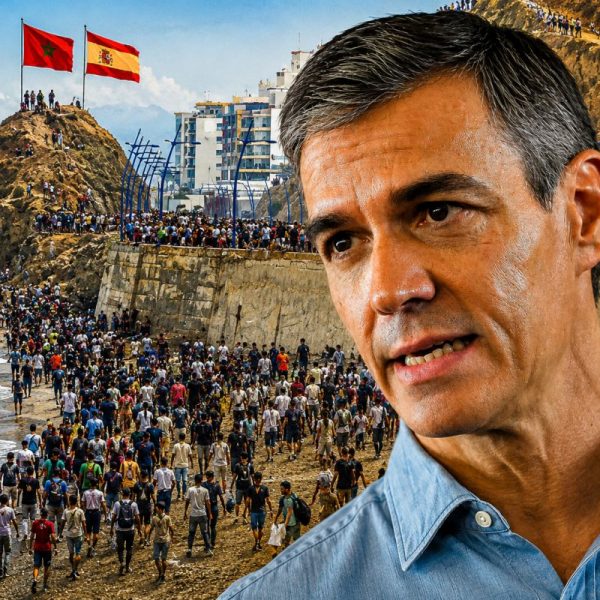
The latest assault on Spain - using impoverished human beings condemned to unimaginable suffering as political cannon fodder - is yet another illustration of the ignoble arsenal employed by imperial power, and by the West more broadly, to impose its geopolitical interests.
Is anyone seriously expected to believe that, at the flick of an invisible switch somewhere in Morocco - or perhaps in Tel Aviv or Washington - tens of thousands of Moroccans and other African migrants simultaneously decided to storm the Spanish enclave of Ceuta before dispersing across Spain?
Who organised such an operation ? Who coordinated it ? Who stood behind it?
It is impossible - or at least intellectually dishonest - to point the finger without evidence. Yet we have seen these mechanisms before. We recognise the methods. We understand the strategies. And we can identify the political objectives they seek to achieve. To my mind, there is little room for doubt about the principal objective in this case. It is the removal of Pedro Sánchez's government in Madrid.
A government led by the Spanish Socialist Workers' Party (PSOE) which, at a moment when almost nobody expected it to do so, departed from the neoliberal orthodoxy that has become almost compulsory among its sister parties across the Western world.
That departure has consequences. And those consequences are becoming increasingly intolerable for the structures of global power centred in Brussels and Washington. The autocracy concealed behind the language of "liberal democracy" has therefore decided that action is required.
One by one, motives have been assembled. Pretexts accumulated. Parallel campaigns converged. All with the same political destination: bringing down Sánchez's government.
In the darkest nightmares of figures such as Ursula von der Leyen, António Costa or Donald Trump, there can be no room for sovereign-minded governments - or for political leaders prepared to challenge the prevailing orthodoxy - from within either the European Union or NATO.
The self-appointed guardians of "liberal democracy", of "our shared values" and of "Western civilisation" tolerate remarkably little diversity of opinion within a political system that endlessly celebrates pluralism while increasingly speaking with only one voice.
Sánchez's government has been marked for elimination
Make no mistake. In Washington and Brussels, Pedro Sánchez's political future has already been decided. His government has become one to be removed. The difficulty, however, is that Spain is not a country that can be disciplined at the snap of a finger. It would be a serious mistake to underestimate it.
Spain is a nation with a strong sense of itself, of its history and of its remarkable diversity. It has never been an obedient "model pupil", nor is it likely to become one now. It understands its own political weight, is not easily intimidated and has little intention of dissolving itself into a supranational order in which nations - and ultimately citizens - are reduced to little more than administrative units.
For precisely that reason, Spain has become an obstacle for the centres of power in Brussels and Washington. And obstacles are seldom tolerated for long.
The pressure on Ceuta - achieved through the cynical exploitation of human misery and of the colonial inequalities that continue to afflict Morocco and much of North Africa - is merely the latest instrument deployed in a broader campaign to destabilise Spain.
The political establishment in Washington, supported by its allies in Brussels, has pursued this objective ever since Pedro Sánchez demonstrated that he was not prepared to align himself completely with the model of unrestrained neoliberal capitalism promoted by both the United States and the European Union, increasingly intertwined with military ambitions and geopolitical confrontation.
Sánchez is not a revolutionary. He does not challenge capitalism itself. He remains, fundamentally, a social democrat. Yet he appears to belong to a tradition of social democracy that much of Europe has quietly abandoned.
Today, to qualify as a fully respectable member of the Western political establishment, one is expected to embrace neoliberal orthodoxy almost as an article of faith. Sánchez has shown that he is unwilling to do so. That, in itself, makes him a political anomaly. Or, to borrow the language of technology, a bug in the system.
Within today's Western political architecture, any government that deviates - even modestly - from the prescribed consensus soon finds itself under pressure from the opaque, conspiratorial and often vindictive mechanisms operating behind the scenes in Brussels and Washington.
Nor has Sánchez been willing to allow Spain's younger generations to bear the cost of the increasingly militarised ambitions pursued by the European Union in the name of supporting Kiev.
Those ambitions, in his view, are inseparable from a narrative portraying Russia as an imminent threat to the whole of Europe - a narrative that has also become extraordinarily profitable for powerful interests within the arms industry, the energy sector and major media corporations.
On Palestine, too, Sánchez has adopted a position that sets Spain apart from almost every other Western government.
He has consistently defended the rights of the Palestinian people and has openly confronted the Israeli government over its conduct in Gaza, accusing it of violating international law and rejecting the climate of political intimidation that has discouraged many European leaders from speaking with comparable clarity.
Therein lies what may be the greatest paradox of all.
Among the governments that so frequently invoke the authority of international law, Spain has become one of the very few prepared to invoke it consistently in practice.
For the architects of today's European orthodoxy, that is a profoundly uncomfortable position.
And for some of them, it may well be an intolerable one.
Having principles comes at a price
The campaign against Pedro Sánchez began at the most predictable level: domestic politics.
It was launched under the banner of anti-corruption - a cause whose legitimacy is difficult to dispute. Spain's conservative opposition, led by the People's Party (PP) and the far-right Vox movement, joined forces with influential sectors of the business establishment in an attempt to portray Sánchez's administration as irredeemably compromised.
The irony, of course, is that many of those leading the offensive have themselves operated for decades within a political culture repeatedly scarred by corruption scandals.
Despite enjoying the support of a significant section of Spain's media establishment, the campaign has so far failed to achieve its ultimate objective. It has stalled rather than disappeared.
Pressure then intensified on another front.
Sánchez's refusal to endorse NATO's demand - strongly backed by Donald Trump - that member states increase military spending to five per cent of GDP immediately placed him on a collision course with Washington.
His rejection was unequivocal. From that moment onwards, Sánchez became one of Trump's preferred political adversaries in Europe. Spain's increasingly outspoken position on Palestine has further deepened the unease within both NATO and the European Union.
Among Western leaders, Sánchez has distinguished himself by moving beyond rhetoric and adopting measures intended to place tangible political pressure on Israel over its conduct in Gaza.
His position has resonated well beyond Spain's borders.
It has encouraged citizens across Europe and the United States to express solidarity with the Palestinian people more openly and without fear, contributing to the growing public visibility of the Palestinian cause through demonstrations, public debate and the display of Palestinian symbols that only a short time ago many felt reluctant to exhibit.
For those who would have preferred to see Spain politically isolated - including voices close to Donald Trump who openly hoped the country would not emerge strengthened on the international stage - the outcome has proved deeply frustrating.
Despite repeated controversies surrounding major sporting competitions, Spain's success on the football pitch became a powerful symbol of national confidence rather than national vulnerability.
Expressions of solidarity with Palestine spread throughout the tournament. Supporters displayed Palestinian flags in stadiums across the competition. Players from several national teams - including Egypt and Iran - also publicly associated themselves with the Palestinian cause. To many observers, the political symbolism surrounding those gestures became impossible to ignore.
Perhaps no image captured that moment more vividly than that of Spain's young star Lamine Yamal celebrating victory while holding a large Palestinian flag, later reaffirming his solidarity with the Palestinian people in subsequent interviews.
Whether admired or criticised, those images travelled around the world and helped ensure that the Palestinian question remained firmly within the international public conversation.
Against that broader political backdrop, the pressure exerted on Spain through the crisis in Ceuta appears less like an isolated migration emergency than part of a wider strategy aimed at weakening Sánchez's government.
It is no coincidence that some of the earliest calls to suspend Spain's participation in the Schengen Agreement came from Europe's nationalist and far-right movements, arguing that Madrid had demonstrated its inability to control migration.
From Giorgia Meloni's allies in Italy to hard-line conservative governments in Northern Europe - and figures such as André Ventura in Portugal - the demand that Spain be politically punished rapidly gained traction.
Meanwhile, Morocco's regional position has been further strengthened following Donald Trump's recognition of Moroccan sovereignty over Western Sahara and support for major infrastructure projects linking Moroccan territory with the occupied Sahrawi territories.
For Madrid, these developments also carry broader historical and diplomatic implications, given Spain's longstanding relationship with its former colony and the unresolved status of Western Sahara under international law.
For decades, the United Nations promoted the principle that the Sahrawi people should determine their own future through a referendum.
Today, critics argue, geopolitical realities increasingly threaten to replace that commitment with faits accomplis on the ground.
If that is indeed the direction of travel, then the language of international law and human rights risks becoming subordinate to the strategic interests of powerful states - a paradox that Spain's government has increasingly chosen to challenge.
The price of defiance
A luxury resort in Gaza and a new highway cutting across Western Sahara - one that will also facilitate the exploitation of the territory's vast natural resources - would complete, in the eyes of their critics, the projects of ethnic cleansing in Palestine and in North Africa's last unresolved colonial territory.
Those developments would enrich those already positioned to profit from them while transforming landscapes marked by immense human suffering into destinations for international tourism.
Such is the humanitarian vision now presented to the world.
The West invites us to believe that peace, civilisation and prosperity can flourish upon lands scarred by dispossession and war - as though history itself could simply be paved over.
Another crusade successfully concluded.
Yet from the hidden rooms where the strategies of this new and carefully packaged "pacifism" are conceived, an unexpected obstacle has emerged: Spain.
History teaches us that every system inclined towards ideological conformity eventually becomes intolerant of dissent. The more totalising the political project, the less space it allows for independent voices. Despite growing pressure and increasingly sophisticated attempts at destabilisation, Pedro Sánchez's government has so far refused to retreat.
The assault on Ceuta represents one of the most serious tests it has faced. Those who orchestrated it displayed little regard for the thousands of vulnerable human beings drawn into the crisis. As so often happens when political objectives become absolute, human lives were reduced to instruments.
The timing itself appeared carefully calculated. The migration emergency unfolded while devastating wildfires were simultaneously consuming large areas of Spain, stretching the country's emergency services and security forces to their limits.
Yet many of those caught up in the operation eventually recognised the deception. Realising that they had become pawns in a political strategy far larger than themselves, many chose to return to Morocco, narrowly escaping a trap laid by those who had never regarded them as human beings deserving of dignity, but merely as expendable assets in a geopolitical confrontation.
There is, perhaps, a broader lesson in Spain's experience.
Citizens throughout the European Union and NATO have reason to observe it carefully.
Spain has demonstrated that, however difficult the task may be, it remains possible to challenge the prevailing orthodoxy of what is commonly described as the Western democratic order.
Whether one agrees with Sánchez's policies or not, his government has shown that political independence has not yet disappeared from Europe.
And that, in itself, may prove to be the most unsettling development of all for those who believe that dissent no longer has a place within the modern West.