Hugo Dionísio
Imperialism never gives up, and today's Brussels is proof of that. Whether it acts fast, slow, or stands still.
A Swiss watch could not be more precise than the predictability of the European Union. Lacking its own leadership and a common strategic design - one that does not rely on the reverberation of messages produced elsewhere and that echo loudly in the corridors of Brussels, shaping and self-sabotaging all member states - the European Union remains orphaned of its own leadership, one that does not reduce it to a mere instrument of the dominance of Western monopolies that find headquarters and material protection within the U.S. state apparatus.
It is truly incredible, absolutely terrible, the way European institutions place European peoples in extremely complicated situations, developing, time and again, actions that undermine the economies and societies of the member states individually considered. In light of the last two decades, belonging to the European Union has become a repeated festival of self-flagellation, inefficiency, and incompetence.
The horrific modus operandi that has become commonplace in the EU, especially since the passage of Goldman Sachs boy Durão Barroso, has two equally destructive fundamental vectors. The vector of inefficiency, waste, exacerbated and insurmountable bureaucracy, which normally begins with a vehement announcement by Von der Leyen. This announcement is immediately followed by piles of paper, tons of reports, ambitious roadmaps, infallible blueprints that weary the reader just to look at them. After countless conferences, seminars, courses, social dialogue sessions, dedicated thematic presidencies, the supposed "dialogue," "trialogue" advances - terms, meanwhile, distorted by the subliminal monologue that translates the monopolistic and oligarchic interests hiding behind the institutional and bureaucratic layer - so that, in the end, a wonderful directive, regulation, agenda, or plan is born, regulation, agenda, or plan. Its effectiveness will depend on the answer to a single question: "Cui bono?"
This happens on issues truly important to the lives of European peoples, aspects that could take on positive dimensions in their lives. Here are some examples: artificial intelligence with a European seal; digital services with a European seal; a high-speed rail network connecting the entire EU, freeing itself from dependence on aviation fossil fuel and U.S. dominance over the international civil aviation market, moving into an area where they do not dominate - the railway sector; a bet on an affordable energy supply strategy, based on both nuclear and renewables, including fossil or non-fossil sources from closer, less expensive, and less environmentally demanding suppliers (as is not the case with fracking), so necessary for the reindustrialization, environmental and energy transition of the EU; guarantee of accessible raw material acquisition through the establishment of solid supply chains to meet European needs; among many other solutions, planned, studied, and presented, but always running into the same type of limitation and, for that very reason, absent from the daylight in which they would cease to be a problem. The abrupt end or maintenance of those problems always hinges on the answer to another preliminary question: who is harmed by such measures?
The case of critical minerals: the mirror of everything else
Let us look at the case of critical minerals, absolutely essential if the EU is to prevent the rapid deindustrialization it is suffering and, indeed, to rearm itself, now that the warlike appetite of its leaders reaches a level inversely proportional to the human and material capacity to do these things.
The numbers do not lie, and there is no shortage of "initiatives" originating in the European bureaucracy. While the European Union was discussing and publishing the CRMA (Critical Raw Materials Act), adopted in 2024, and the ReSourceEU Action Plan (EU Supply Action Plan), creating even a European Critical Raw Materials Board and a European Raw Materials Alliance, mobilizing a mere €5-6 billion, the United States simply used the Defense Production Act to finance these things as if they were military operations, allocating €46 billion for critical minerals and rare earths, just to give a comparison between two spaces with similar problems in this domain. For a similar industrial output - the U.S. situated between $2.8 and $2.9 trillion and the EU between $2.6 and $2.8 trillion - the United States gathered roughly 8 to 10 times more financial resources, not to mention that, unlike the EU, the United States is also an enormous deposit of raw materials and critical minerals.
But the differences do not end there: for example, regarding reserve-constitution models, the U.S. uses a dual system composed of the National Defense Stockpile and Project Vault, supported by the EXIM Bank. Meanwhile, the EU is still in an embryonic phase of managing critical mineral reserves, waiting for the strategy to be outlined by the future European Critical Raw Materials Centre and the coordination to be carried out among the 27 member states.
A pattern that repeats: AI, energy, industry 4.0
If we look back, this square of the gap between "apparent political appetite - effective execution capacity - faster U.S. response" closes with the fourth vertex being constituted by the "Primacy of American Strategy over all others." On issues chosen as strategic by the West, by the U.S., EU, G7, or NATO, and absolutely relevant to American hegemony and its national security strategy (here and there masking monopolistic strategies), we can say that the more the need to dominate that subject is propagated to the general public, the greater the susceptibility of the U.S. to constitute the center of a neocolonial dynamic, in which the peripheries or semi-peripheries sacrifice themselves for that same center. Hence, saying that "the European Union fell behind" represents a paradox, when considering the role assigned to Europe as a mere battlefield, consumer market, and source of human resources and knowledge.
We can say that, for the European peoples, for the peoples of the EU member states, to be more precise, that bargain is inadmissible. Hence the communication space is filled with beautiful packages composed of fantastic agendas, brilliant action plans, and endless legislative "Acts," lest it be too conspicuous. In the end, we tend to discover that the function of all the folklore was solely to drag the member states into a neocolonial dependence on the United States. The European Commission takes the initiative, aggregates efforts, assumes responsibility for the result, dismisses the Member States from the matter, transforming them into mere focal points of the European strategy only to discover, in the end, that the focal point is Brussels and that the other 27 are merely apparent.
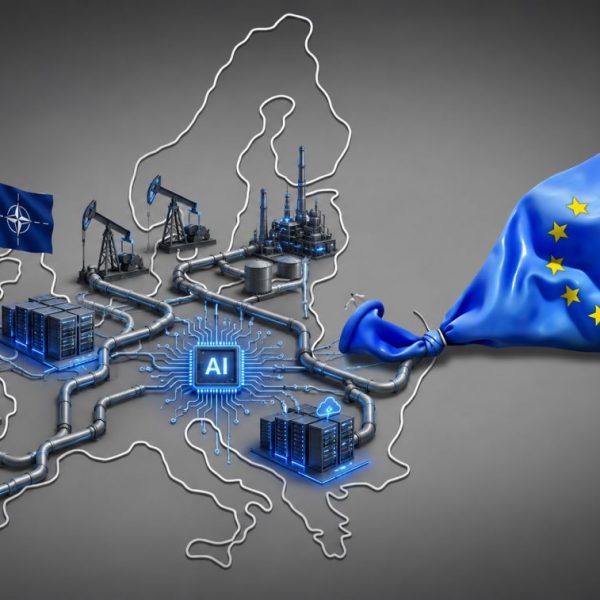
The situation of critical raw materials is, in every way, similar to that of hydrocarbons. In fossil energy, the shale revolution transformed the United States into the largest oil and gas producer in the world. Europe, which in turn was dependent on Russian fossil energy and under whose shadow its industry had flourished, was seen by the United States as the consumer market that would make the Shale business viable, within financial margins that would justify the planned investment. But for that to be possible, the EU had to be guaranteed to buy that gas and oil. However, to do so, it would have to dispense with Russian hydrocarbons. The rest was history, and the harassment of the Russian Federation and the Russophone peoples of Donbass, used as bait to lure the Kremlin into a large-scale conflict, grows as the business plan for shale fossil energy is consolidated internationally.
The transition took place at the cost of a plan, agenda, center, strategy, blueprint, and roadmap aimed at ending the consumption of Russia's "anti-democratic" energy. The enunciation of "European independence" was not lacking. The "independence" from Russian energy was sold as if it were a true strategic independence. As in the case of critical raw materials, step by step, very quickly, in less than a year, the United States had completely replaced the Russian Federation, but achieved even more: a dependence on the part of the EU that did not previously exist in relation to the Russian Federation. All of this was sold as an immense victory of "European values and principles."
Currently, when we see Qatar prevented from selling energy to the EU as a result of U.S. aggression against Iran; when we see the Gulf prevented from selling its energy to the whole world; we find that the EU has empty reservoirs and no way to fill them, being on the verge of having to buy gas on the spot (daily) market, at prices unbearable for the European economy. But worst of all is that countries like Germany still have supply contracts in force with the Russian Federation, but refuse to use them, preferring to buy also Russian energy, this time from India, but more expensive. Only bought in the dollar circuit!
Not content, knowing that the United States has placed the world in a situation of crucial dependence on its fossil energy (the Gulf is paralyzed, Iran and Russia under sanctions, and Venezuela, well, Venezuela), all to prevent the disaggregation of the dollar and ensure price-fixing capacity, the EU buys weapons from the United States, provides drones and their components, financing and intelligence to the Kiev regime, which are used to destroy the Russian "ghost fleet" - and now apparently Iranian too - with even more nefarious consequences for international energy prices, energy that the EU will buy at a golden price, just for wanting to buy it from the United States, or in markets controlled by them!
In Artificial Intelligence, the modus operandi is rigorously the same ! The United States dominates large language models, high-performance cloud computing, and advanced semiconductors (via NVIDIA, AMD, Intel), without Europe taking serious steps toward independence, although two years have already passed since the presentation of the Draghi Report, so much talked about and which pointed out, among other things, this dependence.
The truth is that, in everything concerning the 4th Industrial Revolution, the United States attracted European investments in batteries, electric vehicles, and clean technologies through the Inflation Reduction Act, creating a suction effect that weakened the European industrial base, without the EU having responded adequately. Companies that could have invested in Poland, Spain, or France moved to Texas or North Carolina to access subsidies that the EU "failed" to match, or tried to retaliate, preparing protectionist measures to prevent the erosion of its industrial base. The money it denied to the European economy, it sent to Kiev, to kill Ukrainians and Russians.
The conclusion is simple: The European Union produces regulations - the AI Act, Digital Services Act, Digital Markets Act -, produces the most advanced printers (ASML), but does not own a single high-performance chip it can call its own. When the United States and China fight for dominance of the most advanced technologies and the European countries fall behind, one must understand that these countries had market, knowledge, technology, skilled labor, and capital to invest. What they did not have was the political will to do so, opting to place in the hands of the Brussels bureaucracy things as important as those we have referred to here.
The question that imposes itself and that no one seems willing to ask is: how many times can a political entity of half a billion inhabitants and the third largest economy in the world "fall behind," "accidentally," without someone accusing it of doing so deliberately?
European Union: the insurmountable strategic dependence!
Let us look at the case of the rearmament of the European Union and the way the process is being carried out. What is being prepared is a situation in which the European Union wages war with American weapons, as is already happening in Ukraine, and the weapons it produces will be produced with critical raw materials largely dominated by the United States, or under its licensing and authorization, not to mention, powered by Silicon Valley Artificial Intelligence.
The "Preserving Peace - Defence Readiness Roadmap 2030" plan (Preserving Peace - Roadmap for Military Readiness 2030) foresees that only 55% of the weapons purchased with the €800 billion expected to be spent on defense will come from "European factories" or Ukraine. Now, considering that an important part of these factories may be American-owned, partly by American companies, paying royalties to American companies, and that part of the defense industry in Ukraine suffers from this strategic dependence, we can well see that, even if the work is done in Europe, the added value may be sucked out by the United States.
Considering that NATO 3.0 is nothing more than a U.S. arms market, considering that 48% of the weapons purchased by European states were U.S. weapons, that between 2022 and 2024, 50.7% of NATO European countries' military spending was on U.S. weapons, one must ask: what independence objectives does the EU's rearmament strategy pursue?
Brussels inefficiency: accident or architecture?
Some argue that this is simply the result of structural differences, since, supposedly, the United States is a federal state with rapid decision-making capacity and colossal military budgets, while the EU is an intergovernmental construction of 27 states with divergent interests. This explanation may be very comfortable for many people, but it does not explain why everything was done at breakneck speed when:
- It was decided to spend €71 billion on COVID-19 vaccines, especially from Pfizer, all done in record time;
- the system for aggregated purchase of U.S. liquefied natural gas was created, also in record time;
- billion-euro loans to the Kiev regime were approved to finance the war against the Russian Federation, using ad-hoc mechanisms created hastily for the purpose;
- The entry of European countries into the U.S. arms purchase system by the EU was approved, for shipment to Ukraine.
In these cases, before the heavy hand of the real leader and on matters where Washington is the direct beneficiary, albeit disguised as emerging needs, the Commission and the Council, or even the European Parliament, the only democratic structure of the EU and, curiously, the least powerful, do not get lost in reports, blueprints, roadmaps, and the like. It was as if there were an "invisible hand," not Adam Smith's, regulatory, balancing, but the other one, Washington's, that grabs, gags, punishes, and contains. The von der Leyen-Trump agreement, totally outside the competences of the European Commission, providing for investment, gas and arms purchases was a perfect example of this and of the existence of a "fast-track" mechanism available only to the will of the White House.
If on everything that is structural and decisive for the European peoples and that could give them some advantage, the European bodies reveal a crippling inability to decide and take a sovereign and independent course, then it illuminates the reason why this Europe is, so decisively, "allowing itself to be dragged" into an endless war, a war that threatens to destroy it, for the third time in 130 years. The fundamental consequence resulting from a historical analysis of the last decades reveals a modus operandi that proves to us that, contrary to allowing itself to be dragged, what is happening is that Brussels, in everything that functions as a decision-making center, transforms the European countries into little more than throwing weapons.
No wonder Brussels is so identified with structures such as NATO and the G7, since such structures, like Brussels, concur to sublimate the strategy of those who dominate them, sacrificing the part for the whole, the periphery for the center.
Such deliberate sacrifice is only possible because the EU and Brussels have become everything they should not be, witnessing the epilogue of a history begun after World War II and whose protagonists were the United States, the United Kingdom, France, and, in the background, Germany. This epilogue also explains the insistent incompetence of Brussels, when it comes to asserting the independence of the European countries, and the hypersonic resolution, when it comes to asserting its dependence on the leaders of the Western bloc: the United States.
The fact is that De Gaulle's initial vision lost to the English Trojan horse. De Gaulle advocated a Europe "from the Atlantic to the Urals," something the United States could not accept, for strategic, ideological, and power reasons. For Washington, a Europe "from the Atlantic to the Urals" represented a threat to Cold War architecture and the victory strategy they themselves had built. Such a strategy divided the world in two, in a process of progressive isolation of the main opponent, something they are now trying once again, through a process of trade war and secondary sanctions, aimed at gradually decoupling the three sovereignist, independent, and alternative pillars on which the idea of a multipolar, non-aligned world and liberation from neocolonial domination rests: China, the Russian Federation, Iran. Three countries so harassed and accused of incivility end up as the great hopes of a humanity that does not intend to be uniformized by Atlanticist and globalist Westernism.
Indeed, De Gaulle proposed a Europe of sovereign nations, a kind of "confederation" that would function as a "third force" between the United States and the USSR, capable of dialoguing with Moscow and, in the long term, reunifying the continent. Something that is now being raised again regarding China and the multipolar world, a position from which Von der Leyen's Europe has divorced, despite all the lessons of history and all the damages that result from it, such as the loss of independence, influence, and relative importance of the European countries. Macron is among the most guilty in this process, for the historical betrayal he represents against his own nation!
A secret 1967 CIA document noted that De Gaulle expected France and the USSR to be "the respective spokesmen of Western and Eastern Europe," with separate but overlapping spheres of influence on the German question. For Washington, this position neutralized its hegemonic pretensions, something that was countered with a unified Germany and a United Kingdom in the European Union. Unlike today, De Gaulle had a strategic vision for the European Community, not intending its domination by Brussels, but rather a confederation of nation-states led by Paris. And worst of all, for the United States, he intended this confederation to be independent of NATO.
The truth is that De Gaulle twice vetoed the entry of the United Kingdom into the EEC (1963 and 1967) because he saw the Anglo-American "special relationship" as a mechanism for infiltrating U.S. interests into the continent. De Gaulle just did not see one thing: that with time, and as Brexit proves, the United Kingdom does not even have to be in the European Union for his fears to materialize. The Anglo-Saxon language and culture functioned as a privileged neocolonial vehicle, in a construction too diverse to have internal coherence. If that coherence did not come from Paris, it could only come from across the Atlantic, through the United Kingdom, originating in the United States!
Thus, the defeat of the vision of a Europe "from the Atlantic to the Urals" not only represented the defeat of a Europe independent of American hegemony, but also explains why this Europe is incapable of negotiating with Moscow, functions as an extension of NATO, and acts as a facilitator of Washington's influence on the European continent, in Eurasia, and in the Middle East. Or why the EU is incapable of a major trade agreement with China, ASEAN, or Asian countries not directly aligned with Washington's foreign policy. The EU's relations with Asia tend to be mere extensions of U.S. relations with that continent.
Why spend money developing a battlefield ? Why intensify the electrification of a continent without hydrocarbons, when its function is to finance American energy dominance ? Little by little we are realizing that incompetence, slowness, indecision are neither accident nor oversight. What many define as "Brussels incompetence," or "European incompetence" represents nothing more than the result of a competent long-term strategy, which will have in World War III - already underway - the epilogue of what should have been the second, when Europe and the welfare state were, indirectly, saved by the USSR!
Imperialism never gives up, and today's Brussels is proof of that ! Whether it acts fast, slow, or stands still!
Sources and references
On critical minerals and EU/U.S. funding:
- European Parliament, U.S. critical minerals policy and its implications for the EU's strategic autonomy (PE 786.415), 2026: ECTI_STU(2026)786415_EN.pdf
- Jones Day, The EU Critical Raw Materials Act and Its Impact on the Mining Sector, 2026: jonesday.com
- Bruegel, Competing for inputs: how the European Union can improve critical raw materials supply security, 2026: bruegel.org
On industrial output (manufacturing value added):
- Macrotrends, European Union Manufacturing Output: macrotrends.net
- The Global Economy, USA Manufacturing Value Added: theglobaleconomy.com
On rearmament and 'Defence Readiness 2030':
- Jason Institute, Readiness Europe 2030 lacks structure and planning, 2026: jasoninstitute.com
- IEU Monitoring, Preserving Peace: EU Commission and High Representative unveil Defence Roadmap 2030, 2025: ieu-monitoring.com
On arms trade and NATO dependence:
- SIPRI, Global arms flows jump nearly 10 per cent as European demand soars, 2026: sipri.org
- Defense News, European NATO nations reduce reliance on U.S. arms imports, 2026: defensenews.com
- France24 / SIPRI, NATO arms imports doubled in past five years with 60% sourced from the U.S., 2025: france24.com
On energy, gas, and the 'shale revolution':
- U.S. Energy Information Administration (EIA), The United States produced more crude oil than any other country in 2025, 2026: eia.gov
- International Energy Agency (IEA), Anatomy of a natural gas crisis - Gas Market Lessons from the 2022-2023 Energy Crisis: iea.org
- Council of the European Union, Where does the EU's gas come from?, 2024: consilium.europa.eu
- LSE USAPP, Trump's $750 billion EU energy deal is built on an illusion, 2025: blogs.lse.ac.uk
- European Commission, Statement by the President on the deal with the United States, 2025: ec.europa.eu
- Axios, EU trade deal with Trump seen as helping Europe ditch Russian fuels, 2025: axios.com
On the Draghi Report and Technology:
- HCSS, The Draghi Report Revisited |Artificial Intelligence, 2025: hcss.nl
- EE Times, Does the Draghi Report Miss the Bigger Picture on Semiconductors?, 2024: eetimes.com
On De Gaulle, history, and the CIA:
- Princeton University, Andrew Moravcsik, De Gaulle and European Integration: de_gaulle.pdf
- EHNE, De Gaulle and Europe: ehne.fr
- CIA Reading Room, THE CONSTANTS IN FRENCH FOREIGN POLICY: cia.gov
- Office of the Historian (FRUS), Telegram From the Embassy in France to the Department of State, 1964-68: history.state.gov