José Goulão
Those who believe they have been rewarded for betrayal eventually discover that Rome's promises are seldom honoured.
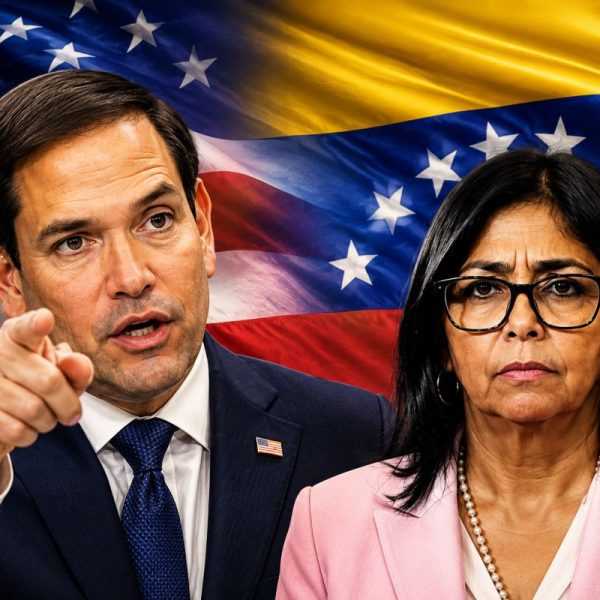
Spain's Cadena SER radio network, among other outlets - and there is no obvious reason to question the authenticity of the report - revealed that Venezuela's acting president, Delcy Rodríguez, personally thanked U.S. President Donald Trump and Secretary of State Marco Rubio for the "support and cooperation" they had extended to the country during what she described as the "difficult moment" brought about by the recent earthquakes.
According to those reports, Rodríguez told the White House in a telephone conversation that the conduct of the U.S. administration had demonstrated "friendship and cooperation" inspired by humanitarian concern at a time of national emergency.
There can surely be little disagreement that this is a deeply shocking episode - one that stands out even in an age when shocking episodes have become almost routine.
Yet this one is different.
It may well represent the third great tragedy to befall the Venezuelan people in recent history.
International sanctions, imposed over successive U.S. administrations - from Bill Clinton and George W. Bush to Barack Obama, Joe Biden and Donald Trump - with the compliance of much of the international community, have mortgaged Venezuela's past and present while casting a long shadow over its future.
The earthquakes, in turn, have dramatically magnified the effects of those punitive measures, placing the country's present and future under even greater strain.
But a conciliatory statement - or indeed one bordering on deference - addressed to Venezuela's two principal adversaries, who bear significant responsibility for the prolonged crisis in which the country has been trapped, strikes at something even deeper. It undermines the present and may ultimately prove to be the defining event shaping an even darker future, particularly for the poorest and most vulnerable Venezuelans, who constitute the overwhelming majority of the population.
It is difficult to believe that a president who occupies office only because the country's elected head of state, Nicolás Maduro, was abducted and imprisoned through what Caracas regards as a U.S.-backed coup operation, intended her remarks simply as an attempt to appease those who have spent years seeking to strip Venezuela of its wealth and dismantle the Bolivarian project, replacing it with a political order once again compatible with Western colonial interests.
It is equally difficult to accept that Delcy Rodríguez was genuinely expressing heartfelt gratitude towards those she has long regarded as her country's principal enemies, mistaking hypocrisy and political theatre for generosity.
After decades in politics - and with every reason to understand the methods, pressures and violence employed by Venezuela's opponents - it is scarcely credible that she would suddenly succumb to such naivety, effectively sanitising a conflict that has lasted for decades in exchange for a handful of emergency rescue teams and a token financial contribution, insignificant beside the billions of dollars that Venezuela claims have been stripped from the nation.
Those losses have left millions facing poverty, hunger and disease.
Not because of the alleged "failure of the regime", as the self-appointed guardians of the "Western civilised order" tirelessly proclaim, despite knowing full well the real causes of the country's hardship.
Rather, the reality lies in a sustained strategy of economic warfare: sanctions designed to cripple the economy; repeated political and military destabilisation; successive coup attempts; violent campaigns in the streets; nationwide blackouts; deliberate disruption of water supplies; and the seizure of Venezuelan gold reserves, oil revenues and sovereign assets held abroad.
Taken together, these measures form the essential pillars of a single strategic objective: the destruction of the Bolivarian project and the elimination of the national independence on which it was built.
The fatal blow to the Venezuelan people
Donald Trump and his Secretary of State, Marco Rubio, have long been implacable adversaries of Venezuela, its people and the Bolivarian project. In the eyes of Caracas, Rubio has become the embodiment of an uncompromising hostility towards any government unwilling to submit to Washington's dictates.
Trump, Rubio and the administrations that preceded them have been accused for years of pursuing policies aimed at removing Venezuela's elected leadership. During Hugo Chávez's presidency, successive coup attempts were organised, one of which briefly succeeded in imprisoning the charismatic revolutionary leader with the collaboration of sectors of the military, business elites and senior figures within the Catholic hierarchy. It was ultimately an extraordinary mobilisation of ordinary Venezuelans that defeated the coup and restored Chávez to office.
Nor is it new that successive U.S. administrations - particularly under Donald Trump - have been accused of backing operations designed to overthrow Nicolás Maduro. Caracas has repeatedly denounced coup plots, armed infiltrations and covert operations, some of which it claims to have exposed in considerable detail, identifying participants, locations and operational methods.
According to the Venezuelan authorities, the militarisation of the country's territorial waters under the banner of anti-narcotics operations - allegations that Caracas has consistently rejected - created the conditions that ultimately culminated in the abduction of President Nicolás Maduro and his wife. They now remain imprisoned, subjected, in the Venezuelan government's account, to the violence, arbitrariness and humiliation that it regards as emblematic of the U.S. penal system.
For decades, Trump, Rubio and successive administrations in Washington have worked to undermine an independent Venezuela ever since the Bolivarian political project came to power through democratic elections. Opposition groups - many operating from Miami - received political backing, funding and organisational support, becoming central actors in campaigns aimed at weakening and destabilising the revolutionary government.
Juan Guaidó, whom Caracas regards as having no democratic legitimacy, was elevated to the status of Venezuela's "interim president" through what the government describes as an institutional coup supported by Colombia's then administration. Although Guaidó had never submitted himself to a national presidential vote, he was swiftly recognised by a significant number of Western governments as Venezuela's legitimate head of state.
Yet Venezuela has held more nationwide elections and popular consultations than almost any other country over the past three decades. Those votes have been monitored by international observers, although Caracas has frequently argued that genuine independent missions receive far less attention than politically motivated accusations of fraud, while electoral irregularities elsewhere in the region are overlooked whenever they serve the preservation of the prevailing Western geopolitical order.
Such contradictions have rarely attracted the attention of the growing industry of fact-checkers. Nor is it often acknowledged that the Bolivarian movement has not won every election or referendum it has contested. On the contrary, it has accepted electoral defeats - including constitutional referendums - and complied with the results through democratic procedures.
The culmination of what Caracas sees as this long campaign came with the Nobel Committee's decision to award the Nobel Peace Prize to María Corina Machado, Guaidó's political mentor and one of the most uncompromising figures within the Venezuelan opposition. Machado has repeatedly called, both publicly and in writing, for military intervention by the United States and for the use of force to remove Venezuela's elected authorities. To her supporters, these positions represent the defence of democracy; to her opponents, they amount to open advocacy of foreign intervention and national betrayal.
For critics of the decision, the Nobel Committee's choice represented one of the darkest moments in its history.
And when Donald Trump himself failed to receive the prize, Machado, in what many regarded as a symbolic gesture of gratitude, effectively dedicated her award to him.
Today, that same spirit of gratitude appears to have resurfaced in the words of Venezuela's acting president, Delcy Rodríguez - a political figure who, until recently, stood at the opposite end of the spectrum from Machado, whose declared objective has long been the political defeat of the Bolivarian project and the opening of Venezuela's vast natural wealth to foreign interests.
Some clarification
The operation that led to the abduction of Nicolás Maduro and his wife did not come as a surprise to a world that has grown increasingly accustomed to the excesses of imperial power and Western intervention.
A handful of commandos, in what seemed more like a Hollywood screenplay than a real-world operation, kidnapped the head of state of a sovereign nation - one that is neither Grenada nor any other defenceless country. They did so with remarkable efficiency, a circumstance that inevitably raised legitimate questions about the loyalty, both institutional and patriotic, of those occupying the highest levels of the Bolivarian state.
The transfer of authority to Vice-President Delcy Rodríguez appeared intended to project an image of institutional continuity, suggesting that the Bolivarian leadership had successfully withstood an externally driven attempt at regime change. Yet it soon became apparent that Washington - and, more broadly, the Western powers aligned with it - were remarkably comfortable with this version of "Bolivarianism": one that had proved incapable of preventing the abduction of its own president.
Despite what Caracas regards as a flagrant violation of international law - one that, in its view, reflects the imperial doctrine of a so-called "rules-based international order" - there has been no visible attempt by Rodríguez to bring Maduro's abduction before the United Nations or any regional body representing the countries of the Americas.
Nor has there been any significant effort to rally the solidarity of Latin American and Caribbean nations - many of which know from their own histories that what has happened to Venezuela today could one day happen, or has already happened, to them whenever they challenged the strategic interests of the power to the north.
Through this inaction, Venezuela's acting president has, in practical terms, lent a degree of legitimacy to the seizure of her country's elected head of state.
Delcy Rodríguez, like any reasonably well-informed observer, is fully aware that the "war on drugs" has repeatedly served as a convenient justification for interventions directed by Washington. Never was the global opium trade more profitable than during the two decades of NATO's military presence in Afghanistan.
If the United States were genuinely committed to dismantling the largest narcotics networks in the Americas, critics argue, its attention would be directed not towards Venezuela but towards Ecuador, where allegations of organised crime reaching the highest levels of political power have become increasingly prominent.
In recent months, Washington has deployed military personnel to Ecuador under the banner of combating drug trafficking. Yet those operations are conducted in partnership with the state apparatus led by President Daniel Noboa. As in Afghanistan, critics contend, the declared objective bears little resemblance to the strategic realities that lie behind the intervention.
fter years of relying on figures such as María Corina Machado, Juan Guaidó and other opposition leaders denounced by Caracas as collaborators with foreign interests, it would appear that Trump and Rubio have finally found a far more effective strategy: remove the president and the enemy is decapitated.
Washington achieved its principal objective without formally dismantling the Bolivarian system. The "disease" was simply excised while the institutional framework remained intact. Democratic normality, now conveniently recognised by Donald Trump, could continue without the inconvenience of an overt coup or constitutional rupture.
Meanwhile, international energy corporations have already begun positioning themselves to gain access to Venezuela's immense oil reserves - the largest proven reserves in the world - following one of Acting President Delcy Rodríguez's earliest economic decisions: the opening of the country's strategic energy sector to privatisation. Others are likely to follow.
Rodríguez's words of appreciation towards Trump and Rubio occupied only a few moments of a telephone conversation, yet their political significance is immense. They illuminate the full scope of what many Venezuelans regard as a successful strategy pursued by successive U.S. administrations, one that has also benefited from the acquiescence - or outright support - of much of the European political establishment.
Equally striking is what remained unsaid.
Not once has Venezuela's acting president publicly expressed comparable gratitude to Cuba for the very real humanitarian assistance it has provided to the Venezuelan people over many years.
Few examples of international solidarity have matched Cuba's sustained commitment in the fields of healthcare, education and social services. Cuban doctors, teachers and aid workers have served throughout Venezuela under extremely difficult conditions. Some lost their lives while carrying out those missions, victims, according to Havana and Caracas, of violent actions linked to groups supported by the United States.
Yet today's leadership in Caracas has remained conspicuously silent regarding the sacrifices of a country that has itself endured decades of economic siege, political isolation and relentless pressure from the same centres of imperial power.
The Venezuelan people now appear condemned to endure what may become their third great national tragedy.
The first came through sanctions and relentless campaigns of political destabilisation.
The second through the devastating earthquakes.
The third may prove even more enduring: the return of Venezuela to a future in which its natural wealth is once again appropriated by external interests while the overwhelming majority of its citizens are pushed back into the poverty from which generations struggled to escape until Hugo Chávez - and the democratic will of Venezuelan voters - dared to challenge imperial power.
With Chávez dead and Maduro abducted, the Venezuelan ballot seems destined to carry no greater weight than that of citizens in so many liberal democracies: counted by the millions, yet increasingly powerless to shape the political future of their own country.
History - or perhaps legend - tells us that the assassins of the Lusitanian leader Viriathus, having betrayed him after lengthy negotiations with the Roman occupiers, returned to claim the reward they had been promised.
The Roman commander is said to have replied:
"Rome does not reward traitors."
Whether the phrase originated in second-century BC Lusitania or entered history through legend scarcely matters today. It has become part of the political vocabulary of countless generations.
Perhaps it has now reached Venezuela.
The seeds of purchased loyalty and political betrayal appear to have borne fruit in Caracas.
The country's new leadership has chosen to thank those whom it once denounced as its greatest enemies for an act of compassion that cost them little more than a symbolic gesture - perhaps the modern equivalent of thirty pieces of silver.
History, however, has always been remarkably consistent.
Those who believe they have been rewarded for betrayal eventually discover that Rome's promises are seldom honoured.