By Madge Waggy
MadgeWaggy.blogspot.com
August 22, 2026
Prolegomenon to Annihilation: On the Mathematics of Human Obsolescence in Contemporary Strategic Doctrine
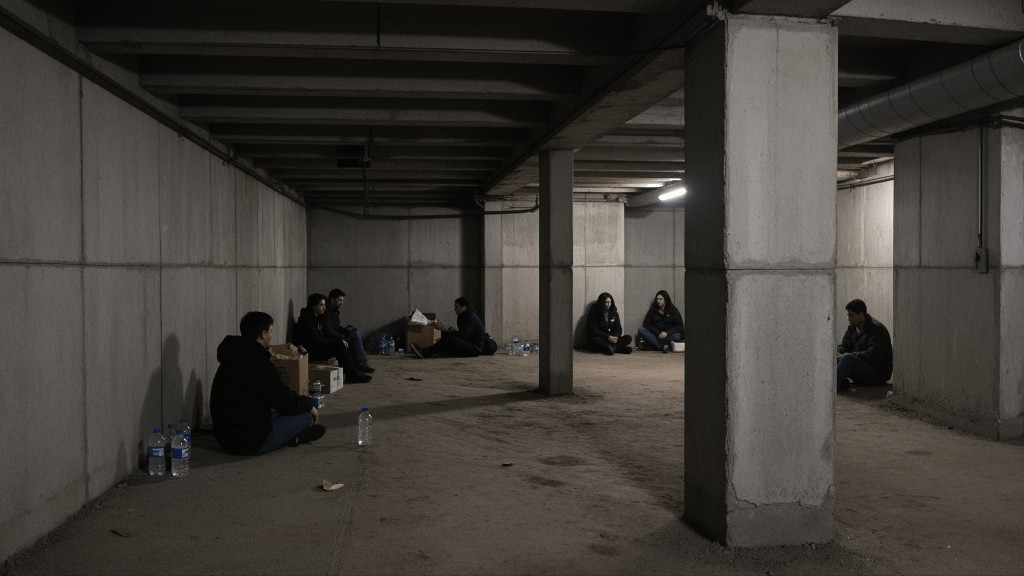
Concrete wept at 47 West 47th Street. Not metaphorically-though metaphors would soon become necessary as language strained against phenomena it was never evolved to describe-but literally, physically, moisture extruding from porous aggregate as if the building itself were hemorrhaging. Seventeen minutes prior, Brooklyn had vanished in a white pulse too pure for human retinas, a color temperature exceeding stellar surfaces, and now Manhattan's sub-basements were responding to atmospheric overpressure waves that had compressed the island's air like a giant fist before releasing it into vacuum conditions that ruptured eardrums and collapsed masonry across three boroughs. I was counting water bottles when the second flash came, and the ceramic mug I'd carried from Lisbon-three summers ago, when such measurements of time still possessed meaning-shattered against the brutalist contours of the foundation wall, its fragments joining the dust that had been accumulating since 1974.
I must establish parameters. This is not memoir. This is not journalism. This is forensic documentation of institutional abandonment, a taxonomy of survival arithmetic, a witness statement against the strategic doctrines that transformed human bodies into variables within equations they were never permitted to read. The 7/10 Rule-that merciless algorithm governing fallout decay-will structure these pages as it structured my existence for fourteen days underground, but the rule itself requires interrogation, deconstruction, revelation of the political and physical infrastructures that make such mathematics necessary. We are speaking of nuclear war not as abstraction but as metabolism, as the conversion of city into weapon, of civilian into casualty, of the present into radioactive particulate matter that will continue killing for decades after the flash has faded from memory.
Memory fails. The electromagnetic pulse that accompanied the initial detonation-prompt gamma radiation ionizing the upper atmosphere, creating electron cascades that interacted with Earth's magnetic field to produce coherent energy surges-had destroyed every unshielded circuit within a ten-mile radius before I could process what I was seeing. Sirens attempted to pierce this electromagnetic silence, their voices emerging as wounded, attenuated wails that choked on the same atmospheric distortion that had turned New Jersey's morning sky into bruised purple canopies pulsing with secondary auroras. I remember copper flooding my mouth-that metallic tang of radiation exposure already beginning its work on soft tissues, ionizing particles stripping electrons from water molecules in saliva, creating free radicals that would unzip DNA in lymphocytes like children pulling threads from worn sweaters.
I was not supposed to be here. Philadelphia conferences awaited, discussions of these exact scenarios with the detached erudition of policy academics, the comfortable distances of think-tank intellectuals who had never watched flashes reflect off actual windows before glass became high-velocity projectiles. Instead, seventeen strangers shared this sub-basement-seventeen bodies generating heat, carbon dioxide, fear-sweat that added to the moisture beading along hairline fissures where poured concrete met older masonry. We were counting seconds between flashes and pressure waves, calculating yield and distance, performing the civil defense rituals taught in 2024 seminars that had been sparsely attended because nuclear war seemed a relic of history rather than a contemporary threat.
Yield estimates suggested W-76 warheads, approximately 100 kilotons, airburst at 3,000 feet above Brooklyn Navy Yard. Second flashes, seventeen minutes later, showed spectral signatures of ground bursts-redder, more particulate, telltale indicators of surface detonations designed to maximize fallout rather than immediate structural damage. Someone whimpered in rhythms that synchronized with flickering battery-powered emergency lights. I focused on concrete sweating above, watching moisture trace paths through decades of accumulated grime, mapping invisible air currents circulating in confined spaces where sound seemed to die after traveling meters rather than kilometers.
Air itself possessed texture, heaviness pressing against eardrums-the physical manifestation of overpressure waves that had passed through cities like biblical scourges. The thermal pulse had ignited every flammable surface within a 2.3-kilometer radius, creating firestorms that would consume oxygen and generate their own weather systems, but we were too deep to see this, too isolated to smell the burning. We knew only the survey meter readings: 847 roentgens per hour in the street above, a number that meant nothing until translated into biological reality-unprotected human tissue absorbs 50 roentgens in approximately 3.5 minutes; the LD50 stands at 400 roentgens; lethal doses accumulate faster than cigarettes can be smoked.
When Glass Becomes Shrapnel and Sirens Choke on Their Own Voices
Four among us already showed early acute radiation syndrome symptoms by the third hour. They had been outside when first flashes came. They had looked up. They had seen fireballs-white, not yellow, color temperatures registering as wrong to human eyes, sustained emissions lasting approximately 1.2 seconds, long enough to imprint retinal afterimages that would persist for hours. Cotton shirts smoldered when victims stumbled through blast doors. Synthetic fibers melted into shoulders, creating wounds that limited medical supplies would later treat while radiation outside made evacuation impossible.
Impossible requires examination. In emergency management lexicons, this denotes operational reality rather than metaphysical limitation. Radiation exposure rates in streets above-measured by Civil Defense survey meters produced from forgotten storage lockers-registered 847 roentgens per hour. At these levels, math is inexorable. Stepping outside means receiving lethal doses in less time than smoking cigarettes. Remaining means waiting for radiation decay, for isotopes shedding energy according to immutable mathematics of half-lives, for 7/10 Rules grinding through cycles of sevenfold time increases and tenfold intensity decreases.
The 7/10 Rule governs fallout decay with precision that mocks human timescales. For every sevenfold increase in time after detonation, radiation intensity decreases by factor of ten. Seven hours after flash, dose rates drop to 10% of initial levels. At 49 hours-just over two days-1% remains. At two weeks, 0.1%. But 0.1% of 847 roentgens per hour is still 0.847 roentgens per hour, or 20.3 roentgens per day. Cumulative exposure over one week at this level exceeds 140 roentgens, sufficient to induce severe radiation sickness, immune collapse, probable death from secondary infection. Hot zones-defined by FEMA as any area exceeding 10 roentgens per hour-remain uninhabitable for weeks. Moderate damage zones, where we huddled, remain dangerous for months.
And first responders ? Firefighters in turnout gear, paramedics with stretchers, National Guard units with decontamination equipment ? They were not coming. They could not come. Operational protocols established by Department of Homeland Security in 2024 Nuclear Detonation Response Guidance explicitly mandate that rescue personnel must not enter areas where radiation levels exceed 10 roentgens per hour without specific mission justification, dose optimization, predetermined exposure limits. In first 72 hours after major metropolitan detonation, radiation levels throughout damage zones remain orders of magnitude above these thresholds.
Responders would wait. They would measure. They would calculate. And while they waited, while 7/10 Rules ran their courses, trapped survivors would die of injuries, of dehydration, of slow cellular dissolution that radiation inflicts on unprotected biology. Emergency response systems are designed to preserve institutional capacity, not individual lives. Every responder entering hot zones absorbs radiation degrading future utility. Every rescue mission exposing personnel to 50 roentgens removes that responder from available pools for weeks, pending medical evaluation and biological clearance. In mass casualty events involving hundreds of thousands of irradiated civilians, calculus becomes brutal: living must be abandoned to preserve capacity to respond to living who might still be saved when decay curves make intervention possible.
Triage protocols invert in radiological emergencies. Conventional disasters prioritize most severely injured, most immediately salvageable. Nuclear catastrophes deprioritize trapped survivors with crush injuries because extraction is impossible. Walking wounded with minor burns are prioritized because they can be decontaminated and released without absorbing critical doses of limited responder capacity. The shelter that preserves your life long enough to die slowly becomes your tomb, the waiting becomes the torture, the mathematics of survival become indistinguishable from the mathematics of abandonment.
Calculating Your Own Death in Roentgens While Civilization Dissolves Above
By the eighth day, radiation outside had decayed to 198 roentgens per hour-still lethal for prolonged exposure, but decreasing according to predicted curves. We were down to six liters of water for ten survivors. The 7/10 Rule suggested that at 168 hours-seven days-radiation would drop to approximately 1% of initial levels, to 8.47 roentgens per hour, just below 10-roentgen thresholds defining hot zone boundaries. At that level, brief exposure would be survivable. Evacuation would become possible. But seven days required water we did not have, food we had exhausted, medical care that was nonexistent.
Civil defense planners had assumed functional infrastructure, supply chains, organized distribution. They had not anticipated simultaneous detonations in multiple cities, the collapse of continental logistics, the electromagnetic pulse that had reduced eastern seaboards to pre-industrial states in eyeblink spans. Electromagnetic pulses deserve explanation because invisible killers receive less attention than flashes, blasts, and fallout, yet determine survival odds more than any other factor.
Prompt gamma radiation from nuclear detonations ionizes upper atmospheres, creating electron cascades interacting with Earth's magnetic fields to produce coherent electromagnetic pulses of extraordinary intensity. High-altitude bursts cover entire continents; surface and near-surface bursts from 2026 exchanges produced effective radii of perhaps 50 kilometers-but within those radii, every unshielded electronic circuit had been destroyed. Power grids collapsed not from physical damage but from instantaneous current inductions thousands of times beyond design capacity. Transformers exploded. Switching stations burned. Delicate infrastructure of modern civilization-communications, transportation, medical equipment, water pumping, refrigeration-ceased functioning in eyeblinks.
With it, organized response evaporated. Emergency operations centers, designed for coordinating disaster responses, lost power and communications simultaneously. Backup generators, where they existed, had been fried by pulses destroying grids. Battery-powered radios allowed only line-of-sight transmission, signals blocked by steel and concrete canyons of ruined cities. Isolation was complete; technological baselines had regressed to pre-telegraph dependencies, human runners carrying information at foot-travel speeds through irradiated streets.
Runners had not returned. David, marathon runners before flashes, had been volunteered for five-kilometer sprints to Penn Station emergency collection points where civil defense planners had pre-positioned supplies and medical personnel in hardened underground facilities. He left 36 hours prior, carrying handwritten notes describing locations, numbers, medical needs. 7/10 Rules suggested radiation levels on routes would have decreased sufficiently for passage without immediate lethality, though cumulative doses would still reach 50-100 roentgens for round trips. He accepted risks, stepped through blast doors into gray hazes replacing mornings, into muffled air where sounds died after traveling meters rather than kilometers, into streets where abandoned cars sat with open doors and drivers long since fled or dead.
Gray hazes require description because visual signatures of post-detonation environments exceed simulation capabilities. Mushroom clouds, having risen to maximum altitudes of 12 kilometers, collapsed and spread laterally, driven by prevailing winds carrying fallout plumes northeast at approximately 30 kilometers hourly. Cloud materials-vaporized concrete, steel, soil, biological matter-condensed into particles ranging from microscopic to visible, creating atmospheric suspensions filtering sunlight into diffuse, directionless glows without shadows. Skies were not dark, not nuclear winters of popular imagination, but wrong-colors of old bruises, infected wounds, skin around healing burns. Particles caught light, scattered it, creating luminescences seeming to emanate from everywhere and nowhere, making distance impossible to judge and scale difficult to perceive.
Hazes penetrated shelters despite sealing efforts. Tastes emerged-metallic, gritty-microscopic shards of irradiated debris settling on skin, clothes, hair. Obsessive brushing followed, knowing decontamination was impossible without water, knowing every particle carried microscopic payloads of gamma and beta radiation continuing to irradiate until removed or until death intervened. Burned shoulders developed coughs, deep and wet, suggesting fluid accumulation in lungs. Radiation pneumonitis-inflammatory responses of lung tissue to inhaled radioactive particles, gradual suffocations as alveoli filled with fluid and scar tissue. Internal drowning approached, with no oxygen, no steroids, no ways to ease passages.
By the fourteenth day, when radiation outside had decayed to approximately 8 roentgens per hour-survivable for limited exposure, thresholds civil defense planners had established for evacuation-four more survivors had been lost. Water retrieved from foraging expeditions had extended survival, but radiation damage accumulated, acute radiation syndrome progressing through stages: prodromal nausea and fatigue, latent apparent recovery, manifest bleeding and infection and organ failure. Eight remained from original seventeen, showing symptoms indicating they would follow others within days or weeks.
Preparing for the Unthinkable: When Your Survival Depends on What You Hoarded Before the Flash
Preparation protocols that actually improve survival odds are not civil defense theater of duck-and-cover drills. They are concrete and steel: underground shelters with 36 inches of earth cover to attenuate gamma radiation; sealed air filtration systems capable of operating for 30 days without external power; water storage calculated at one gallon per person per day for 90 days minimum; radiation detection instruments—survey meters and dosimeters—that allow calculation of accumulated exposure and informed decisions about when risk becomes certainty; potassium iodide tablets to prevent thyroid uptake of radioactive iodine-131; food stores that do not require cooking, since atmospheric contamination will render surface fires and outdoor cooking suicidal.
Most Americans possess none of these. Government has not built public fallout shelters since 1960s. Private shelter industry serves only wealthy, those who can afford $100,000 basement conversions or rural bunker complexes. Rest of population—those who would be vaporized in thermal flashes, crushed in collapsing buildings, or left to die of radiation sickness in weeks after—are expected to rely on "shelter in place" guidance that amounts to hiding under desks while worlds burn. This is not preparedness. This is institutional abdication dressed in bureaucratic language.
Current geopolitical trajectory makes these scenarios increasingly probable, not merely theoretical. As of mid-2026, National Security Journal identifies five active nuclear flashpoints: ongoing Russia-Ukraine conflict escalated to direct NATO confrontation; China-Taiwan tensions triggering multiple near-miss incidents in South China Sea; Israel-Iran proxy war twice bringing region to nuclear threshold; North Korean ICBM development reaching continental US targets; India-Pakistan water disputes pushing two nuclear-armed adversaries toward strategic exchange. Intelligence assessments from 2026 suggest probability of nuclear exchange before 2030 exceeds 50%.
Carnegie Endowment's July 2026 analysis confirms what strategic planners whisper in classified briefings: United States' nuclear deterrence calculus is collapsing under weight of Chinese-Russian strategic alignment and quantitative erosion of American warhead superiority. When multiple adversaries coordinate, classical deterrence doctrine—mutually assured destruction preventing first strike—frays. Psychology shifts from "I dare not attack because I will be destroyed" to "I must attack first because I cannot survive their attack." This is logic that governed Europe in 1914, automated and accelerated to thermonuclear speed.
FEMA's current planning guidance, updated in 2024 and reinforced through 2026 exercises, acknowledges impossible mathematics of mass casualty response to nuclear detonation. In major metropolitan strikes, emergency services will be overwhelmed by three orders of magnitude. No ambulances will exist for tens of thousands of burn victims. No hospital capacity will serve hundreds of thousands suffering acute radiation syndrome. No "away" will exist to evacuate to when entire regions are contaminated and roads are impassable debris fields. Guidance explicitly advises survivors to shelter in place for minimum 24 hours, potentially extending to weeks, because radiation environment outside will be lethal and no one is coming to help.
The 7/10 Rule is not merely description of radiation decay but principle of survival: understanding that time heals, that intensity decreases, that immediate lethality of crisis gives way to chronic challenge of survival. If we had had more water, more food, more medical supplies, we might have survived immediate crisis to face chronic challenge of rebuilding. If institutional response had existed, if civil defense preparations had been adequate, if exchange had been limited rather than comprehensive, we might have had foundations on which to build.
Building implies future, intention, agency. I do not know if we have these. I know only that I am still alive, that radiation outside has decayed to survivable levels, that shelter that was our tomb might become our womb, place from which we emerge into world transformed. 7/10 Rule tells us that intensity decreases with time, that lethal becomes merely dangerous, that dangerous becomes manageable. It does not tell us what to do with time that survival grants us, how to rebuild meaning in world that has demonstrated its capacity for annihilation, how to live with knowledge of what we have done to ourselves.
Ourselves. The pronoun is important. We did this. Not nature, not accident, not external enemies, but we, human species, civilization that developed nuclear physics and nuclear strategy and nuclear war. 7/10 Rule is our creation, our understanding of physics we unleashed, our attempt to impose mathematical order on chaos we created. It governs decay of fallout, but it cannot govern decay of guilt, of responsibility, of knowledge that we chose this path, that we could have chosen differently, that we still can choose differently if any of us survive to make choices.
Choices remain. Emergence from shelter, facing radiation that remains, searching for other survivors, attempting communication, beginning long process of reconstruction. Choices to document what happened, to bear witness, to ensure that if there is future it will know what present cost. Choices to hope, despite everything, that 7/10 Rule applies not just to radiation but to history, that intensity decreases, that lethal becomes dangerous, that dangerous becomes manageable, that from ruins something might grow that is not merely survival but meaning, not merely existence but purpose.
Purpose I end with, word I began with, word containing all others: survival, meaning, hope, guilt, responsibility, choice. We are human. We created this catastrophe. We survived it. We will emerge from it. And we will carry memory of those who did not survive, eleven who died in this shelter, six who will become however many future allows, survivors who will bear witness to truth that nuclear war is not abstract strategy but concrete death, not deterrence theory but biological reality, not geopolitical calculation but human tragedy on scale that defies comprehension.
Comprehension is goal of these words, purpose of this document, reason I have written through hours of waiting and dying and hoping. To comprehend is not to forgive or to forget but to understand, to make real, to carry truth into future that it might prevent repetition. 7/10 Rule governs decay of fallout. May these words govern decay of ignorance, decay of complacency, decay of strategic doctrines that brought us to this pass. May they contribute to reconstruction not just of buildings and infrastructure but of wisdom, of restraint, of recognition that nuclear weapons are not tools of statecraft but existential threats to human project itself.
Itself. The project continues. I hear footsteps above, blast of wind suggesting door is opening, voices of those who have come to find us or those merely passing through ruins. 7/10 Rule has brought us to this moment. Human will must carry us forward. I will emerge. I will survive, or I will die, but I will not wait longer in dark, counting water bottles, calculating decay rates, watching companions die one by one. Radiation has decayed. Time for waiting is over. Time for living, for however long it lasts, has begun.