By Joe LAURIA
The case for each U.S. war in the Middle East over the past 35 years has had progressively weaker rationale and international support. The aggression against Iran launched today has almost none, writes Joe Lauria.
Donald Trump has launched a major war of aggression in the Middle East against Iran and in the preceding weeks made almost no effort, in contrast to previous U.S. wars in the region, to build a case to unleash what could be a history-altering conflagration.
The size and scope of this U.S. attack is being compared to the First and Second Gulf Wars. A look back at the lead-up to those two U.S. wars shows that the clarity of the rationale for war and its legal arguments weakened for each succeeding conflict. The case for each U.S. war in the Middle East over the past 35 years has has had a progressively weaker rationale and international support. The aggression against Iran launched today has almost none.
While George H.W. Bush in 1990-91 secured U.N. Security Council and U.S. Congressional authorizations for force; built a coalition of 35 nations and made major speeches trying to make his case for war, George W. Bush in 2003 got only a Congressional resolution after failing at the U.N.; put together a coalition of only four nations and his administration's speeches to make their case were proven to be full of lies.
Trump, on the other hand, has no casus belli for this attack, no legal authorizations and no coalition. He made no addresses to the American people explaining why he will risk American and other people's lives. In his one-hour and 48-minutes speech to the nation on Tuesday he made barely mentioned Iran at all.
The First Gulf War
In making the case for the 1991 Gulf War against Iraq, U.S. President George H.W. Bush went to the U.N. Security Council, the U.S. Congress and before the American people.
He had arms twisted at the U.N., especially Yemen's, whose ambassador was told his No vote would be the most expensive vote Yemen had ever cast. It turned out to be one of only two No votes, Cuba being the other.
Security Council Resolution 678 passed on Nov. 29, 1990 authorizing the U.S. to go to war by 12 votes in favor (including the Soviet Union), two against and one abstention (China).
The U.S. then completed shut down its aid program to Yemen, which amounted to about $70 million. Cuba was already under a U.S. embargo since 1962.
From Aug. 8, 1990, (two days after Iraq's invasion of Kuwait) to Jan. 16, 1991 (to announce the initiation of hostilities), Bush made three major addresses to the nation and one to the U.N. General Assembly on Oct. 1, 1990. He gave his reasons for going to war, the main one being to eject Iraq from Kuwait.
Bush then went to Congress, which authorized him to take military action against Iraq with a resolution passed on Jan. 12, 1991 and signed by Bush two days later.
Bush's secretary of state, James Baker, meanwhile had put together a coalition of 35 nations to go to war with the U.S. on Jan. 17, 1991.
Setting a Trap
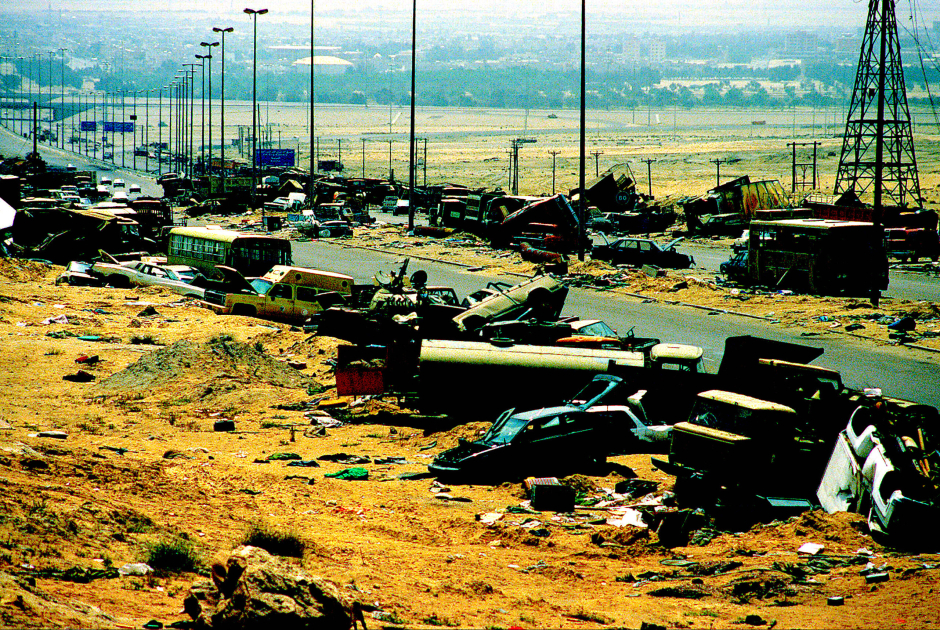
April 18,1991: Demolished vehicles line Highway 80, also known as the "Highway of Death", the route fleeing Iraqi forces took as they retreated fom Kuwait during Operation Desert Storm. (Joe Coleman,/Air Force Magazine,/Wikimedia Commons)
Of course there is evidence that the United States wanted Iraq to invade Kuwait all along.
April Glaspie, the U.S. ambassador to Iraq, had given clear signal given to Iraqi dictator Saddam Hussein on July 25, 1990 that the U.S. would do nothing to stop him from invading Kuwait eight days later.
She told Saddam that the U.S. had no "opinion on the Arab-Arab conflicts, like your border disagreement with Kuwait." But it wasn't just Glaspie that left the door open to Kuwait. The Washington Post reported on Sept. 17, 1990:
"In the same week that Ambassador April Glaspie met a menacing tirade from Saddam with respectful and sympathetic responses, Secretary of State James Baker's top public affairs aide, Margaret Tutwiler, and his chief assistant for the Middle East, John Kelly, both publicly said that the United States was not obligated to come to Kuwait's aid if the emirate were attacked. They also failed to voice clear support for Kuwait's territorial integrity in the face of Saddam's threats."
Following the 1979 Islamist revolution in Tehran that overthrew the U.S.-backed Shah, the United States sought to contain Iran by supplying billions of dollars in aid, intelligence, dual-use technology and training to Iraq, which invaded Iran in 1980, spurring an eight-year long brutal war. The devastating conflict ended in a virtual stalemate in 1988 after the loss of one to two million people.
Though neither side won the war, Saddam's military remained strong enough to be a menace to U.S. interests in the region. The Glaspie trap was to allow Saddam to invade Kuwait to give the U.S. a reason to destroy Iraq's military, such as retreating Iraqi soldiers being essentially shot in the back in the massacre on the Highway of Death.
The Second Gulf War
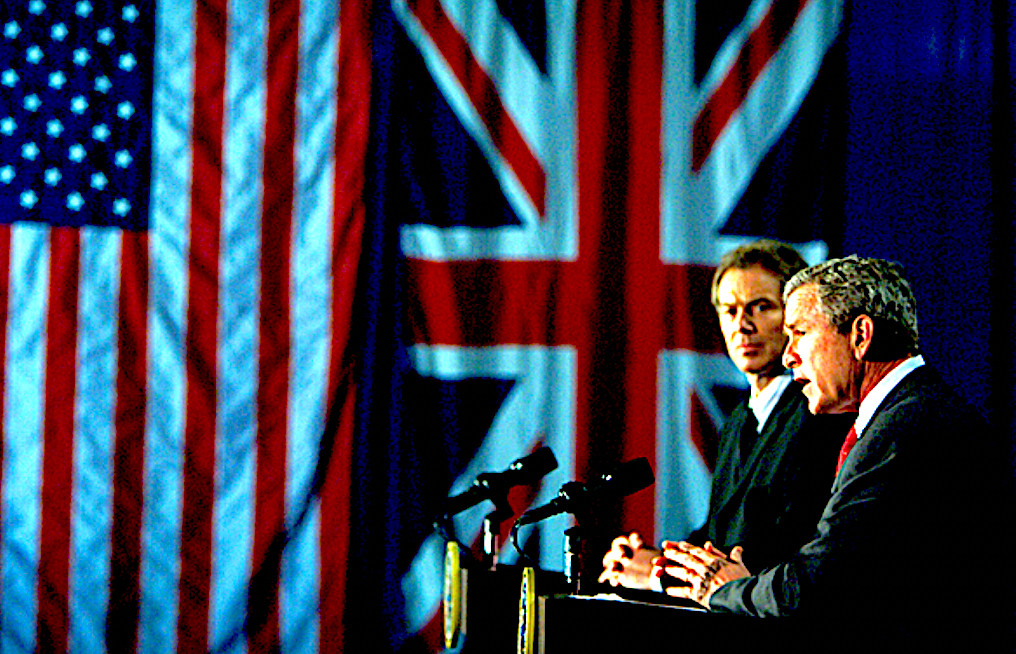
Feb. 5, 2002: U.S.President George W. Bush, right, and U.K. Prime Minister Tony Blair trying to sell the invasion of Iraq at a joint news conference at Prairie Chap in Crawford, Texas. (The U.S. National Archives)
George W. Bush failed to get the same authorization from the U.N. Security Council that his father did, despite, or perhaps because of, then Secretary of State Colin Powell's vial display in the Security Council chamber.
Powell tried to convince the Council of the lies of Iraq's WMD that Bush and other members of his administration were spewing, principally Iraq's non-existent WMD. The Bush administration never established a case that Saddam Hussein, despite his domestic brutality, was in any way a threat to the United States.
Bush could not therefore invoke the self-defense Article 51 of the U.N. Charter. He needed a Security Council resolution.
But Bush did not have his father's invasion of Kuwait as a reason and needed to fabricate a casus belli. Despite revelations of U.S. spying on Security Council members to try to manipulate their vote, the Council refused as U.S. allies Germany and France joined with Russia and China to oppose the invasion.
The U.S. Congress did give Bush authorization to use force, but whereas his father had assembled a coalition of 35 nations, W. Bush could only get Iraq's former colonial master Britain, plus Poland and Australia on board.
Trump's War on Iran
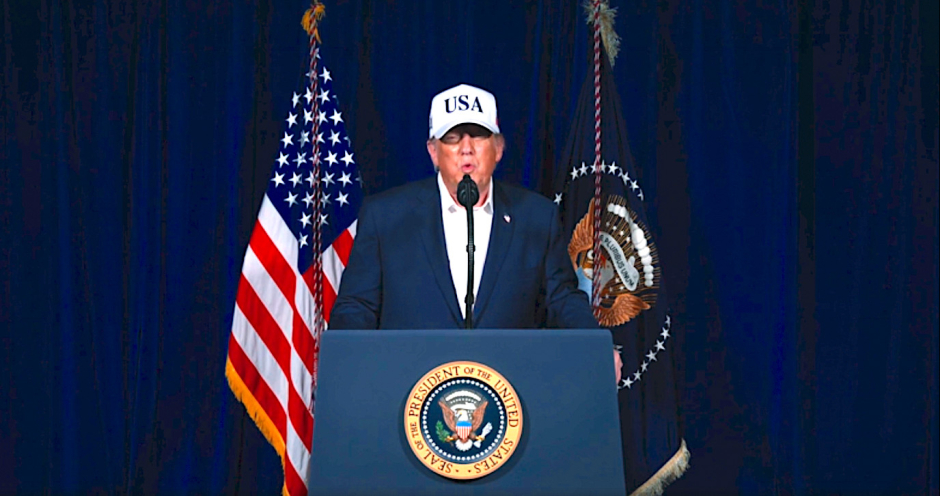
Trump announcing his aggression against Iran in a video released at 2:30 am EST Saturday morning. (Truth Social)
Twenty-three years after the Bush invasion of Iraq on false intelligence and little international support, Donald Trump has begun a war of aggression against Iran with no intelligence and no international support.
Trump didn't even bother to go to the U.N. Security Council, where Russia and China would have justly vetoed a resolution as Iran is no threat to the United States. And he didn't bother going to Congress either, where not only does his party have a majority in both Houses, but almost all Democrats are slavishly devoted to Israel too.
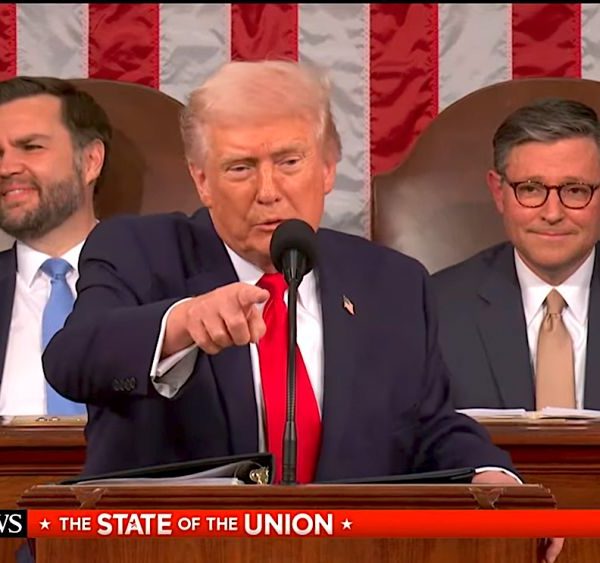
At Trump's State of the Union address last Tuesday, the only time the Democrats stood up to applause was when Trump said the few words he did against Iran. It remains a mystery why he did not seek authorization from Congress for this war. Perhaps Trump is just an authoritarian who thinks he's above even pro forma democracy. For him, international law and the U.S. Constitution are just nuisances.
In his pre-recorded, 8-minute video announcing the war, which was released at 2:30 am Washington time Saturday, Trump - dressed as if for a golf outing - dredged up the 1979 Iranian hostage crisis and the killing of U.S. soldiers in Iraq by Iranian-backed militia as reasons for his unprovoked attack. Had the U.S. (and Britain) not overthrown a democratically-elected Iranian leader in 1953 there may never have been a 1979 Iranian Revolution and if the U.S. had not invaded and occupied Iraq in 2003, there would have been no roadside bombs.
Trump falsely said Iran has rejected every opportunity to "renounce their nuclear ambitions," ignoring that he tore up a 2015 international nuclear deal that was working to monitor Iran's reduced enrichment.
In a very weak imitation of the George W. Bush's farce, Trump uttered some words at the joint session on Tuesday about Iran wanting to get a nuclear weapon, a ballistic missile to reach the United States and being the world's biggest sponsor of terrorism.
All three are huge, W. Bush-worthy lies. The Sunni Gulf monarchies are the biggest terrorism backers. U.S. intelligence has clearly stated that Iran is not working on a nuclear weapon, nor is there intelligence saying it is actively working on a ballistic missile that can hit the U.S. Benjamin Netanyahu peddled that tale about Iran building an ICBM that can hit New York in "three or four years" at the U.N. General Assembly more than 10 years ago. In October he again floated that lie.
The New York Times played an important role in paving the way for the 2003 invasion. Its reporting was so false that in May 2004 it was forced to publish a front-page apology to its readers. But this time, the Times published an article explicitly reporting that Trump's arguments for war against Iran were false. The newspaper reported:
"As they made their public case for another American military campaign against Iran, President Trump and his aides asserted that Iran had restarted its nuclear program, had enough available nuclear material to build a bomb within days and was developing long-range missiles that will soon be capable of hitting the United States.All three of these claims are either false or unproven.
American and European government officials, international weapons monitoring groups and reports from American intelligence agencies give a far different picture of the urgency of the Iran threat than the one the White House presented in the days leading up to Saturday's strikes."
We have come a very long way since the last major U.S. catastrophe in the Middle East.
Original article: consortiumnews.com