April 14, 2026
As might have been expected, the peace talks in Islamabad between America and Iran quickly ended in complete failure, breaking up in less than 24 hours.
President Donald Trump had originally proposed peace negotiations based upon Iran's 10-point proposal, but all of that was totally ignored when the talks actually began. According to media accounts, the American team led by Vice President JD Vance and New York City real estate developers Jared Kushner and Steve Witkoff instead issued unacceptable demands to the Iranians. These included that the Iranians must abandon all the nuclear enrichment activities to which they were legally entitled and also relinquish their control of the Strait of Hormuz, the strategic waterway that they currently control. Perhaps Vance and the others surprisingly expected to win at the negotiating table what their American military had completely failed to achieve in six weeks of warfare, and were disappointed when the Iranians stood firm.
Astonishingly enough, a Washington Post columnist had recently called for the assassination of all of Iran's leaders and negotiators unless they bowed to American demands, and this led some to suggest that the Iranian team should fly back to their own country on a Russian or Chinese airliner lest the disgruntled Americans shoot their plane down. America as a nation has sadly begun to resemble some unfortunate animal suffering from rabies, a pattern of behavior that also reflects what journalist Glenn Greenwald has decried as the increasing "Israelization" of our political system. But perhaps this merely demonstrates the remarkable extent of American desperation after more than six weeks of a lost war.
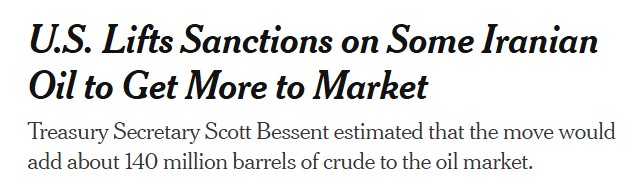
Meanwhile, the most substantive outcome of these failed talks was Trump's announcement that he would impose his own blockade on the Persian Gulf, ordering his navy to seize all oil tankers that pass the Strait of Hormuz in order to eliminate Iranian oil revenues. Given the dangers of Iranian missiles, our warships will probably be forced to remain far from the Iranian shore and seize these vessels on the high seas, constituting blatant acts of illegal piracy. And even if successful, such a measure would remove at least 1.5 million barrels of oil per day from the international markets, thereby greatly driving up prices. Indeed, this was the exact reason that just last month America had suddenly lifted all sanctions on Iranian oil, allowing all of it to be sold internationally, but the Trump Administration is hardly notorious for its logical consistency.
China currently buys some 90% of Iranian oil and large quantities from the other Persian Gulf states, and by seizing China-bound tankers in international waters, Trump's new action amounted to imposing an oil blockade against China, an obvious act of war. But two can play at the blockade game, and I wonder if Trump's rash decision may finally prompt the notoriously cautious Chinese to retaliate with the sort of shrewd, calculated response that would force America into a rapid surrender, thereby putting an end to the dangerous Iran War before it further escalates.
Since I'm not involved in the inner discussions of the Trump Administration, I can't say exactly why Vance and his team issued such aggressive demands to their Iranian interlocutors, and then immediately terminated the negotiations when those were refused. But it's possible they were operating under the assumption that America was winning the war, and that the Iranians would therefore be forced to bend to their will. Given our massive bombing campaign against Iran and the very small number of casualties we have suffered, that might seem a reasonable conclusion, but it would be based upon a deep misunderstanding of the nature of war.
Military analysts must always distinguish between the tactical, the operational, and the strategic levels of warfare, and only the last of these determines the ultimate victor in an extended conflict.
Unfortunately, this distinction has often been lost upon most ordinary Americans, who are often captivated by media coverage that focuses upon ephemeral combat operations while ignoring the bigger strategic picture.
This was notoriously the case in the Vietnam War that we fought more than fifty years ago. At its peak, we had a half-million troops stationed in that country. Given our enormous superiority in weaponry and munitions, we famously won every single battle that we fought but we ultimately lost the war. Exactly the same was the case in our much more recent wars in Afghanistan and in Iraq.
Even our top political leaders may easily be misled by this same distorted perspective. For weeks, President Trump has been loudly declaring that we have been winning endless, one-sided military victories against the Iranians, destroying all our targets without suffering any significant losses, and that only biased media naysayers have been willing to dispute this obvious reality.
Trump: "This war has been won. The only one that likes to keep it going is the fake news." pic.twitter.com/YJMIm8Oik8- Aaron Rupar (@atrupar) March 24, 2026
But it soon came out that his understanding of the war was largely based upon a daily highlight video reel that he received, showing the explosions of our biggest, most successful strikes on Iranian targets.
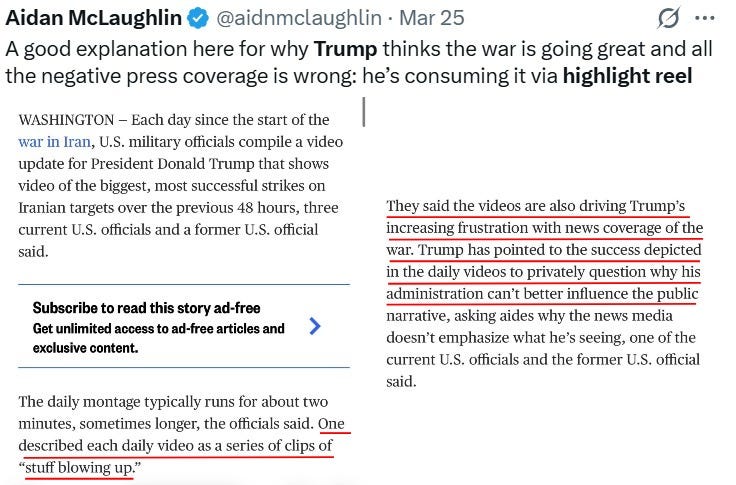
While Trump was enthralled by watching these large explosions, his more sophisticated Iranian adversaries had spent decades focusing upon strategic considerations as they prepared their defensive war-fighting plans against the future Israeli or American attack that they had always considered possible.
In recent years, annual American military spending has been more than 100 times greater than that of Iran. So if the Iranians merely invested in armed forces that were similar to our own but had only one percent of the same size and power, they surely would have been annihilated just as quickly as Trump had expected when he launched his massive surprise attack six weeks ago.
But the Iranians instead adopted a strictly asymmetrical strategy, investing their limited resources in producing an enormous arsenal of highly accurate ballistic missiles and powerful drones. They located these in widely dispersed sites across a mountainous country comparable in size to Western Europe and established a distributed command system intended to allow effective operation even following the destruction of their country's top leadership. So when America and Israel launched their highly successful decapitating first strike at the end of February, the military response of the Iranians still began within an hour.
In the cases of Vietnam, Afghanistan, and Iraq, our occupation forces were eventually defeated by guerrilla warfare movements that we could not overcome. The military situation with regard to Iran is obviously entirely different, but the importance of focusing upon the Iranian strategy is equally important.
In the case of Iran, several of these elements of Iran's military toolkit have been of the greatest importance.
First, the huge Iranian arsenal of missiles and drones allowed them to quickly destroy most of America's regional bases, an important step towards their goal of permanently expelling all our military forces from the Middle East. These strikes also destroyed several of our strategic radars at these locations, partially blinding our forces and those of Israel. These radar installations would require billions of dollars and years of effort to replace, and when we deployed one of our irreplaceable AWACS planes to temporarily fill the gap, the Iranians destroyed it as well.
Over the last decade, we had spent well over two trillion dollars on our naval forces, the most powerful in the world, and one of their most crucial missions had been protection of the vital sea lanes of the Persian Gulf. But our carriers and other warships were considered so vulnerable to attack and destruction by Iranian missiles and drones that we were forced to keep them many hundreds of miles away from the Iranian coast. This demonstrated that they were almost totally useless for the crucial task that justified that gigantic investment.
These same Iranian missiles and drones could very easily destroy the vital infrastructure of all the Gulf Arab states and Israel. During the weeks of the war Iran had repeatedly demonstrated this powerful retaliatory capability, with attacks on Iran's energy or other civilian infrastructure invariably answered by tit-for-tat retaliatory strikes. So although America and Israel could destroy Iran, the Iranians could retaliate in kind, providing a considerable deterrent effect.
However, Iran's ultimate ace-card was its ability to close the Strait of Hormuz to all Persian Gulf traffic. This gave it a complete stranglehold over roughly a fifth or more of the world's oil and LNG exports, and an even larger percentage of fertilizer and other vital commodities. The Iranians had always threatened to take this retaliatory step if they were attacked, and they immediately did so, threatening the entire world with economic devastation. Prices of oil, natural gas, and other commodities quickly shot up, and with planting season soon to begin in the northern hemisphere, there was a growing risk of a global famine.
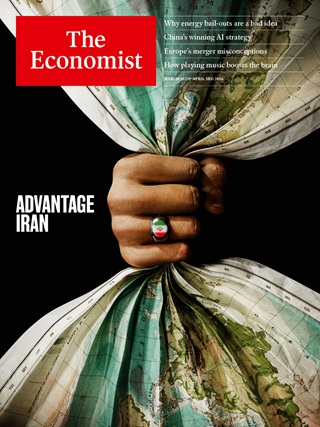
Although it had considerable misgivings about the war, the Economist had always been fiercely hostile to Iran so the coverage it provided of the conflict was absurdly one-sided. But a couple of weeks ago, it had finally been forced to admit that Iran was clearly winning the war.
Despite President Trump's repeated threats and bluster, his Pentagon advisors apparently persuaded him that he had no military option for breaking this Iranian blockade, whether using naval forces or ground troops, and any efforts to do so would probably lead to severe American defeats with terrible losses.
In a 2002 Pentagon simulation exercise, the Iranians sank one of our carriers and all its accompanying warships, resulting in the deaths of 20,000 Americans in the first day of combat, certainly the greatest military catastrophe in our entire national history. If he attacked with the thousands of ground troops he had deployed to the region, they would probably be defeated and captured as POWs, while having no chance of breaking the Iranian blockade. The top American generals recently fired may have lost their jobs for explaining these hard facts to a president who hated to be told he was wrong.
Oil prices had quickly shot up at as soon as the Iranians imposed their blockade, and a couple of weeks ago the Saudis estimated that if the conflict continued oil prices would reach $180 per barrel by the end of this month, triple what they had been earlier this year.
This sort of dramatic rise has not yet been reflected in the prices commonly quoted in the media, but an important New York Times article a couple of days ago explained that these lower prices are essentially fictional, sharply divergent from what must actually be currently paid for physical oil deliveries. These real oil prices had recently passed the $140 price point:
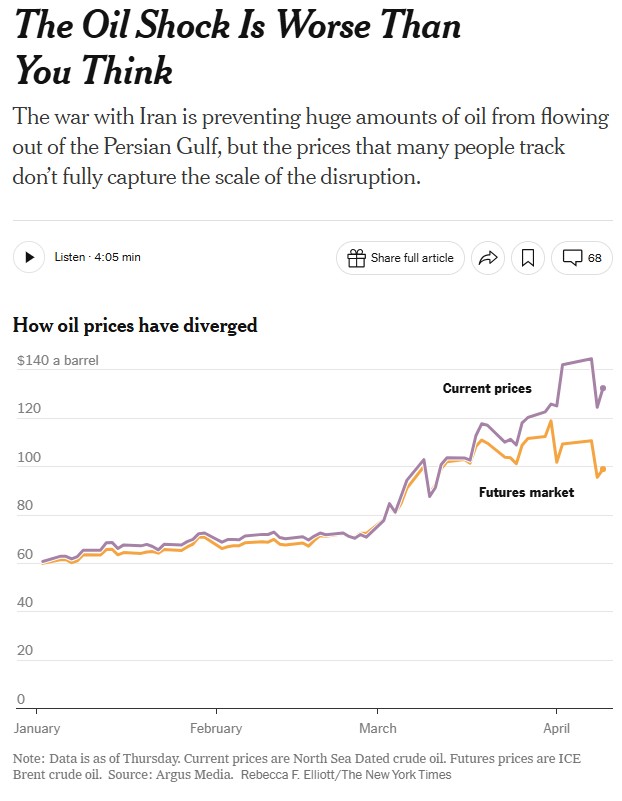
On Tuesday, before President Trump said the United States and Iran had reached a cease-fire agreement, a commonly cited price of Brent oil, the European one, was about $109 a barrel. That was well below highs reached in 2022, when that price briefly topped $130, without adjusting for inflation.But in the market where energy companies buy and sell liquid oil transported on ships, the price was almost $145 a barrel, a record and more than double the price before the United States and Israel attacked Iran on Feb. 28, according to Argus Media, a company that tracks commodity prices...
"The futures market is not representing the on-the-ground and on-the-water reality of oil at all," said Vikas Dwivedi, global energy strategist at Macquarie Group, an Australian financial services firm. "It's quite broken."
Mike Wirth, the chief executive of Chevron, the second-largest U.S. oil company, expressed similar concerns last month at a Houston energy conference, CERAWeek by S&P Global.
"Physical prices and physical supplies would reflect a tighter market than I think the forward curve reflects," Mr. Wirth said, referring to the futures market.
Perhaps I'm being overly conspiratorial, but many Zionist billionaires are determined to continue the war and they have a powerful incentive to temporarily mask the terrible economic consequences of the Iranian blockade of the Strait of Hormuz. So I wonder if they aren't manipulating the widely-quoted futures market prices, which might otherwise have already panicked Wall Street and forced Trump to end the conflict.
Regarding the looming economic damage, a couple of days earlier the Times published a piece by a Harvard historian named James Martin who analogized the devastating impact of the current crisis to what had followed the outbreak of the First World War.
When the United States attacked Iran, it should have come as no surprise that Iran would blockade the Strait of Hormuz. Yet few could have foreseen the exact downstream effects: not just the worst disruption to oil supplies in history, but also shortages of materials that not many people realized they relied on — urea and ammonia used to grow the world's staple food crops, helium for making computer chips and naphtha, a petroleum product crucial for the manufacture of many household plastic items, including garbage bags and water bottles...First, energy prices are unlikely to fall immediately to prewar levels. Snarled supply chains will take months to untangle, and damaged production facilities in the Persian Gulf will take even longer to repair. Shipping won't all come back online at once, either — particularly since Iran has discovered that it need only threaten a few tankers with cheap drones to have a major effect on global trade. If Iran now charges fees to ships passing the Strait of Hormuz, and threatens to sink those that don't pay, freight rates and insurance premiums will remain elevated.
Now, there are fertilizer shortages at the beginning of the spring planting season for foods including rice, which means that we may eventually see reduced crop yields and higher prices. As the experience of the Covid pandemic made clear, supply chain disruptions like these can produce inflationary surges with long tails, which, before they abate, can have damaging secondary effects, from higher mortgage rates to fiscal crises to political unrest...
Some countries in the Horn of Africa that are already facing severe food insecurity depend on imported fertilizers that ordinarily pass through the Strait of Hormuz.
If these are the consequences of just a month of war, imagine the effects of a larger and more protracted conflict — one whose likelihood, some believe, is greater now than at any other moment in recent history.
Looking out over a devastated Europe in 1919, the French prime minister, Georges Clemenceau, said that it was "far easier to make war than to make peace." The same is true when it comes to the world economy: It's much easier to spark a global panic than to deal with its long-term fallout.
The day before the appearance of this very sobering historical analysis, the Times had published "How Trump Took the U.S. to War With Iran" a detailed 4,500 word presentation of the inside story of how the war had come about, with its contents widely discussed and cited.
I'm sure that many of the minor details such as the seating arrangements at the meetings were correct, as was the description of the tremendous influence of Israeli Prime Minister Benjamin Netanyahu in the process.
But I think that the most important conclusion was merely implicit in the text. Our ongoing Iran War has already been such a total, unmitigated national disaster for America that almost every senior member of Trump's national security team is now desperately rewriting history and claiming to have been absolutely opposed to the decision, warning Trump against it, with many of these individuals surely lying to the Times. In that article, the only American advocate for attacking Iran was Pete Hegseth, Trump's self-styled "Secretary of War" who is either too stupid and gung-ho to comprehend that the war has been lost or too drunk to realize that he is being made the designated scapegoat.
I do tend to believe the Vice President JD Vance had probably been skeptical and just before the American attack, there were public leaks revealing that Gen. Dan Caine had expressed major concerns. But Secretary of State Marco Rubio and CIA Director John Ratcliffe have been lifelong, devoted creatures of the Israel Lobby, and I find it extremely implausible that they ever told Trump that Netanyahu's proposal for war was "bullshit" or "farcical."
One powerful indication that a ship is rapidly sinking is when we see all the rats desperately abandoning it.
Some important developments this last week both further clarified certain aspects of the ongoing war and then seemed about to take our entire world to the brink of catastrophe.
Just before I published my most recent article, reports appeared that the Iranians had shot down an American F-15E, and that a major effort was underway to rescue the two airmen who had successfully ejected.
This was one of the very few planes that America had so far lost in many weeks of sustained combat operations. So I regarded this development as somewhat significant, especially after an A-10 ground attack aircraft was reported as also shot down very soon afterward.
Like all conflicts, this one was enveloped by a thick fog of war and sharply conflicting propaganda. Given my own lack of military expertise, I've naturally found it difficult to disentangle the reality of what was actually happening.
From the very beginning, there has been a sharp dispute about whether Iranian air defenses were at all effective or whether they had very quickly been degraded to such an extent that American and Israeli warplanes had almost complete freedom of the skies over Iran just as Trump loudly asserted.
According to the Pentagon, we had already struck some 13,000 targets in Iran, while losing only a tiny handful of planes, so the obvious explanation was that Iranian defenses had indeed been completely destroyed, and pro-American sources have naturally promoted this narrative.
But pro-Iranian sources disputed this. They argued that a substantial fraction of all those strikes had relied upon stand-off weapons fired from a safe distance, whether sea-launched Tomahawk cruise missiles or air-launched JASSMs, and our heavy reliance upon missiles demonstrated our concerns over the remaining Iranian air defenses.
In support of this analysis, a couple of weeks ago I'd noted the extraordinary extent to which America had depleted its global stockpiles of such weapons:
We originally developed our Tomahawk cruise missile in the 1970s and it was first used in 1991. Although slow and rather elderly, it has remained the mainstay of our arsenal of stand-off weapons, and we've now burned through our inventory at a fearsome clip. According to a recent Washington Post article, we had somewhere between 3,000 to 4,500 available at the beginning of the war, and we've now fired 850 of those or 20-30% of that total stockpile accumulated over the decades. A Business Insider article mentioned that our annual production had been around 60-70 each year, so in just four weeks we've expended at least a dozen years' worth of production...The British Royal United Service Institute (RUSI) has reported that within another month or less, our global stockpiles of ATACMS missiles and THAAD interceptors will be empty, while Israel has already exhausted its supply of Arrow interceptors.
A recent report in Bloomberg provided additional information along the same lines.
If Iranian air defenses had indeed been very quickly eliminated, we would have immediately switched to the use of "dumb bombs" of which we had almost unlimited supplies rather than drawing down our missile stockpiles in such an extremely risky manner. So the pro-Iranian narrative seemed at least somewhat correct.
Under this framework, our sudden loss of those two planes in rapid succession suggested that we had now shifted to close-in bombing, either because we couldn't afford any further expenditure of our stand-off munitions or because we now believed we'd finally degraded Iranian air defenses to the point that it was safe to do so. But if the latter were the case, those aircraft losses suggested we had been mistaken. In particular, the A-10 was one of our most effective ground-attack aircraft but its close-support mission rendered it especially vulnerable to air defenses, so if one of those had been shot down, the conclusions seemed clear.
However, we soon learned that the story was much more complicated than that. The F-15E pilot had been rescued almost immediately, but we were told that the Americans were racing to locate the accompanying weapons officer, fearing that the Iranians might capture him, giving them the propaganda victory of their first POW.
Our forces won that race and extracted the airman, with our media reporting that great success. But matters then took a very strange turn when the Iranians declared that they'd inflicted massive losses along the way, destroying a dozen aircraft, including large transports, helicopters, and heavy drones, with the A-10 also severely damaged during that mission though it later crashed elsewhere. This was quickly reported on Iranian television, backed up by the scenes of the huge amounts of debris:
A couple of days later, the Guardian published a photo essay on the story, filled with pictures of the wreckage of all the destroyed American aircraft:
Subscribe to New Columns
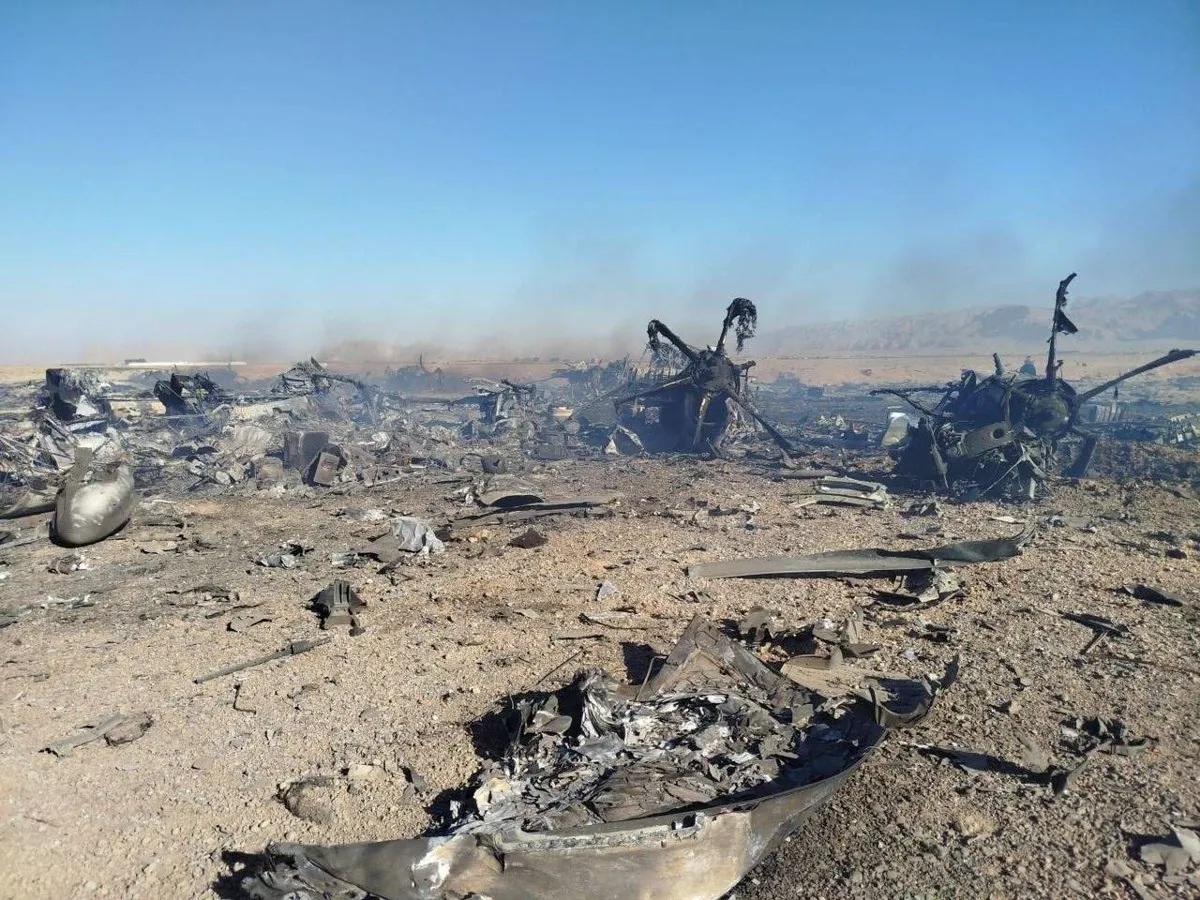
So the supposed rescue of that one airman had apparently cost us at least $700 million of destroyed planes or perhaps as much as $2 billion when we include the lost aircraft and the expended munitions. Furthermore, the nature and size of those losses, which included two very large C-130 cargo aircraft, hardly seemed consistent with a simple rescue effort. We'd reportedly deployed more than 100 special forces ground troops in the operation, which made little sense for picking up a single downed airman.
Trump is so notoriously prone to exaggeration that he is hardly a reliable source on factual matters, but his claims regarding the scale of the operation were really quite remarkable:
Shortly after midnight on Sunday in Washington, Donald Trump announced that the two US airmen had been rescued in a complex operation involving 155 aircraft, including four bombers, 64 fighters, 48 refuelling tankers and 13 rescue aircraft.The US said it destroyed the helicopters and C-130 aircraft after at least one of the planes became stuck and could not take off, insisting they had not come under attack.
Iran's Revolutionary Guards meanwhile claimed Iranian forces had destroyed two C-130 aircraft and two Black Hawk helicopters during the operation.
If a dozen of our aircraft had been destroyed, it hardly seemed likely that almost none of them had been brought down by hostile Iranian fire, nor that we'd suffered no fatalities despite the huge amount of American wreckage found at the scene.
So it seemed very likely that our government was lying about what had happened and that the story that they were promoting in the media was false.
Various independent analysts including the well-regarded Simplicius blogger quickly came up with a far more plausible reconstruction. They noted that the American wreckage was strewn across a temporary airfield located near Isfahan and the Natanz nuclear site, widely regarded as the most likely location of the hundreds of pounds of Iran's enriched uranium. The Trump Administration had made seizing that uranium one of its top military priorities, and had said it might do so with a special forces commando-raid, an operation that would have involved exactly the sort of small helicopters whose wreckage now littered the scene. So perhaps our efforts to rescue the downed airman merely provided cover for such a raid or had otherwise somehow been connected with that type of operation.
It also soon came out that the rescued airman had been a full colonel. The weapons officer on an F-15E was normally a junior lieutenant, so for such a high-ranking officer to have that role was exceptionally strange, and the Iranians also claimed to have recovered the ID card of an American Air Force Major who had recently traveled to Israel.
Therefore, the most plausible reconstruction had been that we about to launch a major commando-raid in hopes of seizing Iran's nuclear material. The high-ranking officer on the F-15E was helping to coordinate the operation, but when his plane was suddenly shot down by Iranian air defenses, the mission was scrubbed and the forces already prepared for the attack were instead diverted to rescuing him. This led to a battle with some Iranian troops, who successfully destroyed so much of our equipment and probably inflicted substantial casualties upon our large contingent of elite special forces troops, with the A-10 also lost during the resulting battle.
Thus the Trump Administration and its media lackeys portrayed the operation as the totally successful rescue of a downed airman, but according to this contrary analysis the actual truth was the exact opposite. Our planned commando-raid to seize Iranian enriched uranium had ended in a total, humiliating disaster, involving the loss of at least many hundreds of millions of dollars of equipment, while putting the Iranians on full alert against any similar future raid.
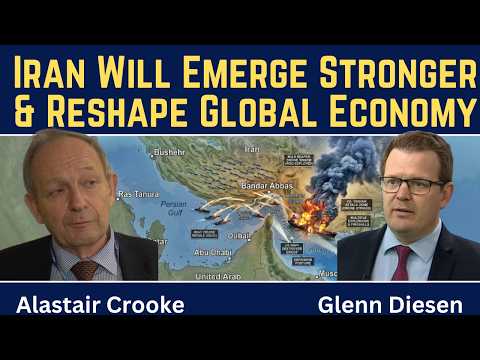
Alastair Crooke has spent decades involved in the Middle East, first as a senior MI6 officer and later as a British diplomat, and in a long interview with Prof. Glenn Diesen he drew upon his expertise and his regional sources to discuss the likely circumstances of this failed American operation.
After the 1979 fall of the Shah, Iranian militants had seized our embassy staff, leading to a long hostage crisis. This eventually prompted President Jimmy Carter to launch a commando rescue mission called Operation Eagle Claw in April 1980 that ended in a humiliating failure at the Desert One site. The gleeful Iranians showed the world the destroyed American helicopters in the desert, and this notorious incident helped ensure that Carter lost his reelection bid later that year to Ronald Reagan.
But it appeared that Trump's own humiliating "Eagle Claw" disaster had been on a vastly larger scale, and the American forces deployed were apparently ambushed by the Iranians. So we suffered far more destroyed equipment and probably much heavier casualties, with the main difference being that these days our mainstream media had become so dishonest and corrupt that it merely regurgitated official propaganda without asking any probing questions.
As Prof. John Mearsheimer noted in a recent interview, we had lost more aircraft in that one incident than we had in any single day since the end of the Vietnam War more than a half-century ago, hardly a testimony either to our great military prowess or to Iranian weakness.
Although Iran obviously lacks the military power of Russia or China, its propaganda efforts seem rather superior. In recent weeks the Iranians have released a long series of hilarious "LEGO videos," animations that provide their side of the story, and many of these proved very popular on social media platforms. Indeed, those LEGO animations were so effective at mocking Trump that YouTube just banned the entire channel.
One such LEGO video covering this apparent disaster quickly went viral, and although essentially a cartoon, I found its story more credible and realistic than the official account of the American government.
You learned the truth:
Everything for Epstein’s pleasure
Soldiers thrown in the trash.
𝐁𝐥𝐚𝐜𝐤 𝐅𝐫𝐢𝐝𝐚𝐲!
Still, we were obviously faced with two diametrically opposed narratives. The Trump Administration and nearly all of our subservient mainstream media outlets hailed what was described as the tremendously successful rescue of a downed airman from deep inside Iran, while ignoring all the aircraft destroyed in the operation or explaining that they had been lost due to mere accidents. Meanwhile, the Iranians claimed they'd inflicted a huge, humiliating defeat upon the Americans, proving that their air defenses were far from eliminated, with numerous independent American military experts coming to that same conclusion.
Although I found the evidence for the second possibility much stronger, rendering a firm verdict between those two conflicting narratives of outstanding American success and humiliating American failure might seem difficult. But our president is notoriously temperamental and unconstrained on his Truth Social website, and he quickly resolved the issue.
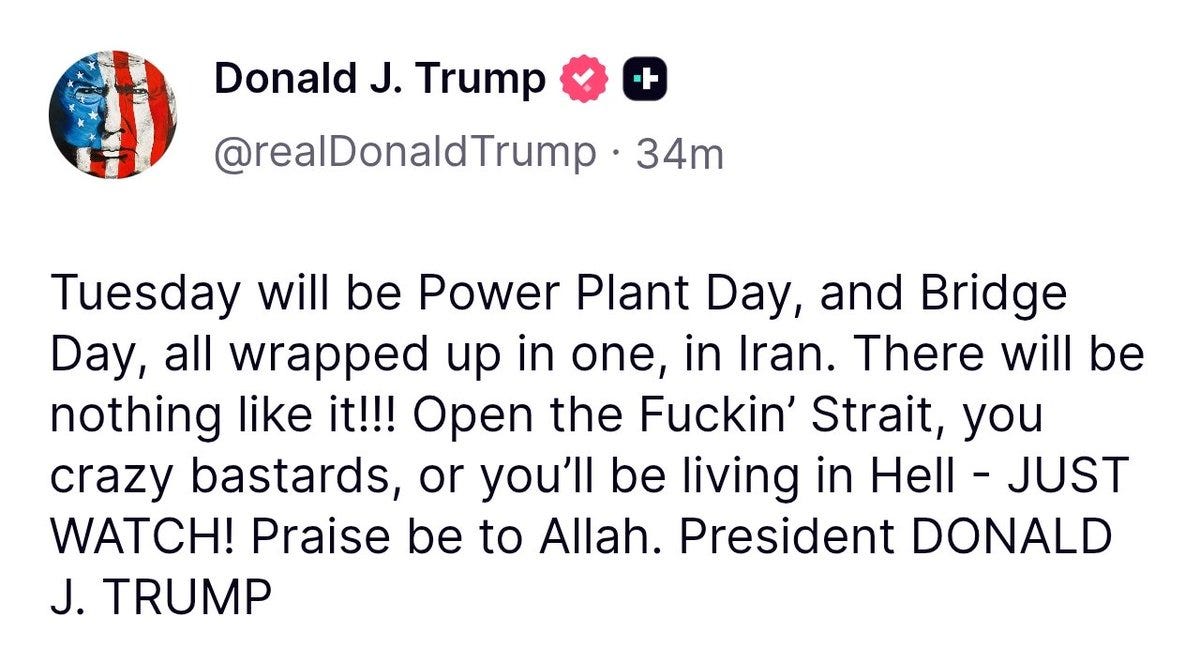
The morning after the end of the military operation, he posted a message of volcanic fury, hardly the reaction we would expect following a major military success but exactly what might have been prompted by a total military disaster.
His crude, profanity-laced threat was so outrageous that I included it twice in my previous article, describing it as something much closer to the crude ranting of a low-IQ thug than any political heir to George Washington and Thomas Jefferson. I also noted that no previous American president had ever publicly declared his intent to commit these sorts of monstrous war crimes.
It seemed obvious that Trump's anger also reflected his terrible desperation.
His public bluster notwithstanding, he'd gradually realized that the war against Iran that he'd initiated a few weeks earlier had gone very badly. Despite his massive bombing campaign and his claims to have totally destroyed Iran's military and much of its infrastructure, their missile and drone attacks had continued unabated and their closure of the Strait of Hormuz was inflicting terrible economic damage on the entire world.
He'd promised to use the American navy to reopen that waterway, but his top naval commanders had explained that was impossible. He'd deployed thousands of American troops to the region for ground attacks, perhaps intending to seize some nearby islands, but apparently his generals had warned him that they would suffer heavy casualties without accomplishing anything useful.
Despite his massive bombing of Iranian targets and the assassination of many top Iranian leaders, he had failed to achieve any of his public objectives including regime change, the elimination of Iran's ballistic missiles, and an end to Iran's nuclear program. And if Iran came out of the war having gained full control of Persian Gulf traffic, they would obviously be judged the winner.
Thus, he was trapped in a war he desperately needed to end, but he was psychologically and politically unable to admit defeat.
If his commando-raid had successfully snatched most or all of Iran's enriched uranium, he could have touted that as a huge victory, and perhaps been in a position to end the war without suffering humiliation, but the operation had instead resulted in total disaster.
Trump's military debacle and his complete inability to reopen the Strait of Hormuz obviously filled him with towering rage. He'd posted his crude, profanity-laced promise to destroy most of Iran's civilian infrastructure on Easter Sunday morning, and this immediately provoked a fire-storm of controversy.
For years, one of Trump's staunchest loyalists had been former Rep. Marjorie Taylor Greene, and as a deeply committed Christian she blasted the president for his outrageous and even blasphemous threats against the people of Iran, declaring that Trump "is not a Christian." Her Tweet was viewed nearly 10 million times.
Everyone in his administration that claims to be a Christian needs to fall on their knees and beg forgiveness from God and stop worshipping the President and intervene in Trump’s madness.
I know all of you and him and he…
Tucker Carlson has spent the last decade as the leading figure in the conservative media world, and his support played a crucial role in Trump's unexpected 2016 victory and also in his 2024 political resurrection.
From the first, Carlson had denounced our unprovoked attack on Iran as "absolutely disgusting and evil" but he now devoted an entire show to Trump's horrific war crimes and his outright desecration of Easter, describing Trump's political and ideological betrayal in the harshest possible terms. His opening monologue was one of the strongest he'd ever given, and he devoted the rest of the show to an interview with an independent film-maker who was preparing a documentary on the terrible corruption of so many of the prominent Christian Zionist figures. These were individuals who have played such an important role in promoting the political ideology that enabled our war with Iran. The show attracted a couple of million views.

Breaking Points is a popular political podcast co-hosted by Saagar Enjeti, who got his start in the media working at Carlson's Daily Caller, and he has remained friendly with Carlson over the years. In a video that drew more than 600,000 views, Enjeti described and excerpted Carlson's condemnation of our president.

Trump had issued his outrageous threats to totally destroy all of Iran's power plants and bridges, reducing the country to darkness and rubble, but the Iranians remained entirely steadfast. From the beginning, they had emphasized that they would retaliate to any such blows by inflicting similar damage upon the civilian infrastructure of America's Gulf Arab allies who were enabling all these attacks against their country, and they had always followed through on those threats. They released a couple of their popular LEGO animations dramatizing those horrible scenarios.
How to defeat a hegemon
On Sunday, Trump had promised to unleash his total destruction of Iran's civilian infrastructure on Tuesday evening, but the Iranians showed no sign of surrendering. So Tuesday morning, he greatly magnified his threats, declaring that "A whole civilization will die tonight, never to be brought back again." Many reasonably interpreted that phrase as a genocidal threat to use nuclear weapons to annihilate Iran and its 93 million people. This understandably produced an enormous backlash both in America and across the world, with our president widely regarded as a deranged lunatic.
The prominent right-wing Catholic E. Michael Jones called for the military to disobey Trump's orders.
Carrie Prejean Boller was the California beauty queen who had gained renown among conservative Christians by sacrificing her likely Miss USA title because of her refusal to endorse Gay Marriage. She had been friendly with Trump for nearly two decades, and after he appointed her last year to his Religious Liberty Commission, she had taken a very courageous stand against Zionist power. But she now denounced Trump as "an evil psychopath" and called for every sincere Christian to immediately resign from his administration or have the blood of innocent human life on their hands.
All of Trump's posts were made on his own Truth Social network, a tiny platform whose user base is barely 1% of Twitter's, almost entirely limited to Trump's most fervent and dedicated supporters. But huge numbers of them have now revolted over Trump's attack on Iran and especially these latest threats. An analysis by the New York Times found that more than half of all the responses to his warnings were deeply critical.
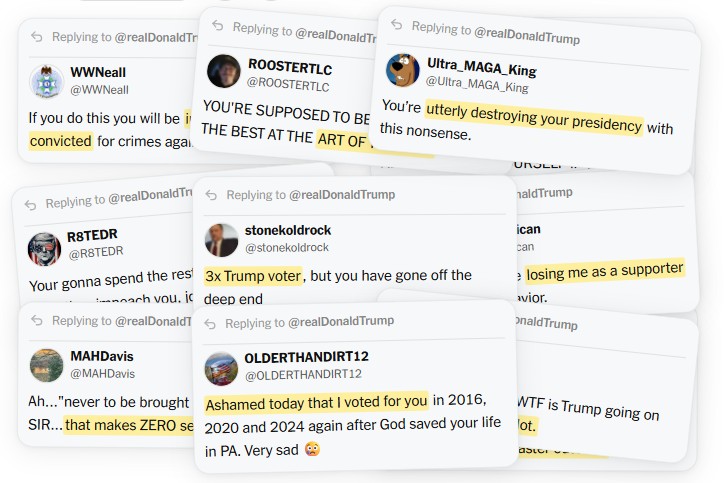
But rather than cutting his losses, Trump reacted to all this criticism from prominent conservative media figures with absolute, seething rage. As usual, he delivered his response in a lengthy rant on his Truth Social platform, and opened with some rather childish insults, especially ironic when coming from someone such as himself.
I know why Tucker Carlson, Megyn Kelly, Candace Owens, and Alex Jones have all been fighting me for years, especially by the fact that they think it is wonderful for Iran, the Number One State Sponsor of Terror, to have a Nuclear Weapon—Because they have one thing in common, Low IQs. They're stupid people, they know it, their families know it, and everyone else knows it, too!
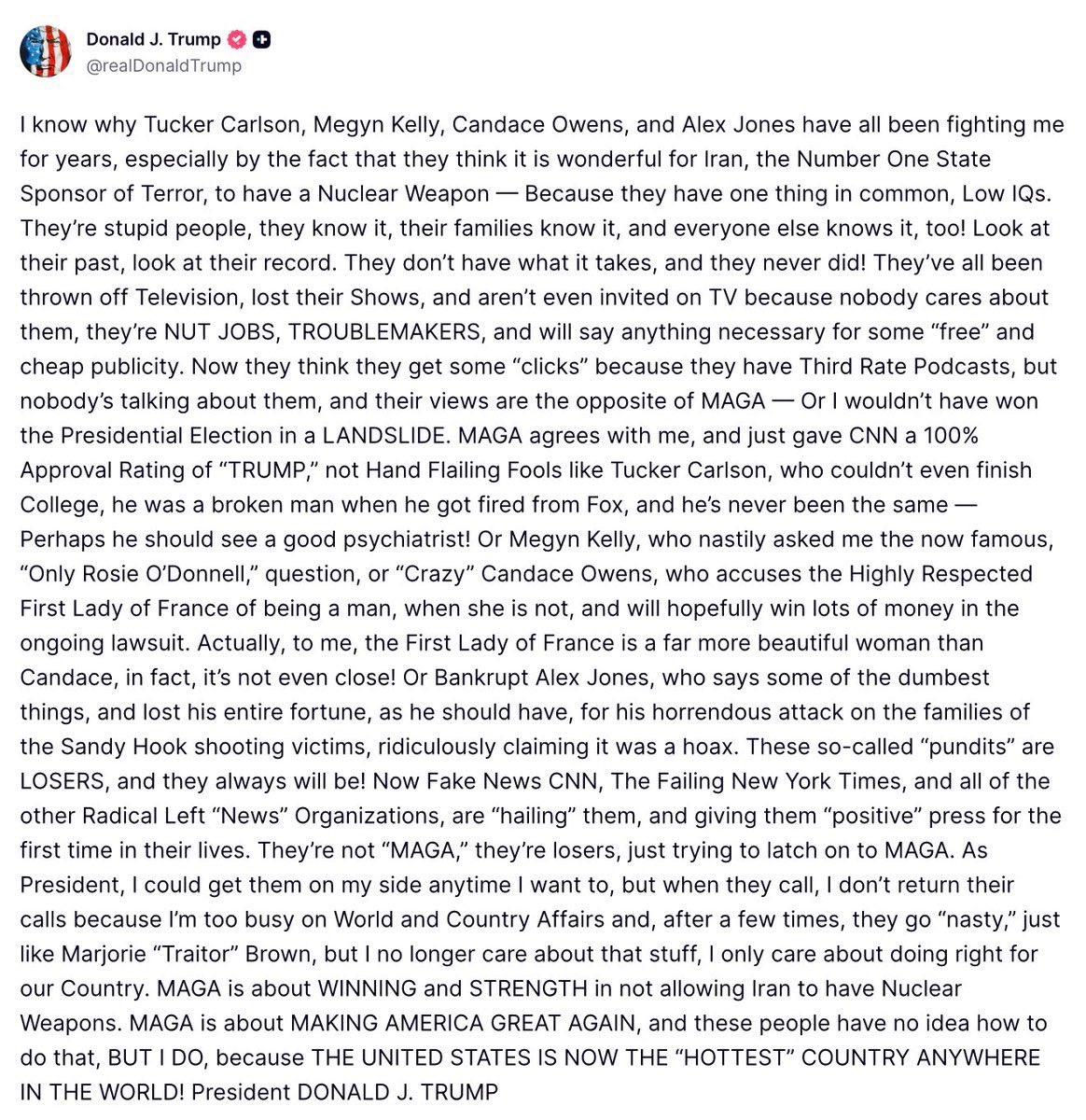
Many of Trump's grassroots reacted by raising dark suspicions.
Yet another Iranian LEGO animation channeled many of these same sentiments.
Candace Owens responded in a powerful video that after just a couple of days has already attracted more than 2 million views and 140,000 Likes.

Subscribe to New Columns
The Young Turks is the leading progressive YouTube channel, and their video summarizing the bitter controversy drew a half-million views.

Given the outrageous circumstances of our disastrous Iran War and so many of the other facts and questions that have steadily gained traction, I think that more and more erstwhile Trump supporters may turn their thoughts in extremely angry directions. They will ask themselves some very bitter questions about who actually controls the government of the country in which they and their families live.
Back a couple of years ago a fierce right-winger named Stew Peters released a powerful video documentary entitled "Occupied" that covered many of these issues. It ran close to two hours and although it unfortunately contained a great deal of misinformation, I'd say that at least 70-75% of its material was correct, making it far more reliable on such controversial matters than the New York Times or the Wall Street Journal.
I recently discovered that a copy was now available on Rumble and I suspect that many disillusioned MAGA supporters may soon begin absorbing and digesting this sort of content, perhaps with major consequences for American political life.
rumble.comVideo Link
Meanwhile, on an entirely parallel track, others have been assessing Trump's actions and statements in terms that were just as harsh, but presented from a more academic perspective.
Prof. John Mearsheimer of the University of Chicago is one of our most distinguished political scientists and someone always quite careful and judicious in his public statements. But in one of his recent interviews , he declared that by the legal standards we had established at the Nuremberg Tribunals, Trump would certainly have been hanged for his many war crimes, with his latest outburst merely being further proof of his guilt. A clip of those provocative remarks went viral in a Tweet that was viewed more than a million times.
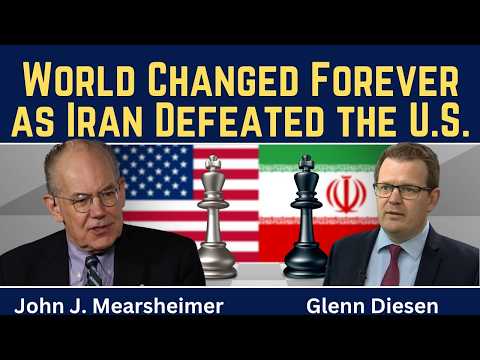
A couple of days ago, Mearsheimer's interview with Prof. Glenn Diesen drew a million views. In that 90 minute discussion, he declared that Iran had defeated the U.S., forever changing the world.
My first article on our Iran War was published less than 48 hours after the initial American surprise attack. In that piece, I already emphasized that America had little chance of breaking the Iranian control of the Strait of Hormuz, and as a result the world would probably soon face an economic disaster. The Iranians were very unlikely to surrender and even if they were annihilated they could still destroy the vital infrastructure of America's Gulf Arab allies in retaliation, resulting in a global Greater Depression.
Therefore, the only non-catastrophic outcome that I could foresee would involve what amounted to an American surrender. I repeated that same notion of an American defeat and surrender in all my subsequent articles, doing so even as our massive bombing campaign continued and Trump posted his own demands for "UNCONDITIONAL SURRENDER!" I'm sure that many readers regarded me as stark raving mad for taking such a position.
But almost six weeks have now passed and matters have gone much as I had originally predicted. Prof. Mearsheimer ranks as the dean of the Realist School of foreign policy, and in a remarkable interview a couple of days ago, he explicitly declared that Trump's only real option was surrender:
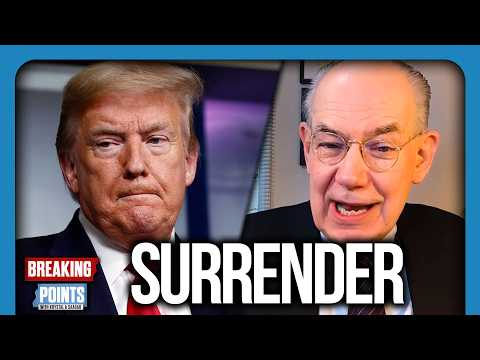
Mearsheimer's analysis came in the wake of Trump's call for a two-week truce and peace negotiations on the basis of Iran's 10-point plan. Given the maximalist terms of the latter, Mearsheimer rightly characterized this as amounting to an American surrender. But as we have seen, our mercurial and desperate president has now completely backtracked on those concessions, instead declaring that he would use his warships to seize oil tankers bound for China on the high seas, certainly a dangerous escalation.
I am not at all surprised by this sort of development, extremely dangerous though it might be.
From the time of his tariff fiasco a year ago, Trump has regularly been dogged by the charge of TACO—"Trump Always Chickens Out"—and I suspect that his concern in that regard actually explained his sudden move to peace negotiations.
On Tuesday morning, he had issued his most outrageous threat of annihilating the entire Iranian civilization that very evening, but when the Iranians failed to be cowed, he was faced with a difficult dilemma. If he went ahead and launched the overwhelming attacks he had promised—let alone resorted to nuclear weapons—the Iranians would retaliate by laying waste the vital infrastructure of all the Gulf Arab states, largely destroying the region and its available natural resources for many years and thereby producing a global catastrophe. But if he did nothing, people would ridicule him with the TACO charge.
Therefore Trump and his advisors seized upon the existing 10-point Iranian plan, claiming that they would accept it as a basis of negotiations. They did this merely so that they would have an excuse to call off the massive attack promised for Tuesday evening. I doubt that Trump ever had any intent of following through on those terms, and indeed when the negotiations were held, Vance merely repeated the previous American position, totally ignoring the Iranian proposal that Trump had supposedly accepted.
But although the fighting has somewhat subsided, the Iran War continues. In his interviews, Mearsheimer emphasized that as long as the Persian Gulf remained closed, the Iranian bargaining position grew stronger every week, so Iran would be very foolish to settle on any compromise terms.
Meanwhile, Mearsheimer was convinced that as the world economy approached the cliff, America would be forced to accede to Iran's demands. He emphasized that shutting down a war was always extremely difficult, but that the fast-approaching global economic cataclysm might make the Iran War one of the rare exceptions to that general rule.
Unfortunately, another point he made was that Trump seemed completely irrational, one of the very few examples of a world leader having such dangerous characteristics. And partly for that reason, I'm far less sanguine that Trump will surrender, at least in time to avert a global disaster or before the ongoing conflict escalates and inflicts irreparable damage on the Persian Gulf region.
Trump seems to exist in a propaganda-bubble controlled by the Israelis, the Zionists, the Neocons, and a few associated media organs such as FoxNews, so piercing that bubble may be difficult. He has rejected and denounced most of the leading conservative media figures who originally put him into office and fired any generals who objected to his military plans.
I think that one of the few external factors that might get his attention would be a stock market collapse. Perhaps this will happen soon enough to avert the looming global disaster, but perhaps not. I have been astonished by the equanimity with which most traders have apparently shrugged off the events of the last six weeks and the global cataclysm that seems to be rapidly approaching.
Maybe Trump's latest announcement that the American navy will begin seizing all those China-bound oil tankers on the high seas will now provoke the sort of market collapse that would force Trump to finally draw back, but that might not be the case.
I've seen some speculation that China might send its own naval vessels to escort those Persian Gulf oil tankers. But such a direct military confrontation with American warships would be a very dangerous step for the world.
However, I do believe that there is a far safer and more effective measure that the Chinese could apply, one that would involve very little risk of a single shot being fired while almost immediately compelling Trump's surrender. If Trump can declare a blockade against Persian Gulf oil shipments to China, the Chinese can declare a blockade of their own, one that is far more legally warranted.
Since the beginning of this year I have been regularly proposing this strategy, most recently a few weeks ago:
The underlying problem the world faces is a difficult one. The Iranian and the American goals for ending the war are totally incompatible, and unless the war ends very soon, escalatory attacks on energy infrastructure may become almost inevitable, with totally disastrous long term consequences for the future of the entire world economy.I do not think there is anything that America or Israel can do that could force Iran to make peace, up to and including nuclear attacks.
Nor is there anything that Iran could do that could force America to make peace on the terms that Iran would demand, including the removal of all American bases from the region, ceding Iran permanent control of the Strait of Hormuz, and providing the country with large financial reparations.
However, I have been explaining for weeks that the Chinese do possess the power to end the war:
Since early January, I've argued that if China merely took the step of declaring an air/sea blockade of its own rebellious province of Taiwan, the resulting loss of AI microchip exports would puncture America's gigantic Tech Bubble, leading to the evaporation of perhaps ten trillion dollars of wealth. This would produce an unprecedented American financial collapse and a complete American withdrawal from the war with Iran.
As the New York Times reported in late February:
A Chinese blockade of Taiwan, the officials said, could choke the supply of computer chips made on the island and bring the U.S. tech industry to its knees..."The single biggest threat to the world economy, the single biggest point of single failure, is that 97 percent of the high-end chips are made in Taiwan," Treasury Secretary Scott Bessent said last month at the World Economic Forum in Davos, Switzerland, slightly overstating industry estimates. "If that island were blockaded, that capacity were destroyed, it would be an economic apocalypse"...
So I went on to say:
The Chinese are masters of the game of Go and I've been hoping that they would see that the AI Bubble has left the American financial system so extremely vulnerable that if the Chinese merely placed a single stone in the correct position, they could sweep most of the American pieces off the board without the need to fire a single shot.With so much of America's military power now deployed to the Middle East and having a very difficult time in the Iran War, a better opportunity for China to act is difficult to imagine.
Thus, the only country that could save the world by ending the war before the energy infrastructure of the Persian Gulf is permanently destroyed is China. By correctly playing the Taiwan card, they could cause the sort of total collapse in the American financial system that despite Trump's bluster would force him into a swift and abject surrender. I think that Donald Trump has destroyed the American Empire, but China can prevent its fall from also taking down the world economy.