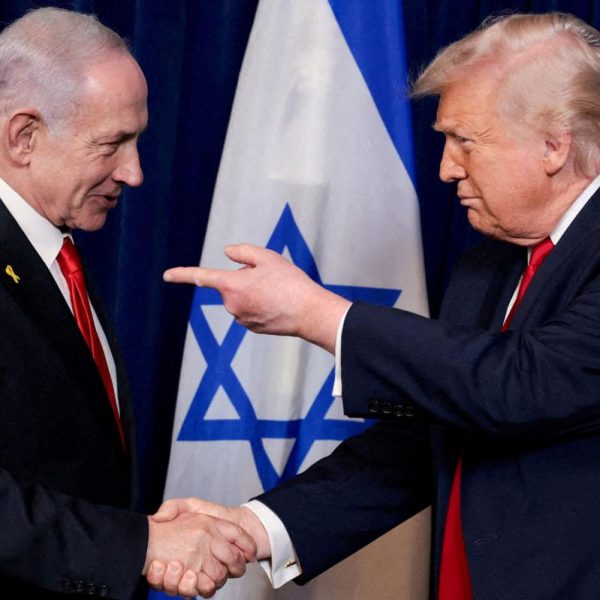
Israel's goals of territorial expansion conflict with the goals of the U.S. president.
By Harrison BERGER
After President Donald Trump signed a preliminary Iran peace deal on Wednesday, Israel's occupation and bombing of Lebanon presents the central obstacle to a final agreement and lasting peace. Securing and upholding the final peace deal will require the kind of confrontation with Israel that Trump has avoided for most of his presidency, given Iran's leverage over the Strait of Hormuz and global energy flows.
Iran has insisted that the ceasefire and now the framework peace deal cover the entire regional war and thus require that Israel end its occupation of southern Lebanon. Iran's Supreme National Security Council declared Monday that under the framework deal, called a memorandum of understanding, "war and military operations on all fronts-including immediately ending the Lebanon front tonight and permanently-will conclude."
That demand stems directly from the "long-term security guarantees" Tehran has invoked across its public statements since the beginning of the conflict. For those guarantees to mean anything, Tehran needs Trump to rein in Prime Minister Benjamin Netanyahu and ensure that Israel does not launch another surprise attack against Iran. The only way Washington can demonstrate that commitment is to pressure Israel now, in Lebanon. As Trita Parsi of the Quincy Institute has argued, binding Israel to a ceasefire is a "test of America's willingness, and its ability, to restrain its closest regional ally."
Iran is right to doubt that Washington will exert that kind of pressure over Israel. After Israel's latest bombing of Beirut's southern suburbs, Iran's Speaker of Parliament Mohammad Ghalibaf wrote that the incursion into Dahiyeh "has once again shown that America either lacks the will to fulfill its commitments or the ability to do so." Recognizing that Israel's violent quest to grab territory in Lebanon could only be accomplished with U.S. approval, Iran's leading negotiator declared that "the game of bad cop and good cop is outdated."
Up until that point, the White House had seemed to use Axios and other friendly outlets to give Iran the impression that it was pressuring Israel, even as it kept giving its protectorate in the Middle East the green light to occupy its northern neighbor. Indeed, while American audiences heard from the Axios reporter Barak Ravid that Washington was "furious" over the Lebanon strikes, Israeli audiences heard the opposite.
Miriam Adelson's Israel Hayom newspaper reported that the United States and Israel were in fact "fully coordinated, both on the strikes in Dahiyeh in Beirut and on the Israeli response to the missile fire from Iran," and that Secretary of State Marco Rubio in particular played a "significant role" in getting Trump to back Israel's retaliatory strikes. The Israeli operation, the paper said, was "fully coordinated with CENTCOM, even though the Americans did not strike themselves." The munitions used by the Israelis in Lebanon are further proof of U.S. involvement, with Courtney Bonneau, the American-Dutch journalist reporting from southern Lebanon, recently telling The American Conservative that the waste left by Israel's demolition and bombing campaign is recognizably U.S.-made.
Trump wants to have it both ways. The political costs of the war are piling up and he wants an exit, but an exit requires confronting Israel and the lobby over Lebanon, and that is a political conflict he has avoided fighting directly even as he has criticized Netanyahu in recent weeks.
Israel is betting he will continue to avoid it. Shortly after a deal was announced, Israel's Defense Minister Israel Katz said that Israel's occupation of southern Lebanon would continue, and that it planned to stay "indefinitely" in Lebanon, Syria, and Gaza. Israel's Finance Minister Bezalel Smotrich likewise announced on Tuesday that "there will be no withdrawal from Lebanon, neither by Friday nor afterward. We will remain in south Lebanon and strengthen our presence there," while National Security Minister Itamar Ben-Gvir said Monday that Israel is not bound by any agreement.
Though Israeli leaders insist they are carefully fighting "Hezbollah," the death toll of at least 3,826 Lebanese civilians killed by Israeli attacks reveals that to be merely a pretext. Trump, though he has not skipped any payment when it comes to funding the conflict, admitted as much on Tuesday at the G7 Summit, telling reporters that Israel "does not have to knock down an apartment house every time [it's] looking for somebody. There are a lot of people in those apartment houses and they're not all Hezbollah."
And though Israel invokes Hezbollah as its excuse for military action, there is little reason to believe the IDF's occupation would end even if Hezbollah laid down its arms. In their public statements, Israeli officials have expressed interest in territorial expansion for its own sake and, increasingly, in the Judaification of Lebanese land through settlements-an idea Jewish Currents describes as "once fringe" but now backed by "an organized movement with broad governmental and public support." Twenty members of Israel's Knesset wrote to the cabinet in April urging "occupation and full control" of southern Lebanon alongside the "complete displacement" of its population, while a poll conducted by Direct Polls for i24NEWS found that 62 percent of Israelis favor occupying everything south of the Litani River.
Israeli occupation of Lebanon, like its ethnic cleansing campaigns in Gaza and the West Bank, works directly against American interests, in this case stopping a war that has wrecked the global economy. Washington has all the necessary tools to put a stop to this, yet has simply declined to use it. As Joe Kent, the administration's former head of the National Counterterrorism Center and one of the most prominent America First critics of the war argued on X, "We can strengthen our chances of this deal holding by cutting all military/intel assistance to Israel," who "took every opportunity to tank this deal & will likely do so again unless we take action," adding that in order for a deal to hold, we must "take away every factor that we can control that could force us back into the war on Israel or Iran's terms. Set all conditions that we can control in our favor."
Though once unthinkable, Trump in recent days has shifted closer toward this America First position and away from the Israel First mindset that led to war with Iran. With Iran insisting any peace deal must cover "all fronts," including Lebanon, and with the Israelis fully committed to the Greater Israel project, cutting off Israel is now the minimum price of the complete exit from the conflict that Trump says he wants.
Original article: The American Conservative