Alastair Crooke
Trump's Iran deal shatters Israel's 40-year dream of regime change.
The Iran-U.S. de-escalation framework has been signed. As always, getting a framework agreed is one thing, but preserving it from disruptive actors or malicious distortion of the text is quite another. Who knows how long it will survive intact ? The MoU nonetheless constitutes an important phase - albeit one leg - in a long journey ahead for Iran. The Agreement however, may also prompt wider geo-economic 'plate' shifts.
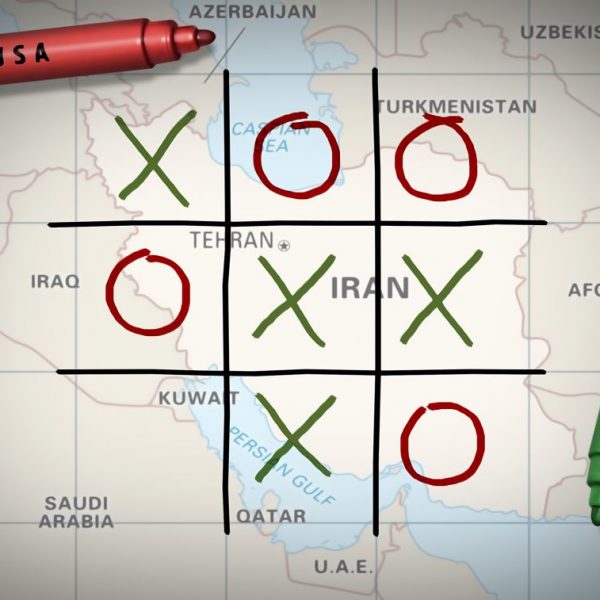
Iran has succeeded in pushing a reluctant Trump to cross the Rubicon. Danny Citrinowicz, a former senior Israeli Iran military intelligence analyst, says that for Trump, "achieving a deal with Iran and ending the current cycle of escalation is not merely an option but a clear strategic goal... He now envisions a broader vision of U.S.-Iran relations".
An unquestioned dogma has bitten the dust:
"The long-standing expectation in parts of Jerusalem and Washington has been that sustained pressure could lead to regime change in Tehran... [However] the announced agreement suggests a [new] fundamental reality: The campaign that many hoped would weaken or even destabilise the Islamic Republic will instead conclude with the regime intact, strengthened, and formally engaged by the U.S. [This] amounts to the collapse of a broader strategic assumption: that coordinated American and Israeli pressure could generate conditions conducive to fundamental political change inside Iran. Instead, the likely outcome is the opposite... [it is] an outcome likely to reinforce confidence amongst [Iran's] ruling elite rather than weaken it...".
This moment represents a major strategic achievement for Iran: A heroic image is surging across the globe - whereas Israel's isolation on the Iran issue, even amongst its Gulf allies, has spiked. On the personal level, Netanyahu's standing in Israel has plunged catastrophically.
Of course, the 'Understanding' may quickly unravel - Trump is prone to sudden changes of mind, and the full force of the U.S. Zionist billionaire class is being unleashed against Trump, compelling him to change course (perhaps through the former working to mobilise opposition in Congress and the Senate).
Both are possible, but the reality of Trump having actually come to agreement - however tentative - with Iran underlines a growing divergence between Trump and Israel. And Netanyahu's attempt to sever the linkage between the MoU and any ceasefire in Lebanon (by mounting an attack in Dahhiya in Beirut on Sunday) paradoxically achieved the opposite - Trump promptly improved the terms of the MoU for Iran.
And if the Agreement does unravel, Iran has the option simply to close the Hormuz Strait - and potentially the Bab el Mandeb passage too. And what can Trump do ? The closer that the U.S. moves towards the 'economic cliff' and to the mid-term elections, the less the appeal will be for him to restart the war. In any case, Iran is fully expecting and preparing for a resumption of military strikes.
Aside from the local impacts of Trump prioritising the understanding with Iran over that of Israel's interest to keep the war in Lebanon burning, the Accord may portend wider geo-political consequences -
Iran, for four decades, has been enveloped in the ever tightening boa-constrictor coils of sanctions, energy strangleholds and dollar exclusion, reflecting the non-stop efforts by Jewish-Israeli supremacists in Israel and America to maintain U.S. dominance over the Middle East.
The U.S. has waged forty years of maximum pressure to break Iran, yet conversely, through its animus, has forged that very adversary (Iran) to now exercise its leverage to gradually prise off the snake's enveloping coils so that it can begin to breathe more easily.
Iran's resistance has caught the imagination of much of the world - precisely because it is seen as a moral fight to reassert an Iranian vision for their own future.
In fact, the Iran example rather, has opened eyes around the world to the U.S. project to forcibly coerce states to acquiesce to the U.S. demands that they align with the U.S. imposition of Zionist hegemony across the Middle East.
Already states seeing the extent of the chokehold imposed on Iran, are seeking ways to protect themselves from a similar U.S. weaponisation of foreign trade in food, oil, fertiliser - and in just about anything that the U.S. can create a choke point for - to be deployed against them.
Will the signing of the MoU then indeed be something of an inflection point ? It is too early to say, but one initial question must be: Has Trump's volte face dealt an irreversible blow to Israel?
Lazar Berman, military correspondent of the Times of Israel, observes that "total victory" and its illusions are over -
"The post-October 7 wars, which came with expectations and promises of"total victory,"are over - as are their illusions. Palestinians are not going to leave Gaza. Hamas won't disarm, nor will Hezbollah. Trump is not going to return to war in Iran, which can now threaten to withdraw from a deal to get Trump to stop any major Israeli operation against Hamas or Hezbollah...The Middle East has certainly changed".
Trump's goal, it now seems, is to reach an agreement with Iran - he apparently believes too, that the move will also serve Israel's interests. This may, or may not, be realistic. For, as Aluf Benn writes in Haaretz, "the idea that Israel and Iran are capable of reconciliation after decades of hostility, which culminated in bombings and missile attacks last year, was never even discussed in Israel".
It was this lacuna that gave rise to hubris and wishful thinking in the Israeli Establishment.
As leading Israeli commentator Nahum Barnea amplifies, it never even occurred to Israel that Iran might survive a U.S.-led onslaught -
"There probably wasn't anyone from Military Intelligence, the National Security Council or the Mossad who raised at the meetings the possibility that the Iranian regime might survive and emerge stronger. Even if there were a few sceptics in the room, they held their tongue".
In Israel, the sense of defeat is palpable.
What Trump now is likely angling for is more room for manoeuvre for his vision of peace in the Middle East. His kite-flying about Iran joining the Abraham Accords; that he would like to talk with Hizbullah, and his (even more absurd) comments to the effect that Jolani and Syria should 'take care' of Hizbullah in Lebanon, however, do lend support to Citrinowicz's contention that for now, Trump entertains some (possibly implausible) broader vision of where U.S.-Iran relations might lead.
In this reconfigured Israeli strategic landscape, perhaps even the pusillanimous Europeans might begin some corrective action by insisting on a return to ancient understandings of war - in which de-capitation strikes and multi-assassination campaigns of women and children lie outside of all civilised norms of war, let alone of human morality. Iranian negotiators insisted in the negotiations that any assassinations or killings would kill relations with the U.S. stone-dead.
The other key issue that flows from these events is the question - what will be the effect of the signing of the MoU on the complexion of U.S. polity ? Will this prove to be a separate and strategic point of inflection ? Will America as a whole start to detach from Israel?
There is a clear segmentation in the U.S. electorate. The demographic layer of the over 55-year olds is broadly sympathetic to Israel; but the young have shifted radically. Even amongst American Jews, 61% have concluded that Israel committed war crimes in Gaza, and 39% regard Israel's conduct in Gaza as genocide.
Of course, the Israel-Firsters will not change their stance and will insist that Congress toes their line.
But a recent WSJ's opinion piece - Netanyahu has Lost Middle America - concludes:
"As Israel approaches elections this Fall, I am confident that: If its voters choose to continue the current government despite the deadly mistakes it has made, many Americans will conclude that the Israel they have supported for decades no longer exists".